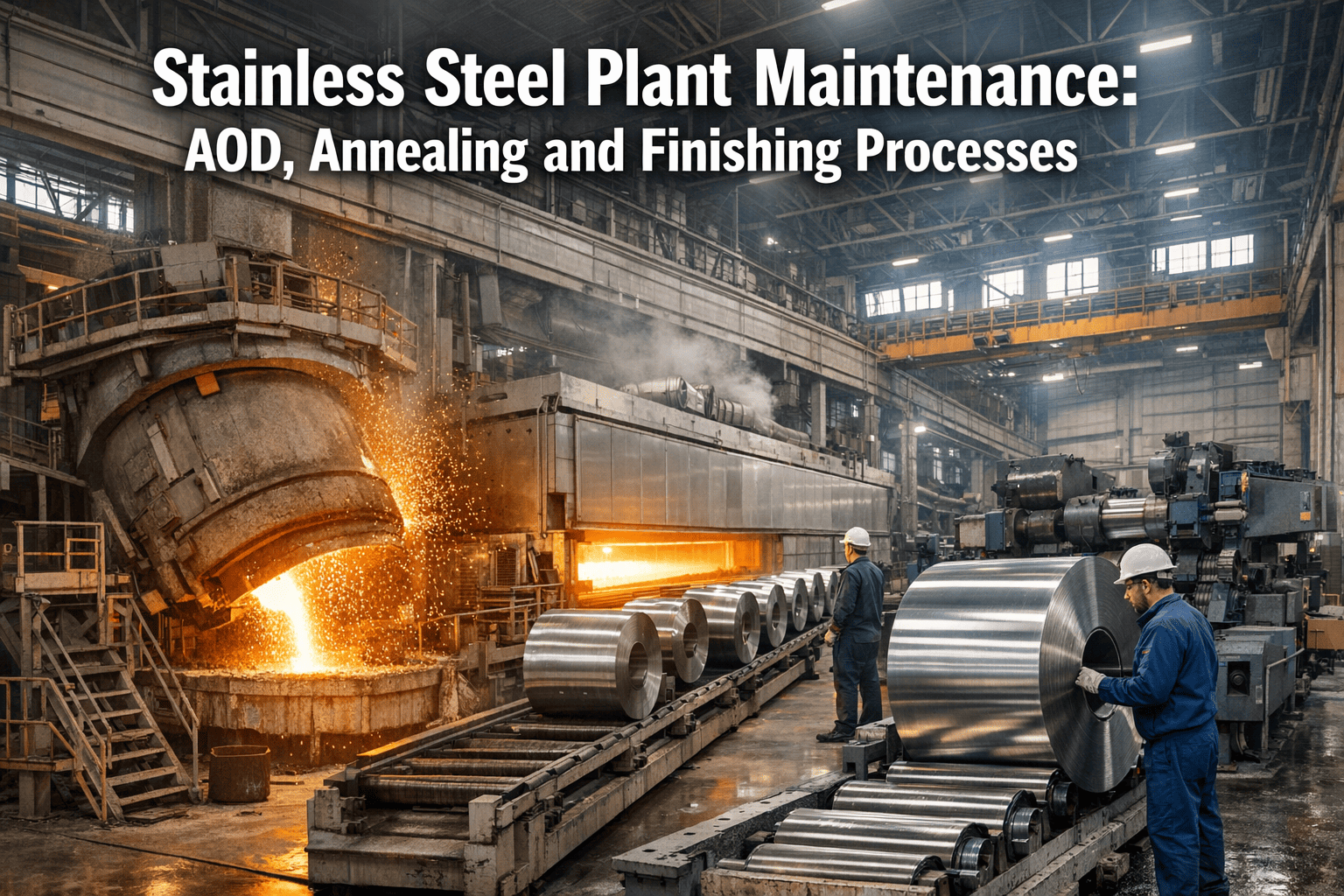
Stainless steel production presents a maintenance engineering challenge that carbon steel plants do not face at the same severity: every major process stage operates under conditions that accelerate equipment degradation far beyond standard industrial benchmarks. The AOD converter handles liquid steel at 1,700°C with aggressive oxygen-argon lancing that erodes refractory at measurable rates per heat. The bright annealing furnace runs a hydrogen atmosphere at 1,050–1,150°C in which any air ingress creates an explosion risk and any combustion product contaminates strip surface quality. The cold rolling mill works austenitic and ferritic grades with work hardening characteristics that demand roll force precision that carbon steel rolling does not. Failure to maintain any of these assets to the correct interval with the correct procedure does not just produce downtime — it produces quality escapes, safety events, and refractory rebuild costs that dwarf the maintenance budget of the PM that would have prevented them. Book a demo to see how OxMaint's Predictive Maintenance AI manages heat-count-based AOD scheduling, refractory wear modelling, and condition-based triggers for annealing furnace and cold rolling mill assets across stainless steel production facilities.
Stainless Steel Plant Maintenance: AOD Converters, Bright Annealing & Finishing Processes
Heat-count-based refractory tracking, hydrogen atmosphere furnace maintenance, cold rolling mill condition monitoring, and finishing line asset management for austenitic, ferritic, and duplex stainless steel production.
AOD Converter Maintenance: Heat-Count-Based Refractory Management
The Argon Oxygen Decarburisation converter is the defining asset in stainless steel steelmaking — and its maintenance programme is fundamentally different from any other vessel in steel production because its primary wear mechanism is not time-dependent but heat-count-dependent. Refractory lining life is measured in heats, not months. The specific heat count at which the lining reaches the critical wear threshold depends on grade mix (high-chromium duplex grades are more aggressive than standard 304), ladle practice, and bottom tuyere condition. Managing AOD maintenance on a calendar basis rather than a heat-count basis is the most common cause of premature refractory failure and unplanned converter downtime in stainless operations.
Bright Annealing Furnace Maintenance: Hydrogen Atmosphere Safety and Quality Requirements
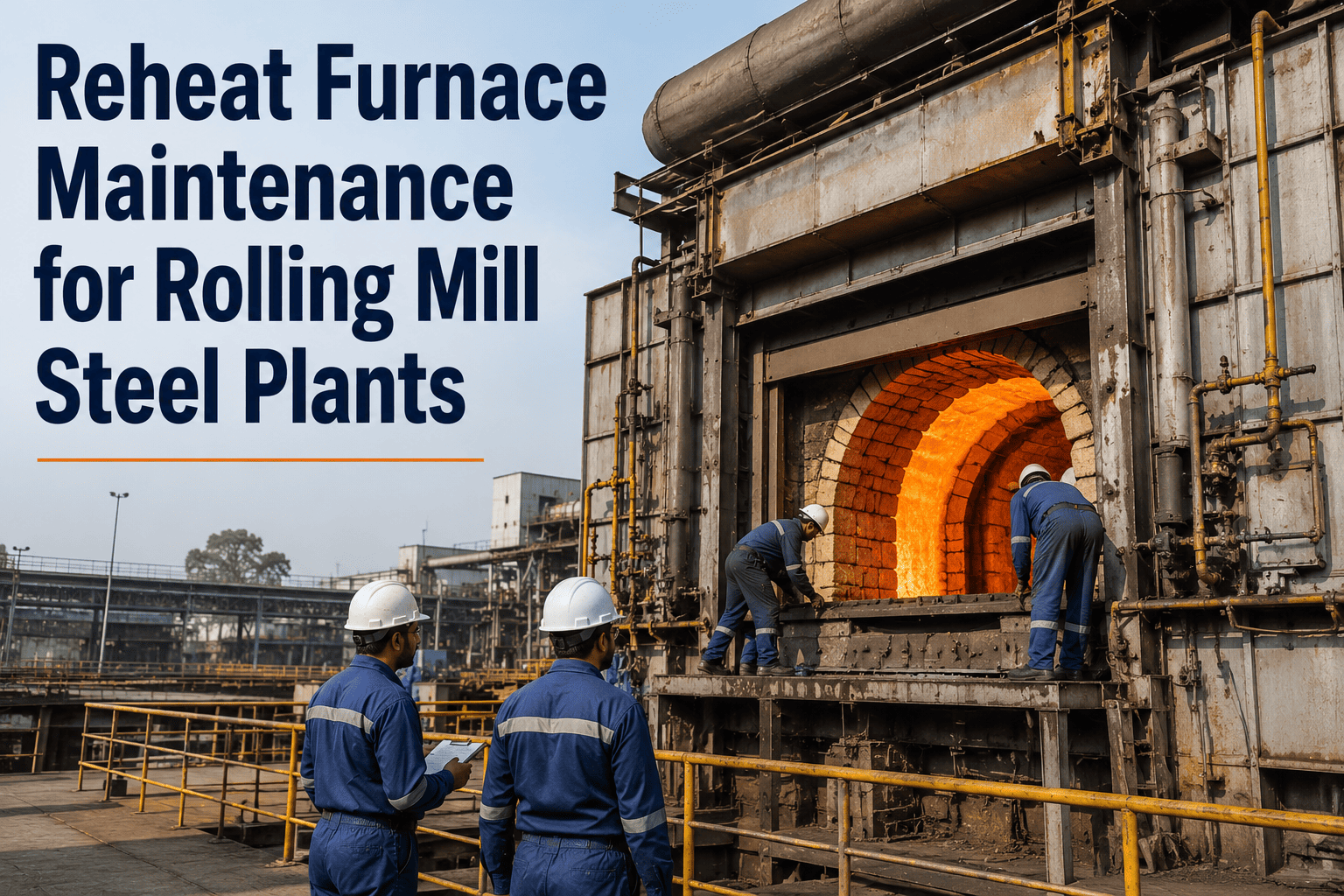
The bright annealing furnace is the most safety-critical asset in the stainless steel cold processing route. It operates in a 75–100% hydrogen atmosphere at strip temperatures of 1,050–1,150°C for austenitic grades — a combination that makes any maintenance error a potential hydrogen detonation event. Every maintenance activity on a bright annealing furnace must be executed within a documented safe-system-of-work that addresses hydrogen purging, inert gas hold, atmosphere verification before re-entry, and seal integrity testing before return to hydrogen atmosphere.
Beyond safety, the furnace is a product quality asset. Any air ingress through a failed muffle seal, damaged furnace end seal, or compromised cooling section creates localised oxidation that produces stripe defects on strip surface — a quality escape that is both expensive and difficult to diagnose if the maintenance history of the atmosphere seals is not tracked. Muffle seal life, end seal condition, and dew point monitoring are the three maintenance variables that most directly predict surface quality outcomes in bright annealing production.
Stainless Steel Cold Rolling Mill: Maintenance for High-Work-Hardening Materials
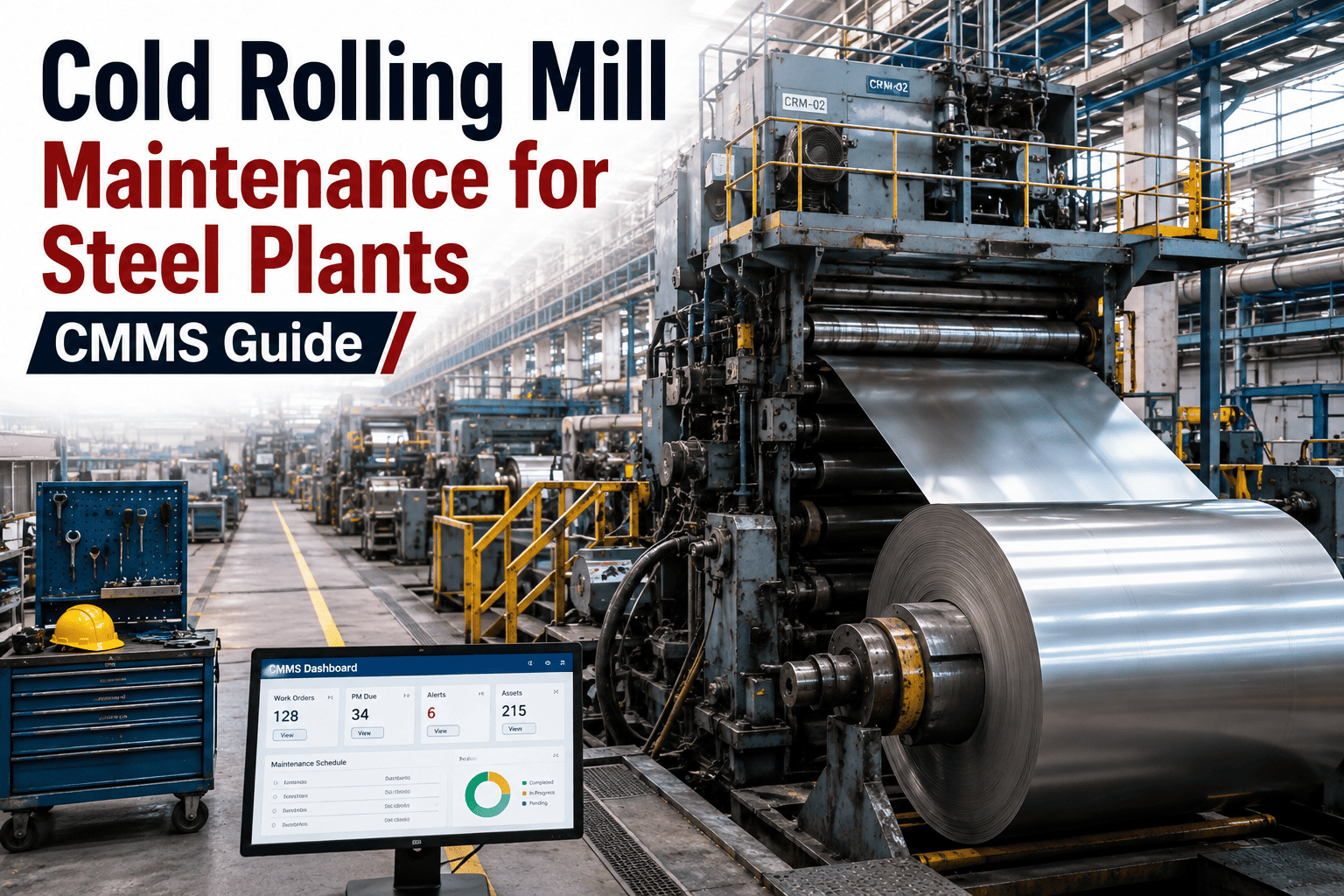
Rolling austenitic stainless grades presents a fundamentally different mechanical environment from carbon steel cold rolling. The work hardening coefficient of 304-grade austenitic is approximately twice that of mild steel — requiring significantly higher roll forces for the same reduction, producing greater roll deflection, and consuming roll surface condition much faster in terms of product kilometres. The cold rolling maintenance programme for stainless production must account for higher roll wear rates, more frequent roll change intervals, more stringent surface roughness requirements (particularly for 2B and BA surface finish specifications), and the need for emulsion system management tailored to stainless processing chemistry.
| Asset / System | PM Task | Interval / Trigger | Quality Impact if Missed | OxMaint AI Trigger |
|---|---|---|---|---|
| Work rolls | Roll change and surface roughness grind back to target Ra | Tonnage-based (lower than carbon steel) or Ra deviation >0.05 µm | Surface finish degradation on 2B/BA product; roughness transfer marks | Roll wear model tracks Ra degradation rate per pass; predicts change trigger 2–3 coils ahead |
| Backup rolls | Bearing vibration analysis + roll contour measurement | Every 4–6 week campaigns or on vibration threshold | Crown deviation producing flatness defects; chatter marks on strip surface | Continuous vibration monitoring; bearing fault frequency tracking; contour wear trending |
| Emulsion system | Concentration, pH, tramp oil content, bacteria count check | Daily concentration; weekly full analysis; bacterial count monthly | Staining, surface contamination, roll corrosion, reduced cooling capacity | Emulsion quality trend alert; concentration deviation triggers automated top-up recommendation |
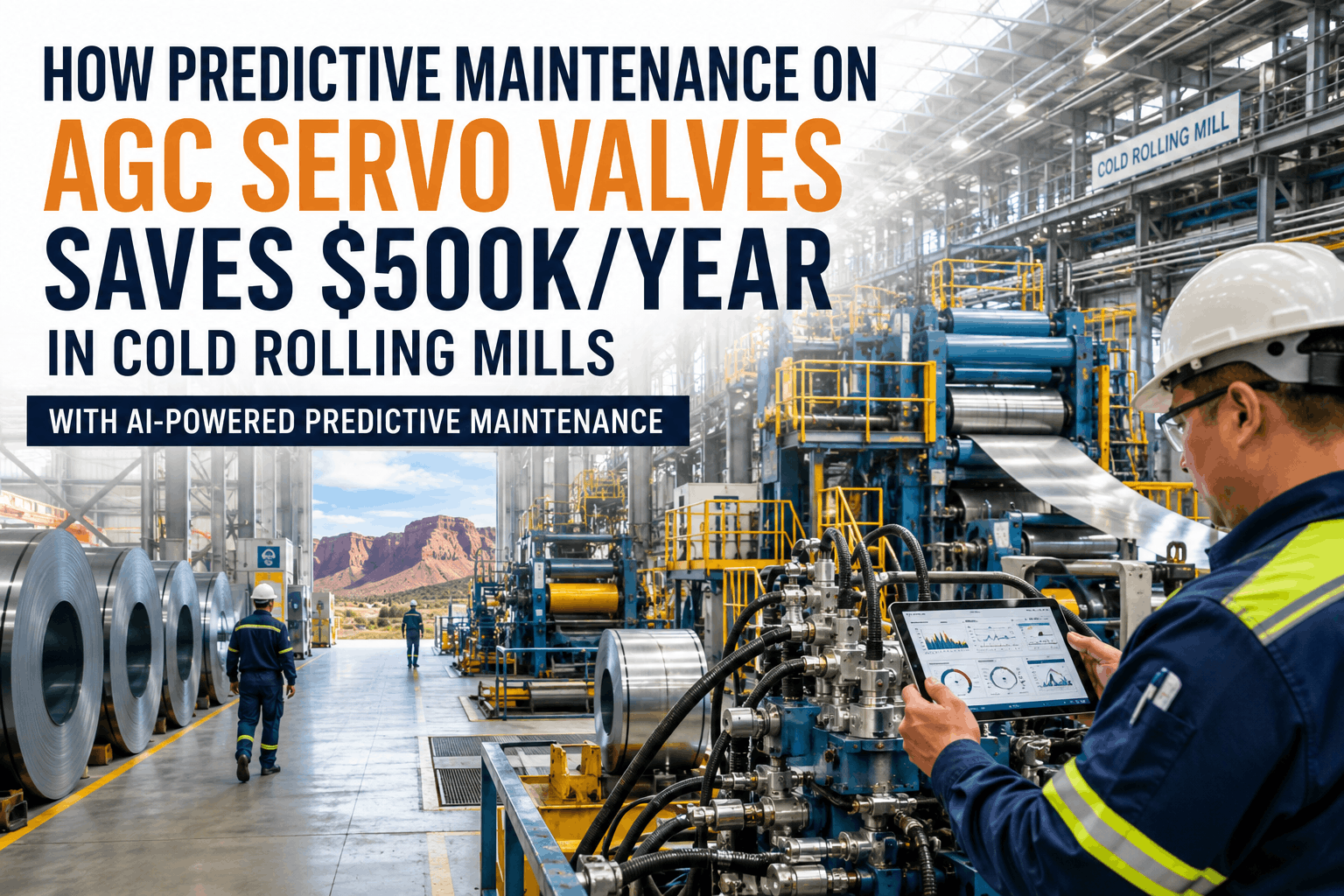
| Hydraulic AGC | Hydraulic fluid condition, cylinder seal integrity, servo valve response test | Monthly fluid analysis; quarterly servo response calibration | Gauge deviation; thickness oscillation; failed AGC response to crown change | Servo response time trending; pressure drop monitoring across servo valve circuit |
| Tension system | Load cell calibration and tension roller bearing inspection | Quarterly calibration; bearing inspection monthly | Tension fluctuation causing strip flatness deviation and coil quality variation | Load cell drift detection; tension variance SPC monitoring correlated with flatness outcomes |
| Strip deflector rolls | Bearing condition, surface condition, alignment check | Monthly inspection; replace on bearing fault signal | Deflector roll surface damage transfers to strip — scratch defect on 2B/BA grades | Vibration signature per deflector roll; replacement triggered by bearing fault frequency detection |
Heat-count PM triggers, refractory wear modelling, roll surface condition trending, and hydrogen system compliance — all managed in one predictive maintenance platform.
Pickling & Finishing Line Maintenance: Acid System and Surface Quality Assets
The stainless steel pickling line removes the oxide scale produced during annealing using hydrofluoric and nitric acid (or alternative electrolytic/mixed acid processes) — a combination that presents both significant corrosion risk to equipment and a critical quality function since incomplete pickling leaves oxide residue that affects corrosion resistance and surface appearance in the finished product. The maintenance programme must address both the chemical integrity of the acid circuit and the mechanical condition of the process equipment operating in a highly corrosive environment.
Predictive Maintenance AI: How OxMaint Manages Stainless Steel Plant Complexity
Stainless steel plant maintenance is more complex than standard steel plant maintenance for three reasons: multiple maintenance trigger types operate simultaneously on the same assets (heat count, calendar, condition, and quality-driven triggers); the safety consequences of missed maintenance on hydrogen atmosphere and acid system assets are disproportionately severe; and the grade mix variability in stainless production means that maintenance intervals that are correct for one grade sequence may be inadequate for another.
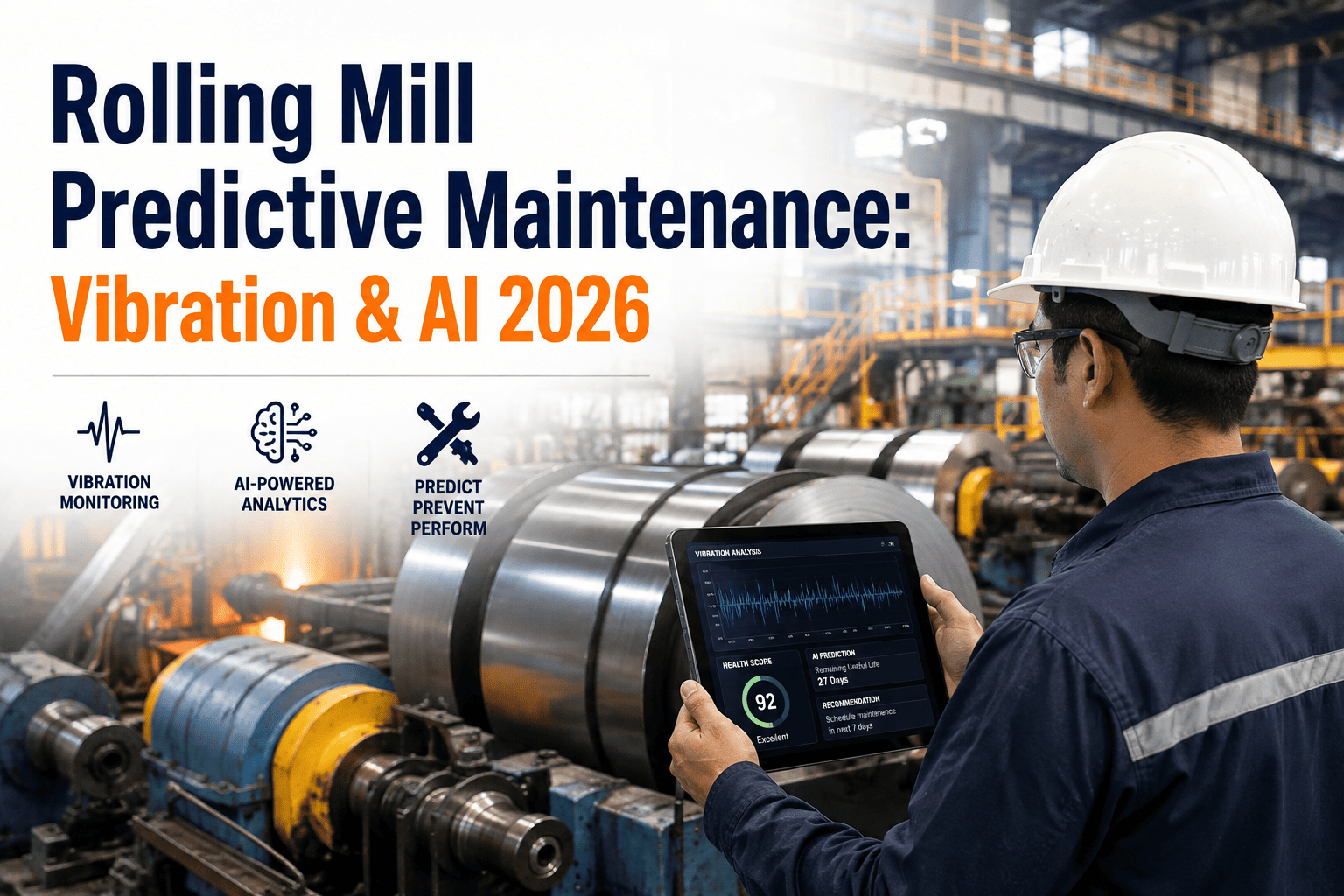
OxMaint's Predictive Maintenance AI addresses this complexity by maintaining separate wear rate models per asset per grade mix, aggregating condition monitoring data (vibration, temperature, fluid analysis) against equipment-specific thresholds, and triggering PM work orders through the mechanism most appropriate for each asset — heat count for AOD refractory, runtime hours for cold mill drive trains, condition-based for roll bearing and hydraulic servo systems, and quality-correlated for roll surface, emulsion chemistry, and acid concentration. The result is a maintenance schedule that reflects the actual state of each asset rather than a fixed calendar that treats all operating conditions as equivalent.
What Stainless Steel Plant Maintenance Engineers Say
AOD refractory management on a fixed calendar is like scheduling tyre changes by date rather than by kilometres driven. A converter running a high proportion of duplex and high-chromium grades will consume the lining at 30–40% more heat-equivalents per tonne than one running predominantly 304. Calendar-based reline scheduling on a mixed grade plant either over-maintains the converter on standard grades or under-maintains it on duplex — and under-maintaining means a breakout risk that has production and safety consequences far exceeding the cost of a premature reline. Heat-count triggers with grade-weighted wear rates are the only technically correct approach.
Gerhard Schöttler, Dipl.-Ing., TÜV-Certified · AOD Process & Refractory Engineering, ThyssenKrupp · 26 Years Stainless SteelmakingThe bright annealing furnace is the asset where I have seen the most expensive maintenance mistakes in stainless steel cold processing — and almost none of them were catastrophic failures. They were all progressive quality escapes: a muffle joint that had been leaking for weeks, producing stripe defects on the strip surface that were being detected in final inspection and being written off as surface defects of unknown origin because nobody had connected the quality record to the dew point trend that was clearly visible in the historian. OxMaint's quality-correlated maintenance triggers would have flagged that connection in the first week of dew point excursion rather than six weeks later.
Priya Venkataraman, NEBOSH IGC · Stainless Cold Rolling & Annealing Process Engineer, Tata Steel Long Products · 19 Years Stainless Finishing OperationsWork roll management in stainless cold rolling is not simply a higher-frequency version of carbon steel roll management. The combination of higher work hardening rate, tighter surface finish specifications for 2B and BA product, and the sensitivity of stainless strip to roll surface contamination (especially from emulsion breakdown products) means that the roll wear model must incorporate grade sensitivity, emulsion condition, and surface finish target simultaneously. A single Ra threshold for all grades is not adequate. OxMaint's grade-specific roll wear models gave us a 23% reduction in surface finish rejects in the first six months after implementation.
Marcus Eidenschink, B.Eng, CRL · Cold Rolling Reliability & Quality Systems, voestalpine · 21 Years Stainless & Specialty Steel RollingFrequently Asked Questions
AOD Heat Counts. Refractory Wear Rates. Hydrogen Seal Condition. Roll Surface Ra. One Platform.
OxMaint's Predictive Maintenance AI manages every trigger type in a stainless steel plant — from heat-count refractory campaigns to quality-correlated maintenance signals — without requiring a separate system for each asset class or process area.