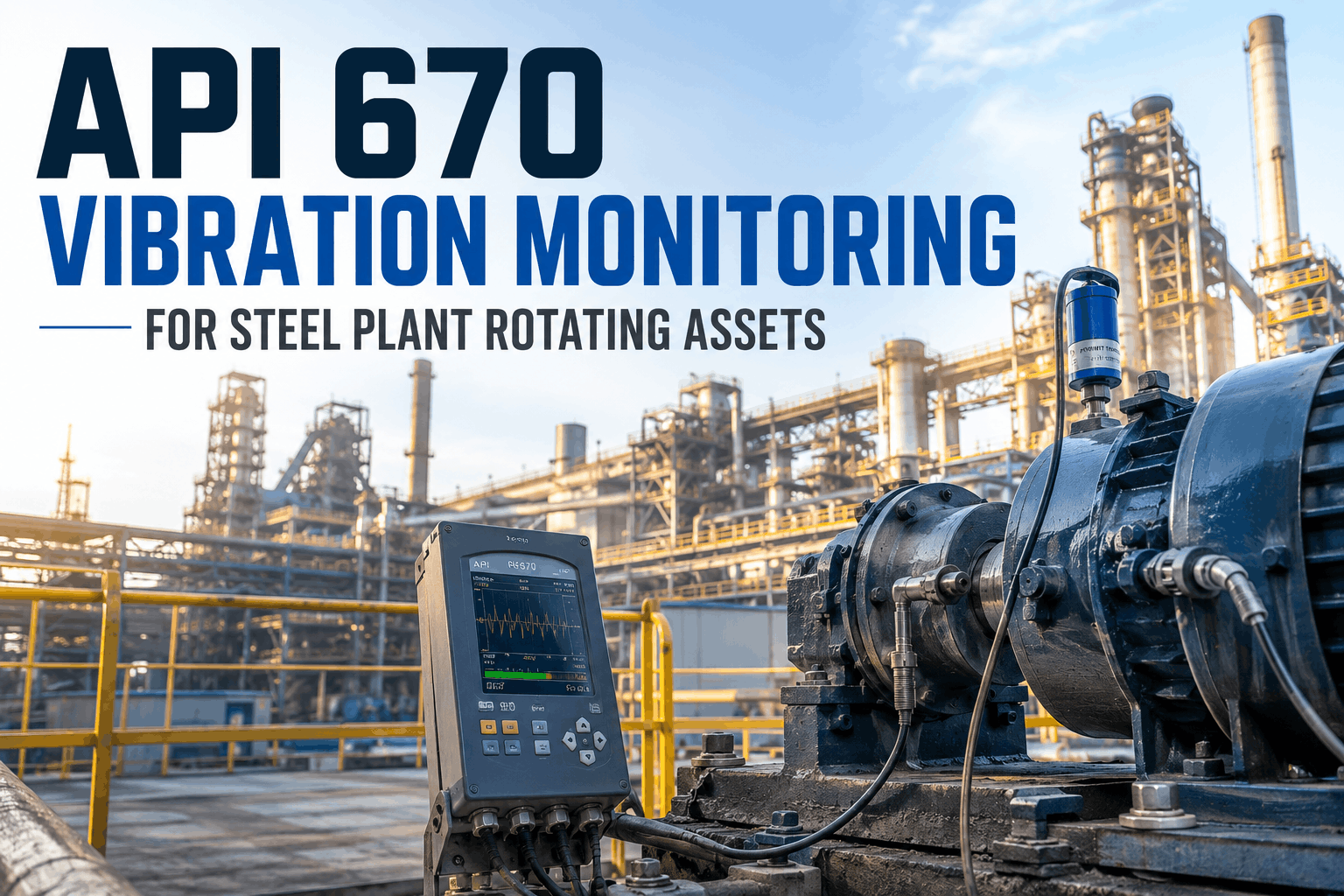
In the high-torque, high-speed world of US steel manufacturing, the reliability of rotating assets is the pulse of the plant. From the massive turbo blowers that breathe life into blast furnaces to the mill drives that shape raw steel into finished products, unplanned mechanical failure is not an option. Implementing an API 670-compliant vibration monitoring program is the gold standard for machinery protection, providing the early warning signals needed to prevent catastrophic rotor contact or bearing seizures. A CMMS-backed vibration strategy ensures that every proximity probe, accelerometer, and signal conditioner is calibrated, functional, and integrated into your plant's reliability DNA. Sign Up Free to start building your API 670 protection roadmap today.
Protect Your Critical Rotating Capital
OxMaint gives reliability teams the tools to manage API 670 monitoring loops, track sensor calibration, and execute condition-based work orders — all in one unified machinery protection portal.
What is API 670 Vibration Monitoring? The Standard for Steel
API 670 is the globally recognized standard for the hardware and installation of machinery protection systems. For a US steel plant, this standard is critical for assets with fluid-film (sleeve) bearings, such as turbo blowers and large mill drives, where non-contact proximity probes measure actual shaft displacement. The standard also covers seismic sensors (accelerometers) for rolling-element bearings in fans and gearboxes. By standardizing the "protection loop" — from the sensor to the monitor module and finally to the emergency trip relay — API 670 ensures that a machine will shut down safely before a catastrophic failure occurs. OxMaint serves as the record-keeping engine for this standard, tracking the "birth-to-death" calibration and health of every sensor in your protection chain. Book a Demo to see our API 670 record management.
Core Components of an API 670 Protection System
Non-Contact Proximity Probes
Monitor shaft radial vibration and axial position in sleeve-bearing machines. OxMaint tracks probe gap settings and linearity records for every installation.
Seismic Accelerometers
Detect high-frequency casing vibration in rolling-element bearings. Automate the PM schedules for sensor verification and mounting integrity.
Signal Conditioners & Transmitters
Convert raw sensor signals into 4-20mA or digital data. Manage the calibration of these critical components as recurring loop-check work orders.
Monitor Modules & Setpoint Management
The "brains" of the system. Document all alarm and trip setpoints in your CMMS to ensure any changes are authorized and auditable.
Emergency Trip Relay Verification
The final link in the chain. Schedule non-negotiable functional trip tests during outages to ensure the system can actually stop the machine.
Phase Reference (Keyphasor) Monitors
Enable advanced diagnostics like orbit and polar plots. OxMaint stores the diagnostic reports generated from these high-value signals.
Vibration Severity Matrix: Assessing Machine Health
Note: Severity limits vary by machine class and speed. OxMaint allows you to configure asset-specific trip and alarm levels based on manufacturer specs.
Implementing API 670 Monitoring with OxMaint
Map Your Machinery Protection Loops
Register every component of the protection chain — from probe to relay — as an asset in OxMaint. Linking these components ensures that a failure in a signal conditioner is immediately seen as a risk to the machine. Sign Up Free to start building your loop register.
Standardize Sensor Calibration Procedures
Configure digital calibration forms for proximity probes (voltage vs. gap) and accelerometers. Technicians log results on the mobile app, providing a clean, auditable record of sensor linearity and health.
Automate Loop-Check PMs
Don't wait for an outage to check your loops. Schedule regular "non-intrusive" signal verifications as PM work orders. Use OxMaint to track compliance and identify drifting sensors before they cause a nuisance trip. Book a Demo to see our loop-check workflows.
Link Vibration Data to Condition-Based Work
When a monitor module hits an "Alert" setpoint, OxMaint can generate a high-priority work order for vibration analysis. This ensures that a diagnostic investigation begins the moment the machine's health begins to deviate.
Centralize Outage "Trip-Test" Evidence
Use the outage window to perform a full functional trip test. OxMaint records the date, the technician, and the pass/fail result, providing the 5-year archive needed to prove to insurers that your critical assets are protected.
Why Machinery Protection Programs Fail — and How to Fix It
Technicians sometimes raise trip levels to avoid nuisance shutdowns. Document and lock all setpoints in OxMaint to ensure any changes require formal management approval.
If a probe's gap is wrong, its reading is fiction. Use OxMaint's mobile calibration logs to ensure every probe is correctly gapped and within its linear range.
If you can't prove a trip test was done, it didn't happen in the eyes of an auditor. OxMaint maintains a permanent, timestamped record of every loop verification.
Vibration data is useless if the maintenance team doesn't act on it. Link vibration alerts to corrective work orders in your CMMS to close the reliability loop.
API 670 Best Practices for US Steel Producers
Implement X-Y Probe Redundancy
Always use two proximity probes mounted 90 degrees apart for critical sleeve bearings. This provides a complete "orbit" view of shaft motion and protects against single-sensor failure.
Conduct Dynamic Probe Calibration
Verify probe performance against the specific shaft material (e.g., 4140 steel). Log the "scale factor" in OxMaint to ensure the monitor is interpreting the voltage correctly.
Audit Setpoints Annually
Review your alert and trip levels against current machine health and OEM specs. OxMaint's setpoint register makes this annual review a 10-minute task rather than a forensic project.
Monitor Signal Integrity & Cable Health
Cabling is the weak link in many systems. Schedule regular visual inspections of conduit and connectors, recording findings in OxMaint to prevent "spiked" signals and false trips.
Link Root Cause to Vibration Trips
If a machine trips, perform a full RCA. Was it unbalance, misalignment, or a bearing failure? Log the findings in OxMaint to prevent the machine from being restarted into a failure.
Leverage Insurance Carrier Credits
Many US insurers offer premium credits for documented API 670 compliance. Use OxMaint's calibration and trip-test history to prove your facility is a "low-risk" rotating environment.
Ready to Secure Your Machinery's Future?
Join the US steel mills using OxMaint to digitize their API 670 protection systems, trend their vibration health, and eliminate catastrophic rotating failures.
Frequently Asked Questions
The API 670 standard ensures that critical rotating machinery is protected from catastrophic failure through continuous vibration and displacement monitoring.
OxMaint tracks the calibration and health of these systems, ensuring your turbo blowers are never left unprotected.
Proximity probes are used for fluid-film (sleeve) bearings to measure shaft displacement, while accelerometers are best for rolling-element bearings.
By logging sensor types in your CMMS, you can ensure that the correct calibration protocols are followed for every critical asset.
US industry standards typically require a full loop calibration and functional trip test during every major planned outage or turnaround.
OxMaint automates these schedules, providing the auditable records needed to prove that your protection systems will fire when needed.
Radial vibration measures the side-to-side motion of a shaft within its bearing, often using two probes mounted 90 degrees apart (X-Y probes).
OxMaint trends these X-Y readings to help reliability engineers identify shaft misalignment or unbalance before they lead to a trip.
Axial position monitoring detects thrust bearing wear; a significant shift can lead to the rotor contacting the casing, causing total machine destruction.
OxMaint triggers alerts if axial trends deviate, allowing for a controlled shutdown rather than a catastrophic failure.
While the CMMS is not a spectrum analyzer, it serves as the repository for the diagnostic reports and corrective action work orders generated from that data.
Linking these reports to the asset history allows for "birth-to-death" tracking of every rotating assembly in your plant.
OSHA and insurance underwriters reference API standards as RAGAGEP (Recognized and Generally Accepted Good Engineering Practices).
Using OxMaint to document your compliance proves that you are following the highest safety standards for high-energy rotating machinery.
OxMaint stores the authorized setpoints for every monitor module, ensuring that any changes to alarm or trip levels are documented and approved.
This prevents "nuisance trips" from masked settings while ensuring that critical protection remains active during all phases of operation.
"Operating critical turbo blowers for a US blast furnace means there is zero margin for error. A single bearing failure could cost us millions in lost production and equipment damage. Before we centralized our API 670 loop records in OxMaint, we were struggling to prove to our insurance carrier that our trip tests were up to date. By moving to digital probe calibration logs and automating our loop verifications, we have not only secured our insurance credits but also eliminated two major nuisance trips caused by faulty signal conditioners. Having the full vibration history and calibration data of our mill drives on a mobile device has been a game-changer for our reliability team."
Ready to Secure Your Machinery's Future?
Start your free OxMaint trial and give your rotating machinery team the tools to document, manage, and enforce API 670 procedures — linked to every work order.