Steel plants lose an average of $25,000 per hour of unplanned downtime — and the world's 500 largest industrial companies collectively forfeit $1.4 trillion annually to equipment failures that condition monitoring programs could have detected weeks in advance. A structured condition monitoring program covering vibration analysis, oil analysis, thermography, ultrasonic testing, and motor current analysis transforms steel plant maintenance from reactive firefighting into data-driven reliability engineering. OxMaint's condition monitoring CMMS connects every sensor reading to structured work orders, trending dashboards, and route-based inspection schedules — closing the gap between data and action that causes most CBM programs to underdeliver.
Steel Plant Condition Monitoring Program: Vibration, Oil, Thermal & Ultrasonic Testing
How to build and run a complete CBM program across critical steel plant assets — with the five core monitoring technologies, asset prioritisation framework, alarm thresholds, and CMMS integration architecture that separates high-performing programs from sensor sprawl.
The Case for Condition-Based Maintenance in Steel Operations
Steel plants operate some of the most mechanically demanding equipment in any industrial setting — rolling mill drives, blast furnace blowers, continuous caster pinch rolls, overhead cranes, and high-temperature conveyor systems running under extreme load, heat, and vibration. Preventive maintenance on fixed schedules services equipment that may not need attention while missing faults that develop between intervals. Reactive maintenance absorbs the most expensive possible repair — plus the production loss, safety exposure, and spare parts premium that accompany unplanned failure.
Condition-based maintenance sits between these approaches. It uses sensor data from the machine itself — vibration signatures, oil chemistry, thermal patterns, ultrasonic emission, and motor current draw — to determine when a specific component actually needs intervention. The result documented across large industrial plants: 25–30% reduction in total maintenance cost, 70% reduction in breakdowns, and 25% improvement in asset availability. In a steel plant operating at continuous production, a single prevented catastrophic bearing failure on a critical drive typically covers the entire year's monitoring program cost.
Core Condition Monitoring Technologies for Steel Plant Assets
No single monitoring technology detects every failure mode. A complete steel plant CBM program layers five complementary techniques — each targeting different failure signatures on different asset classes. The sections below explain how each technology works in a steel plant context, which assets it covers, and what failure modes it detects that other techniques miss.
Vibration analysis is the most widely adopted condition monitoring technique in steel operations, accounting for 26% of global condition monitoring market revenue in 2025. Every rotating machine produces a characteristic vibration signature. When bearing surfaces pit, shafts misalign, impellers cavitate, or gears wear, the frequency spectrum changes in specific, identifiable ways — and accelerometers capture these changes long before they are audible or visible.
In steel plants, vibration monitoring is applied to rolling mill main drives, continuous caster drives, blast furnace blowers, ID and FD fans, water circulation pumps, and overhead crane travel and hoist mechanisms. Fast Fourier Transform (FFT) analysis converts raw time-domain vibration into frequency-domain signatures: unbalance appears at 1x running speed, misalignment shows at 2x and 3x, and bearing defects produce frequencies specific to the bearing geometry (BPFO, BPFI, BSF, FTF).
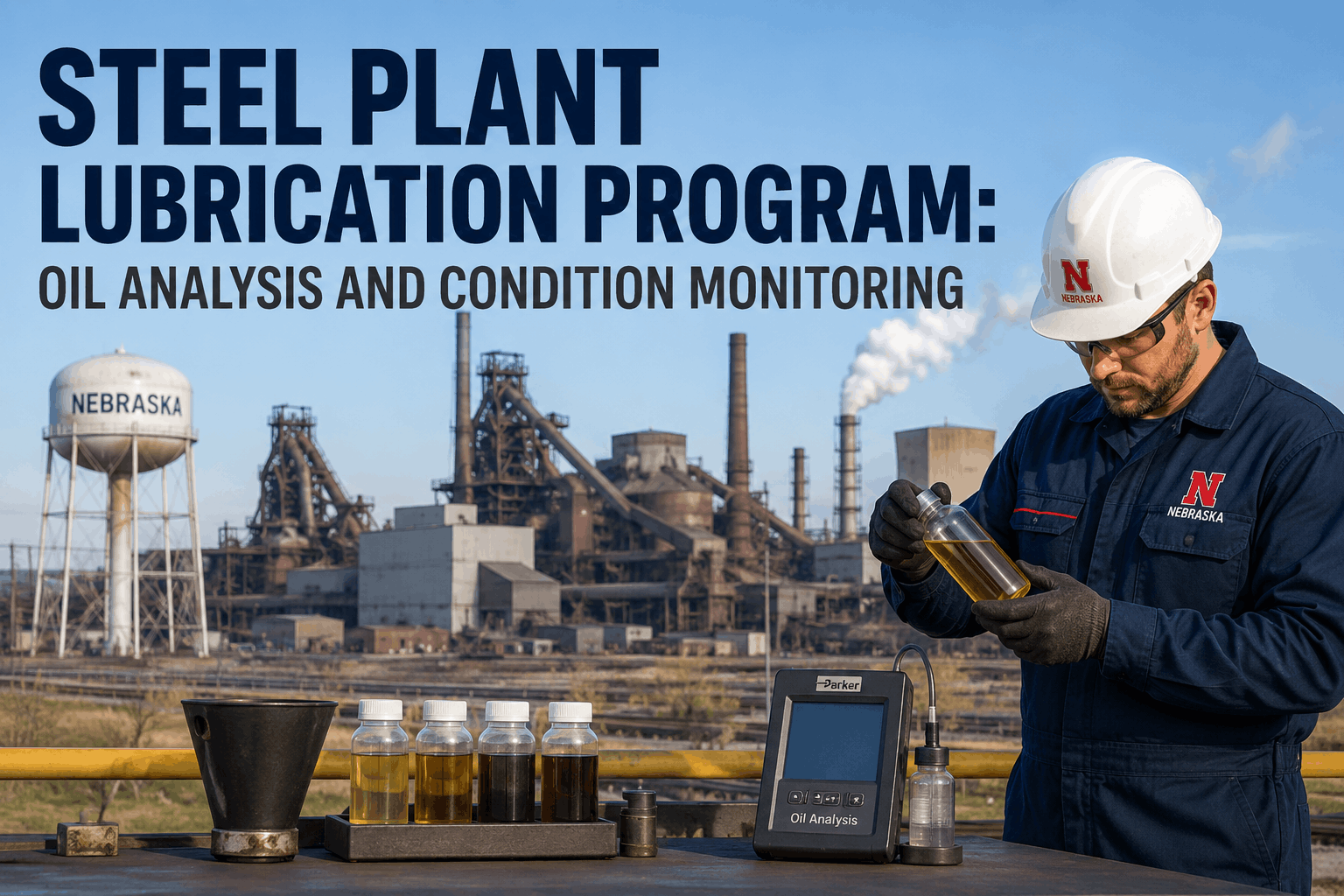
Oil analysis at $20–40 per sample delivers some of the highest ROI of any condition monitoring technique. By examining lubricant samples for wear metal content, particle morphology, contamination, and oil degradation markers, technicians can identify which component inside a sealed system is wearing, how fast, and what type of failure mode is developing — without opening the machine.
In steel plant applications, oil analysis is essential on hydraulic systems (continuous casters, rolling mill screwdowns), gearboxes on high-load drives, turbine lube systems, and compressor oil circuits. Iron particles indicate mechanical wear; copper suggests bearing cage deterioration; silicon points to external contamination through damaged seals; water ingress appears as elevated moisture content and oxidation products. Each failure signature points to a specific component and corrective action.
Thermal imaging detects failures that are invisible to vibration and oil analysis — electrical connection degradation, refractory hot spots, cooling system failures, and high-resistance joints in power distribution systems. In steel plant electrical infrastructure carrying thousands of amps to furnace transformers, motor control centres, and drive systems, a degraded connection generates heat proportional to current squared. Thermography identifies these hot spots at the 4–6 week mark before the connection fails catastrophically and causes a full line shutdown.
Beyond electrical systems, thermography in steel plants covers refractory condition in furnaces and ladles (hot spots indicate refractory thinning), bearing temperature profiling on large slow-speed rolls, cooling system uniformity on continuous caster segments, and steam trap performance (passing traps show as hot on the downstream side). Thermographic surveys require quarterly scheduling on switchgear and MCC panels, and annual surveys on all refractory structures.
Ultrasonic testing detects faults earlier than any other condition monitoring technique. Where vibration analysis requires a bearing defect to reach Stage 2 before reliable detection, ultrasonic monitoring detects inadequate lubrication — the primary cause of early bearing failure — before any damage has occurred. This gives the maintenance team the opportunity to add lubricant rather than replace a bearing.
Ultrasonic technology is particularly valuable in steel plants for two applications beyond bearing monitoring: pressurised gas leak detection on compressed air systems (where a single leak in a steel plant typically costs $3,000–$8,000 per year in wasted energy) and partial discharge detection on high-voltage electrical equipment. Partial discharge — micro-arcing inside motor insulation — is inaudible and produces no heat signature, but generates ultrasonic emission detectable with an SDT or UE Systems instrument months before insulation breakdown causes motor failure.
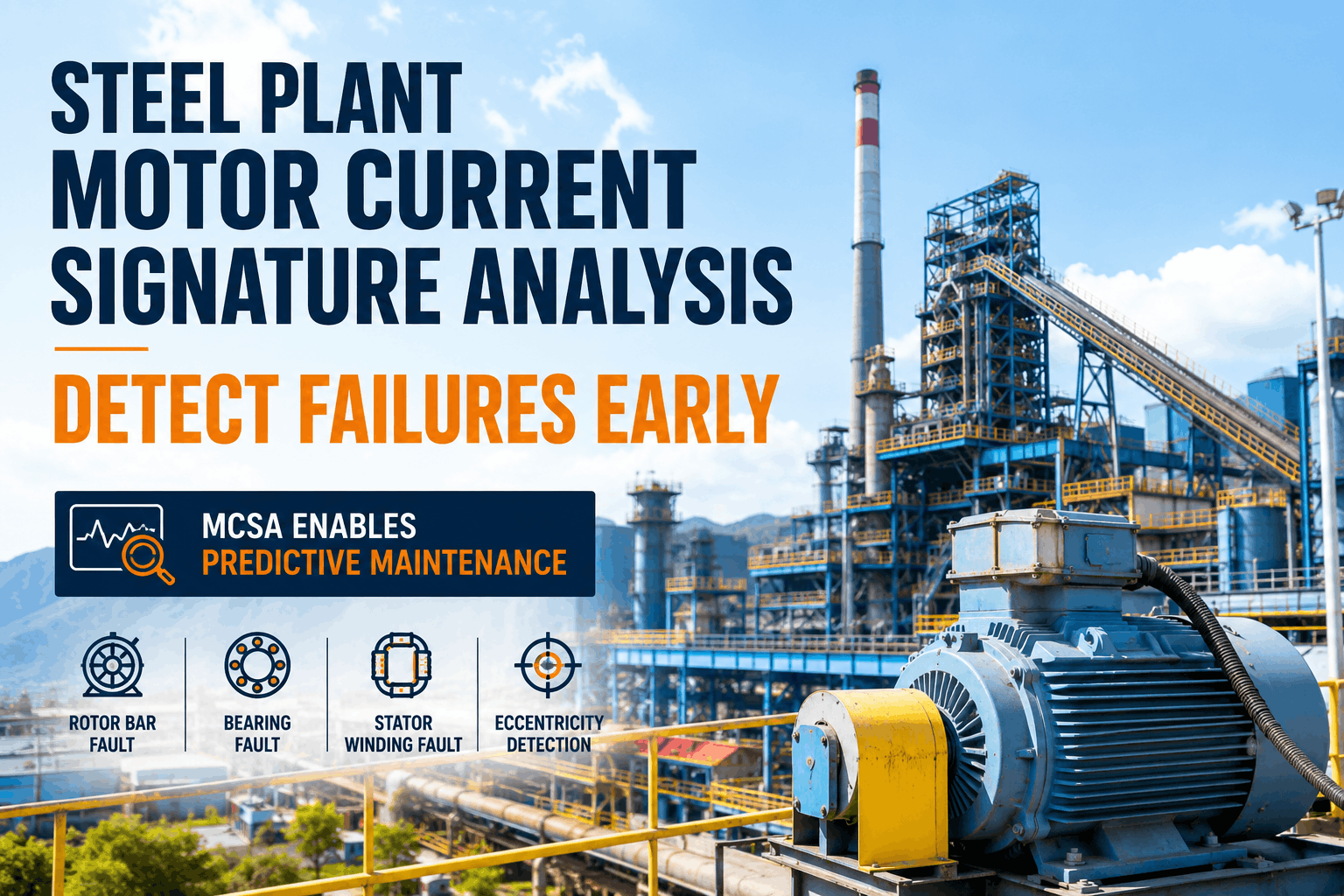
Motor current signature analysis monitors the electrical current drawn by induction motors and detects mechanical faults by analysing the current spectrum. A cracked rotor bar, for example, creates current sidebands at specific frequencies relative to the supply frequency — sidebands that are invisible in vibration data but clearly visible in an MCSA spectrum. This makes MCSA the primary diagnostic tool for motors in inaccessible locations, high-temperature environments, or enclosed systems where mounting accelerometers is impractical.
In steel plant applications, MCSA is particularly valuable on large furnace blower motors, rolling mill main drives, and continuous caster withdrawal motors — all running at high load in environments where physical access for vibration measurement is difficult and dangerous. MCSA is performed non-intrusively via current clamp at the motor control centre or drive panel, with no contact with the motor itself. This also allows screening of all motors in an MCC from a single access point during a shift, making it the most efficient technique for large motor populations.
Connect all five monitoring technologies to structured work orders in OxMaint. Every threshold breach auto-generates a work order with assigned technician, severity rating, and due date — no alerts lost in dashboards.
Choosing the Right Technique for Each Asset and Failure Mode
The table below maps failure mode to detection technology across the most critical steel plant asset classes. A cell marked with a primary indicator means the technology is the best first choice; secondary means it provides useful supporting data; not applicable means the technology is not suited to that failure mode on that asset.
| Asset / Failure Mode | Vibration | Oil Analysis | Thermography | Ultrasonic | MCSA |
|---|---|---|---|---|---|
| Rolling mill bearing failure | Primary | Secondary | Secondary | Primary | — |
| Gearbox gear wear | Primary | Primary | — | Secondary | — |
| Motor rotor bar crack | Secondary | — | — | — | Primary |
| Motor winding insulation breakdown | — | — | Secondary | Primary | Secondary |
| Electrical connection degradation | — | — | Primary | Secondary | — |
| Hydraulic contamination | Secondary | Primary | — | — | — |
| Refractory hot spot | — | — | Primary | — | — |
| Compressed air leak | — | — | — | Primary | — |
| Pump cavitation | Primary | Secondary | — | Secondary | — |
Building the Programme: A Phased Approach
The most common reason condition monitoring programmes fail to deliver ROI is deploying sensors and technology without structured maintenance workflows. Data without action produces dashboards that nobody uses and alerts that nobody acts on. This five-phase implementation model generates measurable results within the first 12 months.
Score every asset on safety consequence, production impact, failure likelihood, and repair cost. In most steel plants, 15–20% of assets account for 80% or more of unplanned downtime cost — these are your first monitoring targets. Rolling mill main drives, blast furnace blowers, and continuous caster withdrawal units almost always rank in the top tier.
For each critical asset, identify every credible failure mode via FMEA or RCM analysis. Map each failure mode to the monitoring technology that provides the earliest P-F interval warning. This step determines which technology to deploy on each asset — it prevents the common mistake of applying vibration analysis to assets where oil analysis would catch failures earlier.
Collect 2–4 weeks of monitoring data on healthy equipment under normal load to establish baseline signatures. Every alarm threshold and trend alert is calibrated against this baseline — not against generic industry values. Baseline establishment is the step that prevents nuisance alarms, which are the primary cause of operator alarm fatigue and CBM programme abandonment.
Build structured collection routes in your CMMS — assigned technicians, defined measurement points, required measurement methods, and data entry fields. Every route completion feeds directly into trending dashboards. Every threshold breach auto-generates a work order with severity, assigned owner, and due date. This is the step that turns sensor data into maintenance action.
Monthly review of trending data by a reliability engineer or senior technician identifies slow-developing faults, validates alarm thresholds against actual plant experience, and captures lessons from each prevented failure back into the programme. Mature CBM programmes with full asset coverage deliver 8–12x return on monitoring investment over 3 years, compounding as historical data accumulates.
What Reliability Engineers Observe in Steel Plant CBM Programmes
How OxMaint Closes the Gap Between Data and Action
A condition monitoring programme without CMMS integration produces data that lives in spreadsheets and specialist software — disconnected from the work order system where maintenance actually gets executed. OxMaint bridges this gap by converting every monitoring event into a structured maintenance action with assigned ownership, due date, and documentation requirements.
Route-Based Inspection Scheduling
Build vibration, ultrasonic, oil sampling, and thermography routes as recurring work orders in OxMaint. Each route specifies measurement points, required technique, and data entry fields. Completion triggers automatic trending updates and comparison against stored baselines.
Threshold-Triggered Work Orders
Configure alarm thresholds per asset and monitoring technology. When a reading breaches a threshold, OxMaint auto-generates a corrective work order with severity rating, assigned technician, and due date — without human intervention in the alert routing.
Trend Dashboards per Asset
Every monitored asset carries a full history of all measurement types — vibration overall levels, FFT spectra, oil analysis results, thermographic findings — on a single asset dashboard. Trend visualisation across measurement history shows developing faults as a rising slope, not a surprise breach.
Prevented Failure Reporting
Every work order generated from a condition alert, completed before failure, is tagged as a prevented failure in OxMaint. The system calculates avoided downtime cost based on your configured production loss rate — building the ROI case automatically with each event.
Frequently Asked Questions
Turn Condition Data Into Maintenance Actions — Automatically
OxMaint connects your steel plant's condition monitoring programme to structured work orders, technician routing, trend dashboards, and prevented failure reporting — so every sensor reading drives a maintenance decision, not just a dashboard alert.