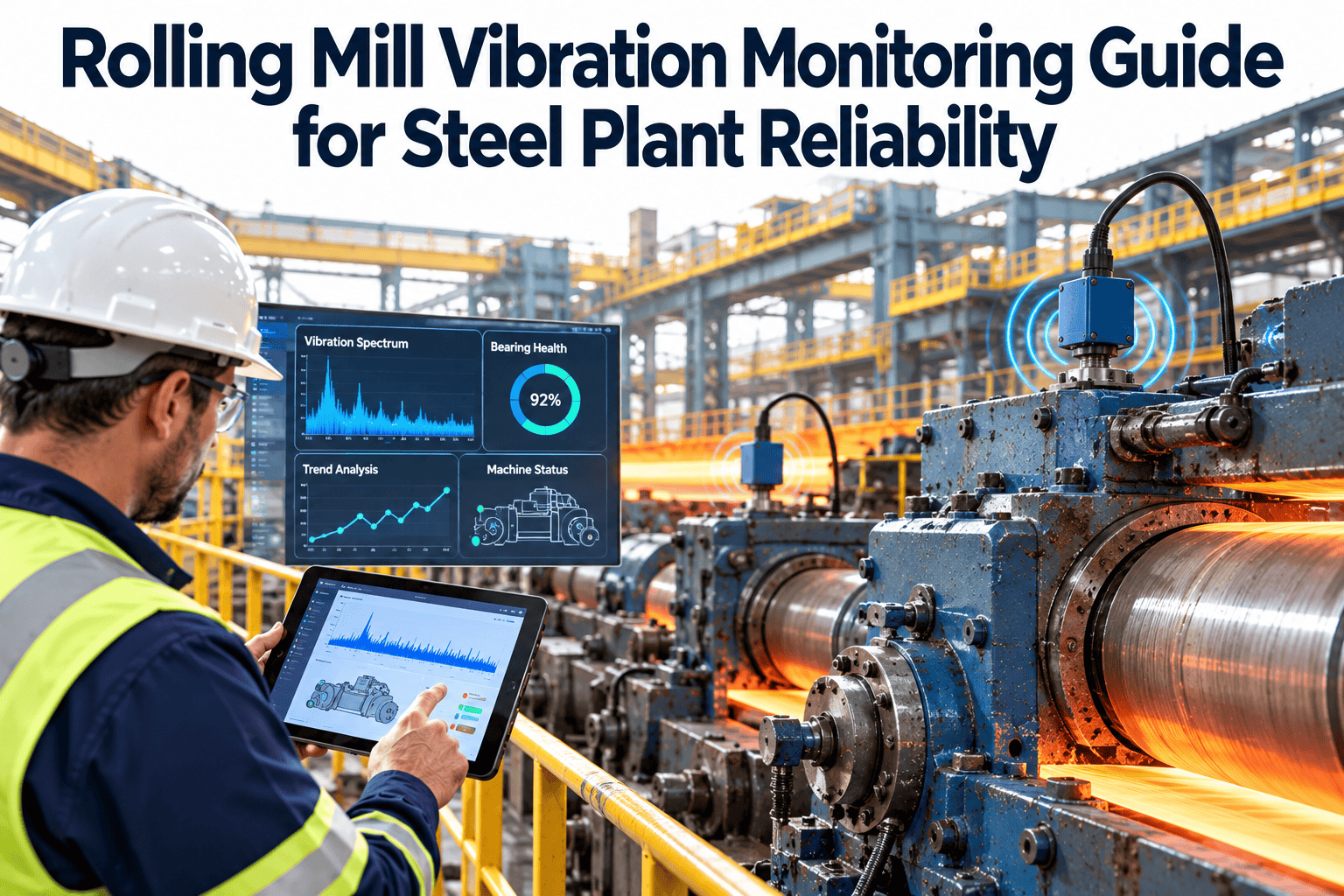
Rolling mills run at high load, in heat, scale and cooling water, and a single bearing or gearbox failure can stop an entire strip, bar or plate line. Vibration monitoring gives maintenance teams weeks of warning before those failures turn into unplanned stops. It shows which stand, drive or auxiliary is degrading and why, so repairs can be planned into a scheduled outage. This guide covers fault signatures, alarm strategy and the workflow that turns readings into action, supported by maintenance management software built for steel plants.
Rolling Mill Vibration Monitoring for Steel Plant Reliability
Detect bearing wear, gearbox damage, imbalance, looseness and misalignment early, and convert every alarm into a tracked work order.
Why rolling mills are hard on rotating equipment
Process conditions
- Shock loads when steel bites into the rolls
- Roll neck bearings exposed to scale, water and heat
- Variable speed drives and reversing duty
- Long gear trains between motor and stand
Maintenance consequences
- Roll changes expose bearings to repeated reassembly error
- Contamination shortens lubricant and bearing life
- Short outage windows leave little time for surprises
- Hot-mill inspection access is limited while running
What vibration tells you that other checks miss
Temperature and motor current usually change only when damage is advanced. Vibration reacts earlier, because a rolling element or gear tooth defect creates a repeating impact long before heat appears.
Common mill faults and their vibration signatures
| Fault | Typical signature | Likely mill locations | Usual cause |
|---|---|---|---|
| Imbalance | Dominant peak at 1X running speed, mostly radial | Fans, pinch rolls, couplings | Buildup, wear, damaged component |
| Misalignment | High 1X and 2X, often strong axial component | Motor to gearbox, spindle couplings | Thermal growth, foundation movement, poor reassembly |
| Looseness | Multiple harmonics, sometimes sub-harmonics | Bearing housings, baseplates, gear casings | Loose bolts, cracked grout, worn fits |
| Rolling bearing defect | Peaks at bearing defect frequencies, envelope sidebands | Roll neck, motor, fan and pump bearings | Contamination, lubrication failure, overload |
| Gear damage | Gear mesh frequency with sidebands at shaft speed | Pinion stands, reduction gearboxes | Pitting, tooth wear, backlash, poor lubrication |
Bearing defect frequencies in plain terms
Each bearing has calculated frequencies for outer race, inner race, rolling element and cage faults. Analysts compare measured peaks against these values from the bearing data sheet to name the damaged part.
From sensor reading to completed repair
Measure
Route-based or online sensors capture velocity, acceleration and envelope data.
Analyze
Spectra and trends identify the fault type and its rate of change.
Decide
Severity, asset criticality and spares availability set the response.
Act
A work order is raised, scheduled into an outage and executed.
Verify
Post-repair readings confirm the fault is gone and update the baseline.
Where most programs break down
The weak link is usually step 4. Analysts find the fault, but the finding sits in an email or report and never becomes a scheduled, tracked job.
Online monitoring versus route-based collection
Route-based readings
- Lower hardware cost
- Suited to many secondary assets
- Gaps between visits can hide fast faults
- Depends on safe access to the machine
Online sensors
- Continuous trend and alarm capability
- Suited to stands, main drives and gearboxes
- Safer for hot or restricted locations
- Higher installation and data-handling effort
A practical split
Many steel plants place permanent sensors on the highest-criticality drives and keep portable route collection for pumps, fans and lower-risk motors. Criticality ranking should drive that choice rather than habit.
Setting alarms that maintenance will trust
| Alarm level | Meaning | Recommended response |
|---|---|---|
| Normal | Readings within baseline range | Continue scheduled collection |
| Alert | Rising trend or new spectral peak | Increase measurement frequency, plan inspection |
| Warning | Confirmed fault with measurable growth | Create work order, reserve spares, target next outage |
| Danger | Severe level or rapid growth | Escalate to operations, assess immediate shutdown |
Guidelines for setting limits
- Use ISO 20816 machine vibration guidance as a starting reference, not a final limit
- Build asset-specific baselines after commissioning or overhaul
- Alarm on trend and spectral bands, not only overall level
- Review limits after every confirmed failure or false alarm
Turn vibration alarms into planned maintenance
Connect findings to work orders, assets and schedules so no warning is left unactioned.
Gearbox and drive train monitoring
Low severity
Slight sidebands around mesh frequency. Check oil condition and trend.
Moderate severity
Growing sidebands and harmonics. Sample oil and plan an inspection.
High severity
Strong mesh peaks with ferrous debris. Schedule repair in the next outage.
Critical severity
Rapid growth or noise change. Escalate and consider stopping the drive.
Combine vibration with other signals
Oil analysis, bearing temperature and motor current confirm what vibration suggests. Together they reduce false alarms and give a clearer repair scope.
Before and after a structured vibration program
Before
- Readings stored in analyst spreadsheets
- Findings sent by email without ownership
- Spares ordered after the failure
- Same fault reappears after each roll change
After
- Each alert linked to an asset record
- Work orders created with priority and due date
- Spares reserved from inventory in advance
- Failure history informs future inspection
How Oxmaint supports a vibration-based workflow
| Maintenance need | Oxmaint capability |
|---|---|
| Track every stand, gearbox, motor and bearing | Asset management with hierarchy and history |
| Act on a warning | Corrective work orders with priority and assignment |
| Repeat inspections and lubrication | Preventive maintenance scheduling |
| Record findings in the field | Mobile inspections and checklists |
| Hold the right bearings and seals | Inventory tracking and reorder control |
| Prove reliability gains | Reports and dashboards |
Condition-based triggers
Alerts from monitoring systems can be turned into work orders through integration, so condition-based maintenance becomes a routine process rather than an analyst task.
Reliability measures to track
Where to mount sensors on a rolling mill
Good data starts with consistent measurement points. A sensor moved a few centimetres between readings can change amplitudes enough to look like a fault, or hide one.
| Asset | Measurement points | Directions | Why it matters |
|---|---|---|---|
| Main drive motor | Drive end and non-drive end bearing housings | Horizontal, vertical, axial | Separates electrical, balance and bearing problems |
| Reduction gearbox | Input shaft, intermediate shaft and output shaft bearings | Horizontal and axial | Gear mesh and shaft faults travel through bearing housings |
| Pinion stand | Both pinion and gear bearing housings | Horizontal and vertical | Detects tooth wear and backlash changes |
| Spindle and coupling | Adjacent bearing housings on both sides | Radial and axial | Shows misalignment and worn joints |
| Roll neck bearings | Chock or bearing housing where access is safe | Vertical, load direction | Captures bearing damage under rolling load |
| Cooling and descaling pumps, fans | Motor and pump bearing housings | Horizontal, vertical, axial | Auxiliary failures also stop the line |
Rules that keep trends comparable
- Mark each point physically and record it in the asset file
- Use the same sensor type, mounting method and measurement settings
- Record operating speed and load with every reading
- Collect data at comparable process states, such as steady rolling
Root causes behind repeat vibration problems
Replacing a bearing without finding why it failed often brings the same alarm back months later. Vibration findings are most useful when paired with a cause.
Mechanical causes
- Incorrect fit or preload after roll changes
- Soft foot or cracked foundation grout
- Thermal growth not allowed for in alignment
- Worn coupling teeth or spindle joints
Maintenance causes
- Wrong grease type, quantity or interval
- Seals not replaced during bearing work
- Bolts not torqued to specification
- Cooling water entering lubricant
Record the cause, not only the repair
Each completed work order should note the failure mode, cause and corrective action. That history lets engineers see patterns across stands and shifts.
Roll changes, outages and vibration baselines
Roll changes are a repeated opportunity to introduce error. A short vibration check after restart catches problems while the mill is still under supervision.
Before the outage
Review open vibration warnings, confirm spares and assign tasks with the outage scope.
During the outage
Record alignment values, bearing condition, lubricant replaced and any damage found.
After restart
Collect readings at defined speeds and compare them against the previous baseline.
After one week
Review the trend, confirm the repair held and update alarm limits if needed.
Reducing false alarms and missed faults
An alarm system that cries wolf is ignored. One that is too loose misses faults. Tuning is an ongoing job.
Common causes of false alarms
- Readings taken during speed changes or non-representative load
- Loose sensor mounting or damaged cables
- Limits applied from generic tables without asset history
- Nearby machines transmitting vibration through the structure
Common causes of missed faults
- Overall velocity used alone, which hides early bearing defects
- Long gaps between route readings on fast-degrading assets
- No envelope or high-frequency analysis on rolling bearings
- Alerts that never reach the people who schedule work
A practical review habit
After each confirmed finding, compare the alarm date with the failure or repair date. If warning time was short, tighten limits or add measurement points.
Safety, records and audit readiness
Vibration findings often justify taking equipment out of service, which makes the decision trail important. Clear records protect both people and production.
- Store the reading, analyst note and recommended action against the asset
- Keep lockout and isolation requirements inside the work order
- Log who approved a deferral and the risk accepted
- Retain inspection history for internal and external audits
Deferral needs a documented reason
Sometimes a repair must wait for production. Writing down the expected remaining life, monitoring plan and review date turns a risky delay into a controlled one.
What a vibration-driven work order should contain
A finding only becomes useful when the technician receives enough detail to act on it. A vague note such as "check bearing" wastes outage time.
| Work order field | Example content | Benefit |
|---|---|---|
| Asset and location | Stand gearbox, intermediate shaft, drive-side bearing | Technician goes to the right component |
| Fault description | Outer race defect frequency with rising envelope level | Defines the expected repair scope |
| Priority and target date | Next planned outage | Aligns work with production windows |
| Parts and tools | Bearing, seals, lubricant, puller, alignment tools | Avoids delays during the stop |
| Safety requirements | Isolation points, permits, hot work limits | Keeps the job controlled |
| Closure notes | Failure cause, damage found, readings after repair | Feeds future analysis |
Link findings to spare parts early
Critical bearings and seals often have long lead times. When a warning is raised, checking inventory the same day gives purchasing time to react.
Trends shaping steel mill condition monitoring
Choosing the right analysis method
No single measurement finds every fault. Matching the method to the failure mode keeps the program efficient and the data meaningful.
Overall velocity trend
Good for broad severity checks on motors, fans and pumps, and for spotting imbalance or looseness.
FFT spectrum
Separates running speed, harmonics, gear mesh and sidebands so the fault can be named.
Envelope analysis
Highlights repetitive impacts from early rolling bearing damage that overall levels hide.
Time waveform
Shows impacts, rubs and looseness that spectra can blur, especially at low speeds.
Low-speed assets need extra care
Slow-turning rolls and drives produce weak signals. Longer sampling times, suitable sensors and careful interpretation are needed to avoid false confidence.
Who owns each step
- Condition monitoring analyst: reviews data, confirms the fault and sets severity
- Maintenance planner: converts the finding into a scheduled work order with parts
- Technician: performs the repair and records what was found
- Reliability engineer: reviews repeat failures and adjusts strategy
- Operations: agrees outage timing and any speed or load limits
Clear ownership prevents lost warnings
When every alert has a named owner and due date, nothing depends on someone remembering to follow up after a busy shift.
Implementation checklist
- Rank mill assets by production and safety criticality
- List bearing models, gear tooth counts and operating speeds
- Choose measurement points and sensor mounting methods
- Capture baselines after commissioning or overhaul
- Define alarm levels and escalation owners
- Link alerts to work order templates and spares
- Train analysts and technicians on shared fault terminology
- Review results after every outage and roll change
Frequently asked questions
What does rolling mill vibration monitoring detect?
It detects bearing wear, gear damage, imbalance, looseness and misalignment before they cause failures.
Should every mill asset have online sensors?
No. Use permanent sensors on critical drives and portable routes elsewhere, based on criticality.
How early can bearing faults be found?
Envelope analysis often finds defects weeks ahead, though timing varies by load and speed.
How does a CMMS fit in?
It turns findings into tracked work orders and spares reservations. Book a demo to see the workflow.
Can we start with one mill line?
Yes. Pilot on one critical line, then expand. You can sign up and configure assets first.
Keep your rolling mill running between outages
Bring vibration findings, work orders, assets and spares into one maintenance system.