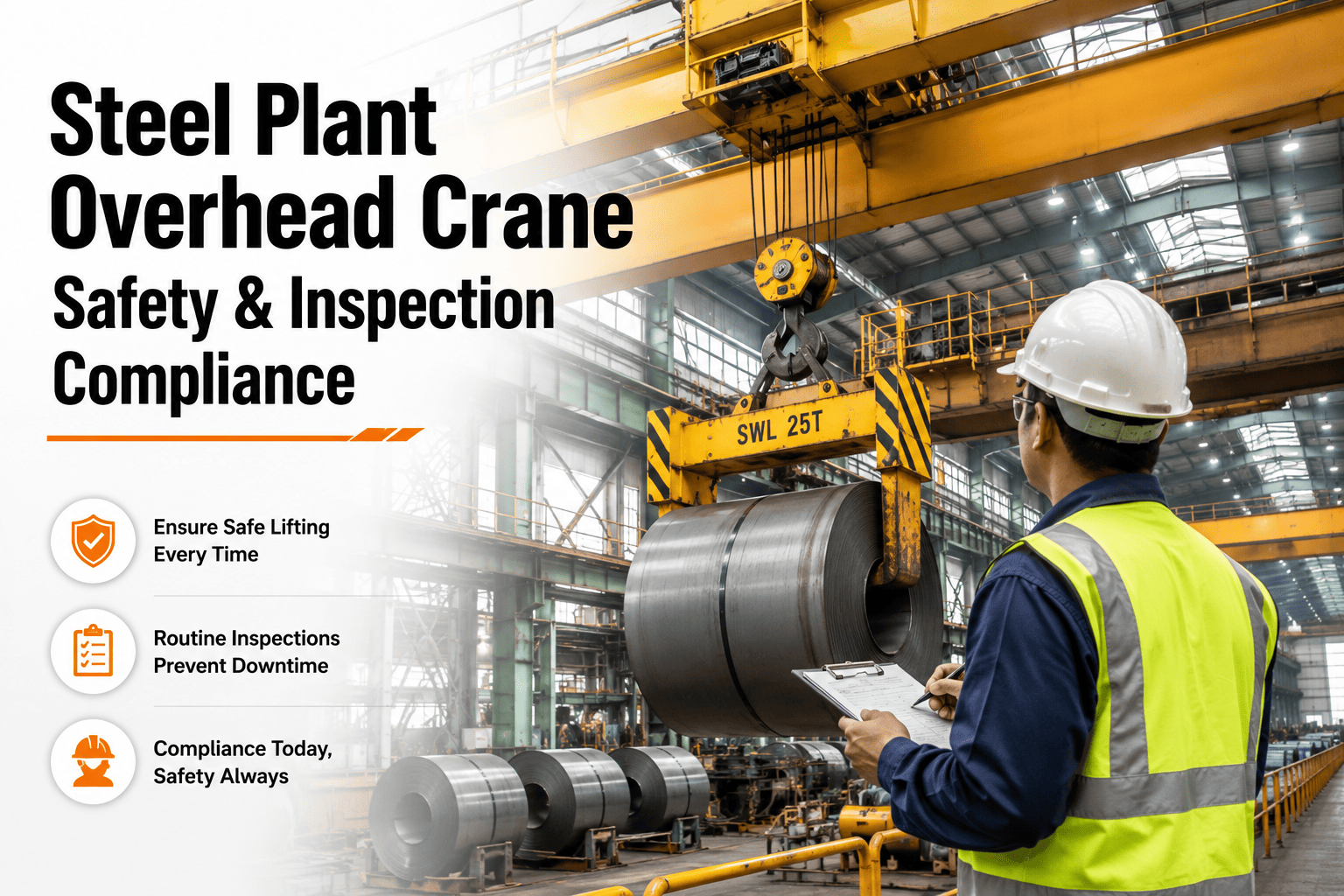
Autonomous Cranes & Yard Logistics for Steel Operations
By Michael Finn on February 24, 2026
It's 2:47 a.m. and the hot strip mill just finished a campaign. Fourteen coils are sitting on the runout table conveyor waiting to be moved to the coil yard for cooling, inspection, and eventual shipping. The overhead crane operator on night shift — one of your two remaining certified operators since the third retired in March and hasn't been replaced — is on the other side of the bay moving a coil to the inspection station. The coils on the runout table are backing up. The mill can't start the next campaign until the table is clear. Every minute of delay is $340 in lost production throughput. The dispatcher radios the yard. The mobile crane that should be staging coils for the 6:00 a.m. truck loading is currently blocked behind a slab transporter that parked in the wrong lane because the driver couldn't see the yard assignment board from his cab. The shipping team calls at 5:30 a.m. asking why the 47 coils for the automotive customer aren't staged at Bay 3. They're scattered across four yard sections because nobody tracked which coils went where after the crane operator placed them wherever space was available at 3:15 a.m. This isn't a crane problem or a yard problem or a scheduling problem. It's all three compounding each other — and it happens in some form every shift at steel operations that run cranes and yard logistics the way they did in 1995: human-operated, radio-coordinated, clipboard-tracked, and hoping the next shift can find what the last shift put down. Autonomous cranes and intelligent yard logistics replace this chain of manual dependencies with systems that move steel continuously, track every piece in real time, optimize storage placement for downstream operations, and eliminate the bottlenecks that turn a 3-million-ton-per-year mill into one that actually produces 2.4 million because 20% of capacity is consumed by material handling delays. The crane doesn't need a bathroom break. The yard management system doesn't lose track of coils. The traffic routing doesn't create deadlocks. And the entire operation runs at 3:00 a.m. with the same precision it runs at 3:00 p.m.
Crane utilization rate — from 75% (manual) to 94% (autonomous) by eliminating idle time between tasks
Reduction in mill-to-yard transfer delays — coils moved from runout table within target window consistently
Real-time coil and slab location tracking — every piece mapped to exact yard coordinates from mill exit to truck loading
Annual value from increased throughput, reduced crane damage, eliminated search time, and faster truck turnaround
The Autonomous Crane: What Changes When the Operator Leaves the Cab
Autonomous overhead cranes don't simply replicate what a human operator does without the human. They fundamentally change how the crane operates — optimizing every movement for speed, energy efficiency, and load safety while executing tasks that no human operator can perform at the same consistency across a 24-hour cycle.
Manual Operation
Operator visually estimates load position — alignment errors cause coil damage and stack instability
Crane idle during shift changes, breaks, and radio coordination — 25% of shift time non-productive
Travel path chosen by operator judgment — suboptimal routing, sway during transit, unnecessary acceleration
One crane per operator — second crane sits idle until operator finishes current task
Placement location chosen in real time — "wherever there's space" — no downstream optimization
Night shift quality degrades — fatigue, reduced visibility, fewer operators available
VS
Autonomous Operation
Laser and camera positioning — ±5mm placement accuracy eliminates coil damage from misalignment
Continuous operation with zero idle time — next task begins before current task's hook is fully raised
Optimized travel paths with anti-sway algorithms — 15% faster transit, reduced structural fatigue on crane
One supervisor monitors multiple cranes — fleet coordination eliminates task conflicts and deadlocks
Placement optimized for downstream — coils positioned by customer, grade, and ship date for efficient loading
Steel operations that sign up for crane-integrated maintenance management connect autonomous crane health data directly to the CMMS — drive motor temperatures, brake wear indicators, rope condition metrics, and structural stress data feeding predictive maintenance models that prevent crane downtime before it impacts production.
Yard Management: From "Where Did We Put That Coil?" to Real-Time Digital Twin
A steel plant yard is a warehouse without walls — thousands of coils, slabs, and plates stored across hundreds of positions, moved dozens of times per day, and needed at specific loading bays at specific times for specific customers. Without a real-time tracking system, the yard becomes a search operation. With one, it becomes a logistics engine.
Yard Digital Twin — Real-Time Material Tracking
Hot Mill Output
●●●○
3 coils · Cooling
Inspection Area
●●○○
2 coils · QC pending
Automotive Grade
●●●●
4 coils · Ship-ready
Structural Grade
■■●○
2 slabs · 1 coil
Loading Bay 1
●●○○
2 coils · Loading now
Loading Bay 2
○○○○
Empty · Next truck 06:00
● Coil■ Slab● Loading○ Open
847coils tracked
124slabs tracked
0lost items
12 seclocate any piece
Every Coil Tracked. Every Crane Optimized. Every Truck Loaded On Time.
OXmaint integrates with autonomous crane systems and yard management platforms — connecting material movement data to maintenance scheduling, crane health monitoring, and equipment performance tracking. When the crane reports a drive motor temperature anomaly, the work order is already generated.
Traffic Management: Eliminating Yard Deadlocks and Collisions
A steel plant yard has more traffic than most people realize — overhead cranes traversing bays, mobile cranes repositioning material, slab transporters moving between caster and reheating furnace, coil cars shuttling between mills, forklifts handling packaging, and trucks arriving for loading. Without coordinated traffic management, these movements create conflicts that consume 10–15% of yard capacity in waiting time alone.
Yard Traffic Management — Conflict Elimination Zones
Crane-to-Crane Exclusion Zones
Adjacent overhead cranes operating in the same bay automatically maintain minimum separation distance. System coordinates task sequencing so cranes never block each other's access to storage positions.
Impact: Eliminates 45 min/shift of crane-to-crane waiting time
Ground-to-Overhead Coordination
Mobile cranes and ground vehicles automatically yield when an overhead crane is operating above their path. Geo-fenced zones prevent ground equipment from entering active overhead crane work areas.
Impact: Zero ground-level incidents under operating overhead cranes
Truck Queue Sequencing
Inbound trucks assigned to specific loading bays with timed arrival slots. Material pre-staged at the assigned bay before the truck arrives. No truck waits for crane availability — the coils are already there.
Impact: Truck turnaround time reduced from 90 min to 35 min average
Slab Transporter Routing
Slab transporters between caster and reheating furnace follow optimized routes that avoid crossing active crane zones and loading areas. Dynamic rerouting when temporary obstructions occur.
Impact: Slab transfer cycle time reduced 22%, zero lane-blocking incidents
Maintenance Access Windows
When maintenance requires access to a crane or yard section, the system reroutes all traffic around the work zone and reschedules material movement tasks to alternative cranes — no production stoppage required for routine maintenance.
Impact: 60% reduction in maintenance-related yard shutdowns
Crane Task Queue: How the System Prioritizes Every Move
An autonomous crane doesn't just execute tasks — it prioritizes them based on production urgency, downstream scheduling, equipment availability, and energy optimization. The task queue is the brain of the operation, ensuring that the highest-value moves happen first and that no crane sits idle while work is waiting. Reliability teams managing crane fleets should book a free demo to see how crane health monitoring integrates with task scheduling.
Crane Task Queue — Priority-Ordered Execution
P1
Clear runout table — HSM campaign complete
Crane: Bay 2 East
Mill blocked — $340/min production loss until table cleared
EXECUTING
P2
Stage 12 coils at Bay 1 — Truck arrival 06:00
Crane: Bay 3 West
Customer delivery deadline — late shipment penalty clause
NEXT
P3
Move 4 coils from cooling yard to inspection station
Crane: Bay 2 West
Quality hold — inspection required before customer release
QUEUED
P4
Reorganize Section C — consolidate automotive grade coils
Crane: Bay 3 East
Yard optimization — reduce future crane moves for next 3 shipments
QUEUED
P5
Return empty coil saddles to HSM exit area
Crane: Any available
Housekeeping — saddle shortage will delay next campaign if not addressed
QUEUED
Smart Storage Placement: Every Coil Where It Needs to Be Tomorrow
A human operator places a coil wherever there's open space. An autonomous system places a coil where it minimizes future crane moves — considering the coil's customer, ship date, quality status, grade, and the loading bay it will eventually leave from. The difference compounds across thousands of movements per week. Operations optimizing yard throughput should sign up to see how smart placement reduces total crane moves by 30%.
Smart Placement Algorithm — Decision Factors
Ship Date Proximity
Coils shipping soon placed near loading bays. Coils with distant ship dates stored in deeper positions where they won't need to be moved to access other coils.
Customer / Order Grouping
Coils for the same customer and order grouped together — so when the truck arrives, all coils are in adjacent positions requiring minimal crane movements to load.
Grade Segregation
Automotive-grade coils separated from structural and commercial grades. Prevents handling damage from adjacent lower-grade material and simplifies quality management.
Crane Travel Minimization
Place material near the crane's current position when other factors are equal — reducing empty travel distance and energy consumption across thousands of daily moves.
Stack Stability & Weight Limits
Heavier coils on bottom, lighter on top. Maximum stack height enforced by weight and coil diameter. No placement decision violates structural safety limits.
Crane Health Monitoring: Predictive Maintenance for the Most Critical Material Handling Asset
An overhead crane failure in a steel plant doesn't just stop one machine — it stops the entire bay. No material moves in or out until the crane is repaired. In a single-crane bay, a 4-hour unplanned breakdown costs $80,000–$120,000 in cascading production delays, overtime, and missed shipments.
Crane Health Monitoring — Predictive Maintenance Parameters
Lead time: 4–8 weeks depending on degradation rate and duty cycle
Brake Wear & Response Time
Normal: Brake pad >60% remaining, response <150ms
Alert: Response time drift >200ms or pad wear below 30% — safety-critical component requiring immediate scheduling
Lead time: 1–3 weeks, but safety criticality demands proactive replacement
Wheel & Rail Alignment
Normal: Lateral deviation <3mm per 10m travel
Alert: Increasing lateral load on flanges — indicates wheel wear, rail deviation, or structural misalignment
Lead time: 6–12 weeks — gradual degradation allows planned intervention
Expert Perspective: Autonomy Is a Journey — Start With the Crane, Then Expand to the Yard
I've led autonomous crane implementations at four integrated steel plants, and the most important lesson is that you don't need to automate everything at once. The highest-value starting point is always the overhead crane that serves the bottleneck process — usually the crane clearing the hot strip mill runout table or the crane feeding the reheating furnace. That single crane, operating autonomously, eliminates the most expensive waiting time in your operation. Once it's running, the data it generates — precise material locations, movement timestamps, cycle times — becomes the foundation for yard management intelligence. You know exactly where every coil is because the crane told the system when and where it placed it. From there, you add traffic management, then smart placement optimization, then truck pre-staging. Each layer builds on the data from the previous one. The companies that try to implement all four layers simultaneously spend two years in commissioning. The ones that start with one crane and expand sequentially are generating value in four months and fully operational in 14 months. The other truth about crane autonomy is maintenance. An autonomous crane is more reliable than a manually operated one — not because the hardware is different, but because the sensors required for autonomous positioning also provide continuous condition monitoring. You get predictive maintenance as a byproduct of autonomy. The crane is telling you about its own health every cycle, and the CMMS is converting those signals into work orders before any human would have noticed a problem.
Start With the Bottleneck Crane
Identify the crane whose delays most directly impact production throughput — that's your first automation target. One autonomous crane eliminating 40 minutes of shift delay pays for itself faster than automating five low-impact cranes simultaneously.
Connect Crane Data to CMMS Immediately
Every autonomous crane generates motor temperatures, rope loads, cycle counts, and positioning accuracy data. Feed it to the maintenance system from day one. The predictive maintenance value alone can justify 15–20% of the automation investment.
Measure Truck Turnaround as Your Yard KPI
The single best indicator of yard logistics health is how long a truck spends on site from gate entry to loaded departure. If it's over 60 minutes, your pre-staging, traffic management, or loading coordination has bottlenecks. Under 40 minutes means the yard is running well.
Move Steel Faster. Track Every Piece. Maintain Every Crane.
OXmaint connects autonomous crane health data, yard material tracking, and maintenance management in one platform — predictive work orders from crane condition monitoring, material location history linked to equipment assets, and maintenance scheduling that never conflicts with production-critical crane tasks.
Autonomous cranes in steel operations are overhead bridge cranes, gantry cranes, and specialized material handling cranes that operate without a human operator in the cab, using sensors (laser positioning, cameras, load cells, anti-sway systems), navigation algorithms, and task management software to execute material movement commands. The crane receives tasks from the yard management system — move coil X from position A to position B — and executes the complete cycle: travel to the pickup location, lower the hook, engage the coil, lift with anti-sway control, travel the optimized path to the destination, place with millimeter precision, disengage, and report completion. Autonomous cranes in steel plants typically achieve ±5mm placement accuracy (compared to ±50–100mm for manual operation), 15% faster cycle times through optimized travel paths and anti-sway algorithms, and 94% utilization rates (compared to 70–80% for manual operation) by eliminating idle time during shift changes, breaks, and radio coordination. A single human supervisor monitors multiple autonomous cranes from a control room, intervening only for unusual situations.
How does yard management work with autonomous cranes?
Yard management and autonomous cranes form an integrated system where the yard management platform acts as the brain and the cranes act as the muscles. The yard management system maintains a real-time digital twin of the entire yard — tracking the exact position, identity, grade, quality status, customer assignment, and ship date of every coil, slab, and plate in the yard. When material needs to move (mill output needs to be cleared, coils need to be staged for shipping, material needs to go to inspection), the yard system generates a task with a priority level and assigns it to the optimal crane based on proximity, current workload, and traffic conditions. The crane executes the task and reports its completion, updating the digital twin with the material's new position. This closed-loop system means no material is ever "lost" in the yard — every piece is tracked from the moment it exits the production line through cooling, inspection, storage, and loading. The system also optimizes storage placement to minimize future crane moves, groups material by customer and ship date for efficient truck loading, and coordinates traffic between multiple cranes and ground vehicles to prevent conflicts.
What is the ROI of autonomous cranes for steel operations?
ROI for autonomous crane systems in steel operations typically ranges from $4–8 million annually at a mid-size integrated plant, driven by five value streams. Increased throughput (40–50% of total value) comes from eliminating mill-to-yard transfer delays and reducing the production time lost to material handling bottlenecks — even a 2–3% throughput improvement at a 3-million-ton plant represents significant revenue. Reduced crane damage (15–20% of value) results from precision positioning that eliminates the coil-to-coil and coil-to-saddle impacts that cause surface damage and downgrading. Faster truck turnaround (10–15% of value) comes from pre-staging material at loading bays based on shipping schedules, reducing truck on-site time from 90 minutes to 35 minutes and enabling more shipments per day. Labor reallocation (10–15% of value) comes from redeploying crane operators to supervisory and maintenance roles rather than replacing them. Predictive maintenance value (5–10%) comes from the continuous condition monitoring data that autonomous positioning sensors provide, enabling predictive work orders that prevent unplanned crane breakdowns. System costs typically range from $2–5 million per crane for full autonomous conversion, with payback periods of 18–30 months.
How does crane autonomy affect safety in steel plant yards?
Crane autonomy significantly improves yard safety through several mechanisms. Removing the operator from the cab eliminates exposure to the extreme heat, dust, noise, and height risks inherent in operating an overhead crane in a steel plant — one of the most physically demanding and dangerous positions in the industry. The autonomous system enforces exclusion zones that prevent ground personnel and vehicles from entering areas where the crane is operating overhead, using geo-fencing and automatic crane stoppage if a person or vehicle enters the restricted zone. Anti-collision systems prevent crane-to-crane contact in bays with multiple cranes, maintaining minimum separation distances that human operators sometimes misjudge. Load monitoring prevents overloading by checking every lift against the crane's rated capacity for the specific hook position and boom angle. Anti-sway algorithms eliminate the load swing that causes struck-by incidents during manual operation. The system also coordinates maintenance access — when a technician needs to work on equipment in the crane's operating zone, the system locks out the crane for that zone while continuing to operate in unaffected areas.
How do autonomous cranes integrate with maintenance management?
Autonomous cranes integrate with maintenance management through the continuous condition monitoring data that the autonomy sensors generate as a byproduct of normal operation. The positioning sensors that guide precise hook placement also detect structural deflection and alignment drift. The motor controllers that manage smooth acceleration also monitor current draw, temperature, and vibration patterns. The load cells that verify lift weight also detect rope degradation and brake performance changes. This data feeds directly into the CMMS, where predictive maintenance algorithms convert sensor trends into work orders — scheduling a motor bearing replacement when temperature trends indicate degradation is approaching the failure threshold, flagging wire rope for inspection when electromagnetic monitoring detects cross-section loss exceeding 5%, or triggering brake pad replacement when response time drifts beyond the safety limit. The scheduling integration ensures maintenance windows are coordinated with production — the system identifies the optimal time for crane maintenance based on production schedules, available alternative cranes, and the urgency of the maintenance need, then automatically reserves the crane and reroutes tasks to other equipment during the maintenance window.