.png)
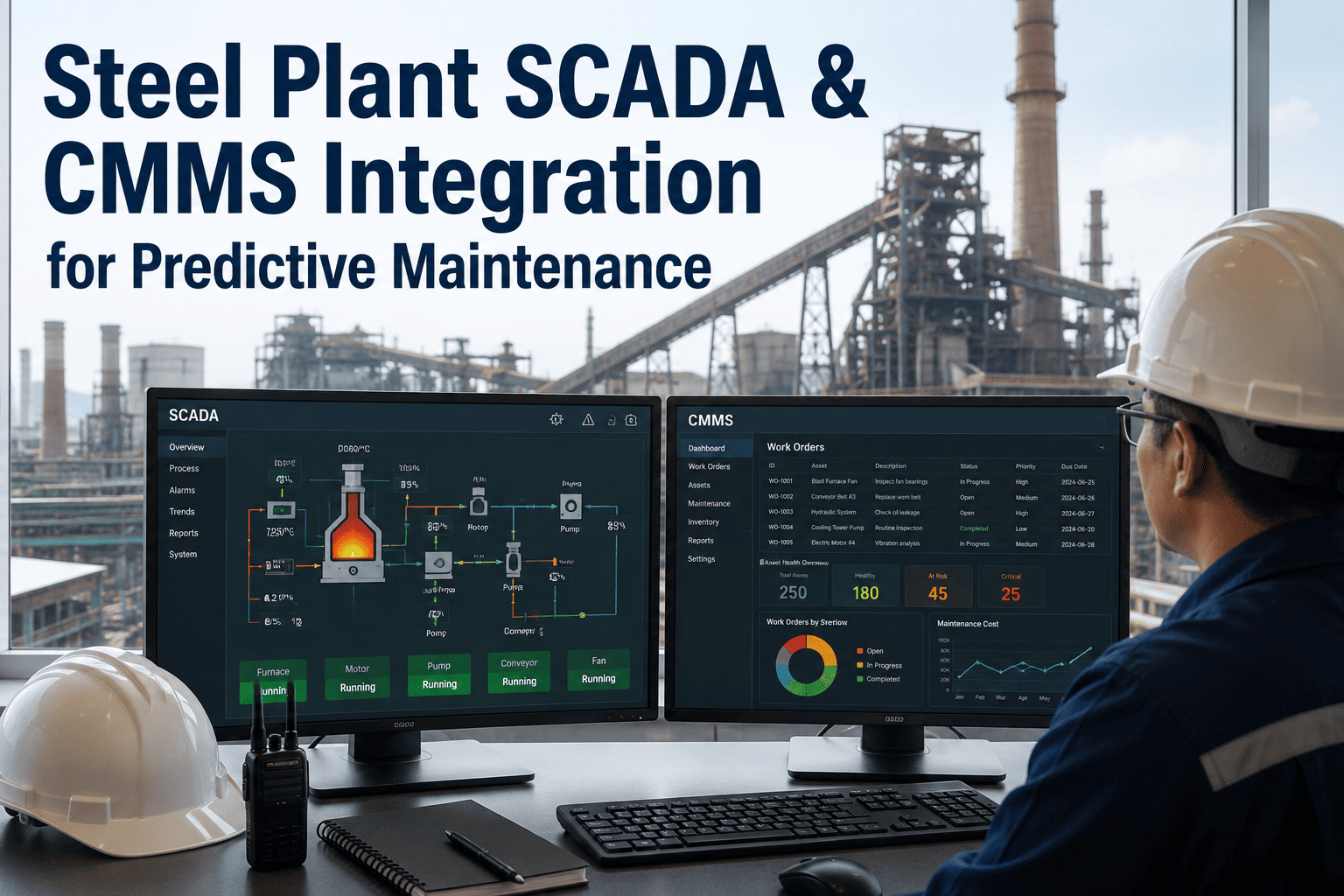
In the data-intensive environment of a North American integrated steel mill, the bridge between Operational Technology (OT) and Maintenance Management (CMMS) is the catalyst for true reliability excellence. While SCADA systems and Data Historians like AVEVA (OSIsoft PI), OSIsoft, and Honeywell PHD capture billions of time-series data points from sensors every hour, this information often remains siloed within the engineering department. Without a direct, bidirectional link to the maintenance execution layer, critical asset anomalies—such as a 10% rise in motor winding temperature, a subtle shift in vibration frequency on a cold rolling mill, or a pressure drop in a high-pressure descaling system—can go unnoticed until a catastrophic failure occurrs. The result is unplanned downtime that costs the facility millions in lost tonnage and emergency repair fees. The solution is a seamless SCADA-Historian CMMS Integration that converts raw sensor data into actionable, automated work orders. By mapping industrial tags directly to CMMS asset records, maintenance leaders can transition from reactive and calendar-based PMs to a high-performance **Condition-Based Maintenance (CBM)** strategy. This integration ensures that the right technician is dispatched with the right parts exactly when the asset's health index begins to decline, significantly reducing unplanned downtime and extending the lifecycle of multi-million dollar steelmaking assets. Start Your Sensor-Driven Audit with OxMaint and unify your real-time data with your reliability workflow. Book a Technical Integration Demo
Steel Plant SCADA & PI Historian Integration: Automated Condition-Based Maintenance
Bidirectional Tag Mapping · Automated Alarm-to-WO Routing · Real-Time Health Index Monitoring · AVEVA PI & Honeywell PHD Sync · Sensor-Driven PM Triggers · Predictive Analytics Integration · 100% Audit-Ready Sensor Logs
The Integration Lifecycle: From Sensor Tag to Work Order
Condition-Based Maintenance (CBM) is not a one-time setup; it is a digital lifecycle that connects the physical heartbeat of the mill to your maintenance strategy. OxMaint provides the middleware and logic required to filter massive time-series data into actionable reliability events, ensuring your team isn't overwhelmed by "nuisance alarms" while never missing a critical failure precursor. Effective integration starts with tag harmonization across different mill levels and ends with a closed-loop feedback system that refines your predictive models based on actual field findings.
Tag Harmonization
Map tags from AVEVA PI, OSIsoft, or Honeywell PHD directly to OxMaint asset IDs. Harmonize disparate naming conventions into a unified reliability hierarchy across multiple facility zones.
Threshold Logic
Define multi-stage thresholds (Warning, Alarm, Critical). Trigger different work order priorities and technician crafts based on the severity of the real-time sensor deviation.
Automated Dispatch
Automatically assign the generated work order to the relevant shop (Mechanical, Electrical, or Controls) with the required spare parts and PdM checklists already listed for the technician.
PdM Feedback Loop
Sync completed work order data back to the Historian. Compare the actual asset condition found by the technician with the sensor trend to refine future predictive maintenance thresholds.
Predictive Maintenance Capabilities: Specific Failure Mode Detection
By integrating your SCADA and Historian data with OxMaint, your reliability team can detect specific mechanical and electrical failure modes long before they manifest as audible noise or smoke. This "Digital First" approach allows for planned interventions during scheduled downtime windows.
Detect **Bearing Wear**, **Imbalance**, and **Soft Foot** via high-frequency vibration tags from Level 2 controllers. Trigger automated lubrication work orders when friction-induced temperature rise is detected.
Monitor **Pump Cavitation** and **Internal Leakage** by correlating motor current draw with discharge pressure tags. Automatically generate 'Seal Inspection' WOs when pressure-flow ratios diverge.
Identify **Insulation Degradation** and **Winding Faults** in high-voltage motors through real-time phase current monitoring. Catch 'Dirty Power' issues before they compromise sensitive VFDs and PLCs.
Technical Integration Roadmap: 5 Steps to CBM Excellence
Transitioning to a sensor-driven maintenance model requires a structured technical approach. OxMaint's integration engineers follow this proven roadmap to ensure a secure and scalable link between your Mill Level 2/3 systems and your Level 4 CMMS, ensuring data integrity and OT network security throughout the process.
Historian API & Gateway Configuration
Configure the secure API gateway or ODBC/JDBC connection to the AVEVA PI Server or Honeywell PHD. Establish an encrypted data tunnel that follows NIST SP 800-82 industrial cybersecurity standards.
Critical Tag Identification (FMEA Based)
Cross-reference your FMEA records to identify the 'Critical-to-Quality' tags that predict failure. Focus on high-tonnage assets like casters, hot strip mills, and finishing lines.
CMMS Mapping & Health Templates
Create 'Condition Monitoring' templates in OxMaint. Map each sensor tag to a specific asset field and define the data ingestion frequency (e.g., real-time for critical, 15-min for secondary).
Alarm Logic & Work Order Routing
Implement the business logic that converts an 'Alarm' event into a Work Order. Define auto-assignments based on mill zone, craft type, and asset criticality to eliminate human delay.
Hyper-Care & Threshold Refinement
Conduct a 30-day 'Hyper-Care' period to eliminate nuisance triggers and verify the accuracy of automated dispatching. Refine threshold levels based on actual field findings documented in OxMaint.
Integration Matrix: SCADA/Historian vs. CMMS Workflow Boundaries
A successful integration relies on clearly defined system boundaries. While the SCADA/Historian environment manages the high-speed, raw time-series data stream, OxMaint manages the high-value reliability response and technical audit trail. This division of labor is essential for system stability, network security, and data clarity across the enterprise.
| Functional Task | Historian (AVEVA / OSIsoft) Role | OxMaint CMMS Role | Reliability ROI Impact |
|---|---|---|---|
| Data Ingestion | Raw Time-Series Capture (Hz/ms) | Asset-Linked Health Aggregation | Elimination of Data Silos |
| Alarm Management | Real-Time Setpoint Violations | Standardized Work Order Conversion | 0-Min Response Lag |
| Condition Trends | Long-Term Tag Archiving | PdM Decision Support & RCA Logs | Data-Driven Capital Planning |
| Asset Health Index | Current Sensor Values | Calculated Remaining Useful Life (RUL) | Pre-Failure Intervention |
| RCA Evidence | Playback of Pre-Failure Trends | Documentation of Corrective Actions | Root Cause Accuracy |
| Compliance Audit | Raw Environmental & Safety Logs | Audit-Ready Proof of Remediation | 100% Audit Readiness |
Convert Your Raw Data into Reliability Results.
Stop letting critical sensor alarms die in your Historian. OxMaint provides the bridge that turns real-time data from AVEVA PI, OSIsoft, and SCADA systems into automated, high-impact work orders. Transition to 100% Condition-Based Maintenance and eliminate unplanned downtime across your mill. Your first tag integration takes under 60 minutes.
CBM ROI: The Economics of Sensor-Driven Maintenance
In a high-tonnage environment like a caster or hot strip mill, the economics of sensor-driven maintenance are undeniable. Catching a single bearing failure, cooling system blockage, or winding fault before it triggers an emergency shutdown can pay for the entire integration project ten times over in avoided production loss alone.
Before vs. After: Traditional Silos vs. Integrated CBM Layer
"Before OxMaint, our OSIsoft PI system was just a massive time-series database that the reliability team looked at once a month to explain why things broke. We were sitting on a goldmine of data but still reacting to failures as they happened. By integrating PI directly with our OxMaint work order flow, we've transformed our entire shop culture. Now, our electricians get high-priority alerts on their tablets the moment a motor baseline shifts—not after it trips. We've caught three major bearing failures in the caster this year alone that would have cost us millions in production downtime. It's the only way to bridge the gap between engineering data and maintenance execution."
Frequently Asked Questions
OxMaint utilizes secure REST API connectors or ODBC/JDBC gateways to establish a secure link with your Historian node.
This follows NIST industrial security guidelines to ensure the OT-IT bridge is fully isolated and does not compromise SCADA network security.
A SCADA alarm is a real-time operational alert for operators; a CMMS work order is a maintenance instruction for technical remediation.
OxMaint maps technical alarms (e.g., high vibration) to work orders, while ignoring operational alerts that don't require maintenance action.
Yes, OxMaint features a 'Condition Logic' engine that allows you to set deadbands, delay timers, and re-trigger counts before a WO is generated.
This ensures that temporary transients or 'blips' in sensor data don't generate unnecessary paperwork for your maintenance team in the field.
ISO 55001 requires proof that maintenance is performed based on risk and condition; the integration provides this proof automatically.
Every work order triggered by a sensor tag includes the historical trend data as an attachment, creating a perfect audit trail of data-driven decision making.
Yes, OxMaint can ingest multiple tag values (e.g., temperature AND vibration) to calculate a composite 'Health Score' for an asset.
A work order is only triggered when the health score crosses the defined threshold, providing a much more accurate prediction of failure than single-tag alerts.
Absolutely, OxMaint's 'Universal Data Bridge' can simultaneously ingest data from legacy Historians and modern wireless IIoT gateways.
This provides a single 'Reliability Dashboard' where all asset condition data is unified, regardless of the source or sensor type across the facility.
During 'Tag Mapping', each alarm-trigger is associated with a specific CMMS failure code (e.g., 'Bearing Wear' or 'Seal Failure').
This ensures that automated work orders are pre-categorized for failure analysis and high-level reliability reporting in the corporate ERP system.
OxMaint supports both real-time 'Push' notifications for critical alarms and scheduled 'Pull' polling for long-term health trending.
Most steel mills utilize real-time triggers for critical production assets and 15-minute polling for secondary monitoring points to balance network load.
Stop Reacting. Start Predicting. Unify Your OT Data Today.
Join the North American steel leaders using OxMaint to convert their SCADA and Historian data into automated, high-impact reliability results. Your journey to 100% Condition-Based Maintenance starts with your first sensor tag. Start your free trial today.