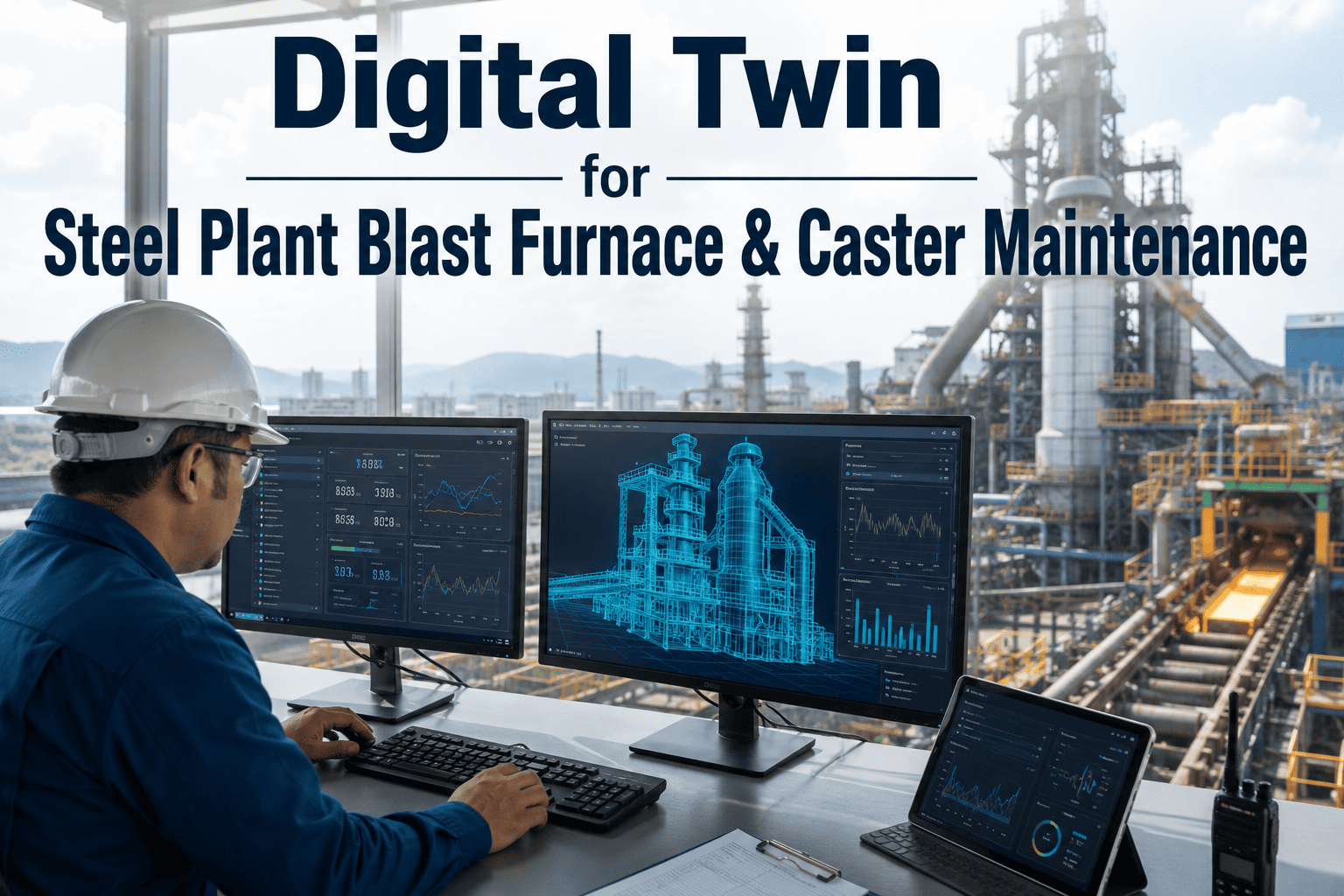
Blast furnace ironmaking accounts for approximately 70% of total energy consumption and emissions in steelmaking. Inside a blast furnace, temperatures exceed 2,000°C, thousands of chemical reactions occur simultaneously, and operators must balance ore quality, coke rate, air flow, and thermal profiles with almost no visibility into what's happening inside. Until now. Digital twin technology creates a real-time virtual replica of your blast furnace, turning this black box into a transparent, predictable, and optimizable process.
Purdue University's Integrated Virtual Blast Furnace (IVBF), funded by the U.S. Department of Energy, can mimic the physics, visualize the flow, and measure the temperature at any location inside the furnace. Tata Steel's digital twin pilot cut coke rate by 2.5%, saving ₹45 crore annually on a single furnace. ArcelorMittal achieved a 12% reduction in energy consumption across European facilities. Oxmaint's CMMS platform provides the maintenance backbone that keeps digital twin infrastructure running at peak performance. Schedule a demo.
The Blast Furnace Is No Longer a Black Box
Digital twin technology gives operators X-ray vision into the most complex process in steel manufacturing — real-time, physics-based, AI-optimized.
Tata Steel pilot
ArcelorMittal EU
Industry average
Steel digital projects
What Is a Blast Furnace Digital Twin?
A digital twin is not a dashboard or a monitoring screen. It is a physics-based, data-driven virtual replica that mirrors your blast furnace in real time. Every sensor reading, every burden charge, every thermal fluctuation is fed into a computational model that predicts what will happen next and recommends what to do about it. Here's how a blast furnace digital twin works, layer by layer:
Physical Layer: Sensors & Data Streams
FoundationThousands of sensors across the blast furnace — thermocouples, pressure transducers, gas analyzers, burden probes, tuyere cameras — stream real-time data. Tata Steel integrates 10,000+ data streams into a central system. This raw data is the heartbeat of the digital twin.
Computational Layer: Physics + AI Models
IntelligenceCFD (Computational Fluid Dynamics) models simulate gas flow, heat transfer, and chemical reactions inside the furnace. Machine learning models (XGBoost, neural networks) predict hot metal quality — silicon, manganese, titanium content — and identify optimal setpoints. The Purdue IVBF combines both into a unified platform.
Optimization Layer: Real-Time Recommendations
ActionThe optimizer balances competing objectives: maximize productivity while minimizing coke rate. It recommends setpoints for blast volume, oxygen enrichment, moisture, PCI rate, and burden composition for any given raw material quality. TCS's "metafur" system does this in real time across production shifts.
Visualization Layer: Operator Interface
Experience3D interactive visualizations let operators "see" inside the furnace: cohesive zone shape, raceway conditions, deadman state, temperature distribution. Operators can rotate, zoom, and query any point in the virtual furnace — capabilities impossible with physical observation.
Learning Layer: Self-Improving Models
EvolutionThe twin continuously compares predictions against actual outcomes, refining its models over time. As furnace conditions drift — lining wear, burden quality changes, seasonal variations — the digital twin adapts. This self-learning capability means accuracy improves with every operating hour.
What a Digital Twin Optimizes in Your Blast Furnace
Digital twins don't just monitor — they actively optimize the most critical KPIs in blast furnace operation. Each optimization directly impacts your bottom line:
Coke Rate
Every 1% reduction in coke rate saves millions annually. Digital twins optimize burden distribution, blast parameters, and PCI injection to minimize coke consumption while maintaining furnace stability and hot metal quality.
Productivity & Throughput
Optimize charging sequences, blast volume, and thermal profile to maximize tonnes per day. Predict and prevent slips, hangs, and chilled hearth conditions before they reduce output. 8% throughput increase reported by ArcelorMittal.
Uptime & Availability
Predict refractory wear, tuyere failures, cooling system issues, and stave damage 2-4 weeks before failure. Schedule repairs during planned shutdowns. Digital twins reduce maintenance costs by up to 30% and eliminate surprise shutdowns.
Hot Metal Quality
Predict silicon, manganese, titanium, sulfur content in hot metal before tapping. Adjust parameters proactively to hit target specifications. Consistent hot metal quality reduces downstream steelmaking costs and improves final product quality.
Carbon Emissions
Lower coke rate directly reduces CO₂ emissions. Digital twins enable hydrogen injection simulation and partial electrification testing virtually before physical implementation. McKinsey: 7% emissions reduction from optimization engine recommendations.
Workforce Training
New operators train on the virtual furnace without risking real production. Simulate upset conditions, emergency scenarios, and unusual burden compositions. 53% of steel companies use VR/digital tools for training — 20% faster onboarding.
Ready to See Inside Your Blast Furnace?
Oxmaint provides the maintenance infrastructure that keeps your digital twin sensors, networks, and compute systems running flawlessly. Predictive maintenance for the technology that predicts maintenance.
The CMMS Foundation: Why Digital Twins Need Oxmaint
A digital twin is only as good as its data. When sensors fail, networks go down, or compute infrastructure degrades, your twin goes blind. Oxmaint manages the physical infrastructure that powers digital twin systems:
Sensor & Instrument PM
Schedule calibration, replacement, and cleaning of thermocouples, pressure transducers, gas analyzers, burden probes, and tuyere cameras. Failed sensors mean blind spots in your twin.
Edge & Server Maintenance
Track edge computing devices, on-premise servers, and network switches. Monitor UPS battery health, cooling systems, and storage capacity. Digital twins demand 99.9% infrastructure uptime.
Performance Baseline Tracking
Log digital twin prediction accuracy over time. When model drift occurs, trigger recalibration workflows. Track KPIs: prediction accuracy, latency, data completeness rate, and uptime.
Spare Parts for Digital Infra
Maintain inventory of critical digital twin components: replacement sensors, network modules, edge devices, cabling. Set reorder points so replacements are always on hand.
Implementation Roadmap: From Black Box to Digital Twin
Deploying a blast furnace digital twin is a phased journey. Most steel plants achieve positive ROI within 12-18 months through efficiency gains and reduced downtime:
Assessment & Sensor Audit
Map existing sensor infrastructure. Identify gaps in temperature, pressure, gas composition, and burden monitoring coverage. Establish data architecture and connectivity plan. Oxmaint catalogs every instrument for PM scheduling.
Data Integration & Baseline Models
Install additional sensors where needed. Connect all data streams to central platform. Build baseline physics models and train initial ML models on 6-12 months of historical data. Validate prediction accuracy against actual hot metal quality.
Digital Twin Deployment
Launch real-time digital twin with operator dashboard. Begin advisory mode — twin recommends, operators decide. Monitor prediction accuracy and build operator trust. Run parallel with existing control systems.
Optimization & Closed-Loop Control
Transition from advisory to optimization mode. Twin actively recommends setpoint changes. Implement multi-objective optimizer for coke rate, productivity, and quality. Measure ROI against pre-deployment baselines.
Scale & Continuous Improvement
Extend twin to other blast furnaces and downstream processes (BOF, caster). Enable self-learning models that adapt to changing conditions. Integrate with enterprise CMMS (Oxmaint) for unified maintenance-operations intelligence.
Build the Digital Foundation First
Every digital twin depends on reliable sensors, networks, and infrastructure. Oxmaint ensures 100% uptime for the physical systems that power your virtual furnace. Start with the foundation.
Frequently Asked Questions
What is a blast furnace digital twin and how does it work?
A blast furnace digital twin is a real-time virtual replica that combines sensor data from the physical furnace with physics-based CFD models and AI/ML algorithms. It receives live data from thousands of sensors (thermocouples, pressure transducers, gas analyzers), processes it through computational models, and generates predictions and optimization recommendations. The TCS "metafur" system and Purdue's IVBF are leading implementations that predict hot metal quality, recommend optimal setpoints, and visualize internal furnace conditions in 3D.
What ROI do steel plants get from digital twin technology?
Steel plants typically achieve positive ROI within 12-18 months. Documented results include: Tata Steel cut coke rate by 2.5% (₹45 Cr/yr savings per furnace), ArcelorMittal achieved 12% energy reduction and 8% throughput increase, and industry averages show 30% less unplanned downtime and 20% first-year ROI on digital transformation projects. The global digital twin market is growing from $21B (2025) to $150B by 2030, reflecting proven returns.
How many sensors does a blast furnace digital twin require?
A comprehensive digital twin requires sensors for temperature (thermocouples throughout shaft, bosh, hearth, and staves), pressure (blast pressure, top gas pressure), gas composition (CO, CO₂, H₂ in top gas), burden distribution (radar probes, stockline monitors), and visual monitoring (tuyere cameras). Tata Steel integrates 10,000+ data streams. Oxmaint schedules calibration and replacement for every sensor to prevent data gaps.
Can digital twins help with blast furnace decarbonization?
Yes. Digital twins enable safe virtual testing of hydrogen injection, partial electrification, and alternative reductants before physical implementation. Purdue's IVBF specifically studies lower-emission operating conditions. McKinsey documented 7% CO₂ reduction from digital twin optimization alone. With 75% of steel players targeting digital transformation for sustainability, digital twins are essential for decarbonization roadmaps.
Why does a digital twin need CMMS software like Oxmaint?
A digital twin is only as reliable as its sensor network and compute infrastructure. Failed sensors create blind spots that degrade prediction accuracy. Oxmaint automates preventive maintenance for every thermocouple, pressure transducer, gas analyzer, edge computing device, and network switch. It also tracks model performance baselines, triggering recalibration when prediction drift is detected. Without disciplined infrastructure maintenance, digital twin ROI degrades rapidly.