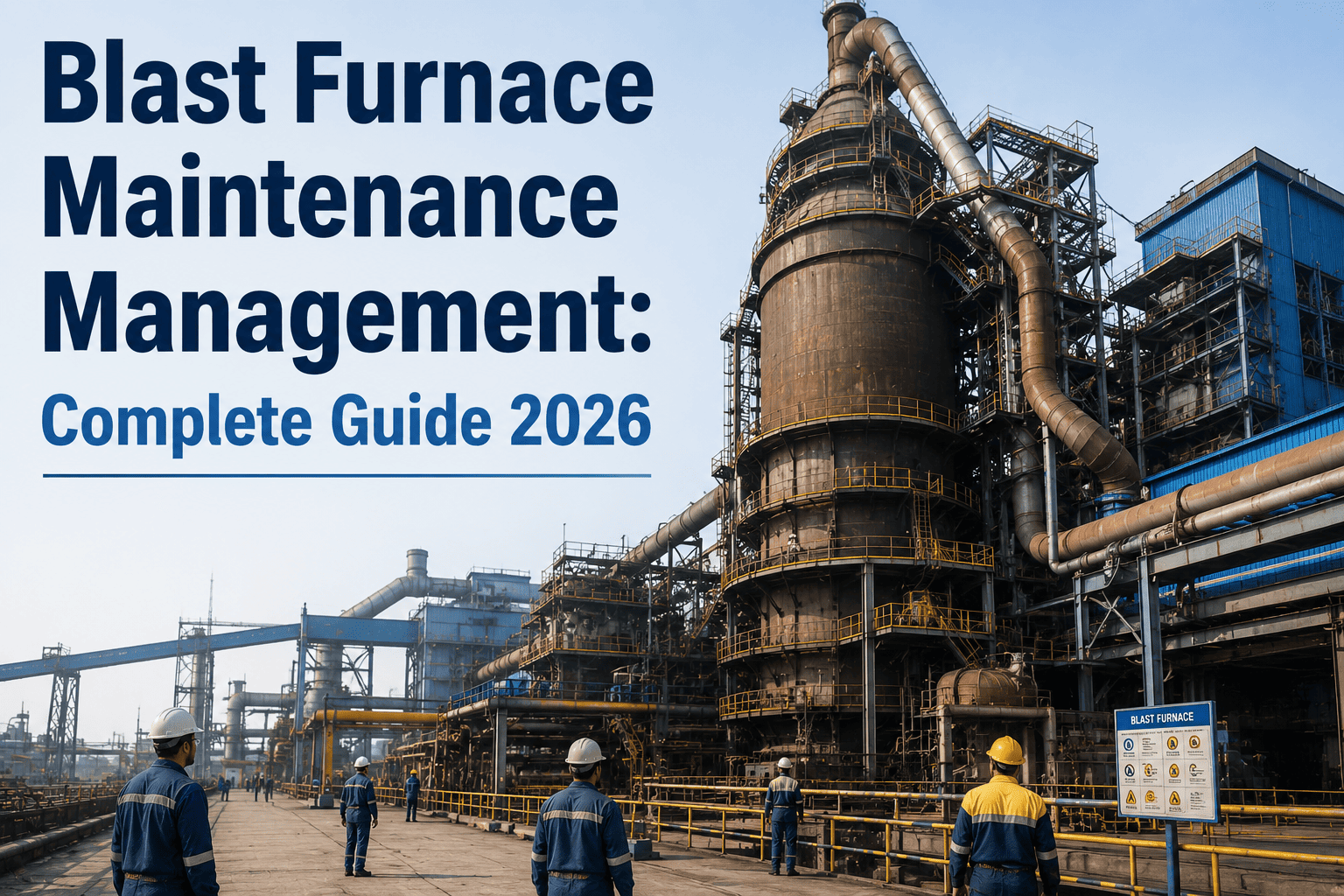
Blast furnace maintenance is the highest-stakes reliability discipline in steel — a single unplanned blowdown can idle a 10,000-ton-per-day unit and vaporize seven-figure margins in hours. This guide distills the 2026 playbook for campaign life extension, tuyere PM, stave cooler inspection, hot blast stove care and casthouse equipment uptime into practical steps your reliability team can act on this quarter. We cover the failure modes that drive 70% of unplanned downtime, the inspection cadences that catch them early, and how a purpose-built blast furnace CMMS turns fragmented spreadsheets into a single auditable maintenance record. Ready to operationalize it? Start Free Trial and configure your furnace hierarchy in under an hour.
COMPLETE MAINTENANCE GUIDE — 2026 EDITION
Is your blast furnace one missed inspection away from a 14-day unplanned blowdown?
The average integrated mill loses $1.2M per day of BF unplanned downtime — yet 70% of catastrophic failures trace back to preventable causes: tuyere burn-through, stave cooler leak progression, and stove dome cracking. This guide shows reliability engineers exactly where to look, how often, and what to do when the data signals trouble.
WHY IT MATTERS
The economics of blast furnace reliability
A modern blast furnace operates 24/7 for 15–20 years between relines, transforming iron ore, coke and flux into 8,000–12,000 tons of hot metal per day. Every minute of unplanned downtime costs $850–$1,400 in lost production margin — and that is before downstream BOF, caster and rolling losses cascade through the mill.
WORKED EXAMPLE
A 4,800-ton-per-day BF in the Midwest US ran a 16-year campaign on a paper-based PM system. A single undetected stave cooler leak progressed to shell overheating, forcing a 9-day emergency blowdown that cost $10.8M in lost hot metal plus $1.6M in emergency refractory repair. Post-incident analysis showed the leak was detectable 11 days earlier via routine flow-rate trending — a $0 fix that became a $12.4M loss.
CAMPAIGN LIFE MANAGEMENT
The 4 critical failure zones — and what to inspect
Campaign life is not a single number; it is the sum of four subsystems degrading in parallel. Managing each on its own curve — not waiting for the furnace to tell you something is wrong — is the difference between a planned 18-year campaign and a panicked 12-year shutdown.
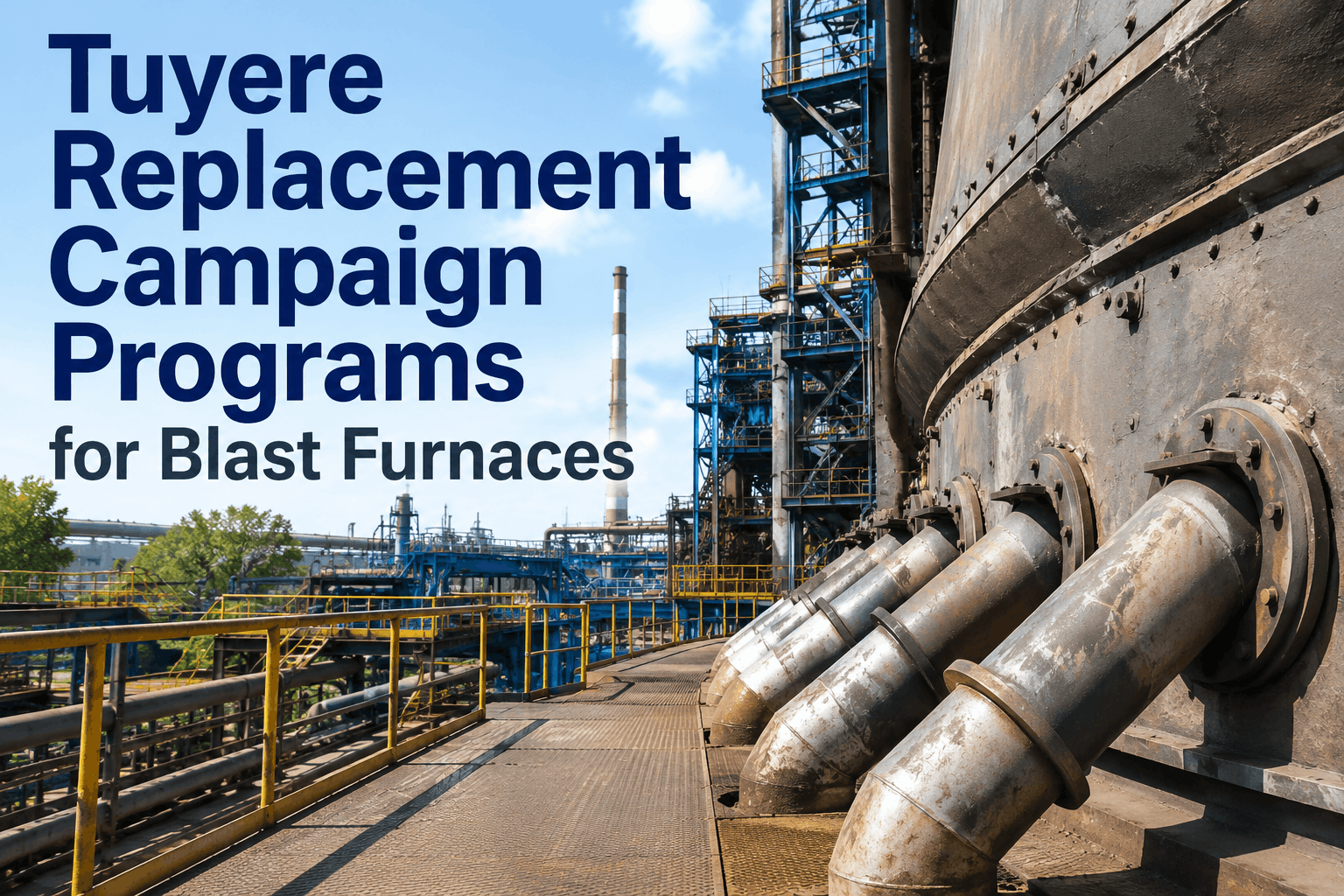
Tuyere & Blowpipe Assembly
32–42 tuyeres per furnace, each cooled by 6–10 m³/h of water at 6 bar. Burn-through destroys the breast wall in under 4 hours.
- Cooling water delta-T logged hourly (target: <8°C rise)
- Nose temperature infrared scan every shift
- Blowpipe alignment check during every cast
- Stockline temperature differential across all tuyeres
Stave & Plate Coolers
300–600 copper/iron staves form the thermal shield. A single leaking stave drops local cooling by 35% and accelerates refractory erosion 6×.
- Individual stave flow & return temperature daily
- Gas detection at cooler outlets (CO = crack indicator)
- Thermocouple mapping vs. baseline trend weekly
- Differential pressure log across cooling circuits
Hot Blast Stoves
3–4 stoves cycle 1200–1350°C blast, dome temps approaching 1500°C. Dome and burner cracking is the #1 stove failure mode.
- Dome thermocouple integrity check monthly
- Cold-blast valve seat tightness every 90 days
- Combustion chamber pressure deviation trending
- Checker brick fouling via draft loss measurement
Casthouse & Trough System
Main trough, iron runners and tilting runner handle 3,000–5,000°C metal contact. Refractory wear governs cast frequency and safety.
- Trough refractory thickness ultrasonic check per cast
- Taphole clay pressure & volume record per drill cycle
- Mudgun and drill guide alignment weekly
- Runner cover cooling water flow verification
12-MONTH PM CALENDAR
Your blast furnace maintenance schedule at a glance
A defensible PM calendar is not a wall poster — it is a live, asset-linked schedule that triggers work orders automatically. Below is the cadence used by top-decile integrated mills, mapped to ISO 55000 asset management principles and TPM autonomous-maintenance tiers.
Winter load baseline & stove efficiency audit
Cold-weather blast demand peaks — complete stove dome thermography, checker brick draft-loss measurement, and recalibrate cold-blast control valves. Verify bustle pipe expansion joints for thermal stress cracking. Target stove efficiency ≥82%.
Stave cooler integrity campaign
Full stave-by-stave flow and temperature audit. Inject trace gas at suspect circuits to pinpoint micro-leaks before they progress. Replace any stave with >15% flow deviation. Log every reading to the CMMS for trend baselines.
Tuyere changeout window & breast inspection
Schedule planned tuyere swaps based on nose-temp trending data — not calendar age. Inspect blowpipe seat wear, tuyere stock alignment, and peep-sight integrity. Average 4–6 tuyere changes per window at 2.5 hours each.
Casthouse refractory rebuild & year-end reliability review
Main trough and runner rebuild during planned short outage. Drill and mudgun hydraulic overhaul. Compile 12-month trend data, update FMEA, and re-baseline campaign-life projections for the following year's budget cycle.
THE COST OF REACTIVE VS. PLANNED MAINTENANCE
What your PM strategy actually costs — and saves
The gap between reactive and planned maintenance on a blast furnace is not 10 or 20 percent — it is often 5× to 8× on a unit-cost basis, because emergency labor, expedited refractory, and lost production compound. The table below models a mid-size integrated plant operating one 4,800-tpd furnace.
| Maintenance Approach | Annual PM Cost | Unplanned Downtime/yr | Lost Production Value | Total Cost of Care |
|---|---|---|---|---|
| Reactive (run-to-failure) | $420K | 9.2 days | $11.0M | $11.4M |
| Calendar-based PM | $680K | 4.1 days | $4.9M | $5.6M |
| Condition-based + CMMS | $540K | 1.3 days | $1.6M | $2.1M |
| Predictive + CMMS (target) | $610K | 0.4 days | $0.5M | $1.1M |
SAVINGS FORMULA
Annual Savings = (Current Unplanned Days − Target Unplanned Days) × Daily Production Value − (New PM Cost − Current PM Cost)
Worked example: moving from calendar-PM (4.1 days) to condition-based (1.3 days) on a $1.2M/day furnace = (4.1 − 1.3) × $1.2M − ($540K − $680K) = $3.36M + $140K = $3.5M annual net savings.
CMMS IMPLEMENTATION
From spreadsheet chaos to a single source of truth
Most BF maintenance teams still run on a patchwork of Excel logs, paper round sheets and tribal knowledge. A purpose-built CMMS replaces that with asset-linked work orders, automatic PM triggers, and trend data that survives personnel turnover — typically paying for itself in under 4 months.
Furnace hierarchy modeling
Map every tuyere, stave, stove valve and casthouse component to a parent asset. Drill from furnace level to individual stave #347 in two clicks — with full work-order history attached.
Condition-triggered PM
Link thermocouple, flow-meter and infrared-scan data to automatic work-order generation. A stave delta-T exceeding 8°C spawns a inspection order before the next shift handover — no human recall required.
Campaign-life projection
Aggregate refractory wear, stave leak history and stove efficiency trends into a live campaign-end estimate. Finance gets a defensible reline date 3 years out — not a guess at budget time.
Audit-ready compliance log
Every inspection, reading, parts swap and sign-off is time-stamped and attributable. ISO 55000, OSHA PSM and internal reliability audits pull in minutes — not weeks of reconstruction.
"We cut unplanned BF downtime from 6.8 days to 1.1 days in the first 14 months on the platform. The stave-leak alert alone paid for three years of subscription in a single avoided blowdown."
— Reliability Manager, 3.2M tpy integrated steel plant, India
READY TO BUILD YOUR BF PM SYSTEM?
Stop managing furnace reliability on spreadsheets.
Configure your blast furnace asset hierarchy, import PM templates, and trigger your first condition-based work order in a single afternoon.
FREQUENTLY ASKED
Blast furnace maintenance — the questions reliability teams ask most
What is the ideal PM inspection frequency for blast furnace tuyeres?
Nose-temperature infrared scans should run every shift (8 hours), cooling-water delta-T logged hourly, and a full tuyere assembly inspection completed every 30 days. Planned tuyere changeouts are driven by trending data — typically every 90–180 days depending on coke quality and blast temperature — not by a fixed calendar. Linking these readings to a CMMS ensures the trend triggers the work order automatically.
How do I detect a leaking stave cooler before it becomes an emergency?
Three early indicators: a gradual flow-rate drop at the individual stave (even 5–8% deviation matters), a rising return-temperature trend, and trace CO gas at the cooler outlet indicating combustion gas is entering the cooling circuit. A condition-based CMMS flags any of these the moment they cross threshold, letting you inject sealant or plan a controlled stave isolation before shell overheating occurs.
Can a CMMS really extend blast furnace campaign life?
Yes — mills using condition-based maintenance on a structured CMMS platform report 12–18% longer campaigns, because wear is detected and mitigated earlier, and PM compliance stays above 92% instead of drifting to 60–70% on paper systems. The platform also preserves institutional knowledge across staff changes. You can Book a Demo to see a furnace-hierarchy walkthrough.
What does a blast furnace maintenance management system cost?
For a single-furnace integrated plant, a CMMS configured with BF-specific PM templates, asset hierarchy and condition triggers typically runs $18K–$45K per year — less than 4% of the cost of a single unplanned downtime day. Most plants achieve full payback within 3–5 months through avoided emergency repairs and reduced unplanned blowdowns.
How long does it take to implement a blast furnace CMMS?
A focused implementation — furnace asset hierarchy, PM template import, work-order workflow configuration, and team training — takes 4 to 8 weeks for a single BF site. You can begin with a free trial at https://app.oxmaint.ai and have your first PM work orders live within 48 hours, then expand to full condition-based triggers as your sensor data is integrated.
START YOUR 2026 BF RELIABILITY PROGRAM TODAY
Every day without a CMMS is a day of preventable risk.
Join the integrated mills that have cut unplanned BF downtime by 70%+ with structured, condition-driven maintenance management.
Free 14-day trial · No credit card