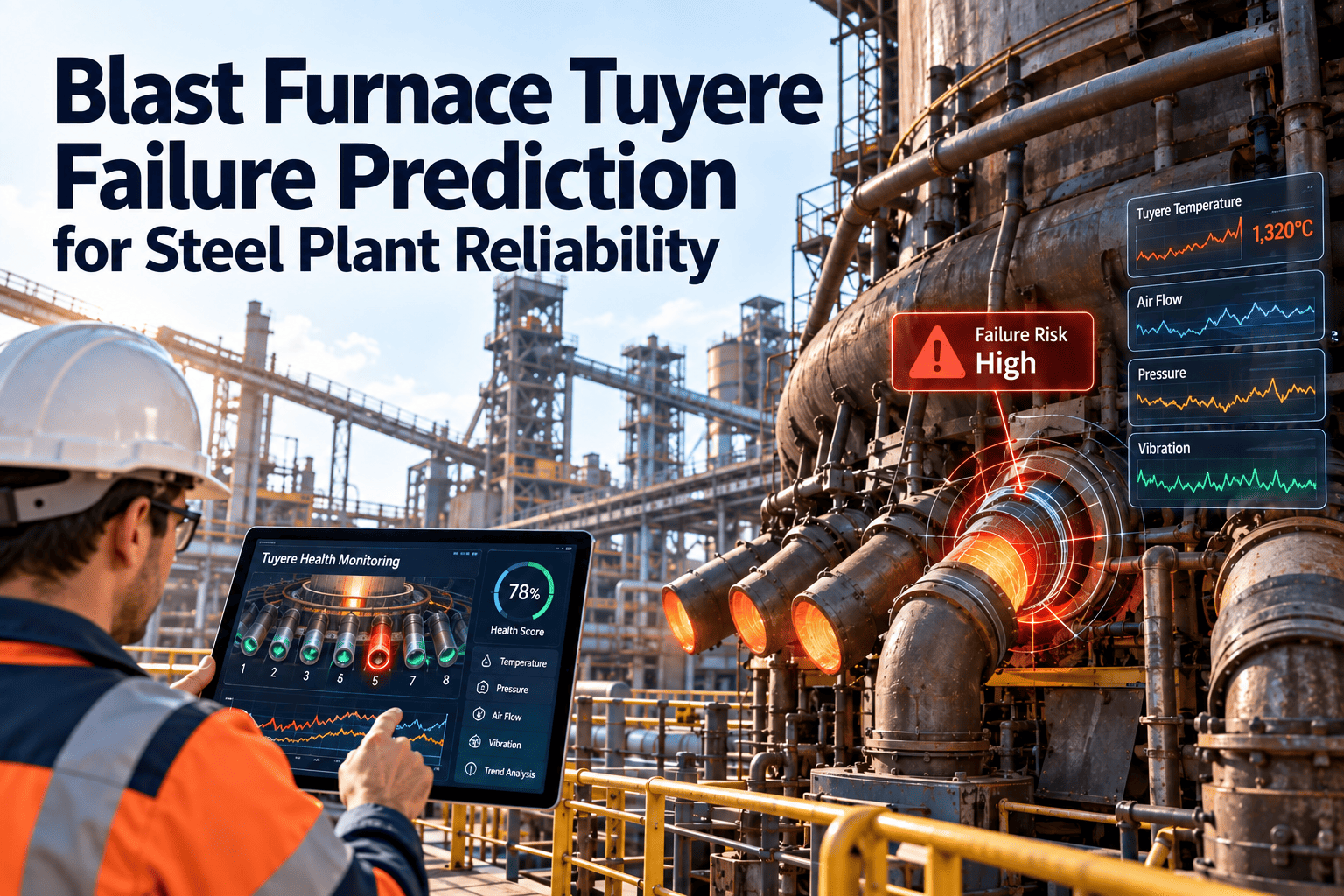
A tuyere is a water-cooled copper nozzle that delivers hot blast into the blast furnace, and a single failed unit can force a blow-down or an unplanned stop. Most failures announce themselves in cooling data well before water reaches the raceway, but only if someone is watching the right trends. Temperature, flow, pressure and repair history each tell part of the story. This article explains how steel teams can turn those signals into early warnings, and how a steel mill CMMS connects each warning to inspection, repair and replacement records.
Blast Furnace Tuyere Failure Prediction for Steel Plant Reliability
Detect cooling anomalies and developing tuyere failures from temperature, flow, pressure and maintenance history, then act before water enters the furnace.
What Makes Tuyere Failure So Costly
Tuyeres sit at the point where blast, coal injection and molten material meet. They are small components with large consequences.
The cost of one failure is rarely the part itself. It is the disruption to furnace stability that follows.
Why Tuyeres Fail: Common Root Causes
| Failure mode | Typical contributing factors | Early indicator |
|---|---|---|
| Burn-through at the nose | Contact with molten iron or slag, poor raceway conditions, inadequate cooling | Rising return water temperature, falling flow |
| Thermal fatigue cracking | Repeated heating and cooling cycles, long service life | Small water make-up loss, minor flow drift |
| Scale and deposit buildup | Water quality, treatment gaps, low velocity in channels | Higher differential temperature at stable flow |
| Erosion and wear | Abrasive material, flow turbulence, coal injection effects | Gradual change in pressure drop |
| Installation or sealing issues | Misfit, damaged seals, uneven clamping | Early-life anomalies after replacement |
Root causes vary by furnace design and operating practice. Use your own failure history to rank them.
The Data Behind Tuyere Failure Prediction
Prediction does not require exotic technology. It begins with the measurements most blast furnaces already collect, organized per tuyere.
Temperature
Inlet and outlet water temperature, and the differential across each tuyere, show how much heat the unit is absorbing.Flow
Individual flow readings reveal blockage, leakage or loss of cooling that furnace-wide averages hide.Pressure
Supply and return pressure changes can indicate fouling, restriction or a developing leak.Water make-up
Unexplained loss in a cooling circuit is one of the clearest early leak indicators.Maintenance history
Age, repair count, supplier, position and past anomalies give context to current readings.Operating context
Blast volume, coal injection rate and recent furnace events explain many apparent deviations.From Raw Signal to Early Warning
The aim is not to replace operator judgment. It is to give the furnace team a documented, earlier prompt to look closer.
Give Tuyere Alerts a Clear Next Step
See how a cooling anomaly can become an inspection task with history, parts and ownership attached.
Reading the Signs: Pattern Guide
| Pattern observed | Possible meaning | Suggested response |
|---|---|---|
| Differential temperature rising, flow steady | Higher heat load or deposit buildup | Inspect, review water quality |
| Flow falling, temperature rising | Partial blockage or restriction | Check lines and strainers promptly |
| Flow and pressure dropping together | Possible leak | Escalate to furnace team immediately |
| Make-up water increasing in one circuit | Leak in one or more units | Isolate by zone and check each unit |
| Anomaly in a recently replaced unit | Fit, seal or supplier issue | Review installation record and batch |
Treat this guide as a starting point. Your furnace designers and operators define the true limits and responses.
Why a CMMS Matters for Tuyere Reliability
Sensors detect. A maintenance system decides what happens next, and keeps the evidence.
Without a connected system
- Alarms live in the control system only
- Replacement history sits in notebooks
- Repeat failures by position go unnoticed
- Spares planning reacts to failures
With Oxmaint
- Each tuyere is an asset with full history
- Findings become corrective work orders
- Failures trend by position, age and supplier
- Inventory and shutdown planning stay aligned
Oxmaint Capabilities for Blast Furnace Maintenance
Asset management
Register every tuyere, cooler and blowpipe with install date, supplier and replacement history.Inspection checklists
Standardize visual checks on cooling lines, connections, leaks and tuyere condition.Work orders
Assign inspection, repair and replacement with priority, permits and crew details.Condition-based triggers
Use readings you capture to prompt inspections when values drift beyond set limits.Inventory
Keep spare tuyeres and seals available in the quantities your failure history supports.Reporting
Review service life, failure frequency and response time to guide purchasing and practice.Live process data from your historian or sensors can be reviewed alongside maintenance records so the decision has full context.
Measuring Prediction Performance
Unplanned changes
Tuyere replacements forced by failure versus planned.Warning lead time
Time between first alert and confirmed fault.False alerts
Alerts with no fault found, used to tune limits.Service life
Average life by position, supplier and design.Begin with your own history. A few months of clean data allow sensible limits to emerge.
Practical Checklist Before You Start
- Confirm individual flow and temperature data exists per tuyere
- Collect past failure and replacement records by position
- Agree alert thresholds with furnace operations
- Define who inspects, who approves and who replaces
- Match spare stock to realistic failure frequency
- Review cooling water quality and treatment regularly
Frequently Asked Questions
What data is needed to predict tuyere failure?
Per-tuyere water temperature, flow and pressure, plus make-up loss and maintenance history, give the strongest basis.Can prediction eliminate unplanned tuyere changes?
No, but earlier warnings let teams plan more replacements instead of reacting to failures.How does a CMMS help with tuyere monitoring?
It links each alert to inspection, parts and repair history. You can get started by registering your tuyere assets.Why compare tuyeres against neighbors?
Furnace-wide changes move all units together. A single outlier points to a local problem.Can the workflow be adapted to our furnace?
Yes. Book a demo to map your layout and inspection routine.Catch Tuyere Problems Before They Reach the Furnace
Bring cooling trends, inspections and replacement history into one maintenance workflow built for steel plants.