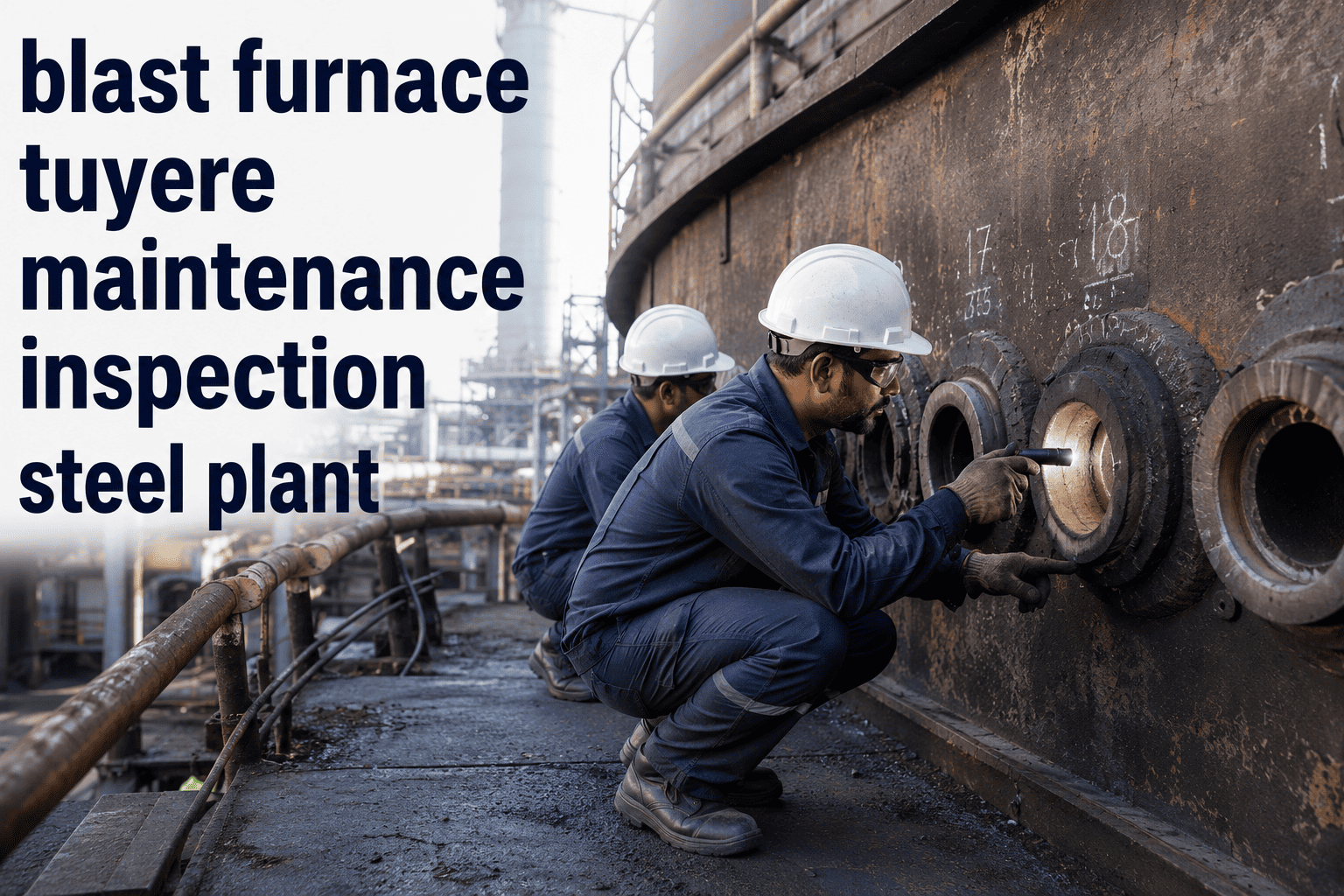
A single blast furnace tuyere failure can shut down a 10,000-ton-per-day iron campaign, melt a copper cooler in under 90 seconds, and trigger a blowpipe eruption that endangers every operator on the cast house floor. Tuyere assemblies sit at the harshest intersection of the furnace — 2,100°C hot-blast air on one side, 1,500°C molten iron and slag on the other — which is why burn-throughs, stock-assembly leaks, and cooler blockages account for a disproportionate share of unplanned blast-furnace downtime across the global steel industry. This guide breaks down the inspection cadences, predictive detection methods, and preventive-maintenance workflows that keep tuyeres running reliably between relines, with a CMMS-driven framework you can deploy in weeks, not months. If you want to operationalize it immediately, you can Start Free Trial and configure the tuyere PM templates described below today.
Is one tuyere burn-through about to erase your quarterly production target?
Every unplanned tuyere change on a large blast furnace costs 4–8 hours of lost production — upwards of 3,000 tons of hot metal. With 20–40 tuyeres in service and a typical campaign lasting 15–20 years, a disciplined inspection and PM program is the single highest-leverage reliability investment you can make on the cast house floor.
Daily inspection checklist for tuyeres and stock assemblies
Operators walk the tuyere platform every shift to catch the early thermal, hydraulic, and gas-leak signatures that precede 80% of burn-throughs. These eight checkpoints form the first line of defense.
Tuyere nose temperature scan
Infrared-gun each tuyere nose. Baseline is 40–60°C; any reading above 90°C or a sudden 15°C delta versus sister tuyeres flags restricted internal water flow and imminent burn-through risk.
Cooling-water delta-T and flow
Verify flow rate per tuyere (typically 8–14 m³/h) and outlet temperature rise. Delta-T exceeding 8°C above baseline indicates scale buildup, gas intrusion, or partial blockage inside the copper cooler.
Blowpipe and bellows alignment
Inspect the tuyere-stock-to-blowpipe seal for gas escape, oxidation streaks, or incandescent glow. Misalignment greater than 3 mm accelerates bellows fatigue and induces gas leaks within weeks.
Stock-assembly water leak check
Inspect the tuyere stock, packing gland, and swivel joint for weep marks. Even a 0.5 L/min seep erodes packing material and can escalate to a high-pressure water leak onto molten iron.
CO detection around tuyere platform
Confirm fixed CO monitors read below 25 ppm at the tuyere platform. Rising background CO signals gas leakage past the tuyere nose or blowpipe joint — a leading indicator of seal deterioration.
Listening for whistles and rumble
A trained operator can detect a partially blocked tuyere by the change in blast whistle pitch. Document any acoustic deviation alongside the thermal reading for the reliability engineer's review.
Peepsight internal condition check
Open the peepsight to verify blast pattern, coke bed motion, and flame color. A dark or sluggish tuyere indicates a salamander intrusion, scaffold formation, or chilled hearth condition.
Tuyere-stock lubrication point
Grease the swing-bolt and swivel-joint pins per the OEM schedule. Missed lubrication cycles account for roughly 30% of premature stock-assembly failures observed in post-campaign teardowns.
Tuyere PM schedule: from shift walks to shutdown overhauls
A tiered preventive-maintenance structure ensures the right depth of inspection happens at the right interval. Below is the cadence deployed by high-availability integrated mills — every task templated inside the CMMS, every reading trended.
| Interval | Scope | Key Tasks | Crew | Typical Duration |
|---|---|---|---|---|
| Shift (8 hr) | Walk-around inspection | Nose temp, water flow, CO check, visual seal inspection, peepsight | 1 operator | 20–30 min |
| Daily | Trend review | Log all readings into CMMS, flag deltas, verify yesterday's corrective actions | Reliability tech | 45 min |
| Weekly | Deep visual & acoustic | Full acoustic survey, blowpipe alignment sweep, packing-gland torque check | 2 techs | 2–3 hr |
| Monthly | Instrumented inspection | IR thermography of all tuyeres, ultrasonic wall-thickness on exposed noses, cooler flow-balancing | Reliability + NDT | 6–8 hr |
| Quarterly | Stock assembly PM | Blowpipe internal borescope, bellows flexibility test, swivel-joint repack, lance injector check | 3 techs + crane | 1 shift |
| Shutdown (planned) | Full tuyere change-out | Remove suspect tuyeres, install refurbished copper coolers, re-align stock, hydro-test cooling circuit | Full crew | 4–6 hr per tuyere |
How to catch a tuyere burn-through before it happens
Burn-throughs rarely occur without warning. In reviewed incident data, 88% of catastrophic tuyere failures were preceded by a measurable thermal or hydraulic anomaly in the preceding 2–72 hours. The table below maps each failure mode to its leading indicator and the corrective window.
| Failure Mode | Leading Indicator | Detection Method | Corrective Window | Action |
|---|---|---|---|---|
| Tuyere nose burn-through | Nose temp spike above 90°C; delta-T rise in cooling water | IR scan + flow meter trending in CMMS | 2–6 hours | Reduce blast, isolate, planned change-out |
| Copper cooler erosion | Progressive wall-thickness loss below 4 mm at nose crown | Monthly ultrasonic thickness survey | 1–4 weeks | Schedule shutdown replacement |
| Stock-assembly gas leak | CO creep at platform; oxidation streaks on bellows | Fixed CO monitor + visual inspection | 4–24 hours | Repack gland, re-align blowpipe |
| Cooling-water blockage | Flow drop greater than 15%; outlet temp rise above 55°C | Flow meter + RTD alarms | 1–3 hours | Reverse-flush circuit, descale, inspect |
| Packing-gland failure | Visible water weep; rust streaks on stock body | Shift visual + ultrasonic leak detection | 8–48 hours | Repack during next brief slowdown |
| Bellows rupture | Audible gas hiss; sudden blowpipe vibration | Acoustic monitoring + accelerometer | Immediate | Emergency blast reduction, change-out |
What a tuyere failure actually costs a steel plant
Reliability investments live or die on the cost-avoidance math. Use this formula to size the stake for your own furnace, then benchmark it against the preventive program cost.
A 3.2 MTPA integrated mill with 28 tuyeres
This plant historically experienced 6 unplanned tuyere change-outs per year, each costing an average of 6.5 hours of downtime at 380 tons/hour of hot metal valued at $320/ton. Add $14,000 in copper-tuyere parts and $3,500 in emergency labor per event, and the annual failure cost runs to approximately $4.87 million. A structured PM and CMMS-driven inspection program that prevents even half of those events returns roughly $2.4 million in avoided cost — against a program investment of about $85,000 per year in labor, instrumentation, and software. Payback: under five weeks.
Deploying tuyere PM workflows in a modern CMMS
The difference between a checklist on a clipboard and a reliability program that prevents burn-throughs is whether the data flows back into action. Here is the four-step implementation path plants follow inside the Oxmaint CMMS.
Build the tuyere asset registry
Register every tuyere position (1 through 28+) as a unique asset with parent-child links to its copper cooler, stock assembly, blowpipe, and cooling-water circuit. Attach OEM drawings, design flow rates, and material specs so every work order carries full context.
Template the tiered PM schedules
Create reusable PM templates for shift, weekly, monthly, quarterly, and shutdown intervals — each with digital checklists, mandatory numeric readings (temp, flow, delta-T), and photo capture. Trigger auto-generation so no inspection is ever skipped.
Wire detection thresholds to work orders
Configure alarm rules: if a tuyere nose temperature exceeds 90°C or cooling-water delta-T breaches the baseline by more than 8°C, the CMMS auto-generates a corrective work order assigned to the reliability team — no manual escalation required.
Trend, review, and continuously refine
Monthly reliability reviews use the CMMS dashboard to compare tuyere performance across positions, identify repeat offenders, and refine inspection intervals. Plants that close this loop typically cut unplanned tuyere events by 40–60% within the first 12 months.
Ready to stop the next burn-through before it starts?
Deploy pre-built tuyere PM templates, automated alarm-to-work-order triggers, and full asset history in the Oxmaint CMMS — live for your crew in under two weeks.
Tuyere maintenance, answered
How often should blast furnace tuyeres be inspected?
Shift-level walk-around inspections should occur every 8 hours, focusing on nose temperature, cooling-water flow, and visual seal integrity. A deeper instrumented inspection — infrared thermography, ultrasonic wall-thickness, and flow-balancing — is recommended monthly. Quarterly, the stock assembly should receive a borescope and repack. Full tuyere change-outs are typically planned during scheduled slowdowns or shutdowns, not reactively.
What temperature indicates a tuyere is about to burn through?
A tuyere nose surface temperature above 90°C — measured by infrared gun — is the critical threshold, especially when accompanied by a rapid 15°C rise over sister tuyeres. At that point the internal copper wall is likely thinning and water-cooling capacity is compromised. Immediate action is to reduce blast pressure and plan a change-out within the next 2–6 hours.
Can a CMMS really prevent tuyere failures?
Yes — when configured with numeric reading thresholds and automatic work-order generation, a CMMS closes the gap between detection and action. Rather than relying on an operator to remember to escalate a high reading, the system auto-triggers a corrective work order the moment a threshold is breached. You can Book a Demo to see the tuyere alarm-to-work-order workflow configured live for your furnace.
What is the typical lifespan of a blast furnace tuyere?
A well-maintained copper tuyere in a stable furnace campaign typically lasts 12–24 months in service. Premature failures usually trace back to cooling-water quality issues (scale, sediment), blast imbalance, or undetected stock-assembly misalignment. Mills with disciplined PM programs routinely extend tuyere life beyond 18 months and reduce annual change-outs by 40–60%.
How much does a tuyere failure cost an integrated steel plant?
For a mid-size integrated mill producing 380 tons/hour of hot metal, a single unplanned tuyere change-out costing 6.5 hours of downtime translates to roughly $790,000 in lost production alone, plus $14,000 in copper parts and $3,500 in emergency labor. At 6 events per year, the total avoided-cost value of a preventive program easily exceeds $4.8 million annually.
Build a burn-through prevention program your crew will actually use
Pre-built tuyere PM templates, automated alarm triggers, full asset history, and mobile inspection capture — configured for your blast furnace in days, not months.
Free 14-day trial · No credit card