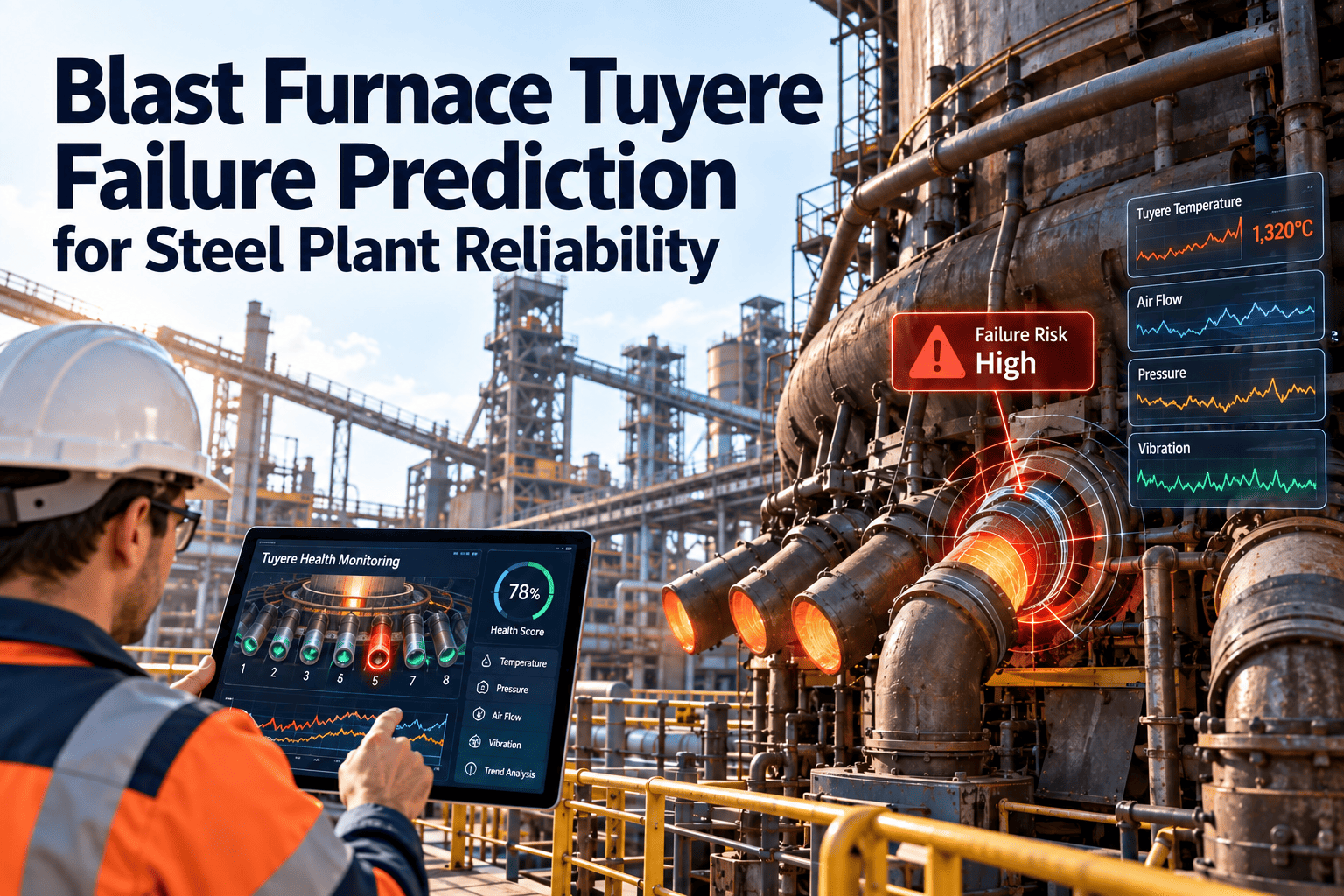
Most blast furnace teams replace tuyeres reactively — after a burnout forces an emergency shutdown costing $800K to $1.2M in lost production. A structured tuyere lifecycle management program using digital CMMS software cuts unplanned replacements by over 60% and extends average tuyere life by 3–4 months per unit.
Blast Furnace Tuyere Maintenance: Inspection, Replacement & Failure Prevention
A complete guide to tuyere inspection intervals, failure mode detection, replacement procedures, and how CMMS software manages tuyere lifecycle across 20–40 units in active furnace campaigns.
Why Tuyere Maintenance Fails in Most Steel Plants
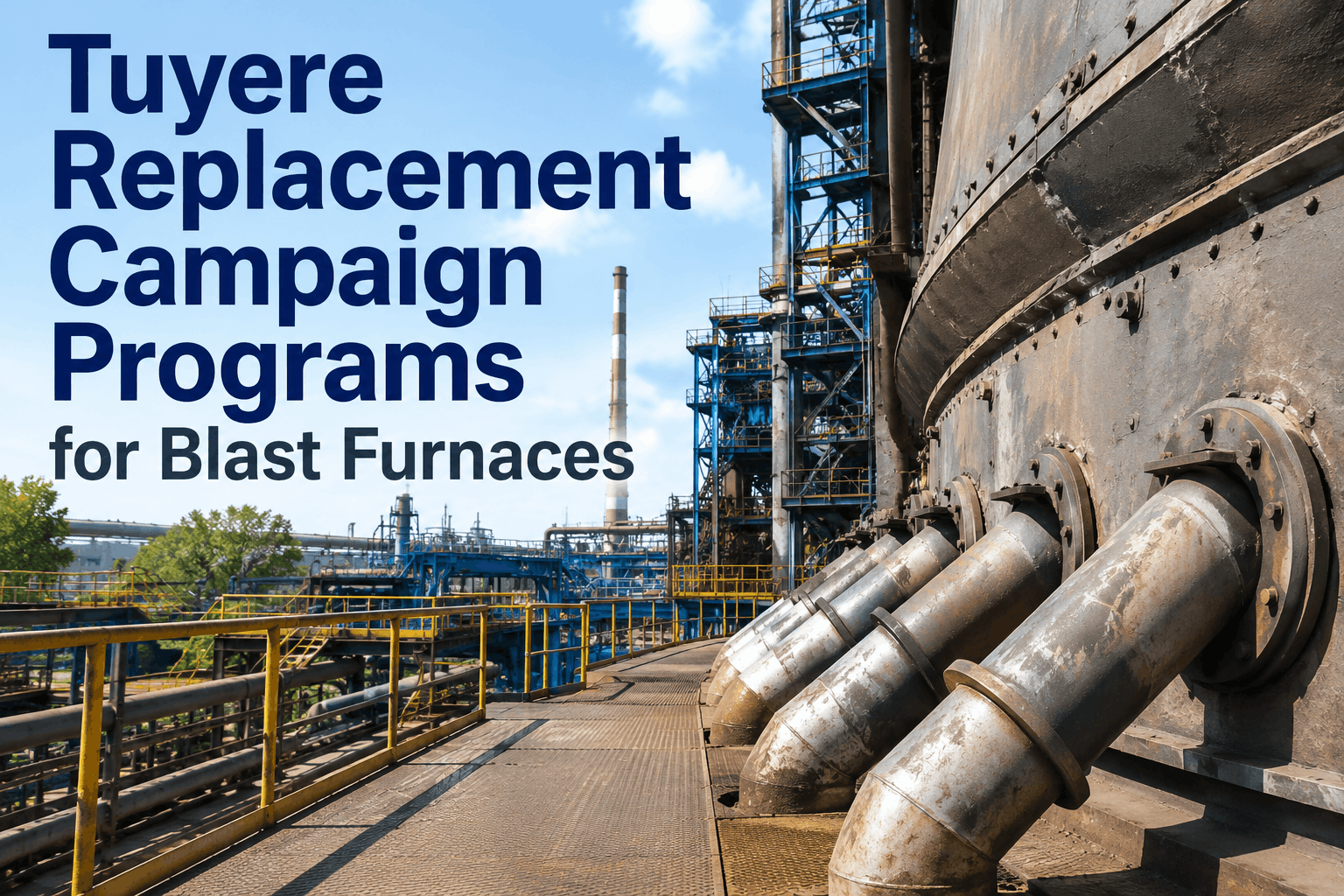
A modern blast furnace operates with 20 to 40 tuyeres simultaneously — each one a water-cooled copper nozzle injecting 1,100°C hot blast into the raceway. When one burns out, the furnace loses blast distribution balance. When two or more fail within a cast, the operation must shut down for emergency replacement. In a 5,000-tonne-per-day furnace, a 6-hour shutdown from a tuyere emergency costs between $800,000 and $1.2M in lost production value.
The fundamental problem is not that tuyeres wear out — that is expected. The problem is that most plants cannot predict which tuyere will fail next, or when. Without per-unit condition data, maintenance becomes reactive. Without a CMMS tracking tuyere installation dates, cooling water performance, and inspection history, the only signal is failure itself.
We were replacing tuyeres based on who reported the loudest problem, not based on actual condition data. Once we tracked per-unit cooling performance in Oxmaint, our emergency replacement rate dropped from 14 per campaign to 3.
— Maintenance Head, Integrated Steel Plant, GermanyTuyere Inspection Intervals and What to Measure
Tuyere inspection is not a single task — it is a layered monitoring program operating at shift, daily, weekly, and campaign levels. Each layer detects different failure precursors. Collapsing all of this into a single monthly walkdown is why plants miss early warning signals.
Thermal & Flow Check
- Record outlet water temperature per tuyere circuit
- Verify flow rate at each cooler header
- Check for steam at outlet connections
- Note any irregular flame pattern at tuyere peephole
Pressure & Balance Audit
- Measure supply/return pressure balance across tuyere cooling manifold
- Log makeup water consumption rate
- Compare delta-T against previous 7-day baseline
- Review DCS alarm log for suppressed cooling alerts
Thermal Imaging Survey
- Scan all tuyere noses using infrared camera during blast-on operation
- Inspect blowpipe and tuyere shell connections for surface hotspots
- Record maximum shell temperature per tuyere position
- Document and rank any position above 80°C shell temperature
Physical & Dimensional Inspection
- Measure tuyere nose bore erosion using go/no-go gauge
- Inspect internal water passage for scale using borescope
- Check tuyere seat and blowpipe seal face for wear
- Weigh removed tuyeres — copper mass loss indicates erosion rate
Managing inspection data from 20–40 tuyere positions across multiple shifts on paper creates critical information gaps. Oxmaint mobile inspection forms allow operators to log readings per tuyere position with automatic threshold flagging — so nothing gets missed and nothing gets lost between shift handovers.
Tuyere Failure Modes: Causes, Signals & Consequences
Each failure mode has a distinct signature in the inspection data. Understanding the detection window — the time between first detectable signal and failure — determines whether a replacement can be planned or must be emergency-executed.
| Failure Mode | Primary Cause | Early Signal | Detection Window | Consequence if Missed |
|---|---|---|---|---|
| Burnout / Perforation | Scale blockage reducing internal flow; refractory loss exposing copper nose | Rising outlet temperature trend over 3–5 days | 7–14 days | Water release into raceway — potential steam explosion |
| Nose Erosion | Coke and ore abrasion; high-velocity hot blast; skulling cycles | Bore diameter increase on weekly gauge measurement | 4–8 weeks | Blast gas leakage, reduced raceway depth, irregular burden descent |
| Cracking / Splitting | Thermal shock from cooling circuit interruption; improper installation torque | Sudden pressure drop in cooling circuit; visible crack on IR scan | Hours to 2 days | Rapid water ingress; forced emergency shutdown within one cast |
| Internal Scale Blockage | Poor water chemistry control; high hardness; inadequate inhibitor dosing | Rising outlet temperature with normal flow rate — reduced heat transfer | 3–6 weeks | Progressive overheating leading to burnout if not caught |
| Seat Leakage | Worn tuyere seat face; improper seating torque; foreign material on seating surface | Hot blast pressure drop across blowpipe; visible gas leakage near tuyere joint | 1–3 days | Hot blast bypass reduces combustion efficiency; fire risk at tuyere front |
→ Swipe to view all columns on mobile
The 7-to-14 Day Detection Window for Burnout Is Routinely Missed
Tuyere burnout — the costliest failure mode — has a 7–14 day detection window when outlet temperature trending is in place. Plants that log per-tuyere outlet temperatures daily and track trends catch the signal in time for a planned replacement. Plants that rely on shift operator memory or weekly manual readings typically do not. Start tracking tuyere temperatures digitally with Oxmaint and turn a $1M emergency into a $40,000 planned change.
Tuyere Replacement: Planned vs Emergency Procedure
The procedural difference between a planned and emergency tuyere replacement is not the physical steps — it is preparation, coordination time, and production impact. A planned replacement on an isolated blowpipe takes 3–5 hours per unit. The same job done under emergency conditions, with no spares pre-staged and crews uncoordinated, takes 8–16 hours and frequently involves collateral refractory damage.
Pre-Replacement Preparation
Stage replacement tuyere from inventory (verify correct dimension and copper grade). Pre-heat new tuyere to 80–100°C to prevent thermal shock on installation. Confirm new blowpipe seal and tuyere holder hardware are on-site. Notify cast house team for coordination on blast-off timing.
Blast Isolation & Cooling Shutdown
Close blowpipe isolation valve and confirm blast pressure drop to zero. Shut cooling water to affected tuyere circuit only — maintain all adjacent circuits at full flow. Allow tuyere nose to cool to below 200°C before physical contact. Lock-out/tag-out blowpipe and confirm with shift supervisor sign-off.
Removal & Physical Inspection
Release tuyere holder clamps and extract tuyere assembly. Inspect removed tuyere for failure mode classification — photograph erosion pattern, measure bore diameter, weigh unit and record mass loss. Inspect tuyere seat in furnace shell for damage or skull buildup before new unit installation.
New Tuyere Installation
Clean tuyere seat surface and apply heat-resistant sealing compound. Insert pre-heated replacement tuyere and torque holder to specification — undertorquing causes seat leakage, overtorquing cracks the holder. Reconnect cooling water circuit and verify flow before blast restoration. Check for leaks at all connections before blast-on.
Post-Installation Monitoring & CMMS Update
Monitor new tuyere outlet temperature for first 4 hours post-blast-on — confirm temperature stabilizes within expected range. Log installation date, tuyere serial number, copper grade, and pre-installation weight in Oxmaint asset record. Set next inspection date and PM schedule for the installed unit. Close work order with completion timestamp.
Managing Tuyere Lifecycle Across 20–40 Units
A blast furnace with 32 tuyeres generates 32 parallel asset lifecycles — each at a different point in its service life, each accumulating cooling performance data, each drawing from a shared spare parts inventory. Managing this complexity without a structured asset management system means flying blind on spare parts stock, replacement scheduling, and supplier lead times.
Per-Unit Asset Records
Each tuyere position is an individual asset record with installation date, serial number, copper grade specification, total service hours, and cumulative thermal exposure history. This data drives replacement forecasting — not guesswork based on general campaign length.
Spare Parts Inventory Control
A furnace with 32 tuyeres requires minimum safety stock of 4–6 units at all times, factoring 8–12 week supplier lead times for custom copper-grade components. Oxmaint tracks inventory levels and triggers reorder alerts automatically when stock drops below the configured minimum.
Predictive Replacement Scheduling
By tracking service life per unit and outlet temperature trends, Oxmaint identifies tuyeres approaching end-of-life 3–6 weeks ahead of failure. Replacements are scheduled into planned maintenance windows — not reacted to when the furnace signals distress at 0200 during peak production.
Failure Mode Analytics
Recording failure mode at each replacement builds a dataset over time — revealing whether specific furnace positions consistently fail from erosion, whether cooling water quality changes are affecting burnout frequency, or whether a specific copper supplier's material has shorter service life than alternatives.
Managing tuyere lifecycles across 20–40 positions requires a system built for industrial asset tracking — not spreadsheets. Set up your tuyere asset register in Oxmaint free and start building per-unit condition history from day one.
How CMMS Software Transforms Tuyere Maintenance
The gap between reactive tuyere management and condition-based replacement is not technical knowledge — most BF maintenance engineers know exactly what they need to track. The gap is data infrastructure: a system that captures per-unit readings at every inspection, persists historical trends, manages spare parts inventory, and generates replacement schedules without manual coordination overhead.
Mobile Inspection Forms
Operators record per-tuyere outlet temperature, flow rate, and visual observations on mobile devices during rounds. Numeric entries with threshold validation flag deviations immediately — not at the next morning meeting.
Asset Lifecycle Tracking
Each tuyere position is a tracked asset with full replacement history, service life data, and condition trends. Know exactly which unit is oldest, which has the highest thermal exposure, and which is next in line for scheduled replacement.
Spare Parts Inventory Integration
Link tuyere stock levels to work orders. When a replacement is scheduled, Oxmaint checks inventory automatically and triggers procurement if stock is below safety level — eliminating the scenario where a planned replacement gets blocked by missing spares.
Automated PM Scheduling
Shift-level, daily, and weekly tuyere inspection tasks are created and assigned automatically. Campaign-level physical inspections are triggered by service hours, not calendar dates — ensuring high-load positions get more frequent attention than those in lower-stress zones.
Tuyere Maintenance: Frequently Asked Questions
What is the typical service life of a blast furnace tuyere?
Service life varies significantly by furnace design, blast volume, coke quality, and cooling water chemistry — but the typical range is 3 to 12 months per tuyere unit in high-output furnaces. Plants with structured condition monitoring and water chemistry control consistently operate at the higher end. Plants replacing tuyeres reactively tend to cluster around 3–5 months because burnout failure cuts life short rather than allowing the unit to reach natural erosion limits. Track service life per unit in Oxmaint to establish your plant's actual baseline.
How many spare tuyeres should a plant keep in stock?
Standard practice is 15–20% of the installed count as minimum safety stock, plus one full campaign allowance for planned replacements. For a 32-tuyere furnace, that means 5–6 units minimum on-hand at all times. With supplier lead times for custom copper-grade tuyeres running 8–12 weeks in most markets, stocking below this level creates a direct emergency risk. A CMMS with inventory minimum/maximum controls eliminates this risk by automating the reorder trigger.
What are the most reliable early warning indicators for tuyere failure?
For burnout prevention, a sustained upward trend in outlet water temperature over 3–5 consecutive days is the most reliable and earliest signal — detectable 7–14 days before failure. For erosion, weekly dimensional measurements using a calibrated bore gauge give an objective trend. Thermal imaging of tuyere noses during operation is particularly useful for detecting cracking and seat leakage — failure modes that have short detection windows. Book a demo to see how Oxmaint automates threshold alerting for all these parameters.
Can we implement tuyere lifecycle management without full CMMS deployment?
A structured spreadsheet can capture installation dates and basic inspection data for a single furnace — but it breaks down quickly under the volume of data generated by daily multi-point inspections across 20–40 units. More critically, a spreadsheet cannot trigger automated PM schedules, manage spare parts inventory levels, or route escalation workflows when thresholds are breached. These are the capabilities that close the gap between data collection and actionable maintenance decisions. Oxmaint is designed so that BF teams can be running digital tuyere checklists within 2–3 days without an IT project.
Does tuyere position matter for failure rate analysis?
Significantly. Tuyeres in the coke-charging quadrant, near nut coke injection points, or in positions with historically difficult burden descent experience higher erosion rates and shorter service life. Tracking replacement frequency per furnace position over multiple campaigns reveals these patterns — and allows maintenance engineers to increase inspection frequency or specify higher-specification copper at high-wear positions. This level of analysis requires per-position asset records, which is exactly what Oxmaint's asset lifecycle management module is built for.
Replace Your Last Reactive Tuyere Change With a Planned One
Steel plants using Oxmaint for tuyere lifecycle management track condition data for every unit, schedule replacements into planned windows, and eliminate the $1M+ emergency shutdown from tuyere burnout. Set up your tuyere asset register in minutes — no IT project required.