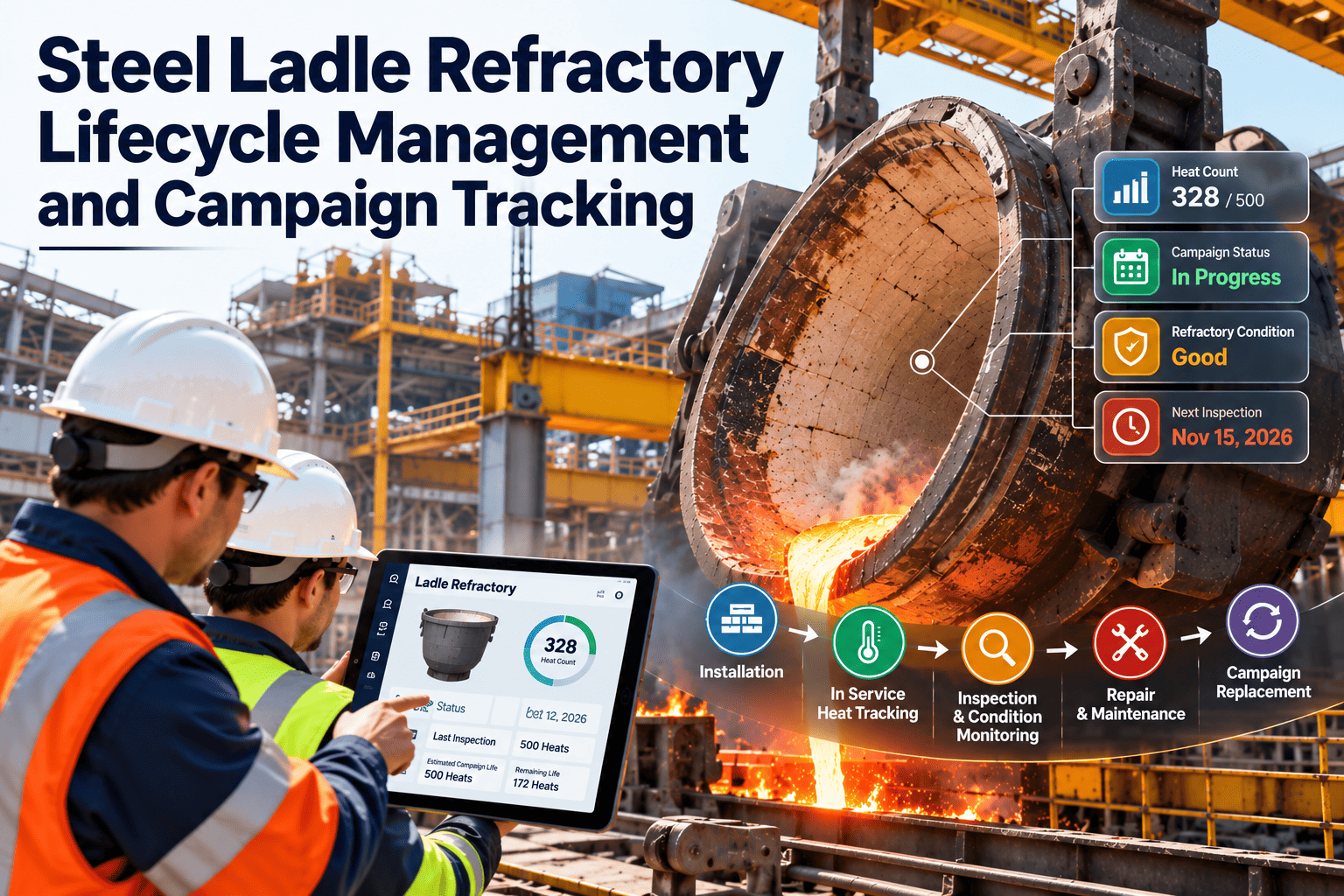
Basic oxygen furnace availability is the single largest determinant of integrated steel plant productivity — every minute of BOF downtime cascades into delayed castings, idled rolling mills, and missed order commitments. A well-structured BOF maintenance program targets vessel refractory campaigns of 3,000–5,000+ heats, trunnion bearing reliability above 99 percent, and off-gas system uptime that keeps emission stacks compliant and energy recovery steam boilers fed. When these systems are coordinated through a CMMS rather than spreadsheets, plants typically recover 8–12 percentage points of OEE on the convertor line. Ready to move from reactive fire-fighting to campaign-driven planning? Start Free Trial and configure your BOF asset hierarchy in under an hour.
Is your convertor line bleeding availability between campaigns?
A single unplanned trunnion failure or skull-stuck vessel can idle a 3 Mt/yr BOF shop for 18–36 hours and erase an entire month's availability gains. Structured campaign management, predictive refractory wear tracking, and off-gas PM choreography reverse that loss — and the math is compelling.
Why BOF availability governs the entire integrated plant
A 250-tonne BOF converts a heat in roughly 38–45 minutes, but the convertor is only one node in a hot-metal chain — blast furnace, desulphurization, ladle metallurgy, caster, rolling mill. When the BOF stops, everything upstream buffers and everything downstream starves.
Industry benchmarking by World Steel Association members shows that top-quartile BOF shops sustain >94% convertor availability against a median of 88–90%. The gap — roughly 4–6 percentage points — translates to 120,000–180,000 additional tonnes of liquid steel per furnace per year with zero capital spend, purely through maintenance discipline. A BOF CMMS closes that gap by linking refractory wear data, gunning records, trunnion vibration trends, and off-gas fan vibration spectra into one campaign plan.
A 3.0 Mt/yr BOF shop: reactive vs. campaign-driven
Consider a two-furnace BOF shop producing 3.0 Mt/yr, running a 3,200-heat average refractory campaign and spending $1.9M annually on gunning mix, bearings, off-gas repairs, and ladle preheater combustion parts. The comparison below models a 14-month transition from calendar-based PMs to CMMS-coordinated campaign management.
| Metric | Reactive (baseline) | Campaign-driven (CMMS) | Delta |
|---|---|---|---|
| BOF availability | 88.4% | 94.1% | +5.7 pts |
| Refractory campaign length | 3,200 heats | 4,150 heats | +950 heats |
| Gunning mix consumption | 4.8 kg/t steel | 2.9 kg/t steel | −40% |
| Unplanned downtime events/yr | 22 | 7 | −68% |
| Off-gas fan vibration alarms | 146 | 31 | −79% |
| Annual maintenance spend | $1.90M | $1.42M | −$480K |
| Additional liquid steel/yr | — | 171,000 t | +$10.3M margin |
The payback arithmetic: $10.3M in recovered contribution margin plus $480K in maintenance savings against roughly $85K/year for CMMS licensing, integration, and one dedicated reliability engineer — a 13-month payback with ongoing 140x ROI. This is why campaign management is the first lever plant managers pull when BOF availability slides below 90%.
The four subsystems that decide BOF availability
Every BOF maintenance program reduces to four asset groups. Use these tiered checklists to scope PM rounds, condition-monitoring routes, and campaign-overlay tasks inside your CMMS.
Vessel refractory & shell
- Laser wear mapping every 50 heats; flag zones <80 mm residual
- Gunning log: location, kg applied, slag chemistry, gunner ID
- Shell temperature scan (IR) on tap-pad & trunnion zones each shift
- Slag-line MgO-C brick residual tracked vs. campaign target curve
- Campaign-end criteria documented: 3,800 heats OR min 60 mm barrel
Trunnion ring & bearings
- Vibration route (ISO 10816) on both trunnion bearings weekly
- Grease analysis: Fe, Cu, H₂O content monthly via lab sample
- Trunnion ring crack inspection (MT/PT) every campaign changeover
- Tilt-drive gear backlash & brake wear check quarterly
- Bearing temperature trend vs. load — auto-alarm at Δ15°C
Off-gas & energy recovery
- ID fan vibration & blade deposit balance every 2 weeks
- Suppressed-combustion hood refractory condition per campaign
- Steam accumulator pressure-relief valve test monthly
- Water-cooled panel flow & ΔT alarms — trend for fouling
- Damper actuator stroke time <4 s; lag => air quality drift
Ladle preheating stands
- Burner combustion ratio tune — O₂ 2–4% in flue, weekly
- Ladle lining preheat curve adherence (log actual vs. target)
- Dome refractory spalling inspection every 5 ladle cycles
- Gas train leak test & flame-safety relay check monthly
- Slide-gate mechanism functional test pre-tap, every heat
A 4,200-heat BOF campaign, month by month
A campaign-driven shop does not react to wear — it predicts it. Here is how a 4,200-heat campaign unfolds across roughly seven months when refractory wear data, trunnion vibration trends, and off-gas fan health are choreographed in one CMMS.
Baseline & break-in
Post-reline dry-out complete. Establish baseline laser scan, trunnion vibration signature, and off-gas fan balance. First gunning at heat ~350 on slag line. Target availability 96%+ while refractory is fresh.
Steady-state wear
Slag-line wear accelerates as MgO-C picks up oxidation. Gunning shifts to impact pad and trunnion zones. Weekly vibration routes confirm bearing health. Ladle preheater combustion efficiency audited.
Intermediate gunning window
Major gunning stop (8–12 hr). CMMS auto-schedules off-gas fan inspection and trunnion grease sampling in the same window. Off-gas hood panel flow trends reviewed for fouling.
Critical wear zone
Barrel thickness approaches 100 mm in spots. Laser scans move to every 25 heats. Gunning consumption peaks (4–6 kg/t). CMMS flags campaign-end forecast; reline crew and brick inventory reserved.
Extended campaign management
Shell temperature monitoring intensifies. Trunnion bearing temp trend watched for load-induced drift. Slag chemistry adjusted to protect thin zones. Every heat reviewed against wear-map forecast.
Campaign close-out & reline
Controlled cool-down, skull removal, and 96–120 hr reline. CMMS generates campaign report: heats achieved, gunning kg/t, downtime hours by cause, lessons logged for next campaign target curve.
Stop losing heats to spreadsheet PMs and siloed wear data
OxMaint ties refractory scan data, trunnion vibration, off-gas fan health, and ladle preheater logs into one campaign-aware plan — so your convertor line runs 4,000+ heats per campaign with fewer surprises.
BOF maintenance, answered
How often should BOF refractory wear be measured during a campaign?
Laser wear mapping should occur every 50 heats during the first 1,500 heats, then increase to every 25 heats once any zone drops below 120 mm residual thickness. Shops running 4,000+ heat campaigns typically combine laser scans with thermocouple-shell-temperature trends so thinning zones are flagged between formal scans. The CMMS should auto-trigger a scan work order based on heat count, not a calendar date, so measurement cadence tracks actual refractory consumption.
What is a realistic BOF availability target for an integrated plant?
Top-quartile BOF shops sustain 94–96% convertor availability including planned reline time amortized across the campaign. Median performance sits at 88–90%. The gap is almost entirely unplanned downtime from trunnion bearing failures, off-gas fan imbalance, and skull-stuck vessels — all of which are predictable with condition monitoring and a campaign-aware CMMS. You can Book a Demo to see how OxMaint benchmarks your shop against these targets.
How does a CMMS improve refractory campaign length?
A CMMS correlates gunning location and quantity, slag chemistry, heat profiles, and laser wear maps heat-by-heat, then forecasts the campaign end date and the zones that will fail first. This lets planners schedule intermediate gunning stops precisely when they extend campaign life most — rather than reactively after a zone is already below 60 mm. Shops typically gain 600–1,000 heats per campaign after 2–3 cycles of CMMS-driven optimization.
What condition-monitoring routes matter most for BOF trunnions?
Weekly ISO 10816 vibration velocity readings on both trunnion bearings are the foundation, paired with monthly grease sample analysis for iron, copper, and water content. Bearing temperature should be logged continuously and auto-alarmed at a 15°C rise above baseline. At every campaign changeover — when the vessel is empty and cooled — perform magnetic-particle inspection on the trunnion ring welds and measure tilt-drive gear backlash. CMMS route templates ensure no reading is skipped.
Can BOF maintenance scheduling integrate with ladle and caster plans?
Yes — and it should. BOF availability only matters if hot metal flows through to the caster without buffering. A campaign-aware CMMS shares the reline and intermediate-gunning calendar with ladle preheater PM scheduling and caster sequence planning, so maintenance windows align with caster tundish changes and ladle shop turnarounds. Start a Start Free Trial to configure the multi-asset integration in your plant context.
Run your next BOF campaign on data, not guesswork
Join the steel plants recovering 5–7 percentage points of convertor availability with OxMaint's campaign-aware maintenance platform. Configure your BOF asset hierarchy, import wear maps, and publish your first campaign plan in a single afternoon.
Free 14-day trial · No credit card