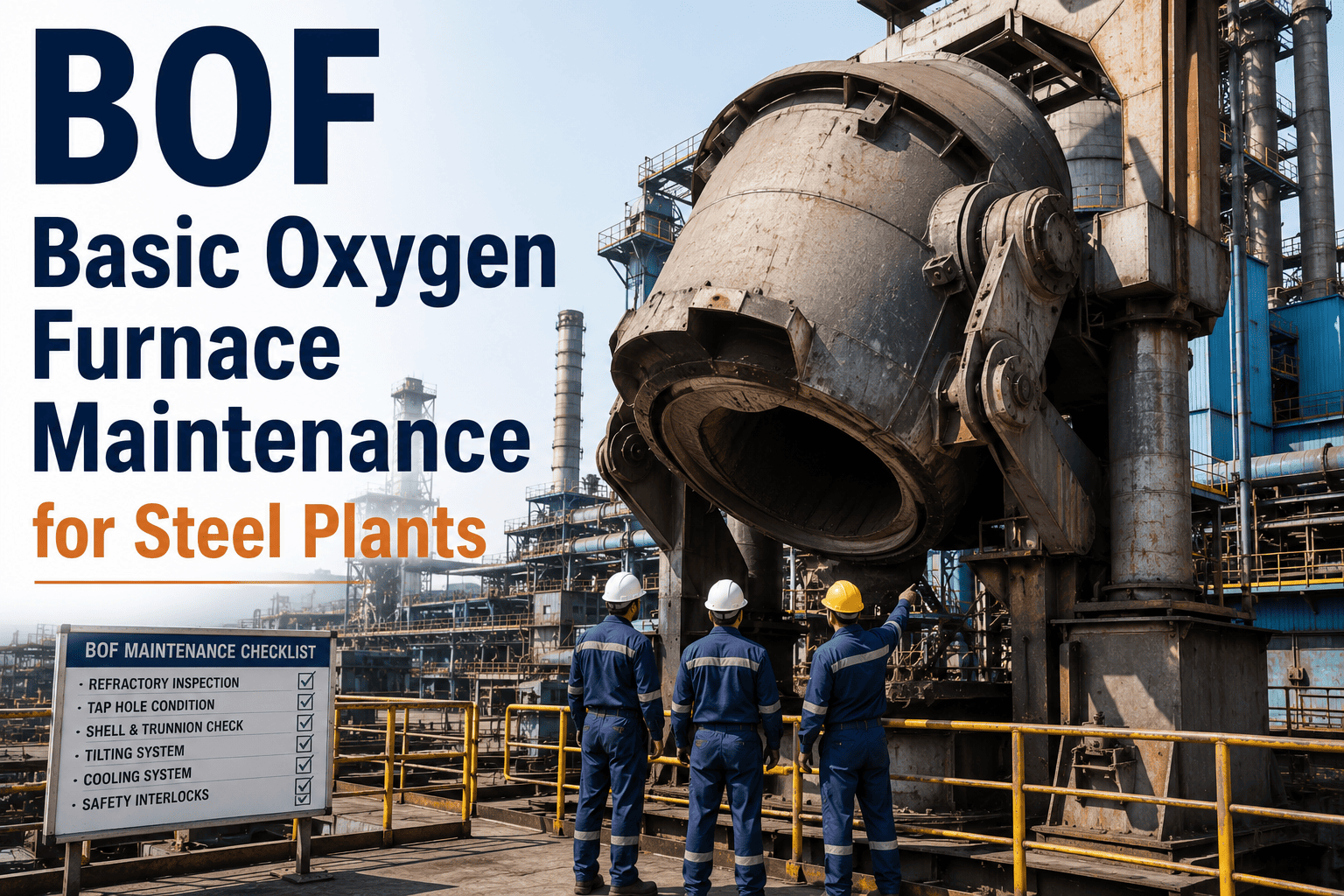
The Basic Oxygen Furnace is the heartbeat of integrated steelmaking — converting 250-350 tonnes of hot metal into liquid steel in 30-45 minutes per heat. But every heat takes its toll: refractory lining erosion of 0.5-2.0 mm per heat, trunnion bearing degradation from 1,200°C thermal cycling, lance tip wear from supersonic oxygen jets, and vessel shell deformation from relentless thermal stress. When a BOF vessel goes down for an unplanned reline, the entire steel plant loses $1.5-$4 million per day in lost production. A planned campaign extension of just 200 heats, by contrast, adds $400K-$1.2M in value by deferring the $8-$15 million reline cost and eliminating 15-25 days of lost production.
BOF maintenance optimization is the highest-leverage reliability investment in any integrated steel plant. The difference between a 3,000-heat campaign and a 5,000-heat campaign isn't luck — it's precision refractory management, condition-based maintenance of mechanical systems, and data-driven decision-making on vessel rotation and repair timing. Oxmaint's CMMS platform tracks every aspect of BOF vessel health: refractory wear profiles, mechanical component condition, slag splashing effectiveness, and campaign economics — giving melt shop managers the data to push campaigns further while keeping unplanned failures near zero.
Every Heat Counts. Every Millimeter of Refractory Matters. Every Day of Campaign Life Is Worth $100K+.
BOF Vessel Anatomy: Critical Maintenance Zones
A BOF vessel isn't a single asset — it's an assembly of interdependent systems, each with different failure modes, wear rates, and maintenance strategies. Understanding the anatomy is essential for optimizing the whole:
Refractory Lining
Oxygen Lance System
Trunnion Ring & Bearings
Vessel Shell & Cooling
Tap Hole & Slide Gate
Refractory Wear Management: The Campaign Life Multiplier
Refractory is 90% of BOF campaign economics. Oxmaint tracks wear across every zone of the vessel and provides the analytics to extend campaigns while maintaining safety margins:
Slag Splashing: The Single Most Effective Campaign Extension Tool
Nitrogen-driven slag splashing after tapping coats the refractory with a protective slag layer, reducing wear by 30-50% in targeted zones. Properly optimized slag splashing is the difference between 3,000 and 5,000+ heat campaigns. Oxmaint tracks splashing frequency, duration, nitrogen pressure, and post-splash wear rates to optimize the process continuously.
Every Heat Beyond Plan Is Pure Profit
Extending a BOF campaign by 500 heats defers $8-15M in reline costs, avoids 15-25 days of downtime, and adds $2-6M in production value. Oxmaint's refractory tracking and condition monitoring make it possible.
Campaign Economics: The Math Behind Every Decision
Understanding the financial impact of campaign management decisions is critical for prioritizing maintenance investments and justifying operational spending:
Cost Per Heat
Downtime Avoidance Value
Campaign Extension Value
Oxmaint BOF Maintenance Dashboard
Real-time vessel health visibility that enables data-driven campaign management decisions. Every data point feeds into Oxmaint's BOF campaign tracker:
3D vessel model showing remaining refractory thickness by zone, updated after every laser scan. Color-coded: green (>300mm), yellow (200-300mm), red (<200mm). Predicts remaining campaign life by zone.
Rolling average wear rate per zone over the last 50/100/200 heats. Detects acceleration in wear rate that signals lining deterioration before it becomes critical. Triggers PM actions automatically.
Current heat count vs. target campaign length. Projected end date based on current production rate and wear trajectory. Countdown triggers reline planning activities at configurable milestones.
Real-time thermal profile from thermocouple arrays and IR scanning. Hot spot detection with automatic alarms at 350°C and emergency alerts at 400°C. Historical trending for each shell zone.
Lance tip heat count, water flow differential (leak detection), nozzle condition assessment. Automatic lance change work order generated at configurable heat count or flow anomaly threshold.
Running cost-per-heat calculation, cumulative refractory repair spend, and projected total campaign cost. Compares current campaign performance vs. historical average and best-ever campaigns.
Push Every Campaign Further. Plan Every Reline Perfectly.
Oxmaint gives melt shop managers the refractory intelligence, mechanical condition data, and campaign economics to maximize vessel life while maintaining zero tolerance for unplanned failures.
Frequently Asked Questions
How does Oxmaint track refractory wear without stopping the vessel?
Oxmaint integrates with laser scanning systems (such as SMS Concast or Vesuvius systems) that measure refractory thickness during scheduled vessel stoppages between heats — typically every 50-200 heats depending on campaign stage. Between scans, wear is estimated using a heat-based wear model calibrated to your specific vessel: slag chemistry, blow patterns, and splashing effectiveness all feed the model. Shell thermocouple data provides continuous indirect wear monitoring — rising shell temperatures in a specific zone indicate thinning refractory in that area. The combination of periodic direct measurement and continuous indirect monitoring gives a complete picture without additional downtime.
What's the ROI of extending a BOF campaign by 500 heats?
Direct financial impact: 500 additional heats × 300 tonnes/heat = 150,000 tonnes of steel production that would otherwise be lost to reline downtime. At a conservative $50/tonne margin, that's $7.5M in production value. Plus deferred reline amortization of ~$1.2M and avoided production ramp-up losses of ~$500K. Total value: approximately $8-10M per 500-heat extension. The incremental cost of achieving this extension (additional gunning, slag splashing optimization, enhanced monitoring) is typically $200-500K — a 16-50x return on investment.
How do you decide when to end a campaign vs. continue with repairs?
Oxmaint's campaign decision model evaluates three factors: safety margin (minimum refractory thickness in any zone must remain above 150-200mm), wear rate acceleration (if the limiting zone's wear rate has increased >30% over the last 200 heats, the refractory is deteriorating and repair effectiveness is declining), and economics (compare the cost of continued gunning/repair vs. the value of additional heats). When the safety margin is thin AND the wear rate is accelerating AND repair costs per heat exceed $2,000-3,000, the campaign should end. Oxmaint generates this analysis automatically and presents a clear recommendation with supporting data.
Can Oxmaint manage multi-vessel converter rotation?
Yes. Most BOF shops operate 2-3 vessels in rotation. Oxmaint tracks each vessel's campaign independently and provides a fleet-level view showing: which vessel is active, which is in repair/reline, and projected campaign end dates for each. The system supports optimized rotation scheduling — ensuring relines are staggered so that vessel availability never drops below the minimum required for the plant's production plan. For 3-vessel shops, this means maintaining 2-vessel availability at all times, with the third always in some stage of preparation, active campaign, or reline.
How does slag chemistry affect refractory wear and campaign life?
Slag chemistry is one of the most critical variables. High-FeO slags (>25%) are extremely aggressive to MgO-C refractory, increasing wear rates by 40-80%. Low basicity (CaO/SiO₂ < 2.5) slags also accelerate erosion. Oxmaint logs slag chemistry data from every heat and correlates it with measured wear rates, enabling the melt shop to identify the specific chemistry ranges that accelerate wear and adjust blowing practices accordingly. The platform also tracks the effectiveness of slag splashing by composition — higher MgO content in retained slag produces more durable protective coatings, extending campaign life by 15-25%.