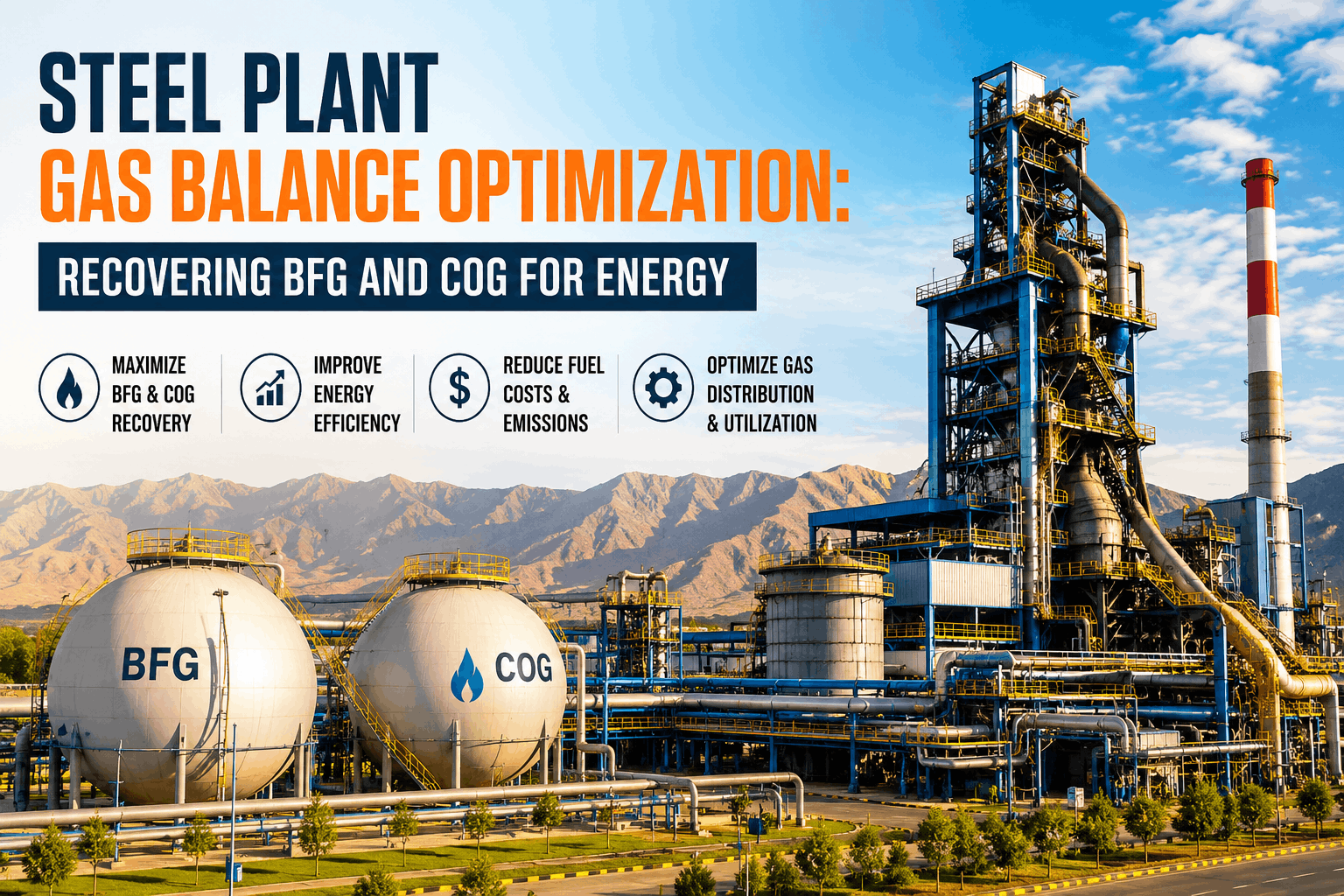
In an integrated steel plant, blast furnace gas (BFG) and coke oven gas (COG) are not waste streams—they are valuable energy assets that can supply 30–40% of the plant's total energy requirement when recovered and distributed effectively. Yet across the industry, gas flaring remains common, gas holders cycle between excess and deficit, and boilers swing between fuels because the balance between gas generation and consumption is managed reactively rather than optimized. Steel plant gas balance optimization is fundamentally a maintenance and reliability challenge: gas recovery systems must operate continuously, gas cleaning trains must maintain pressure and quality, distribution networks must remain leak-free, and consuming equipment must be available to accept gas when it is generated. Without structured maintenance tracking across the entire gas network—from recovery at the furnace top to combustion at the boiler burner—a plant cannot confidently reduce flaring, maximize energy cost savings, or meet increasingly stringent environmental commitments. Sign Up Free to see how OxMaint gives energy and maintenance teams the equipment reliability tracking, gas system PM scheduling, and flaring event documentation needed to turn by-product gas from a disposal problem into a strategic energy asset.
Turn Your By-Product Gas From a Flaring Loss Into a Competitive Energy Advantage
OxMaint connects gas recovery system reliability, distribution network maintenance, and consuming equipment availability to give steel plants the data foundation for real gas balance optimization—and the flaring reduction that follows.
Why Gas Balance Optimization Depends on Maintenance Reliability
Gas balance is not simply an energy management equation—it is a reliability equation. A plant can model the ideal BFG and COG distribution perfectly, but if the blast furnace top gas recovery system trips due to a failed bleed valve, or the gas cleaning train loses pressure because a scrubber pump is down for unplanned repair, or the BFG-fired boiler is unavailable because a tube leak wasn't caught during the last inspection—the model collapses and gas goes to flare. Structured maintenance management in OxMaint connects the reliability of every asset in the gas network: recovery equipment at the generation source, cleaning and conditioning systems, gas holder integrity, distribution piping and valve stations, and consuming equipment at boilers, stoves, and reheat furnaces. Facilities that Book a Demo with OxMaint see how gas system asset reliability tracking, failure history analysis, and PM compliance monitoring combine to maximize the hours per year that the gas network is fully available—which directly determines the percentage of by-product gas that is recovered versus flared.
OxMaint tracks PM completion and failure history for blast furnace top gas recovery, BOF gas recovery, and COG primary cooling—the systems that capture gas at the source before it can be flared.
Wet scrubbers, electrostatic precipitators, and bag filters must operate continuously for gas quality to meet consuming equipment specifications. OxMaint schedules PMs and tracks downtime per cleaning train.
Gas holders buffer the imbalance between generation and consumption. OxMaint schedules seal inspections, piston alignment checks, and corrosion monitoring to prevent holder outages that force flaring.
Gas leaks represent energy loss, safety risk, and environmental non-compliance. OxMaint schedules pipeline inspections, valve station PMs, and leak detection surveys—tracking repairs to closure.
A boiler or furnace that cannot accept gas forces flaring. OxMaint tracks the PM status and reliability of every major gas consumer—BFG boilers, hot blast stoves, reheat furnaces, and power plant units.
Every flaring event has a root cause—equipment failure, process upset, or maintenance outage. OxMaint logs flaring events with duration, volume, and root cause for continuous improvement analysis.
Essential Steel Plant Gas Balance Optimization Checklist
BFG is the largest-volume by-product gas stream in an integrated steel plant, and the top gas recovery system determines whether that energy is captured or lost. The system includes the furnace top bleed valves (which must seal tightly to prevent gas loss), the dust catcher or cyclone for coarse particulate removal, and the gas cooling and cleaning train that delivers gas of sufficient quality for downstream combustion. A bleed valve that fails to reseat after a furnace slip, a dust catcher hopper that plugs, or a scrubber pump that trips on high vibration—any of these forces gas to flare. OxMaint schedules preventive maintenance for every component in the BFG recovery chain: bleed valve actuation testing and seat inspection, dust catcher level monitoring and hopper discharge system PM, scrubber pump vibration monitoring and seal water system checks, and downstream gas quality instrumentation calibration. Facilities that Sign Up Free can begin scheduling BFG recovery system PMs and tracking the reliability that determines gas availability.
COG presents a different maintenance challenge than BFG: it contains tars, naphthalene, and water vapor that condense and foul equipment if cooling and cleaning systems are not maintained at peak performance. The primary cooling system must reduce gas temperature sufficiently to condense tars and water; the electrostatic precipitator or tar removal system must maintain high-voltage field integrity to remove tar aerosols; and the naphthalene wash system must prevent naphthalene crystallization in downstream piping and compressor internals. A primary cooler with fouled tubes, an electrostatic precipitator with failed high-voltage elements, or a naphthalene wash operating below design efficiency will send contaminated gas downstream—fouling compressor internals, burner nozzles, and control valves throughout the distribution network. OxMaint schedules primary cooler cleaning intervals based on pressure drop trending, electrostatic precipitator voltage and current monitoring with scheduled internal inspection, and naphthalene wash oil quality checks—preventing the gas quality degradation that cascades into maintenance problems across the entire COG network. Teams that Book a Demo can see how gas cleaning PMs are configured and tracked.
Gas holders are the buffer that absorbs the mismatch between continuous gas generation and variable gas consumption—when a holder is out of service for maintenance, any generation-consumption imbalance goes directly to flare. Holder maintenance is specialized and safety-critical: for dry-seal (piston-type) holders, the sealing membrane between the piston and holder shell must maintain gas-tight integrity, the piston alignment must remain within tolerance to prevent seal wear, and the roof venting and emergency systems must be tested regularly. For water-seal holders, water level and makeup systems must be maintained to prevent gas breakthrough. A holder forced out of service for emergency repair eliminates the plant's ability to buffer gas, directly increasing flaring for the duration of the outage. OxMaint schedules all holder inspections and PMs—seal condition assessment, piston level and alignment readings, corrosion thickness measurements on the shell, and safety system function tests—and tracks the maintenance history that supports holder life extension decisions.
The gas distribution network connecting generation sources to consumers spans the entire steel plant—often kilometers of large-diameter piping with valve stations, pressure control points, drain pots, and expansion joints. Leaks in this network represent simultaneous energy loss, safety hazard (BFG contains 20–25% CO, which is lethal at low concentrations), and environmental non-compliance. Valve stations that are not exercised regularly seize in position, eliminating the ability to isolate sections for maintenance or emergency response. Drain pots that are not emptied accumulate condensate that restricts gas flow and creates corrosion cells. OxMaint schedules pipeline walk-down inspections with leak detection, valve station PMs (lubrication, actuation test, packing inspection), drain pot maintenance, and expansion joint condition assessment—tracking every leak found and repaired to closure. Regular leak detection survey records demonstrate to environmental regulators and safety auditors that the gas network is being actively managed rather than allowed to deteriorate.
Gas balance requires not just that gas is available, but that consuming equipment is available to accept it. The largest gas consumers—BFG-fired boilers, hot blast stoves, reheat furnaces, coke oven battery underfiring, and captive power plant boilers or gas turbines—must all be operational for the gas distribution system to achieve balance without flaring. When a major consumer trips or is down for maintenance, the gas it would have consumed goes to flare unless another consumer can absorb the surplus. Structured maintenance tracking across all major gas consumers provides the availability forecasting that gas balance optimization requires: if the power plant has a scheduled boiler outage, the gas management team can plan to divert BFG to other consumers or anticipate increased flaring. OxMaint tracks PM schedules, current equipment status, and planned outages across all major gas consumers—giving the energy management team visibility into the demand-side availability that determines whether gas balance can be achieved on any given day. Facilities can Sign Up Free and begin loading gas consumer assets with their PM schedules and availability tracking.
Every minute of gas flaring has a specific root cause—and logging those causes creates the data foundation for continuous gas balance improvement. Flaring events are categorized by root cause: equipment failure (pump trip, valve failure, instrument fault), process upset (furnace slip, gas quality excursion, pressure surge), maintenance outage (planned or unplanned consumer unavailability), or operational decision (startup, shutdown, gas holder at capacity). Each category points to a different improvement action: equipment failures drive PM program enhancement, process upsets drive operational procedure refinement, and maintenance outages drive outage coordination improvement. OxMaint logs flaring events with timestamp, duration, estimated gas volume lost, and assigned root cause—building a flaring history that the energy management team analyzes monthly to identify the largest contributors and direct improvement resources where they will have the greatest flaring reduction impact.
Steel Plant Gas System: Reliability-Driven Optimization Reference
| Gas System Component | Optimization Objective | Critical Maintenance Activity | OxMaint Record | Flaring Impact of Failure |
|---|---|---|---|---|
| BFG Top Gas Recovery | Maximize gas capture at source | Bleed valve seal PM; dust catcher discharge system check | Valve test date, seal condition, recovery downtime hours | Direct: all uncaptured BFG to flare |
| COG Primary Cooling/ESP | Maintain gas quality for downstream use | Cooler cleaning; ESP voltage checks; naphthalene wash PM | Pressure drop, voltage readings, gas quality parameters | Indirect: poor quality forces consumer trips, then flaring |
| Gas Holder | Maintain buffer capacity | Seal inspection; alignment check; corrosion monitoring | Seal condition, piston position, shell thickness readings | Direct: no buffer means all surplus to flare |
| Distribution Piping Network | Minimize losses; ensure safety | Leak detection survey; valve station PM; drain pot maintenance | Leak location, repair WO, valve actuation test, drain log | Indirect: leaks force section isolation; safety incidents |
| Major Gas Consumers | Maximize consumer availability | Boiler PM; stove burner inspection; furnace refractory check | Consumer status, PM completion, planned outage schedule | Direct: unavailable consumer means gas to flare |
How OxMaint Supports Steel Plant Gas Balance Optimization
Gas balance optimization is a reliability-driven pursuit—the plant that recovers the most by-product gas is the plant whose gas system equipment experiences the fewest unplanned outages, whose PMs are completed on schedule, and whose consuming equipment is available when gas is generated. OxMaint connects gas recovery system reliability tracking, gas cleaning train PM management, gas holder integrity monitoring, distribution network leak management, and consuming equipment availability into a single platform—giving the energy manager and maintenance manager shared visibility into the asset health that determines gas balance outcomes. When OxMaint shows recovery system PMs completed on schedule, gas holders with current inspections, distribution leaks identified and repaired, and major consumers available with no overdue PMs, that is the operational foundation for confident gas balance optimization—and the flaring reduction, energy cost savings, and emissions reduction that follow. Facilities can Sign Up Free and begin building the gas system reliability record that supports real gas balance improvement.
Building a Reliability-Driven Gas Balance Optimization Program: Implementation Steps
Map the Complete Gas System Asset Register
Load every asset in the gas network into OxMaint—from recovery, through cleaning and holder storage, distribution piping and valves, to every major consumer—creating the complete asset hierarchy that gas balance depends on.
Establish Critical PM Schedules per Gas Asset
Define the PM tasks and intervals that keep each gas system asset reliable: bleed valve inspections, scrubber pump vibration monitoring, holder seal checks, pipeline leak surveys, valve station actuation tests.
Create Consumer Availability Visibility
Configure OxMaint to display the current PM status and planned outage schedule for every major gas consumer—giving the energy team demand-side visibility for daily gas balance planning.
Implement Flaring Event Logging Protocol
Establish a standard process for logging every flaring event in OxMaint—duration, estimated volume, root cause category, and the corrective action that will prevent recurrence—building the improvement database.
Review Gas System Reliability Monthly
Joint monthly review between energy management and maintenance: PM compliance across gas assets, unplanned outage events, flaring volume by root cause, and actions to address the top contributors.
Drive Continuous Flaring Reduction
Use OxMaint's flaring event data and gas asset reliability trends to direct PM improvements, capital replacement decisions, and operational procedure changes—achieving measurable flaring reduction quarter over quarter. Book a Demo to see the full gas balance optimization workflow.
Frequently Asked Questions
How much energy can a steel plant recover from BFG and COG?
In a well-optimized integrated steel plant, BFG and COG together can supply 30–40% of the plant's total energy requirement. BFG alone typically represents 20–25% of total energy, used primarily in hot blast stoves, BFG-fired boilers, and captive power generation. COG, with its higher calorific value, contributes an additional 10–15% and is used in reheat furnaces, coke oven battery underfiring, and supplemental firing. The actual recovery percentage depends directly on gas system equipment reliability—every hour of flaring reduces the recovered energy percentage.
What is the most common cause of BFG flaring in steel plants?
The most common causes of BFG flaring are: (1) consuming equipment unavailability—when a major BFG consumer (boiler, stove, or power plant) is down unexpectedly and the gas cannot be redirected fast enough; (2) gas holder being at capacity during a period of low consumption; and (3) top gas recovery system component failure such as a bleed valve that fails to reseat or a dust catcher that plugs. All three causes are addressable through structured maintenance and reliability improvement programs tracked in OxMaint.
How does gas holder maintenance affect flaring rates?
Gas holders provide the buffer capacity that absorbs generation-consumption imbalance. When a holder is out of service for maintenance, the plant loses its primary gas balancing mechanism—any surplus gas goes directly to flare. A holder forced out of service for emergency seal repair, for example, can increase flaring rates by 5–15% for the duration of the outage. Structured holder PM programs that prevent emergency outages are therefore a direct contributor to flaring reduction.
How does OxMaint help reduce gas flaring?
OxMaint reduces flaring by improving the reliability of every asset in the gas network: ensuring recovery system PMs are completed so gas is captured, ensuring cleaning train maintenance sustains gas quality, ensuring holder inspections prevent emergency outages, ensuring leak surveys and valve station PMs maintain distribution network integrity, and ensuring major consumers are available with no overdue maintenance. When the entire gas system is reliable, the plant can confidently optimize gas distribution rather than reacting to equipment failures with flaring.
What is the relationship between gas balance optimization and environmental compliance?
Gas flaring is increasingly regulated as an environmental concern—flaring represents both visible emissions and greenhouse gas (CO₂ and CH₄) release. Many jurisdictions now require flaring volume reporting and impose limits or fees. Beyond compliance, many steel companies have made public decarbonization commitments that require measurable flaring reduction. Structured flaring event logging and root cause analysis in OxMaint provides the documented improvement trajectory that demonstrates progress to regulators, stakeholders, and sustainability reporting frameworks.
Turn Gas System Reliability Into Measurable Flaring Reduction and Energy Savings
OxMaint gives steel plant energy and maintenance teams the asset reliability tracking, outage coordination visibility, and flaring event analysis to recover more by-product gas and flare less—quarter after quarter.