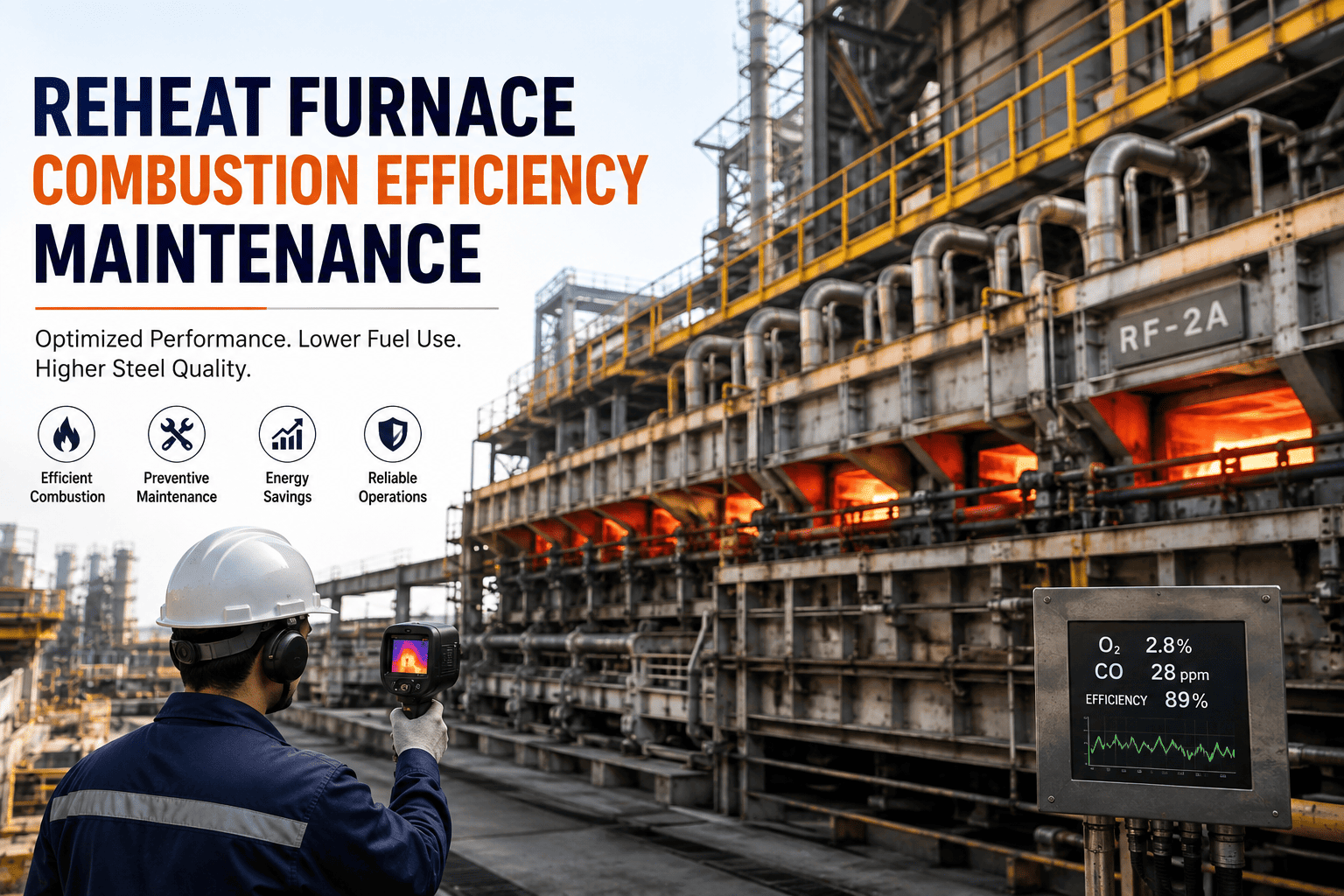
Reheat furnaces consume 67% of the energy in the continuous casting and rolling process — making them the single largest energy consumer in an integrated steel mill [citation:1]. A typical walking beam reheat furnace burning natural gas or by-product fuels can consume $5–15 million in fuel annually. Yet most reheat furnaces operate at 70–80% thermal efficiency, with the remaining 20–30% of fuel energy escaping as exhaust heat, radiation losses, and incomplete combustion. The gap between average and best-in-class fuel consumption represents $1–3 million in annual savings for a single furnace — and a 10–20% reduction in carbon emissions [citation:2]. Start a free trial with Oxmaint to track furnace performance and optimize combustion, or book a demo to see how steel plants use Oxmaint's energy management module to reduce fuel consumption and emissions.
REHEAT FURNACE · ENERGY OPTIMIZATION · STEEL MILL · 2026
Steel Plant Reheat Furnace Optimization: Reducing Fuel Consumption with Combustion Control and Heat Recovery
Combustion optimization, oxygen trim control, air-fuel ratio tuning, furnace pressure control, recuperator maintenance, burner tuning, refractory management, and waste heat recovery — the complete guide to reducing natural gas and by-product fuel consumption in steel reheat furnaces.
67%
Of continuous casting and rolling energy consumed by reheat furnaces
20–30%
Potential fuel savings with optimized combustion control
36%
Of fuel energy lost through exhaust gas — target for heat recovery [citation:1]
$1–3M
Annual fuel savings per furnace with best-in-class optimization
Reheat Furnace Energy
Every 1% of Fuel Saved Is $50,000–150,000 Per Year per Furnace
Oxmaint's furnace optimization module tracks combustion efficiency, oxygen trim, heat recovery performance, and burner condition — generating work orders that optimize fuel consumption. Steel mills using Oxmaint report 10–20% fuel savings.
Why Reheat Furnaces Consume So Much Fuel — And How to Reduce It
Reheat furnaces operate at 1,000–1,250°C to bring steel slabs to rolling temperature. The energy consumed is a function of four factors: combustion efficiency (how completely fuel is burned), heat transfer efficiency (how effectively heat reaches the slab), heat loss (exhaust, radiation, water cooling), and production scheduling (how efficiently the furnace is loaded). Optimization opportunities exist in every factor — and most do not require major capital investment [citation:7]. Start a free trial or book a demo to see how Oxmaint's furnace optimization module addresses each factor systematically.
The 5 Factors That Determine Reheat Furnace Fuel Consumption
Combustion Efficiency
How completely fuel is burned. Excess air (too much) wastes heat; insufficient air (too little) causes incomplete combustion and emissions. Oxygen trim control optimizes the air-fuel ratio.
Exhaust Heat Loss
Flue gas exiting the furnace carries away 30–40% of fuel energy. Recuperators preheat combustion air using exhaust heat, recovering 15–25% of this energy. Maintenance of recuperators is critical.
Furnace Pressure Control
Positive pressure causes heat leakage through openings; negative pressure draws in cold air, reducing efficiency. Proper pressure control maintains optimal combustion conditions.
Temperature Uniformity
Uneven temperature distribution creates hot spots (wasted fuel) and cold spots (incomplete heating). Zone temperature control and burner tuning improve uniformity.
Refractory Condition
Deteriorated refractory increases heat loss through furnace walls. Cracks and spalling allow heat escape and create cold spots. Regular refractory inspection and repair reduce losses.
8 Optimization Measures That Reduce Fuel Consumption
The eight measures below represent the highest-ROI interventions for reducing reheat furnace fuel consumption. Each measure addresses one or more of the five efficiency factors — and each is tracked in Oxmaint's furnace optimization module. Steel mills that implement all eight measures consistently achieve 15–25% fuel reduction with payback under 12 months [citation:7].
Optimization Measure
Action
Fuel Saving Potential
Payback
1. Oxygen Trim Control
Continuous O2 measurement and air-fuel ratio adjustment
3–8%
6–12 months
2. Recuperator Maintenance
Cleaning and repair of recuperator tubes; leak detection
5–12%
6–18 months
3. Burner Tuning
Adjust fuel-air ratios per zone; flame optimization
3–6%
3–6 months
4. Furnace Pressure Control
Maintain slight positive pressure; seal openings
2–5%
3–9 months
5. Zone Temperature Optimization
Precise zone control; minimize temperature overshoot
Maximize hot charging; reduce furnace waiting times
5–15%
0–6 months
8. Waste Heat Recovery
Flue gas heat exchangers; preheat combustion air
5–20%
12–36 months
Without vs. With Furnace Optimization
The gap between a steel mill with a structured furnace optimization program and one without is visible across every energy metric — from fuel consumption per tonne to carbon emissions. The comparison below shows the baseline versus the optimized result. Oxmaint delivers the optimized result with automated tracking of all eight optimization measures.
Achievable: 0.9–1.2 GJ/tonne. Oxygen trim, recuperators, and burner tuning improve efficiency to 82–88%. Fuel cost: $6–11/tonne.
0.9–1.2 GJ/tonne
Without Optimization Program
Annual Fuel Cost (1.5M tonne furnace)
Natural gas at $8/MMBtu: $8–15M annually. 20% of energy lost as exhaust heat.
$8–15M/year
With Optimization Program
Annual Fuel Cost (1.5M tonne furnace)
15–20% reduction: $6–11M/year. Recuperator recovers 15–25% of exhaust heat.
$6–11M/year
Without Optimization Program
CO₂ Emissions
Natural gas combustion emits 50–55 kg CO₂/GJ. 1.5M tonne furnace: 90,000–130,000 tonnes CO₂/year.
90–130K tonnes CO₂
With Optimization Program
CO₂ Emissions
15–25% reduction: 70–100K tonnes CO₂/year. Supports EU ETS and carbon reduction targets.
70–100K tonnes CO₂
Furnace Optimization Maturity Scoring
Furnace optimization maturity follows a clear spectrum — from no program (high fuel consumption, high emissions) to fully optimized operations with oxygen trim, heat recovery, and digital control. The scoring framework below lets steel plant managers assess their current capability — identifying the gaps that are costing millions in fuel annually.
5
Fully Optimized · Digital Control · Heat Recovery
Oxygen trim control active. Recuperators maintained. Burner tuning continuous. Zone temperature optimization digital. Slab scheduling optimized. Fuel consumption: 0.9–1.1 GJ/tonne.
15–25% fuel savings. Best-in-class emissions.
4
Proactive · Some Optimization
Oxygen trim installed but not fully optimized. Recuperator maintenance scheduled. Burner tuning annual. Some zone temperature control. Fuel consumption: 1.1–1.3 GJ/tonne.
Manual combustion control. Recuperators cleaned only when efficiency drops. Burner tuning reactive. Zone temperature manually set. Fuel consumption: 1.3–1.5 GJ/tonne.
Gap: Significant fuel waste. Prioritize oxygen trim and recuperator maintenance.
2
Minimal Optimization
No oxygen trim. Recuperators poorly maintained. Burners rarely tuned. High excess air. High radiation losses. Fuel consumption: 1.5–1.7 GJ/tonne.
Risk: Millions in wasted fuel. Immediate optimization program required.
1
No Optimization
No combustion optimization. No heat recovery. No temperature control. Fuel consumption: 1.7–2.0 GJ/tonne. High emissions. No energy management system.
Risk: Maximum fuel cost and emissions. Immediate optimization program required.
Furnace Optimization Technology — What You Need
Effective reheat furnace optimization requires the right technology stack. The components below work together to reduce fuel consumption and emissions. Oxmaint integrates with all major furnace control and monitoring systems — giving you a single platform for all furnace performance data.
Oxygen Trim Control
Continuous O2 measurement in flue gas. Automatic air-fuel ratio adjustment. Maintains optimal combustion. Reduces fuel 3–8%.
Recuperator Monitoring
Track recuperator efficiency, pressure drop, and temperature differential. Schedule cleaning and maintenance based on performance data.
Zone Temperature Control
PID control per furnace zone. Track temperature deviation. Optimize zone setpoints for fuel efficiency and temperature uniformity.
Furnace Pressure Control
Maintain slight positive pressure. Minimize air infiltration. Prevent heat leakage through openings. Optimize damper position.
Burner Condition Monitoring
Track burner performance. Flame quality inspection. Fuel-air ratio verification. Schedule tuning based on performance data.
Thermographic Inspection
Infrared imaging of furnace walls. Detect refractory degradation, insulation failure, and heat loss points. Prioritize repair.
Slab Scheduling Optimization
Maximize hot charging. Minimize waiting time. Optimize furnace loading. Reduce heating time and fuel consumption [citation:8].
CMMS Integration
All furnace performance data flows into CMMS. Automated work orders for maintenance and optimization. Centralized fuel consumption records.
"
Our walking beam reheat furnace was consuming 1.5 GJ/tonne — well above industry benchmark. We implemented oxygen trim control, repaired our recuperator, and optimized zone temperature control. Within 12 months, fuel consumption dropped to 1.15 GJ/tonne — a 23% reduction. Annual fuel savings: $2.8 million. CO₂ emissions reduced by 22,000 tonnes per year. The optimization program paid for itself in 9 months.
Energy Manager — Integrated Steel Mill, US Midwest
What is the single most effective fuel-saving measure for reheat furnaces?+
Oxygen trim control combined with recuperator maintenance is the most effective combination. Oxygen trim ensures optimal air-fuel ratio (saving 3–8%), while recuperators recover 15–25% of exhaust heat. Together, these measures reduce fuel consumption by 8–20% with payback under 12 months. Book a demo to see how Oxmaint tracks both measures.
What oxygen level should be maintained in reheat furnace flue gas?+
Optimal O2 in flue gas is 2–4% for natural gas-fired furnaces. Lower than 2% risks incomplete combustion (CO emissions). Higher than 4% wastes heat (excess air carries heat out the stack). Oxygen trim control maintains this optimal range continuously. Start a free trial to configure O2 monitoring thresholds in Oxmaint.
How often should recuperators be cleaned and inspected?+
Recuperators should be inspected quarterly and cleaned as needed based on pressure drop and temperature differential. Annual chemical cleaning or mechanical cleaning is typical for most steel plant recuperators. Fouled recuperators can reduce heat recovery efficiency by 30–50%. Oxmaint tracks cleaning schedules and efficiency trends.
What is the fuel consumption benchmark for reheat furnaces?+
Best-in-class walking beam reheat furnaces achieve 0.9–1.1 GJ/tonne. Average performance is 1.2–1.6 GJ/tonne. Poorly maintained furnaces consume 1.7–2.0 GJ/tonne. The gap between average and best-in-class represents $1–3 million in annual fuel savings per furnace. Worldsteel benchmarking data shows significant variation between plants, indicating substantial optimization opportunity [citation:9]. Start free to benchmark your furnace performance.
How does a CMMS help with reheat furnace optimization?+
A CMMS like Oxmaint provides five furnace optimization advantages: (1) Performance tracking — fuel consumption, O2 levels, temperature uniformity monitored, (2) Maintenance scheduling — recuperator cleaning, burner tuning, refractory repair scheduled, (3) Trend analysis — efficiency trends identify degradation, (4) Work order integration — optimization actions generate work orders, (5) Benchmarking — compare actual vs target fuel consumption. Start free to see how Oxmaint manages furnace optimization.
Furnace Intelligence from Oxmaint
Every 1% of Fuel Saved Is $50,000–150,000 Per Year per Furnace
Oxygen trim control, recuperator maintenance, burner tuning, zone temperature optimization, and slab scheduling — unified in one CMMS that reduces fuel consumption 15–25%. Stop wasting fuel. Start optimizing combustion.