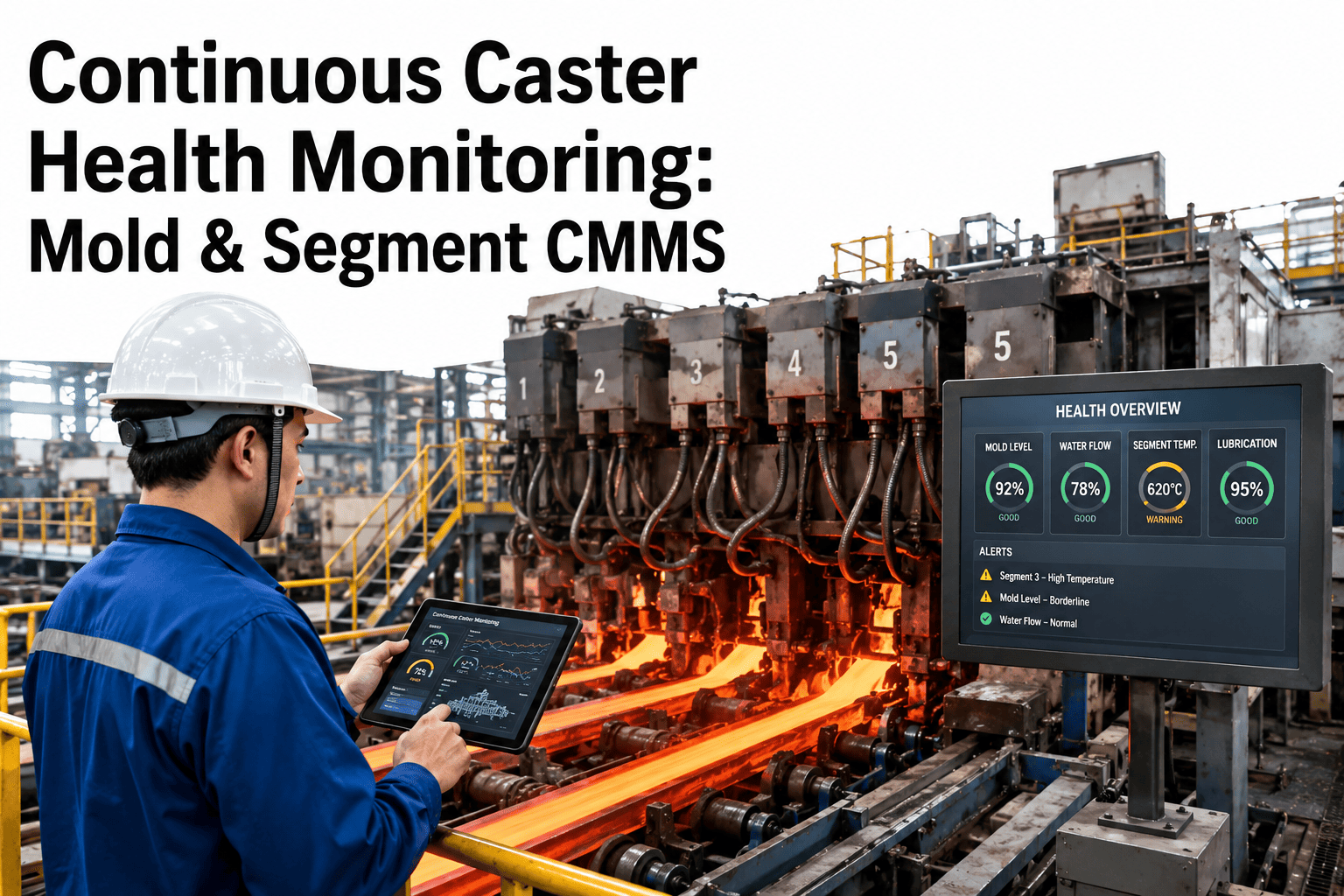
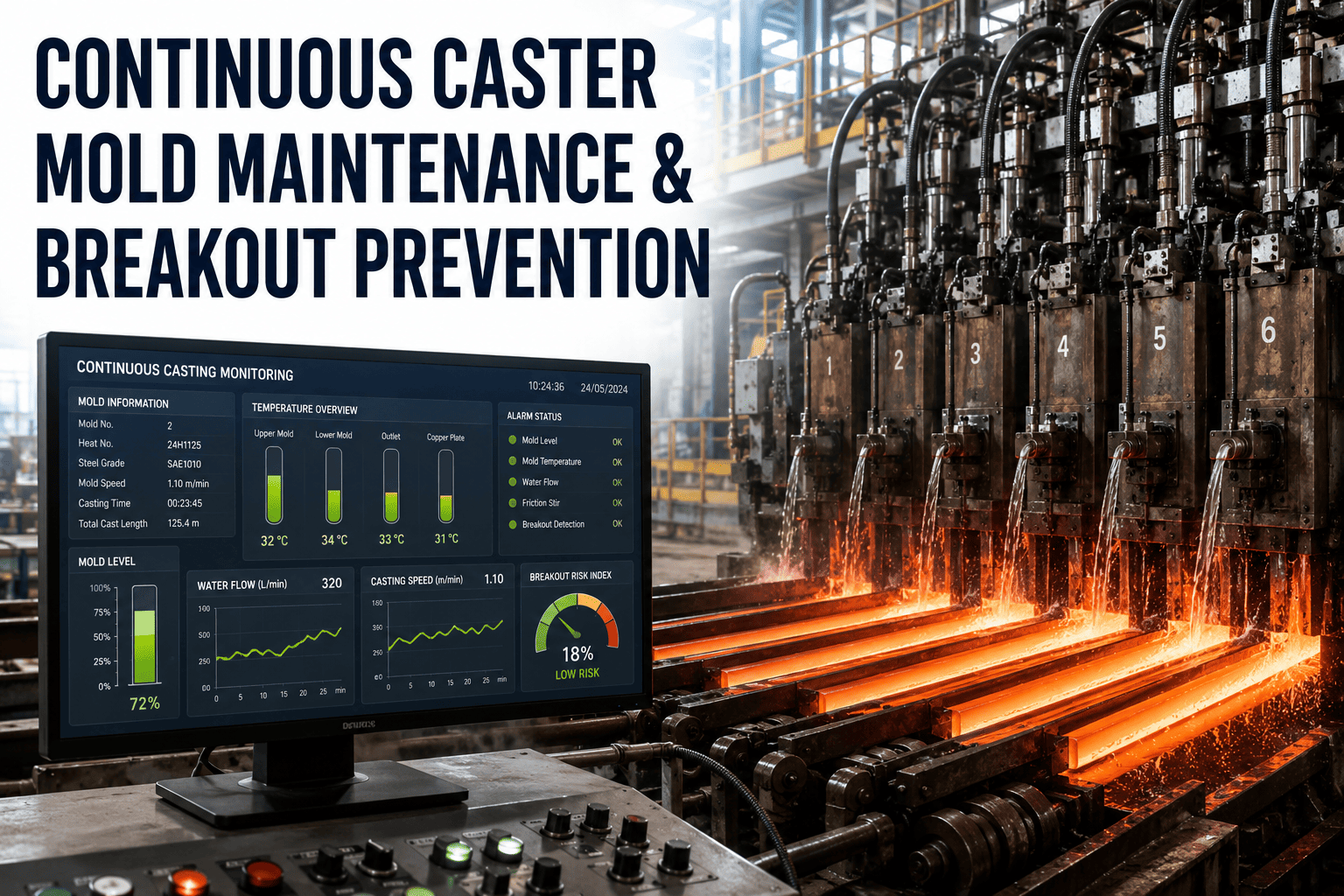
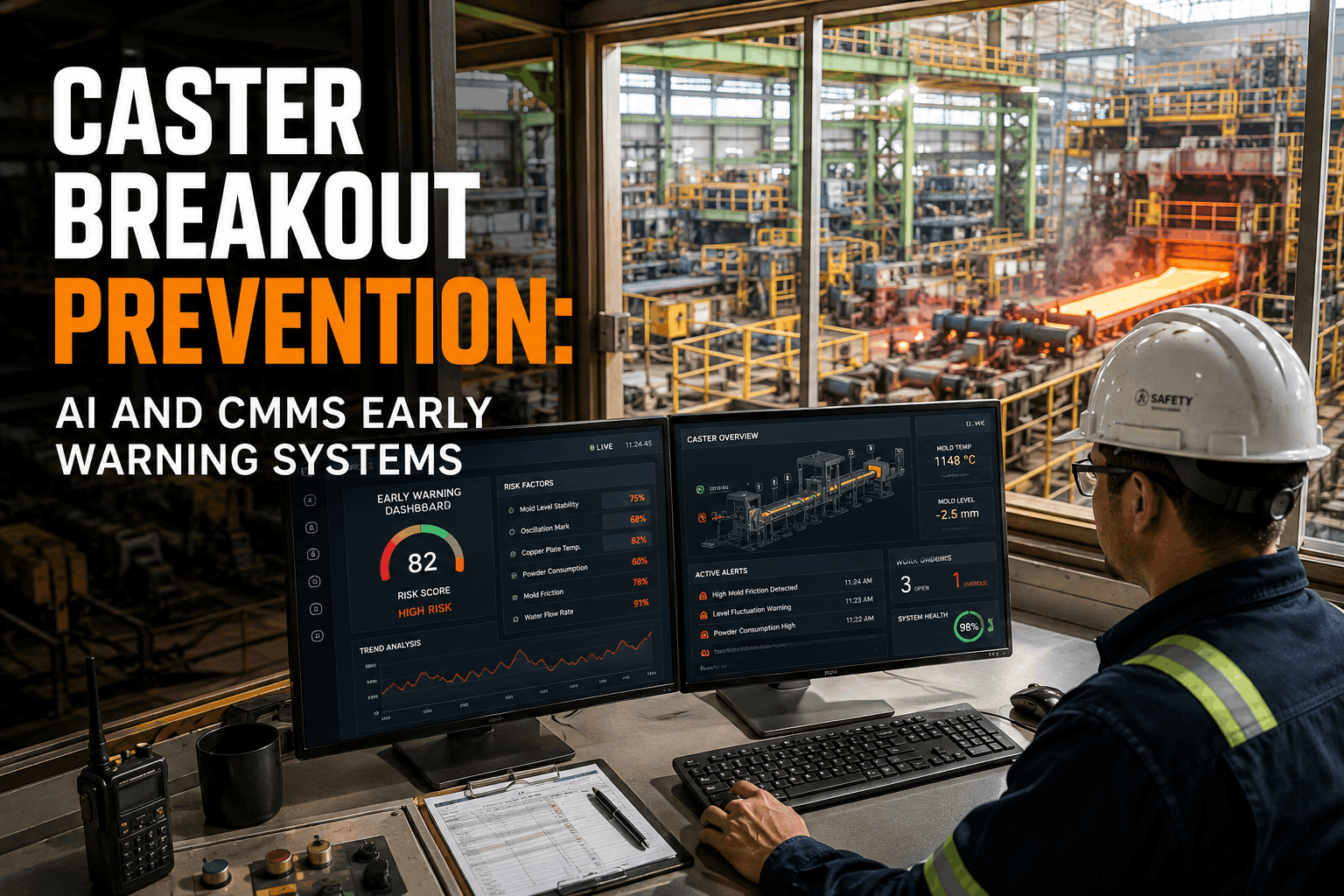
Every caster breakout that occurs in a steelmaking facility was preceded by a detectable sequence of events. Thermocouple anomalies, rising friction indices, oscillation irregularities, and mold level instability are all measurable precursors — the problem is that most facilities lack the infrastructure to connect these signals into a coherent early warning. This article examines how integrating breakout detection systems with a CMMS closes that gap, and why auto-generated work orders triggered by thermocouple and friction data are the practical difference between a near-miss and a full breakout event. Book a demo to see Oxmaint.ai's breakout alert integration in action.
Caster Breakout Prevention: Early Warning Systems & CMMS Integration
For steelmaking engineers and caster operations teams — connecting your early warning system to your maintenance platform is the step that transforms a detection capability into a prevention capability.
The gap between detection and prevention is not a technology problem — it is an integration problem. Facilities with breakout detection systems that are not connected to their maintenance workflows produce alerts that are acknowledged, logged manually, and then lost between shifts. Integrating alert generation directly with CMMS work order creation closes the loop structurally.
How Breakouts Develop: The Precursor Sequence
A sticker breakout — the most common type — begins with strand shell adhesion to the copper plate in the mold. The initiating event is typically a localised failure of the powder/oil lubrication film at the meniscus, causing the solidifying shell to stick momentarily. If the sticker is not detected and the casting speed is not reduced immediately, the shell tears below the mold exit, leading to liquid steel breakthrough at the strand surface within seconds.
The thermocouple array embedded in the mold copper plate is the primary detection instrument. A sticker produces a characteristic thermal signature: one thermocouple temperature rises sharply as the sticking shell drags heat downward, followed immediately by a temperature drop in the thermocouple directly below it as the torn shell releases. This inverted temperature pattern — rising above, falling below — is the diagnostic signature that modern breakout detection algorithms identify in real time.
Once a sticker is detected, the casting team has approximately 8–15 seconds to reduce casting speed and allow the adhesion to release before the shell tears completely. A manual response chain — detection system alarm, operator acknowledgement, speed reduction command — typically consumes 10–20 seconds. Automated speed reduction protocols triggered by the detection system reduce response time to under 3 seconds, which is why auto-response integration is not optional in high-speed casting operations above 1.5 m/min.
Beyond sticker events, breakouts can also originate from longitudinal cracks in the mold shell (detectable through mold heat flux distribution asymmetry), from transverse depressions caused by oscillation irregularities (detectable through friction force monitoring), and from corner cracks caused by inadequate corner cooling or mold taper problems. Each failure mode has a distinct precursor signature — and each requires a different maintenance response. The value of integrating these detection systems with a CMMS is that each alert type can trigger a contextually appropriate work order, not just a generic alarm acknowledgement.
The Four Early Warning Mechanisms
Effective breakout prevention requires monitoring across four independent detection mechanisms. Each provides a different view of caster health, and none is sufficient alone.
Thermocouple Array Monitoring
The mold thermocouple array provides the earliest and most reliable sticker detection signal. Modern detection algorithms analyse temperature gradients between adjacent thermocouples in real time — flagging the inversion pattern that indicates shell adhesion within 1–2 seconds of onset. Array completeness is critical: a single non-responsive thermocouple creates a blind spot that eliminates detection coverage for that mold region. CMMS-integrated thermocouple status tracking ensures maintenance teams are alerted to sensor failures before they create undetected risk.
Friction Force & Oscillation Monitoring
Mold friction is the mechanical resistance between the oscillating mold and the solidifying strand shell. A rising friction index — calculated from the oscillation drive force relative to the casting speed — indicates insufficient lubrication or the early stages of shell adhesion. Friction monitoring provides a leading indicator of sticker risk before thermocouple signatures become visible, particularly in operations using oil lubrication where the lubrication film is less thermally transparent than casting powder.
Mold Heat Flux Distribution
The distribution of heat flux across the mold face — calculated from thermocouple readings corrected for mold cooling water temperature and flow rate — reveals asymmetries that indicate shell thickness non-uniformity. Persistent cold spots on one face indicate inadequate contact or taper problems; hot spots indicate over-rapid heat extraction that accelerates refractory wear. Heat flux trending across sequences enables maintenance engineers to identify developing taper issues before they reach the critical range where breakout risk increases significantly.
Mold Level Instability Tracking
Abnormal mold level fluctuations indicate problems at the submerged entry nozzle — clogging, eccentric flow, or argon injection irregularities — that cause asymmetric meniscus behaviour and localised turbulence. This turbulence disrupts the powder/oil lubrication film and creates the localised adhesion conditions that precede sticker formation. Mold level instability data integrated with the CMMS maintenance schedule enables proactive SEN replacement scheduling before clogging progresses to a casting disruption.
CMMS Integration: Closing the Loop Between Detection and Action
A breakout detection system that issues an alarm but does not automatically generate a maintenance record has documented a problem without creating accountability for its resolution. The integration between detection systems and a CMMS platform like Oxmaint.ai transforms passive alerts into active maintenance workflows — with work orders, assigned technicians, and closure requirements that survive shift changes.
How Oxmaint.ai Handles Breakout Alert Integration
When a detection system event is logged — whether a thermocouple inversion, a friction spike, or a mold level anomaly — Oxmaint.ai creates a timestamped work order with the alert type, severity level, affected mold zone, and the casting sequence reference number automatically. The work order is assigned to the designated maintenance role for that alert category and must be formally closed with a recorded response action before the next sequence begins.
This structured response protocol eliminates the most common breakout risk amplifier in manual systems: the acknowledged-but-not-acted-upon alert that is passed verbally between shifts and forgotten. Every alert becomes a traceable record with an owner, a deadline, and a required closure action.
Thermocouple Trending: From Reactive to Predictive
The most advanced application of thermocouple data integration is not real-time sticker detection — it is predictive trending that identifies developing problems across multiple sequences before an event occurs. A single thermocouple showing a slow upward drift in steady-state temperature over 20 sequences is not an alarm condition in any commercial detection system. But it is a clear indicator of local copper plate wear, reduced contact conductance, or nickel coating degradation that will eventually produce an alarm — and ultimately a breakout — if left unaddressed.
Oxmaint.ai's thermocouple trending module aggregates temperature baseline readings per thermocouple position across sequences, calculates the rolling deviation from the campaign average, and generates a condition alert when any position shows a statistically significant upward trend. This alert creates a maintenance investigation work order — not a casting stop — giving engineers the opportunity to inspect the mold at the next planned maintenance window with specific knowledge of which zone requires attention. Schedule a demo to see how thermocouple trending is configured within the platform.
Connect Your Breakout Detection System to Oxmaint.ai
Transform detection alerts into structured maintenance work orders — with assigned technicians, recorded response actions, and a complete audit trail that survives every shift change.
Disconnected Alerts vs. CMMS-Integrated Breakout Prevention
The operational difference between a breakout detection system running in isolation and one connected to a CMMS platform is the difference between documentation and prevention.
| Capability | Standalone Detection System | Detection + Oxmaint.ai CMMS |
|---|---|---|
| Sticker Event Response | Alarm issued, operator responds manually — 10–20 second response time typical | Auto work order created, response logged, closure required before next sequence |
| Thermocouple Degradation | Failed thermocouples noted in shift log — may be missed across shift handover | Non-responsive sensors flagged as PM items with pre-campaign replacement verification |
| Alert Frequency Trending | No cross-sequence trending — each alert treated as isolated event | Per-zone alert frequency trended across campaigns to identify developing mold wear |
| Maintenance Accountability | Verbal shift handover — no formal closure requirement for acknowledged alerts | Work order assigned with technician attribution and mandatory closure before casting resumes |
| Audit Trail | Detection system log only — not linked to maintenance actions taken | Complete event-to-closure record with timestamps usable for insurance and regulatory submissions |
Swipe to compare on mobile
We had a functioning breakout detection system for three years before we connected it to Oxmaint.ai. In that time, alerts were acknowledged and verbally passed between shifts — but there was no formal record of what was done. After integration, we discovered that several recurring thermocouple anomalies on the same mold zone had been acknowledged across 30+ sequences without anyone ordering a copper plate inspection. The plate was found to have significant meniscus erosion during the next planned maintenance window.— Process Metallurgist, Slab Caster Operation, Central Europe
Frequently Asked Questions
How does Oxmaint.ai receive alert data from a breakout detection system?
Oxmaint.ai supports alert integration through API-based event notifications and manual alert logging within the platform. For facilities where the detection system supports outbound event webhooks or OPC-UA data export, automated work order creation can be configured without operator intervention. For systems without direct integration capability, Oxmaint.ai provides a structured mobile alert logging workflow that ensures each detected event is recorded with sequence reference, zone, and initial response action before the technician leaves the casting floor. Book a demo to discuss integration options for your specific detection system.
Can Oxmaint.ai trend thermocouple data across sequences to identify developing mold wear?
Yes. Thermocouple baseline temperature readings can be logged per position per sequence within Oxmaint.ai's mold asset record. The platform calculates rolling deviations from campaign baselines and generates condition alerts when any zone shows a statistically significant upward trend. These condition alerts create maintenance investigation work orders — not casting stop commands — that direct the next planned inspection to the specific zone showing anomalous behaviour. Start a free trial to configure thermocouple trending for your mold assembly.
Does the platform support multi-strand casters with independent detection systems per strand?
Yes. Each strand is configured as an independent asset within the caster hierarchy in Oxmaint.ai, with its own mold assembly, thermocouple zone structure, and alert history. Work orders generated by alerts on one strand are associated only with that strand's asset record and do not affect the maintenance queue for other strands. Maintenance managers can view alert activity across all strands from a single dashboard to identify patterns that span the full caster operation.
How are friction force anomalies handled differently from thermocouple alerts in the work order system?
Alert categories in Oxmaint.ai are configured independently with different work order templates, assigned roles, and required response actions. A thermocouple inversion alert might trigger a work order assigned to the mold maintenance team with a copper plate inspection requirement. A friction spike alert might trigger a work order assigned to the lubrication system technician with an oil flow rate and nozzle inspection requirement. Each alert type routes to the appropriate maintenance discipline with a contextually appropriate response protocol — not a generic alarm acknowledgement workflow. Book a demo to see the alert category configuration.
Can the audit trail generated by Oxmaint.ai be used for insurance or regulatory submissions?
Yes. Every alert event, work order creation, technician assignment, and closure action is stored with precise timestamps and user attribution in Oxmaint.ai. Reports can be exported by date range, event type, mold zone, or sequence number in formats suitable for insurance claim documentation, regulatory safety submissions, and quality management system audits. The completeness and timestamped attribution of the record meets the evidentiary standards required by most industrial insurance and regulatory frameworks. Start a free trial to review the reporting module.
Your Detection System Needs a Maintenance System Behind It
Breakout detection without CMMS integration produces logs, not prevention. Oxmaint.ai connects the signals your detection system generates to the maintenance actions your team takes — with work orders, accountability, and an audit trail that holds across every shift rotation.