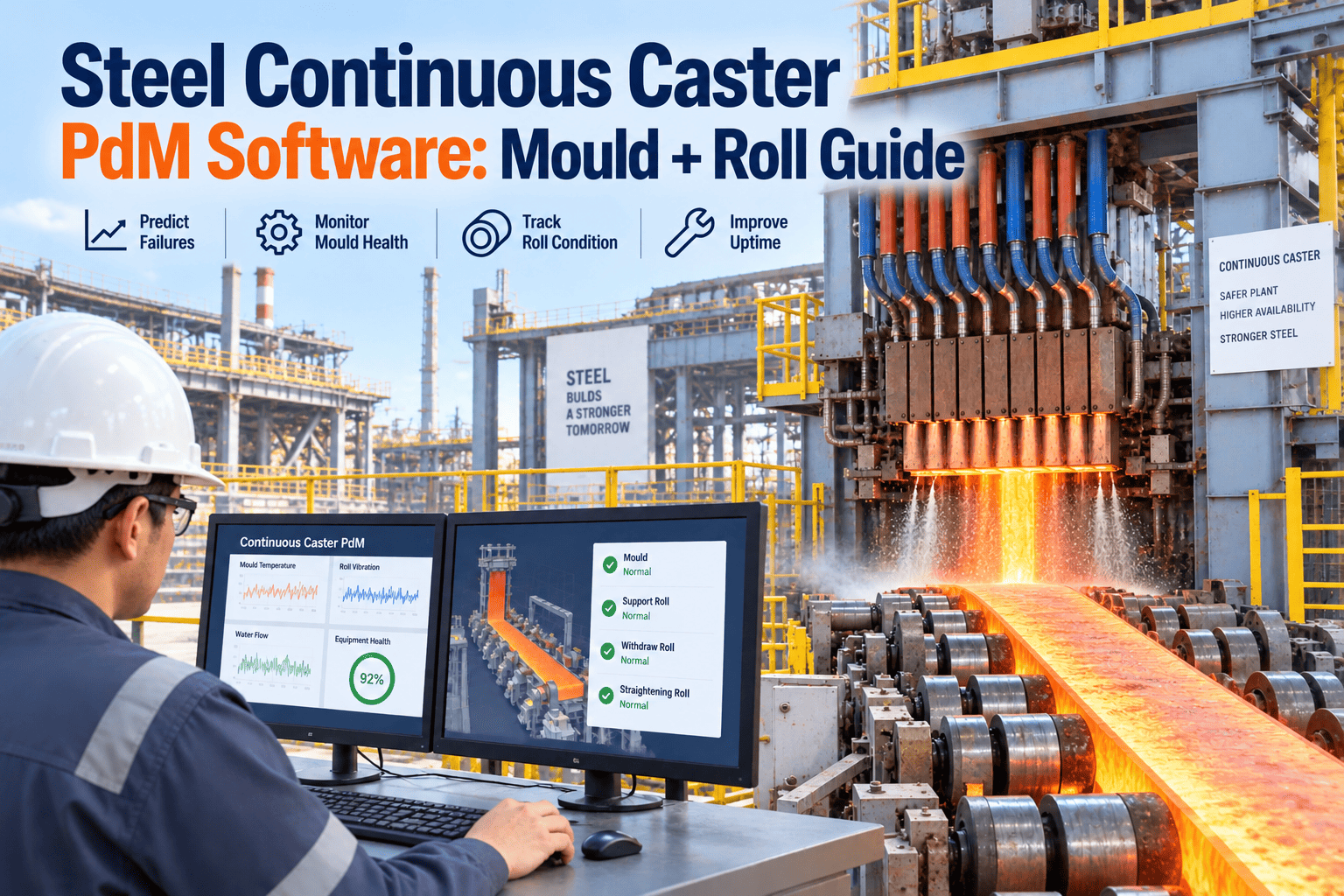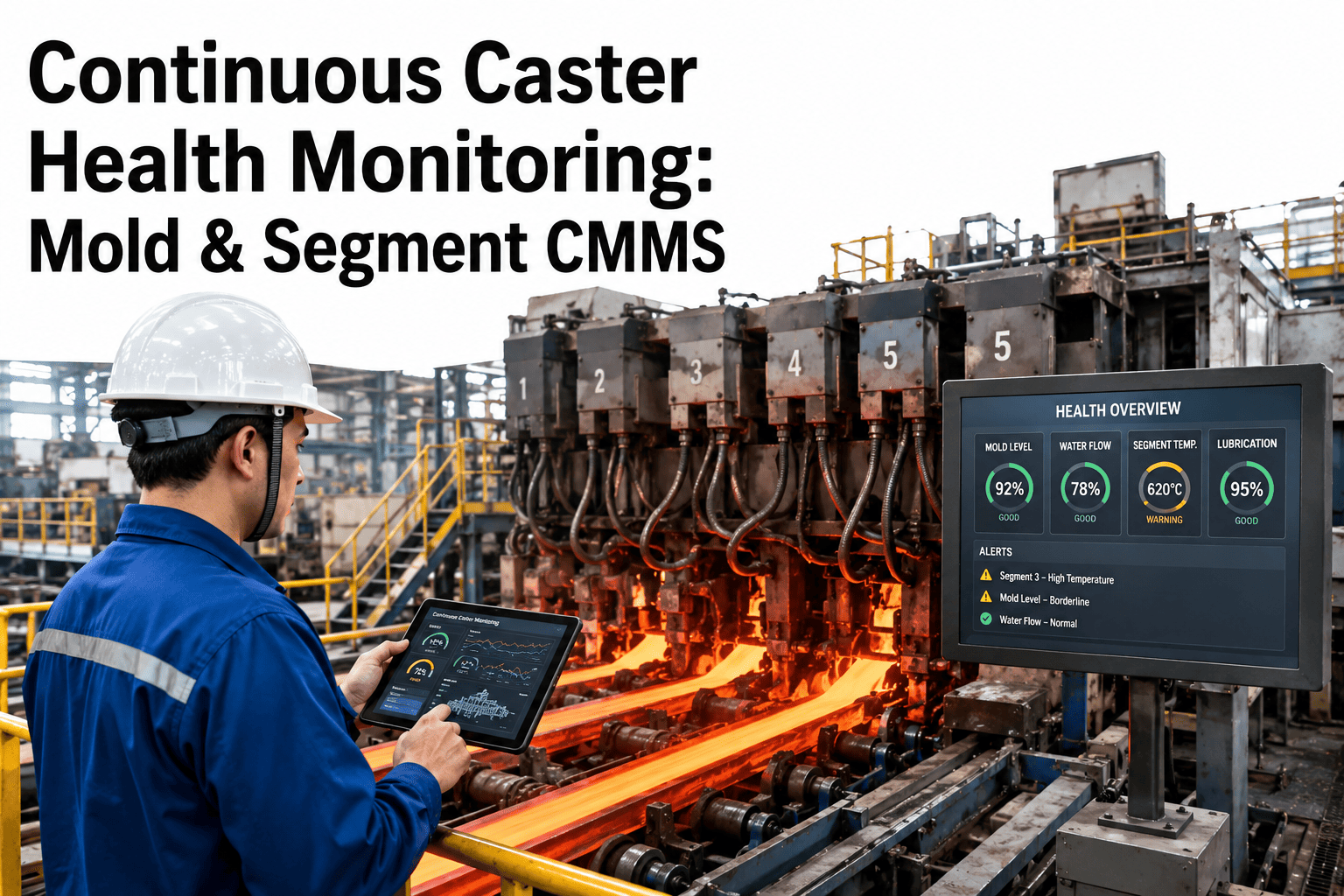
Continuous caster health monitoring is the discipline of tracking mold copper temperatures, segment roll displacement, oscillator vibration and secondary cooling flow in real time so steel mills can predict breakouts before they happen. A single mold breakout on a slab caster can cost $50K–$250K in lost production, refractory damage and cleanup, which is why high-performing mills treat caster condition monitoring not as an add-on but as the core of their reliability strategy. By feeding mold thermocouple data, segment position feedback and roll temperature trends into a CMMS like OxMaint, maintenance teams convert raw sensor signals into scheduled interventions that protect cast rate, surface quality and tonnage. This guide covers the full spectrum of continuous caster monitoring—from mold thermocouple health to segment roll tracking to oscillator condition analysis—and shows how a caster health CMMS turns that data into action. Ready to see it on your assets? Start Free Trial or read on.
Every breakout is preventable when your CMMS listens to the mold, segments and oscillator.
Mold thermocouple deviations, segment roll temperature spikes and oscillator vibration drift appear hours before quality defects or breakouts occur. OxMaint ingests that data, triggers work orders automatically and schedules interventions that protect cast rate and slab quality.
Mold thermocouple monitoring: catching breakouts before they start
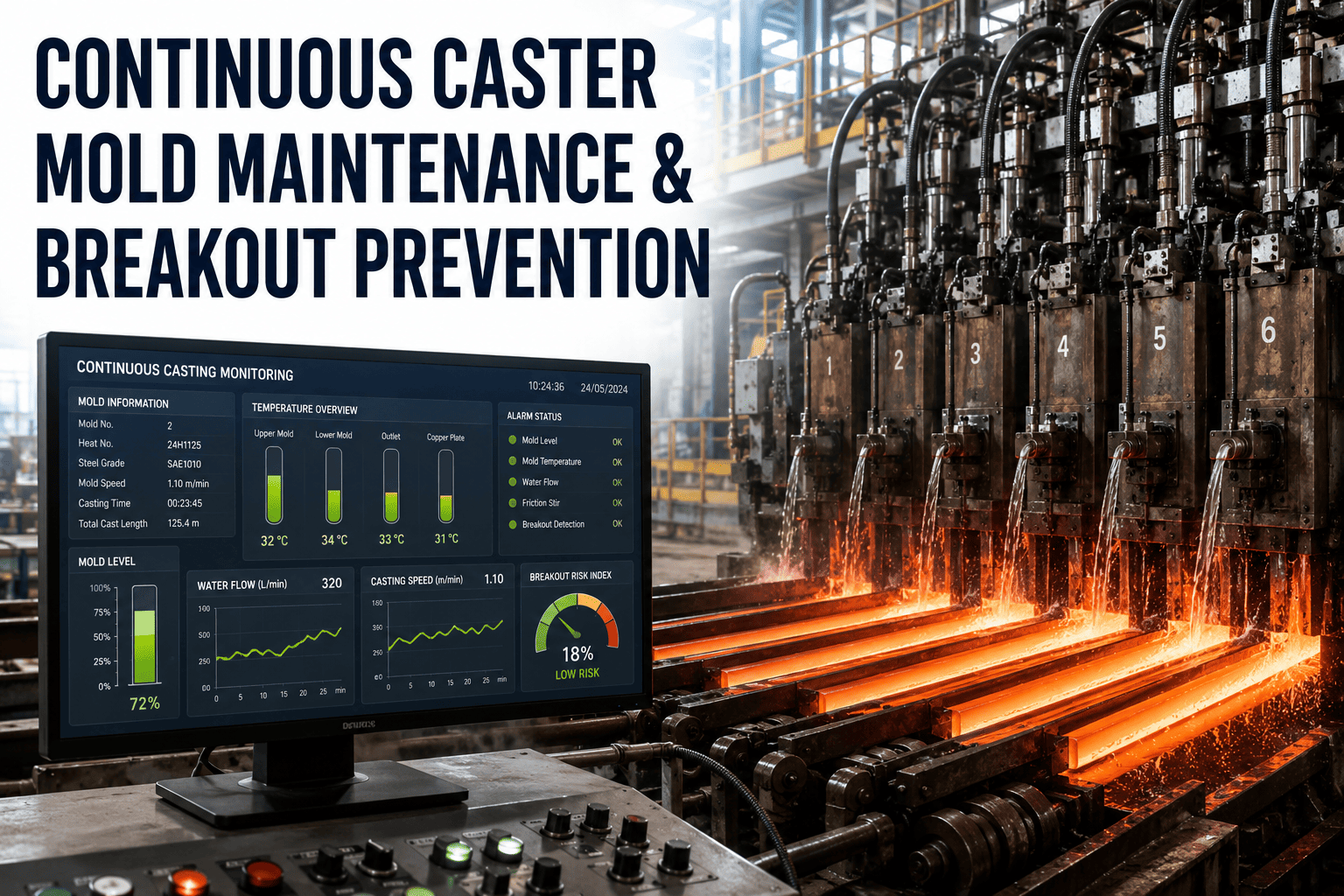
A standard slab caster mold carries 30–80 embedded thermocouples arranged in rows across the copper plates. When breakout shells begin, thermocouple temperatures deviate 8–15°C from baseline in localized clusters — often 3–20 minutes before the shell tears.
Thermocouple Health Tracking
OxMaint logs every thermocouple reading against asset-level baselines. When a cluster deviates beyond configurable thresholds, the CMMS auto-generates a work order tagged to the specific mold position — no manual triage required.
Breakout Prediction Window
Mold thermocouple monitoring detects shell-sticking events 3–20 minutes before a breakout. OxMaint routes alerts to the caster operator and the maintenance shift lead simultaneously, giving both teams time to adjust casting speed or lubrication.
Trend-Based Mold Replacement
Instead of calendar-based mold changes, OxMaint tracks cumulative heat cycles, thermocouple failure counts and copper wear trends to schedule mold offline maintenance at the optimal point — extending mold life 12–18% without risking quality.
Segment roll monitoring: displacement, temperature and alignment
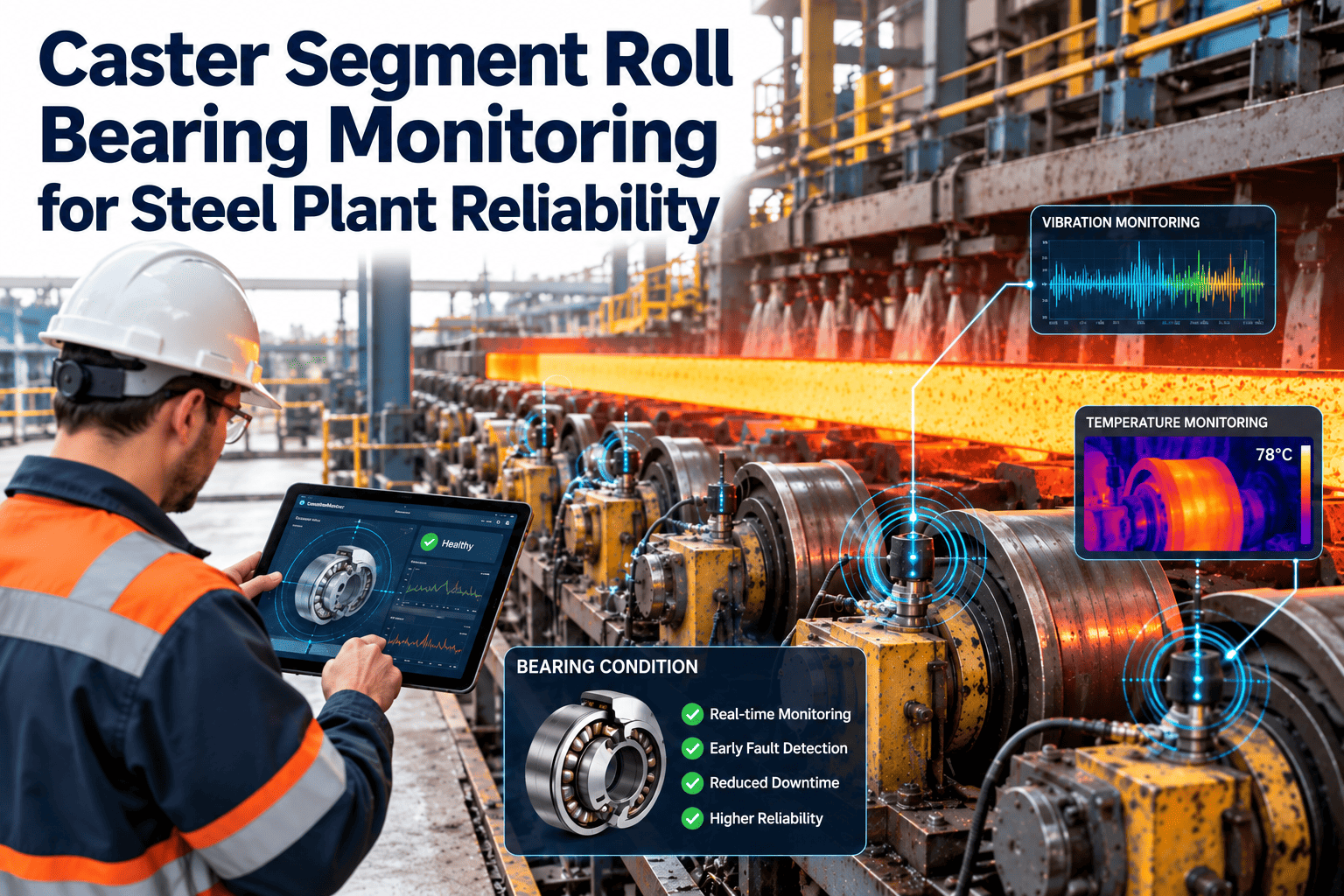
Caster segments guide the solidifying strand through the secondary cooling zone. Roll misalignment of just 0.5 mm can produce surface cracks, while roll bearing failures escalate to strand jams that take 4–12 hours to clear. Continuous caster monitoring tracks three segment health dimensions simultaneously.
Track roll gap deviation across every segment
OxMaint ingests segment position transducer data and flags roll gap deviations beyond ±0.3 mm. When drift is detected, the CMMS generates a segment inspection work order synchronized with the next planned casting gap — so alignment checks happen without losing production time.
Detect bearing failure before seizure
Segment roll temperature rises 20–40°C above baseline when internal bearings degrade. OxMaint monitors roll surface and bearing housing temperatures in real time, triggering predictive work orders when trends exceed ISO 10816 vibration severity thresholds.
Maintain spray nozzle integrity and cooling uniformity
Nozzle blockage or flow imbalance causes uneven solidification and internal cracks. OxMaint tracks secondary cooling flow rates per zone, compares them against metallurgical models and schedules nozzle cleaning or replacement when flow deviation exceeds 8%.
Schedule alignment checks during caster gaps
Strand guide alignment drift compounds over thousands of heats. OxMaint ties alignment measurement data to segment change-out schedules, ensuring that realignment happens during planned maintenance windows — not as an emergency response to quality defects.
Oscillator vibration monitoring: protecting surface quality
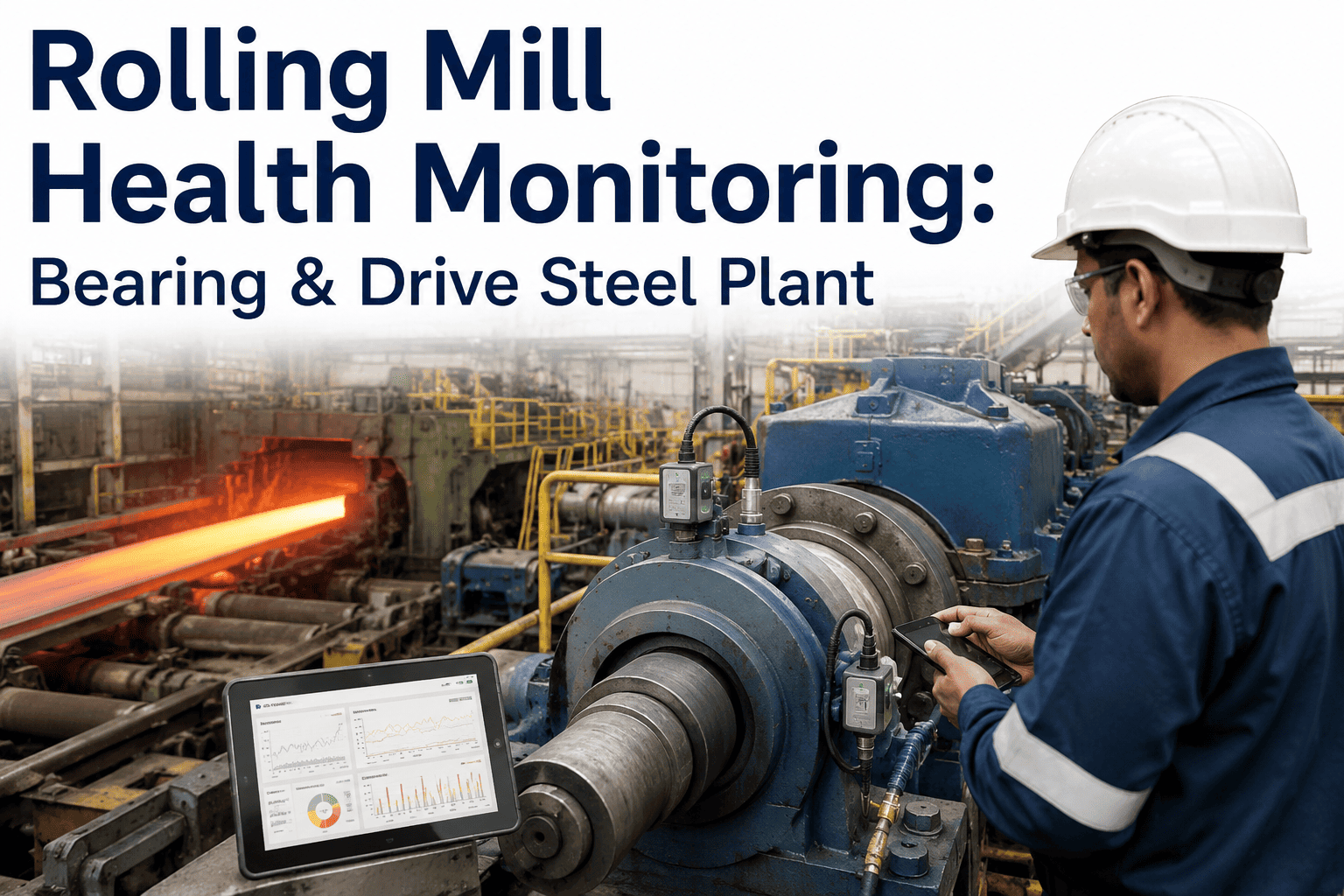
The mold oscillator operates at 50–300 cycles per minute with stroke amplitudes of 4–12 mm. Even small deviations in oscillation frequency, stroke or sinusoidal symmetry produce sticker defects, deep oscillation marks and surface cracks that fail downstream inspection.
| Oscillator Parameter | Healthy Range | Deviation Threshold | Defect Risk If Ignored | OxMaint Action |
|---|---|---|---|---|
| Oscillation Frequency | 50–300 cpm | ±2 cpm | Sticker breakouts | Auto work order + operator alert |
| Stroke Amplitude | 4–12 mm | ±0.3 mm | Deep oscillation marks | Schedule oscillator inspection |
| Sinusoidal Symmetry | 90–100% | Below 85% | Surface cracking | Flag for drive system check |
| Bearing Vibration (ISO 10816) | Zone A/B | Zone C entry | Bearing seizure | Predictive bearing replacement |
| Position Feedback Drift | < 0.1 mm | > 0.2 mm | Stroke instability | Calibration work order |
From caster health data to scheduled intervention
A mid-size steel plant operating two strand casters at 120 heats per day was losing 8–12 hours of production monthly to unplanned segment roll bearing failures and mold thermocouple blind spots. Their maintenance team relied on spreadsheet-based tracking and reactive responses to quality alerts.
Baseline Assessment
OxMaint ingested 14 months of historical mold thermocouple, segment displacement and oscillator vibration data. The AI engine identified 23 early-warning patterns that had preceded previous failures — none of which had been acted on in real time.
CMMS Integration
Sensor thresholds mapped to automated work orders. Segment roll temperature alerts triggered predictive bearing inspections. Mold thermocouple cluster deviations generated breakout-prevention checklists for the casting floor team within 30 seconds.
Measurable Results
Unplanned caster downtime dropped 38%. Mold life extended 14% through trend-based replacement. Zero breakouts over the quarter — down from a baseline of 2–3 per month. The plant recovered $1.2M in annualized production capacity.
Continuous Improvement
OxMaint's analytics engine refined threshold models using accumulated casting data, reducing false positives by 45% and enabling the reliability team to shift from preventive to predictive maintenance across all caster segments and auxiliary systems.
Stop reacting to caster failures. Start predicting them.
See how OxMaint turns mold thermocouple, segment roll and oscillator data into automated work orders that prevent breakouts and extend equipment life.
Caster health CMMS: four capabilities that protect cast rate and quality
OxMaint is an AI-powered CMMS and EAM platform built for maintenance and reliability teams in heavy industry. For steel mills, it connects caster sensor data directly to work order execution — closing the gap between detection and intervention.
Real-Time Sensor Integration
OxMaint ingests mold thermocouple temperatures, segment position data, roll temperatures and oscillator vibration at source. Threshold breaches generate work orders automatically — no manual data entry, no delayed response.
Predictive Maintenance Engine
AI-driven trend analysis on thermocouple degradation, roll bearing vibration and oscillator stroke drift predicts failures 5–30 days in advance. Work orders are generated and prioritized automatically based on risk score and production schedule.
Asset & Inventory Tracking
Track every mold, segment and oscillator as a distinct asset with full maintenance history. Link spare parts — copper plates, bearings, spray nozzles — to each asset so the right parts are reserved when predictive work orders fire.
Maintenance Analytics & KPIs
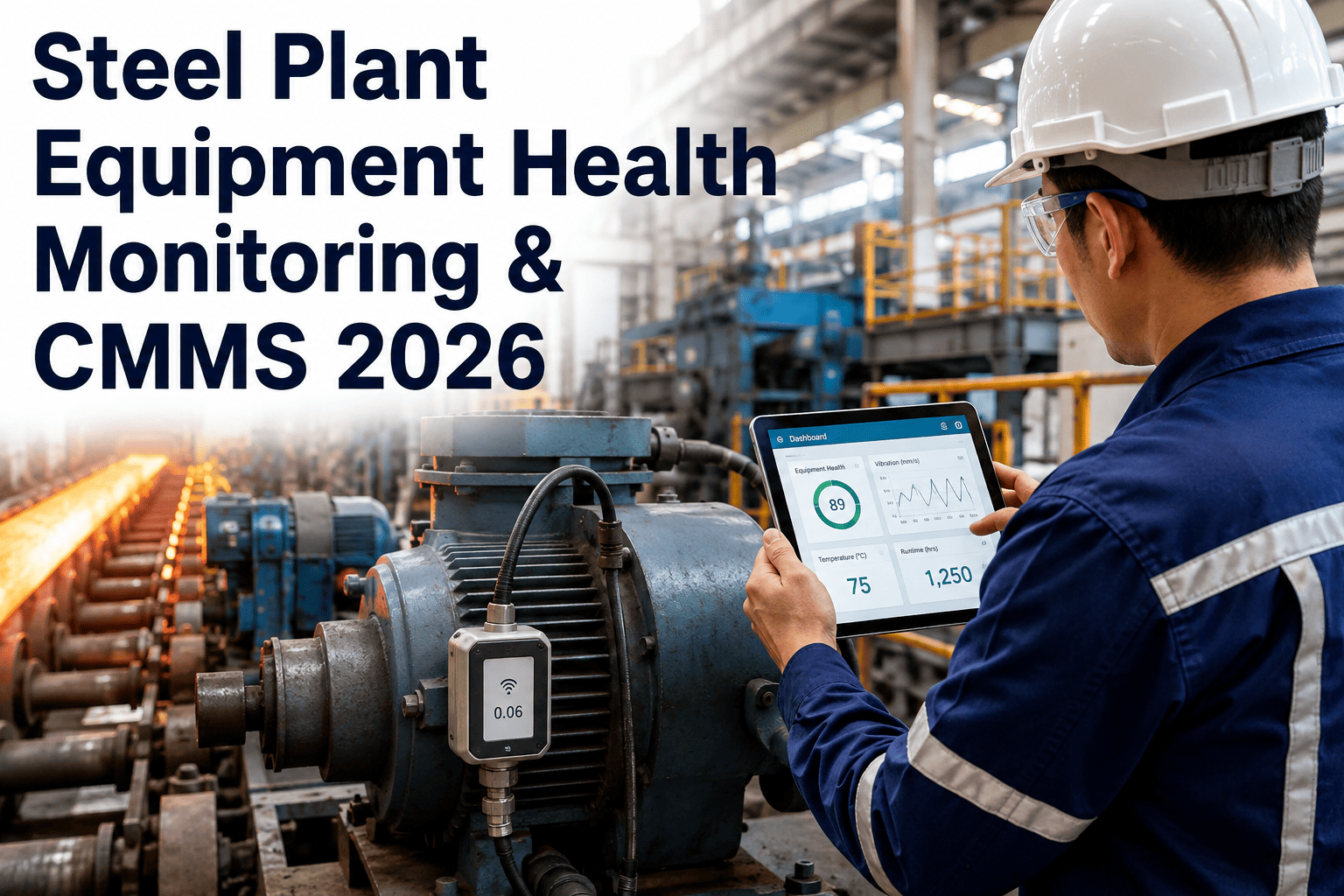
Live dashboards track MTBF, MTTR, OEE and breakout incidents per caster. Reliability teams see which segments, molds and oscillators are trending toward failure — and which interventions actually improved cast rate and quality.
What caster monitoring failures actually cost your mill
When continuous caster monitoring is handled through spreadsheets and operator vigilance alone, the costs compound silently until a breakout or segment seizure forces an emergency stop.
Average loss per slab caster breakout — production tonnage, refractory wear, mold damage and labor hours combined.
Time to clear a jammed strand and replace a failed segment roll — plus 2–4 hours of reheating and sequence restart.
Slabs cast with undetected oscillator or segment drift are downgraded or scrapped, eroding margin on prime-grade output.
A two-strand caster running 120 heats/day with spreadsheet-based monitoring typically loses $1.5M–$2.5M annually to preventable caster failures. OxMaint customers recover 40–60% of that within the first year.
Continuous caster health monitoring: frequently asked questions
What is continuous caster health monitoring?
Continuous caster health monitoring is the real-time tracking of mold thermocouple temperatures, segment roll displacement and bearing conditions, oscillator vibration parameters and secondary cooling flow rates to predict breakouts, quality defects and equipment failures before they occur. A caster health CMMS like OxMaint connects that sensor data directly to automated work orders so maintenance teams can schedule interventions during planned gaps rather than reacting to emergencies.
How does mold thermocouple monitoring prevent breakouts?
Mold thermocouples detect localized temperature deviations of 8–15°C that indicate shell sticking — the precursor to a breakout — typically 3–20 minutes before the shell tears. When OxMaint detects a thermocouple cluster exceeding configured thresholds, it instantly generates an alert and work order so operators can reduce casting speed, adjust mold flux or take corrective action. You can see this in action — Book a Demo and we'll walk you through a live scenario.
Which caster parameters should a CMMS track for segment health?
A caster segment CMMS should track roll gap displacement (deviation beyond ±0.3 mm signals misalignment), roll surface and bearing housing temperatures (20–40°C above baseline indicates bearing degradation), secondary cooling nozzle flow rates per zone (deviation beyond 8% means blockage or imbalance) and strand guide alignment measurements. OxMaint ingests all four data streams and ties them to segment-specific work orders and change-out schedules.
How much does unplanned caster downtime cost a steel mill?
A single mold breakout costs $50K–$250K in lost production, refractory damage and cleanup. Segment roll seizures typically cause 4–12 hours of unplanned downtime, and at a two-strand caster producing 120 heats/day, each hour of lost production can represent $6K–$10K in margin. Mills using reactive maintenance commonly lose $1.5M–$2.5M annually to preventable caster failures. Start your Start Free Trial to calculate your specific exposure.
Can OxMaint integrate with existing caster sensor and PLC systems?
Yes. OxMaint connects to existing mold thermocouple arrays, segment position transducers, oscillator vibration sensors and secondary cooling flow meters through standard industrial protocols. The platform ingests data at source, applies AI-driven threshold models and generates work orders without requiring operators to manually enter readings or switch between systems.
Put your caster health data to work.
Book a 30-minute demo and see how OxMaint turns mold thermocouple, segment and oscillator monitoring into automated work orders that prevent breakouts, extend equipment life and protect your cast rate.
Free 14-day trial · No credit card