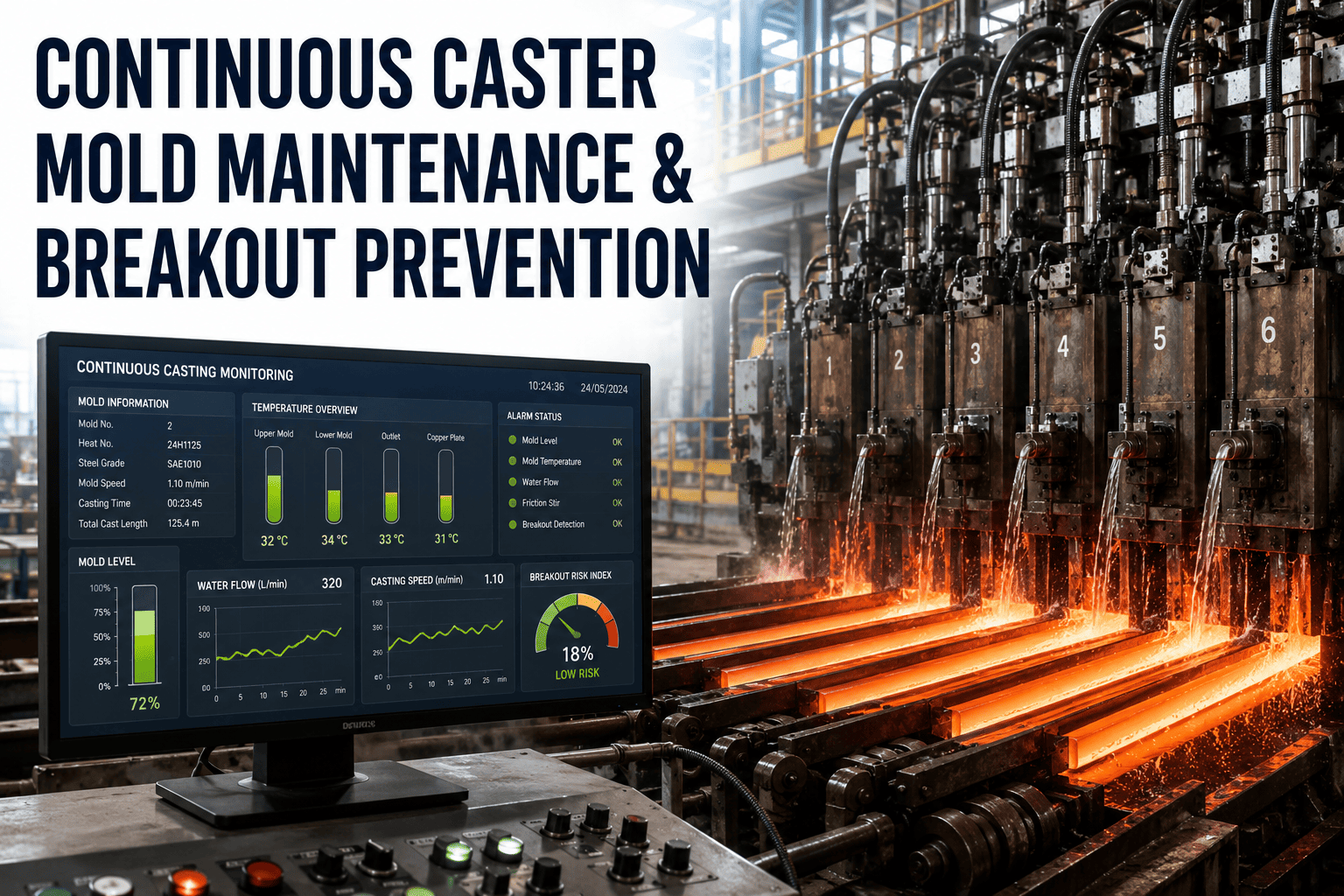
A single caster breakout in continuous steel casting costs between $2 million and $5 million in direct and indirect losses—yet 68% of steelmakers still rely on reactive response systems instead of predictive monitoring. Casting breakouts occur when molten steel escapes the mold or strand due to undetected level fluctuations, mold oscillation failures, thermal stress, or sticker breakouts. Without real-time mold level monitoring, thermocouple sensing, and predictive shutdown algorithms, incoming crews lack the visibility to prevent catastrophe. Start Free Trial with Oxmaint's caster breakout prevention module to monitor mold condition in real time, detect level loss acceleration, and enable predictive shutdown before molten steel damages the machine. Schedule a Demo to see how top steelmakers reduce caster breakouts by 75–90% through structured CMMS-driven mold condition tracking, automated alarm logic, and predictive intervention workflows. This comprehensive guide provides casting engineers and production managers with a framework to standardize mold monitoring, embed predictive thresholds, and eliminate the information gaps that lead to $2M+ breakout events.
The Economics of Caster Breakouts: Why Prevention Is Exponentially Cheaper Than Recovery
Continuous casting is the most capital-intensive, automation-dependent process in integrated steelmaking. A single breakout halts casting for 48–96 hours, destroys mold components (copper plates, oscillation system), creates extensive strand surface damage requiring grinding or cutting, contaminates surrounding equipment, and often triggers secondary failures in cooling water systems or strand support rolls. The financial impact cascades across multiple cost centers. Direct costs include emergency mold replacement ($200k–$400k), strand damage rework ($150k–$300k), machine cleanup and recalibration ($100k–$200k), and lost steel production (250–400 tons × $1,200/ton = $300k–$480k). Indirect costs include reduced caster availability (24–48 hour minimum), extended downstream finishing delays, inventory disruption, and safety investigation expenses. Start Free Trial to deploy real-time mold level monitoring that detects deviation acceleration and triggers shutdown before molten steel escape. Plants implementing predictive caster monitoring cut breakouts by 75–90%, eliminating $2M–$5M in annual catastrophe costs while improving caster availability by 4–8 percentage points—translating to 30,000–50,000 additional tons of saleable steel annually.
Root Cause Analysis: Why Breakouts Occur and Early Warning Signals
Caster breakouts are not random—they follow predictable warning patterns. Mold level oscillations accelerate, thermocouple readings spike, strand surface temperature deviates, and oscillation frequency changes hours before molten steel escapes confinement. Schedule a Demo to see how Oxmaint consolidates real-time mold sensor data and flags convergent failure patterns that human operators miss in the moment.
Uncontrolled mold level fluctuations (±5mm or greater) indicate imminent level loss. Without continuous level sensing and feedback control, deviation accelerates until molten steel overflows mold dam.
Mold oscillation frequency or amplitude degradation reduces heat transfer and allows hotspot formation. Mechanical wear, hydraulic drift, or electronic controller failure goes undetected without continuous monitoring.
Mold thermocouple temperatures exceed safe limits (>250°C copper face temperature typically) indicating mold powder breakdown or inadequate cooling. Escalating temperature predicts imminent mold damage.
Strand surface sticking to mold during oscillation prevents normal heat transfer and causes localized hotspots. Detected by thermocouple deviation and acoustic signature; requires immediate casting speed reduction.
Mold powder consumption rate spikes or composition drift accelerates thermal failure. Manual powder level checks miss gradual depletion until cooling efficiency collapses.
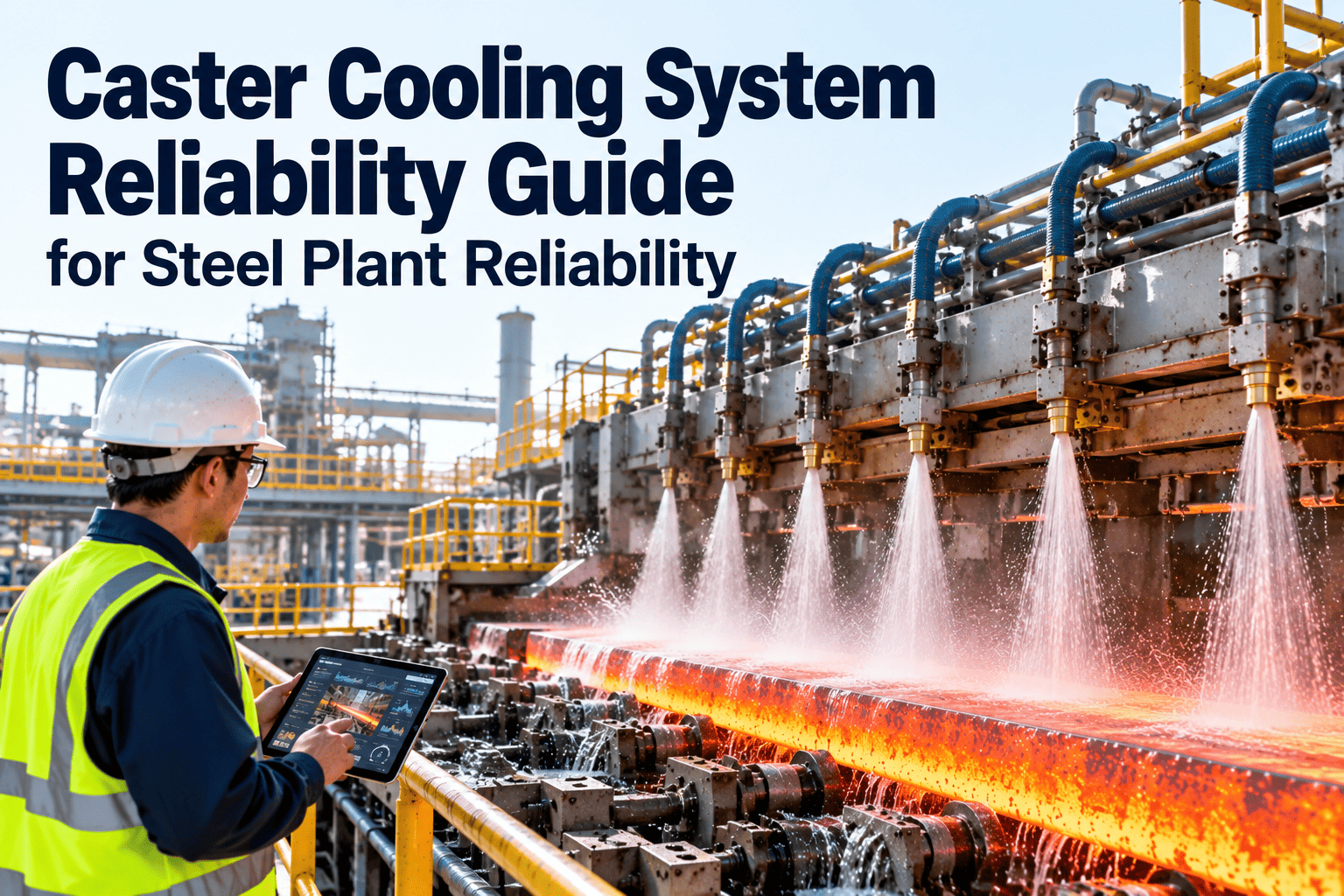
Loss of primary or secondary cooling water flow, even brief, causes mold temperature spike within seconds. Without automated flow and temperature monitoring, loss goes undetected for minutes.
Caster Breakout Prevention Framework: Critical Monitoring Elements and Standards
Caster operators and reliability engineers implementing structured breakout prevention standardize sensor data collection, establish real-time alarm thresholds, and embed predictive shutdown logic into production control systems. The table below outlines critical monitoring elements, failure modes they detect early, and measurable production impact from implementation.
| Mold Monitoring Element | Failure Mode Detected | Structured Prevention Practice | Monitoring Frequency | Breakout Prevention Impact |
|---|---|---|---|---|
| Real-Time Mold Level Sensing | Uncontrolled level oscillation, overflow risk | Continuous capacitive or radiometric level sensor with feedback control and ±2mm setpoint accuracy | Continuous (≥100ms update) | Eliminates unplanned overflow; enables precision level maintenance; 50–70% reduction in near-miss events |
| Thermocouple Monitoring | Mold copper face overheating, powder breakdown | Multi-zone thermocouple array with automated alert escalation at 200°C, shutdown trigger at 250°C | Continuous with ≥1sec resolution | Early intervention prevents mold damage; detects cooling water loss within 10–20 seconds |
| Oscillation System Health Tracking | Frequency/amplitude drift, hydraulic failure | Continuous oscillation sensor with mechanical and electrical parameter logging; deviation alert if frequency ±2% from setpoint | Per casting event | Predictive intervention prevents secondary sticker formation; maintains consistent heat transfer |
| Cooling Water Flow and Temp Monitoring | Loss of primary or secondary cooling, thermal stress | Flow and temperature sensors on primary and secondary circuits with automatic casting ramp-down if flow loss >5% | Continuous (≥10sec update) | Automated response prevents mold thermal shock; zero undetected cooling loss events |
| Strand Surface Temperature Trending | Hotspot formation, sticker risk, thermal anomaly | Infrared imaging with zone-based temperature thresholds and motion detection to flag asymmetric cooling | Continuous for multi-strand casters | Detects sticker and hotspot conditions 5–15 minutes before mechanical failure; enables preemptive speed reduction |
| Mold Powder Consumption Tracking | Powder depletion, degraded cooling performance, thermal runaway | Automated or manual powder level log linked to powder consumption rate trending and alert when consumption spikes >20% | Per casting sequence or continuous measurement | Prevents casting with inadequate powder coverage; reduces thermal incidents 30–50% |
| Predictive Shutdown Automation | Operator delay or failed decision in breakout escalation scenario | Automated casting shutdown when alarm convergence detected (e.g., temperature + level deviation + oscillation drift all within threshold window) | Real-time decision logic | Shutdown triggers within 30–60 seconds of critical condition onset; 75–90% reduction in full breakout events |
Building Caster Breakout Prevention with Predictive CMMS
Steelmakers operating the most reliable continuous casters standardize real-time mold monitoring, establish automated alarm escalation, and embed predictive shutdown triggers into production control. Schedule a Demo to see how Oxmaint integrates sensor data, establishes convergent failure pattern detection, and enables predictive intervention before molten steel escape.
- Install capacitive or radiometric level sensors on primary and secondary mold circuits with ±2mm accuracy and ≥100ms update frequency
- Configure automated tundish shroud level feedback to maintain setpoint within ±5mm and escalate alert if deviation exceeds threshold
- Integrate level sensor data directly into CMMS and production control system for real-time visibility across all casting positions
- Deploy thermocouple arrays across mold copper face (minimum 4–6 zones) with continuous temperature logging and ≥1 second sensor resolution
- Establish alert thresholds: 200°C warning (immediate investigation), 250°C casting speed reduction trigger, 280°C automatic casting shutdown
- Link thermocouple alarms to CMMS and automatic notification to control room, operations, and reliability teams with context-specific guidance
- Install oscillation frequency and amplitude sensors to detect mechanical or hydraulic degradation with automated deviation alert if ±2% from setpoint
- Deploy flow and temperature sensors on primary and secondary cooling circuits with automatic casting ramp-down if flow loss exceeds 5%
- Configure convergent failure logic: if mold temp + level deviation + oscillation drift + cooling anomaly occur within same 5-minute window, trigger automated shutdown
- Implement infrared imaging system for real-time strand surface temperature trending across multiple zones with automatic hotspot detection and speed adjustment logic
- Track mold powder consumption rate and flag anomalies (>20% spike from baseline); link to casting control for preemptive ramp-down when powder depletion detected
- Create operator dashboard and mobile alerts showing real-time breakout risk score (composite of level, temperature, oscillation, flow metrics) enabling preemptive intervention
Caster Breakout Prevention Best Practices and Quick Wins
Caster Reliability KPIs and Breakout Prevention Targets
Steelmaking operations tracking breakout prevention KPIs directly link predictive monitoring investment to production throughput and asset reliability. Start Free Trial with Oxmaint's caster analytics dashboard to monitor breakout risk in real time and execute predictive interventions.
Total unplanned casting stops due to breakout. Best-in-class mills achieve < 0.2. Each event costs $2M–$5M. Mills deploying predictive monitoring cut breakouts by 75–90%.
Percentage of scheduled casting time machine is actually running. Breakout prevention adds 4–8 points; each point = 30,000–50,000 tons additional annual production.
Number of heats per mold before thermal or mechanical damage requires replacement. Predictive monitoring reduces thermal stress and extends mold life by 20–30%.
Count of mold temperature alerts per million heats. Stable or decreasing indicates controlled conditions. Rising trend predicts imminent breakout risk.
Count of times cooling flow dropped >5% without automatic alert and response. Automated flow monitoring should prevent all undetected losses.
Percentage of automated or operator interventions that prevent breakout occurrence. Success >80% indicates effective early detection and control response.
Customer Impact: Preventing Breakouts and Recovering Production Economics
"Our 3-strand caster experienced 2–3 breakouts per year, averaging $3.5M per event in losses. After implementing Oxmaint with continuous level monitoring, thermocouple arrays, and automated shutdown logic, we detected and prevented what would have been 8 potential breakouts in the first 18 months alone. We've had zero unplanned breakouts since deployment. That's $28M in cost avoidance. Caster availability improved from 88% to 96%, adding 200,000 tons of annual production capacity. The Oxmaint system paid for itself in the first 6 weeks."