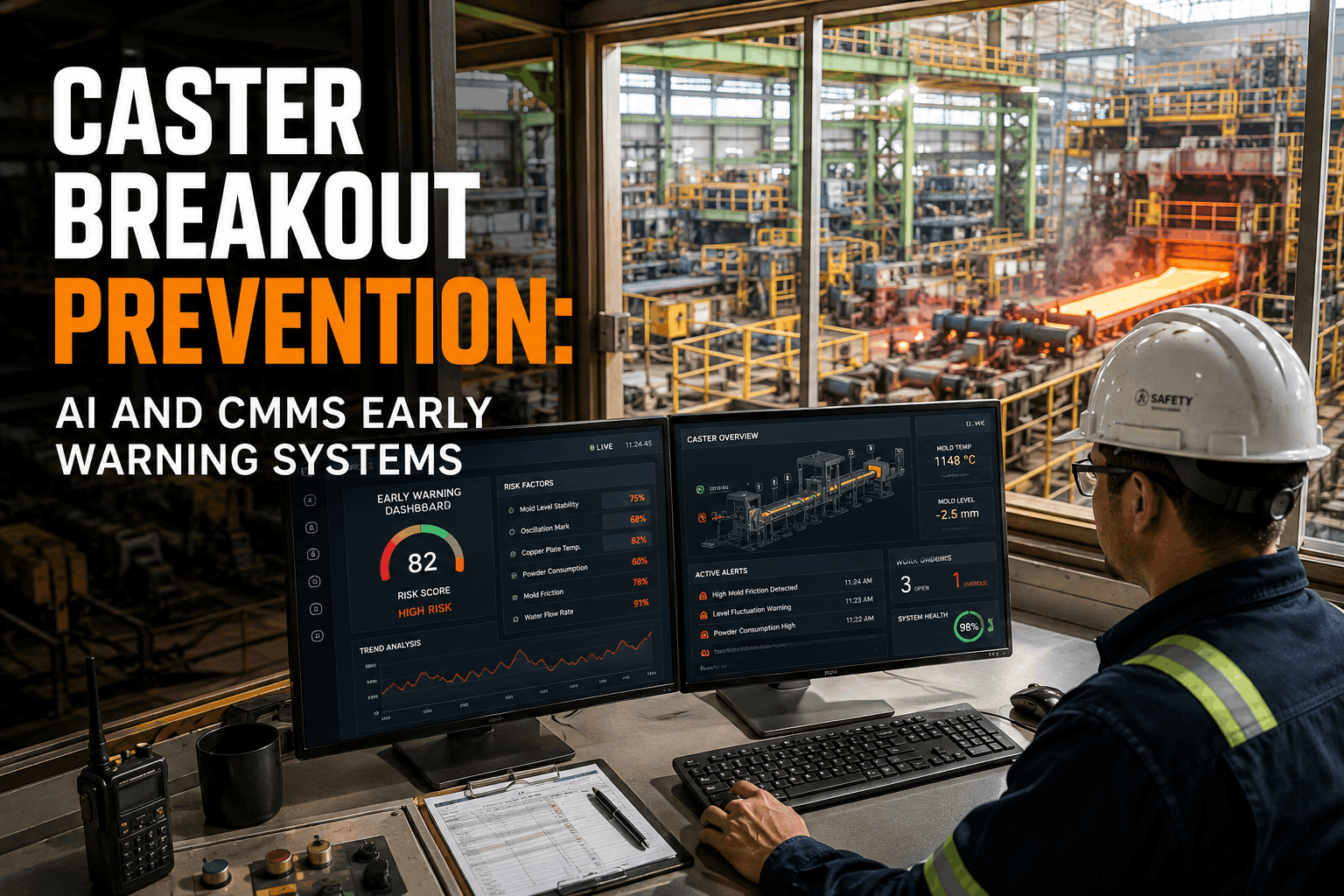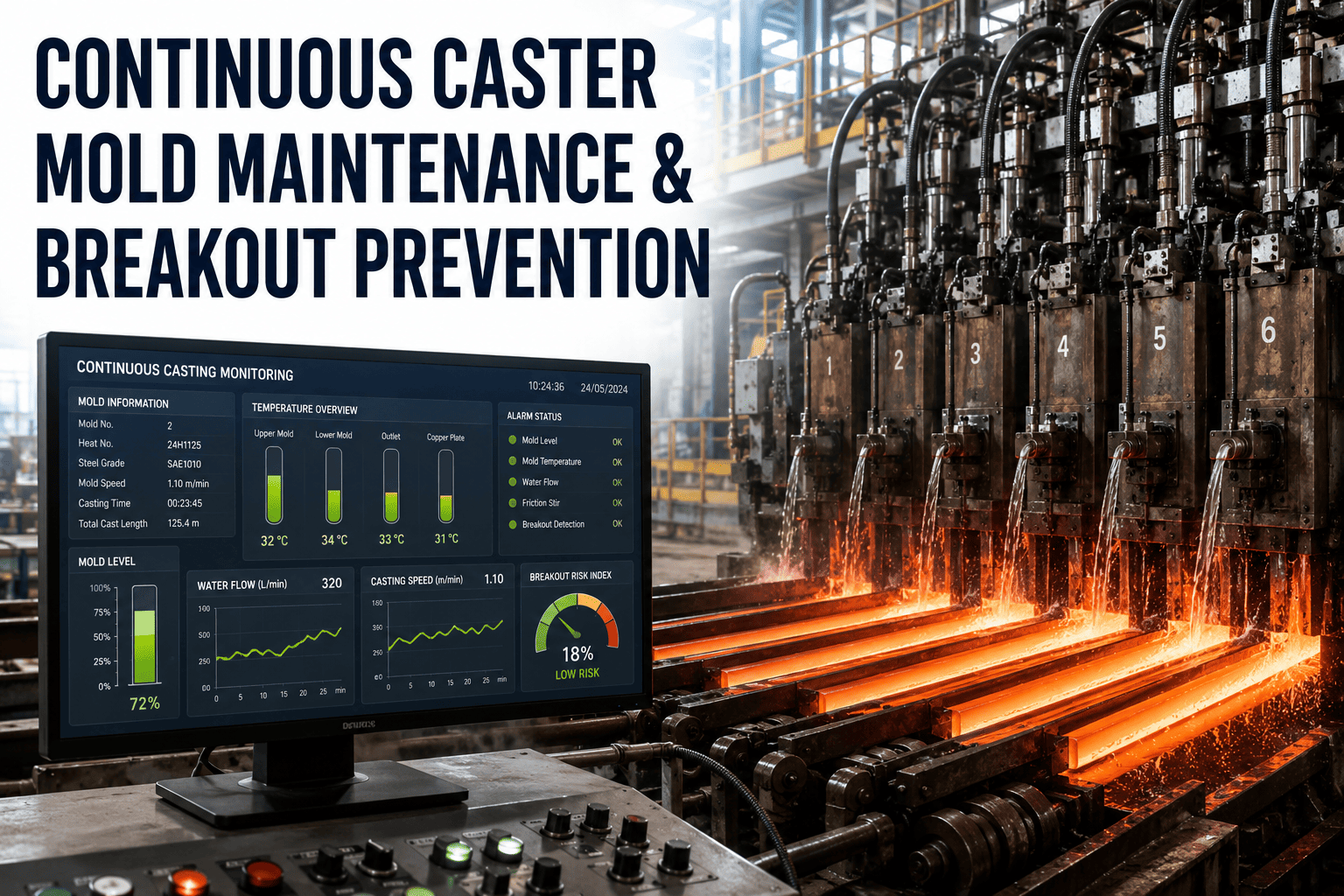
Continuous caster mold maintenance is the single highest-leverage discipline in a steel plant — a well-maintained mold prevents breakouts, preserves surface quality, and sustains cast rate across thousands of heats. Breakout prevention depends on tracking copper plate wear, verifying thermocouple integrity, monitoring mold friction, and executing disciplined oscillation PM on every shift. Mills that still rely on spreadsheets and clipboards typically experience 30–50% more mold-related downtime than those using a dedicated caster mold CMMS. OxMaint brings AI-powered work-order automation, predictive analytics, and asset tracking into one platform so your reliability team can catch mold degradation before it becomes a breakout — Start Free Trial and see the difference on your own caster.
Caster Mold Maintenance & Breakout Prevention
Is a single mold breakout costing your mill over $200K per incident?
A sticker breakout on a billet caster can drain $50K–$500K in lost steel, refractory damage, and 4–12 hours of unplanned downtime. OxMaint helps reliability teams predict mold failure before it happens — tracking thermocouple health, copper wear, friction trends, and oscillation PM in one AI-powered CMMS built for steel plants.
Why Mold Condition Drives Everything
The Real Cost of a Caster Breakout
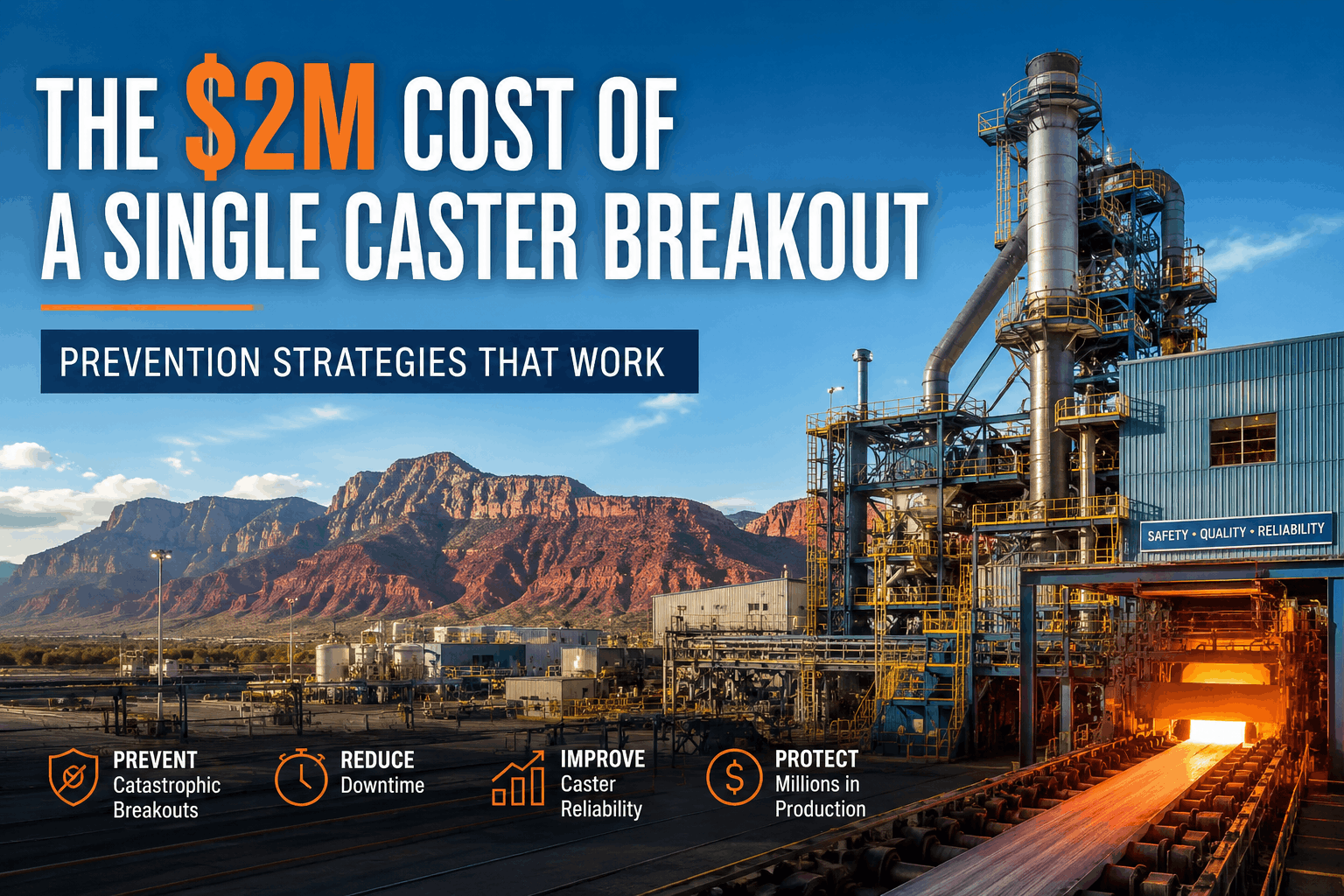
A breakout is not just a steel leak — it is a cascading production loss. When liquid steel breaches the solidifying shell, the strand drops, the tundish stops, and the caster can sit idle for a full shift. Industry data shows that a single sticker breakout on a slab caster costs $200K–$500K in scrap, refractory, mold tube replacement, and lost tonnage. On a billet caster, the bill still runs $50K–$120K. Mills casting 6–10 heats per hour lose $15K–$25K in revenue for every hour of caster downtime.
The discipline that separates world-class casters from struggling ones is mold maintenance rigor. Top-tier mills measure taper after every campaign, trend thermocouple arrays in real time, and schedule oscillation PM before friction drifts past 5%. Mills still tracking mold life on a whiteboard typically replace tubes 15–20% too late — right when breakout risk spikes.
Copper Plate Wear & Taper Measurement
How to Track Mold Copper Wear and Taper Loss
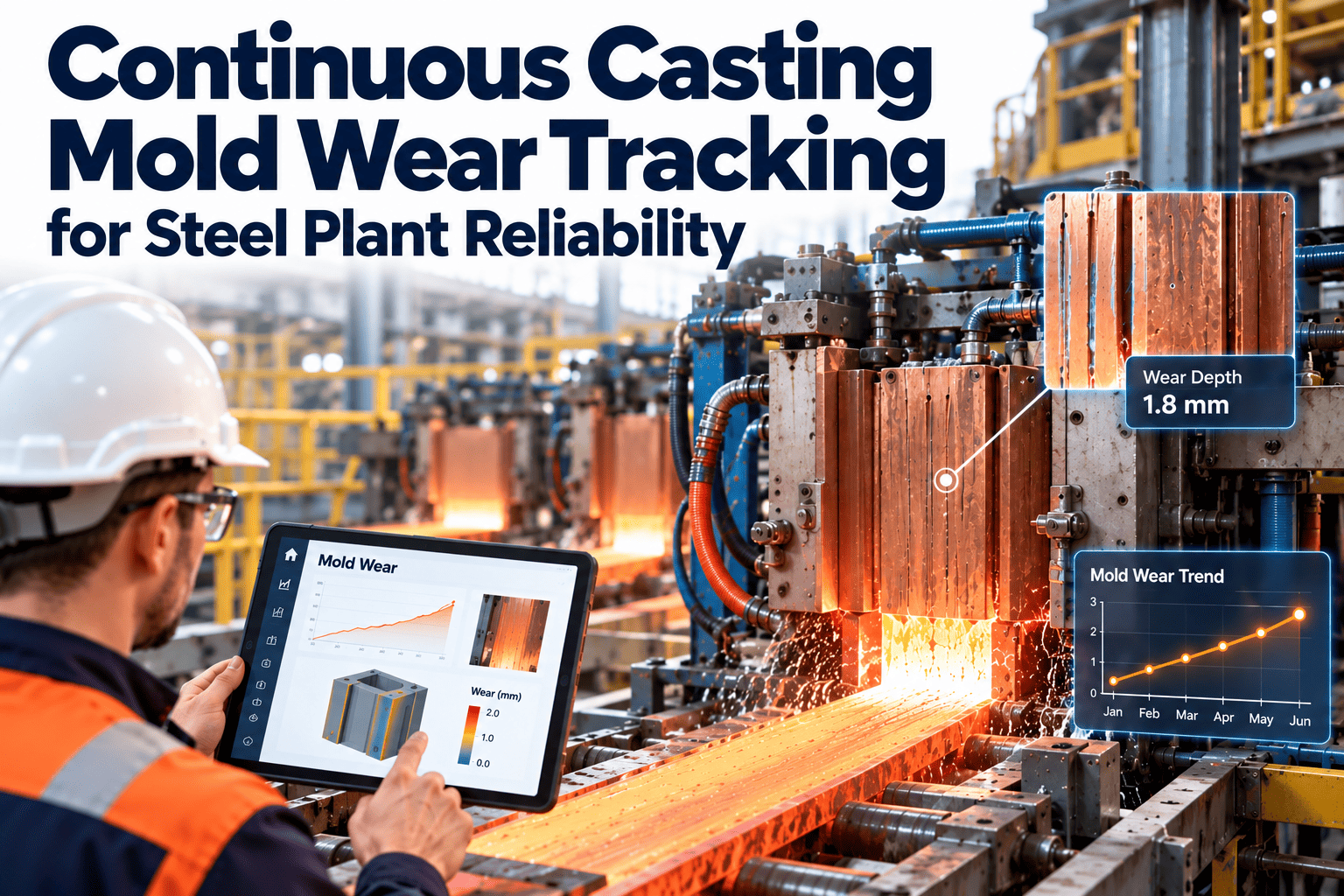
Mold copper plates are precision components — a parabolic taper of 0.7–1.2%/m guides the solidifying shell downward without sticking. As copper wears, taper narrows, friction rises, and the risk of a sticker breakout climbs. A mold with 0.3 mm of copper wear at the meniscus has already lost 15–20% of its designed taper — a critical threshold that demands immediate attention.
Measure copper plate thickness at the meniscus zone after every campaign using a calibrated ultrasonic gauge. Flag any wear exceeding 0.25 mm for taper correction or tube change-out.
Run a taper gauge through the full mold length after every 200–300 heats. Compare the measured profile against the original design — deviation beyond 0.15%/m increases sticker risk by up to 3×.
Inspect copper faces for thermal fatigue cracks longer than 5 mm using dye-penetrant testing. Cracks at the meniscus propagate quickly and degrade heat transfer by 10–15%.
Verify Ni-Cr or ceramic coating thickness on narrow faces. Coating wear below 50 µm accelerates copper erosion and shortens mold life by 200–300 heats.
Confirm uniform cooling water gap (typically 4–5 mm) between copper and water jacket. Asymmetric gaps cause uneven heat extraction and shell thinning — a leading precursor to corner cracking.
Record copper plate back-wall temperatures at 20-heat intervals. A 5–8°C rise from baseline signals scale buildup or reduced water flow that degrades heat transfer and raises breakout probability.
Worked Example
A 4-strand billet caster running 320 heats/day
Without a mold CMMS, this mill replaced mold tubes on a fixed 1,000-heat schedule. Thermocouple data later revealed that 2 of 4 strands showed taper loss exceeding 0.2%/m by heat 750 — meaning 250 heats were cast at elevated breakout risk. After implementing OxMaint with heat-by-heat taper trending, the mill shifted to condition-based change-outs and cut mold-related downtime 38% in the first quarter while extending average tube life by 120 heats.
Thermocouples, Friction & Oscillation
Mold Condition Monitoring: Thermocouple Arrays & Friction Trending
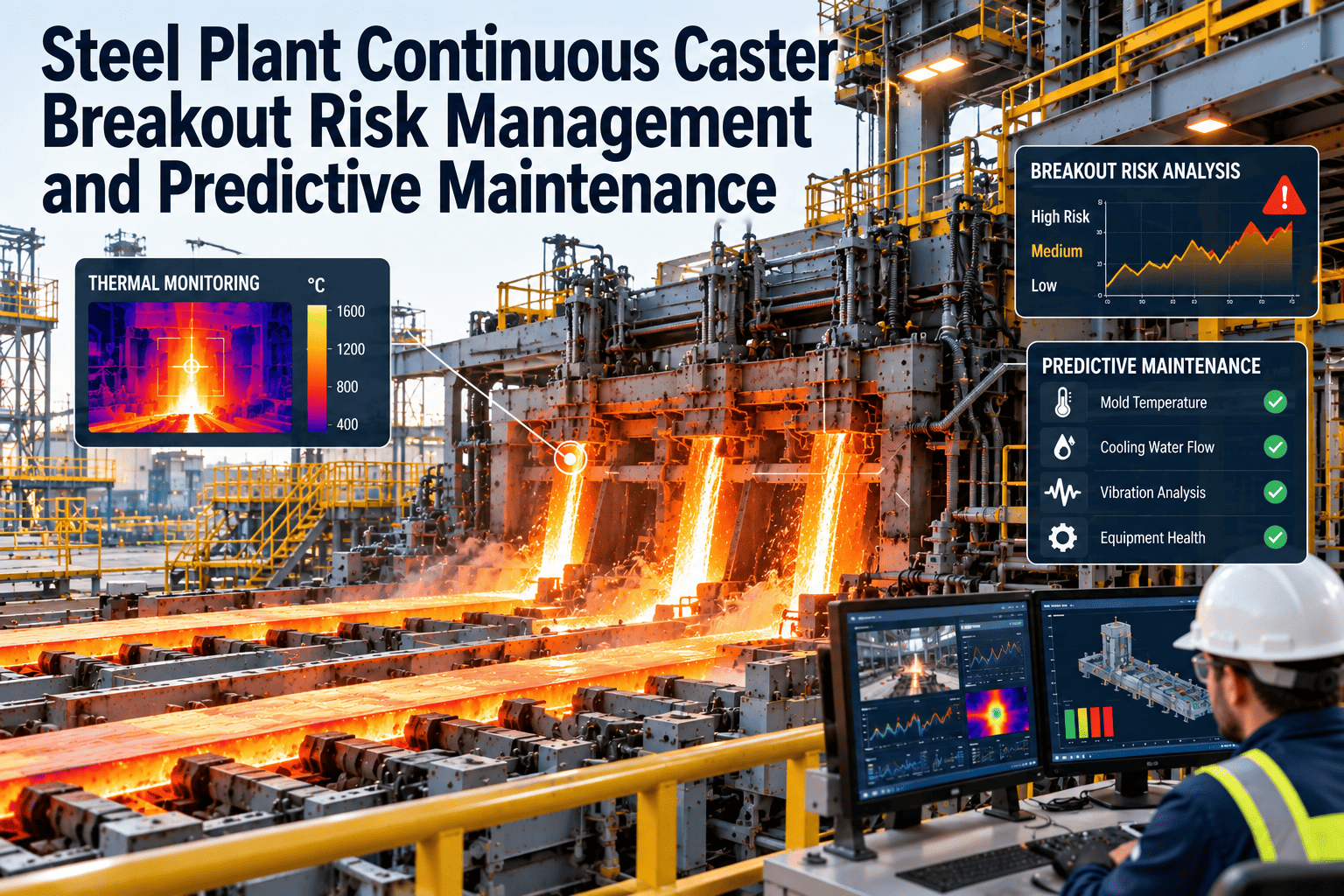
Modern slab and bloom casters embed 20–80 thermocouples in the copper plates — arranged in staggered rows from the meniscus downward. These thermocouples are the caster's early-warning system. A sudden 15–20°C spike in adjacent thermocouples within 2–4 seconds is the signature of a sticker: a point where the solidifying shell tears and re-welds. If the sticker does not heal within 5–8 seconds, it propagates into a full breakout.
| Monitoring Parameter | Healthy Range | Warning Threshold | Action Required |
|---|---|---|---|
| Thermocouple temperature | 120–180°C (steady) | >200°C or ΔT >20°C in 4s | Reduce cast speed 20%, check flux feed |
| Mold friction (kN) | 3–8 kN stable | >12 kN or rising trend | Inspect taper, oscillation stroke, mold flux |
| Thermocouple integrity | 100% arrays functional | >2 dead TCs per row | Schedule mold tube change-out at next opportunity |
| Oscillation frequency | ±2% of setpoint | >5% deviation | Check hydraulic servo, oscillation bearings |
| Mold flux consumption | 0.3–0.6 kg/t steel | <0.25 kg/t or >0.7 kg/t | Adjust feed rate, verify flux viscosity grade |
| Cooling water ΔT | 6–10°C steady | >12°C or fluctuating | Inspect water jackets, descale copper back-wall |
Mold friction is the second critical signal. Hydraulic oscillation systems measure friction in kilonewtons — a stable 3–8 kN range means the mold flux liquid film is lubricating properly. When friction climbs past 12 kN, the shell is dragging against the copper. If friction exceeds 15 kN, the sticker risk is imminent and the caster should reduce speed or stop immediately. Trending friction over hundreds of heats — not just per-cast snapshots — is what separates prediction from reaction.
Preventive Maintenance Timeline
Caster Mold PM Schedule: From Per-Heat Checks to Annual Overhauls
A disciplined mold maintenance program operates on four time horizons. Each interval has specific tasks, owners, and documentation requirements — and missing any interval dramatically increases breakout probability. The timeline below mirrors the PM templates built into OxMaint's caster mold CMMS module.
Per-Heat Mold Checks
Verify mold flux feed rate and distribution. Confirm thermocouple array readouts are stable — no single TC spiking >15°C above neighbors. Check oscillation mark uniformity on the strand surface. Inspect meniscus level control stability (±2 mm). Log all readings digitally — no clipboards.
Shift-End PM (8–12 hrs)
Review friction trend chart for the full shift. Inspect oscillation system hydraulic pressure and stroke length. Check cooling water flow rates on all circuits — flag any deviation >5%. Confirm mold level sensor calibration. Clean meniscus slag rim if present.
Campaign PM
Pull mold for taper gauge measurement. Perform ultrasonic copper thickness check at meniscus, mid-body, and exit. Dye-penetrant inspect copper faces for thermal cracks. Verify coating thickness on narrow faces. Record all measurements in OxMaint against the mold's serial number for trend analysis.
Mold Tube / Plate Change-Out
Remove and replace mold tube or plates. Inspect water jacket for scale and corrosion — descale if buildup exceeds 0.5 mm. Replace all O-rings and seals. Recalibrate thermocouple array. Perform full oscillation system stroke test. Baseline new mold with first-heat thermocouple and friction readings.
Stop reacting to mold failures — start predicting them
See how OxMaint's AI-powered CMMS tracks mold thermocouples, copper wear, and friction trends across every strand — so your team prevents breakouts before they cost a single heat.
How OxMaint Helps
Mold Maintenance Software Built for Steel Casters
OxMaint is an AI-powered CMMS and EAM platform designed for maintenance and reliability teams in heavy industry. For continuous caster operations, OxMaint replaces spreadsheets, whiteboards, and paper work orders with a single digital system that tracks every mold by serial number, automates PM scheduling, and uses predictive analytics to flag breakout risk before it materializes.
Predictive Mold Analytics
OxMaint ingests thermocouple temperature data, friction readings, and copper wear measurements — then uses AI to predict mold failure 50–200 heats in advance. Reliability teams get alerts when a mold is trending toward breakout risk, not after the sticker occurs.
Automated PM Scheduling
Every mold PM — per-heat checks, campaign inspections, tube change-outs — is auto-scheduled based on actual heat count, not calendar guesses. OxMaint triggers work orders at the right interval and routes them to the right technician with checklists, safety procedures, and parts lists attached.
Mold Asset Lifecycle Tracking
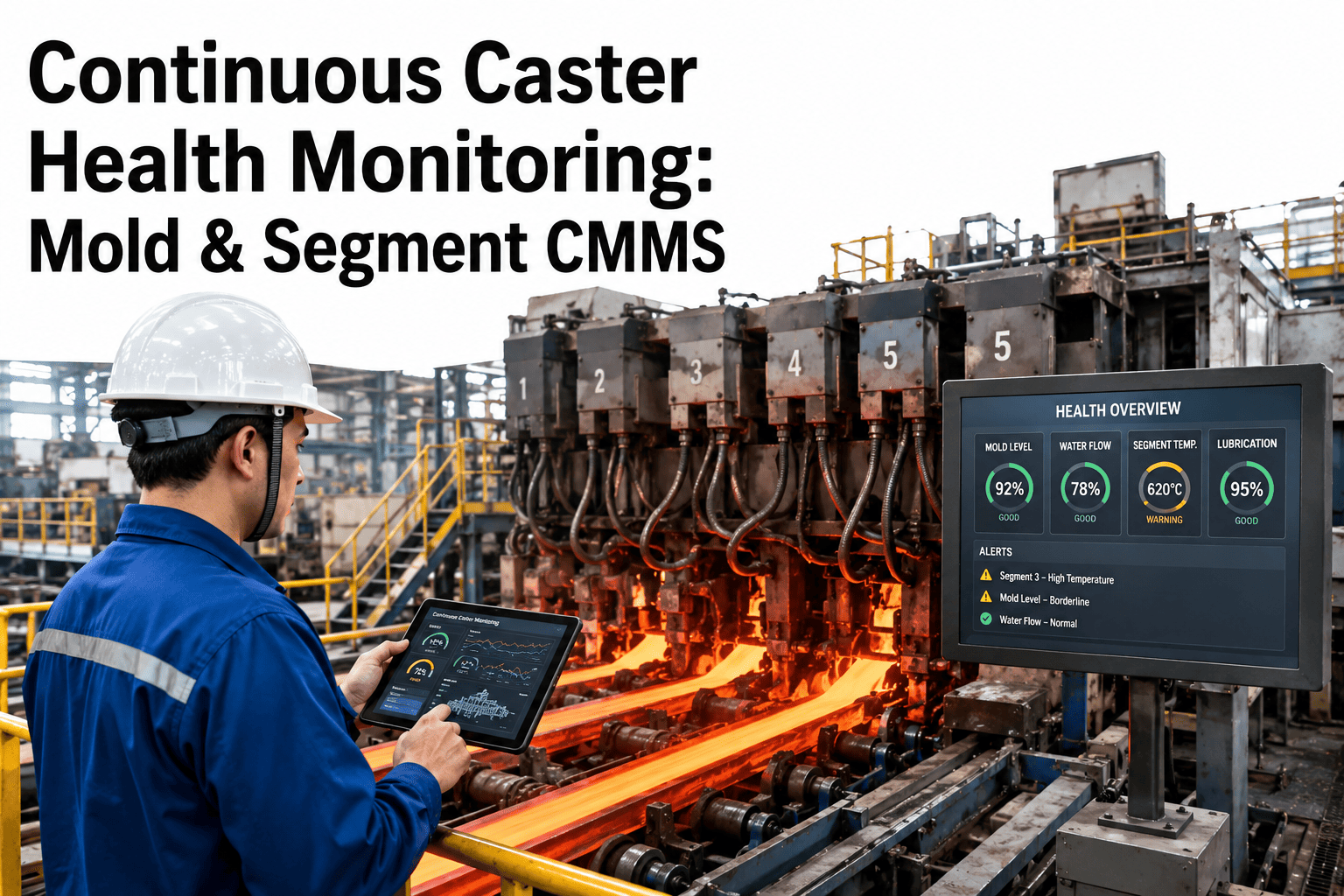
Every mold tube and plate has a digital twin in OxMaint — serial number, installation date, heat count, taper measurements, thermocouple health, coating status, and change-out history. Reliability engineers see the full lifecycle of every mold on every strand in one dashboard.
Spare Mold Inventory & Parts Management
OxMaint tracks spare mold tubes, copper plates, thermocouples, O-rings, and oscillation components in real time. When a PM or change-out is triggered, the system auto-reserves parts and alerts the storeroom if stock falls below safety minimums — so you never delay a change-out waiting on a $4 O-ring.
ROI Snapshot
A 4-strand billet caster preventing one breakout per quarter
A mill casting 320 heats/day on 4 strands typically experiences 2–3 mold-related breakouts per year. Preventing just one breakout saves $75K–$120K in scrap, downtime, and mold damage. OxMaint's annual cost for a single caster deployment is a fraction of that — payback in under 90 days.
Breakout Prevention FAQs
Continuous Caster Mold Maintenance — Frequently Asked Questions
What causes breakouts in a continuous caster?
Approximately 42% of continuous caster breakouts are caused by mold condition issues — primarily worn copper plates with taper loss, failed thermocouples that miss sticker events, inadequate mold flux lubrication, and oscillation system drift. The remaining causes include steel chemistry variations, casting speed changes, and meniscus level fluctuations. A well-maintained mold with functioning thermocouples and stable friction catches 80–90% of stickers before they propagate into breakouts.
How often should continuous caster molds be inspected?
Mold thermocouple readings and friction trends should be reviewed every heat. A full visual meniscus inspection and oscillation check should occur every shift. Taper measurement and ultrasonic copper thickness checks should happen every 200–300 heats. Full mold tube or plate change-out typically occurs at 800–1,200 heats — but condition-based monitoring using a CMMS like OxMaint can safely extend this to 1,000–1,400 heats on well-performing strands.
How does a CMMS help with caster mold maintenance?
A caster mold CMMS like OxMaint tracks every mold by serial number, auto-schedules PMs based on actual heat counts (not calendar dates), and stores all thermocouple, taper, friction, and inspection data in one asset record. This eliminates the spreadsheet-and-clipboard problem where critical measurements get lost between shifts. OxMaint's predictive analytics also flag molds trending toward failure 50–200 heats in advance. You can Book a Demo to see the mold tracking module on your own caster data.
What is the ideal mold taper for breakout prevention?
The ideal mold taper depends on section size and casting speed, but typically ranges from 0.7–1.2% per meter for billet and bloom casters and 0.5–0.9% per meter for slab casters. Parabolic tapers are preferred over linear because they match shell shrinkage. When taper loss from copper wear exceeds 0.15–0.2%/m from the design profile, sticker breakout risk increases by up to 3× and the mold should be scheduled for change-out.
How much does a caster breakout cost a steel plant?
A single breakout on a slab caster costs $200K–$500K in scrap steel, refractory damage, mold tube replacement, and 4–12 hours of unplanned downtime. On a billet caster, the cost is typically $50K–$120K. For a mill casting 6–10 heats per hour, every hour of caster downtime means $15K–$25K in lost revenue. Preventing even one breakout per year typically pays for a CMMS deployment many times over.
Protect Every Mold, Every Heat
See OxMaint on your continuous caster — book a 30-minute demo
Join steel plants using OxMaint to predict mold failures, automate PM scheduling, and prevent breakouts before they cost a single heat. Our team will walk you through mold asset tracking, thermocouple analytics, and friction trending on a live system.
Free 14-day trial · No credit card