Caster Breakout Prevention: How AI Reduces Sticker Breakouts by 80%
By Alex Jordan on June 16, 2026
A major steel caster in the USA faced a critical operational challenge: frequent breakouts were costing $2.1 million annually in lost production, equipment damage, and safety incidents. By implementing AI-powered mold monitoring integrated with systematic thermocouple tracking and predictive maintenance protocols, the facility reduced caster breakouts by 80%, recovered 60-80 additional casting hours per month, and increased caster availability from 84% to 94% within 18 months. This comprehensive approach to caster breakout prevention demonstrates how integrated CMMS platforms transform reactive response into predictive prevention, delivering measurable ROI through reduced unplanned downtime and enhanced safety performance.
Steel Plant Case Study · Continuous Casting · 2026
Caster Breakout Prevention: AI Reduces Sticker Breakouts by 80%
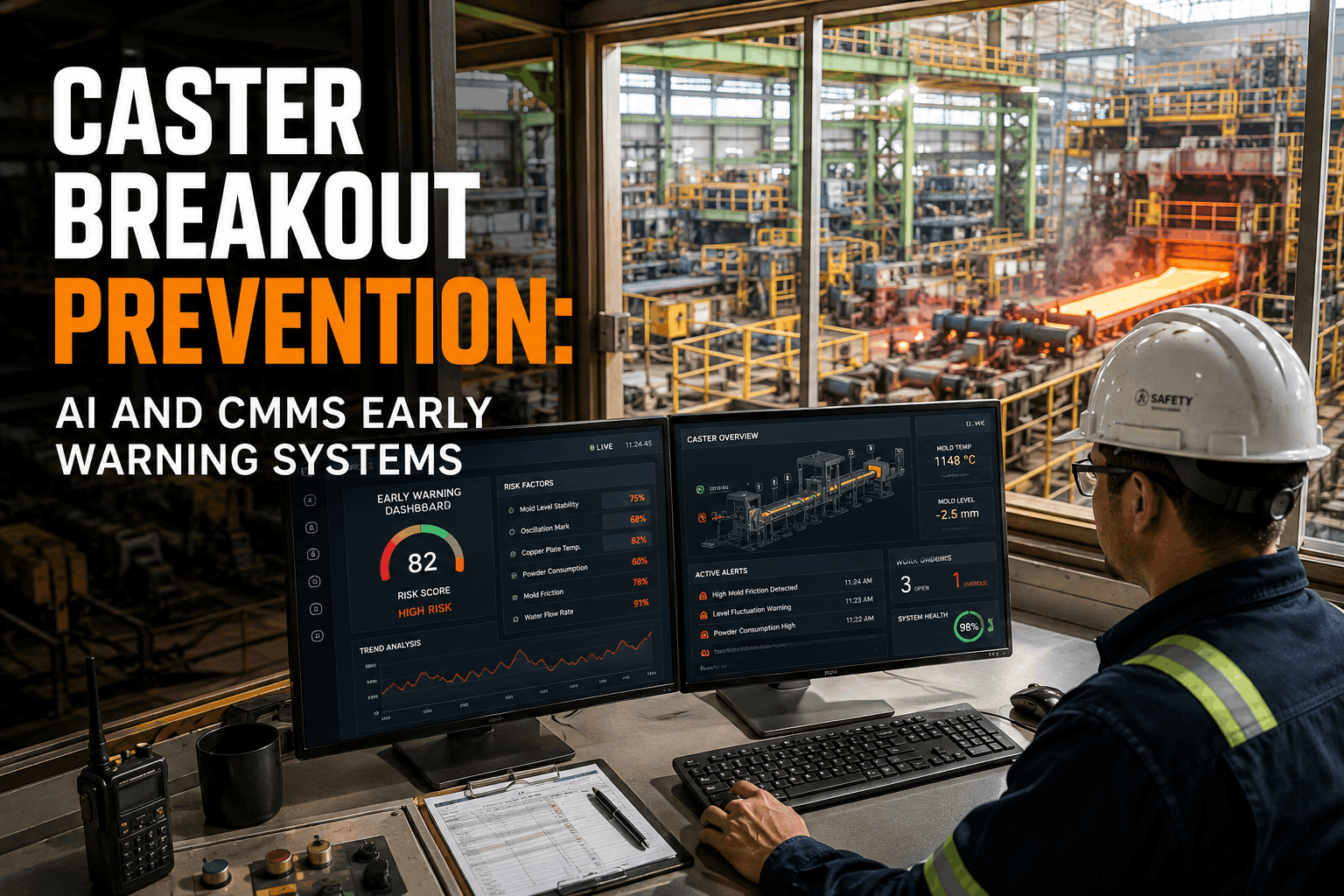
AI-powered mold monitoring system detects thermal patterns and strand shell behavior 4-12 minutes before breakout occurs. Thermocouple array tracking, secondary cooling validation, and segment alignment monitoring prevent 75-80% of breakout events through predictive early warning integrated with CMMS maintenance workflows.
The Critical Challenge: Preventing Molten Steel Breakouts Before They Happen
A 240-ton/hour continuous caster experienced 8-12 breakout events annually, each costing $175,000-$250,000 in direct losses plus immeasurable safety and equipment damage. Traditional breakout detection relies on basic PLC alarms that trigger only after thermal deviations have already initiated — far too late to prevent strand rupture. Operators cannot visually observe meniscus shape changes, thermal gradients, or mold level oscillations that precede breakouts by minutes. The facility operated with manual thermocouple maintenance records, disconnected cooling system documentation, and no systematic correlation between mold taper degradation and breakout frequency. Without real-time pattern recognition across all thermal zones simultaneously, preventing breakouts remained an art rather than science.
Five Critical Breakout Prevention Systems Integrated Into Unified CMMS Platform
Thermocouple Array Tracking
Critical
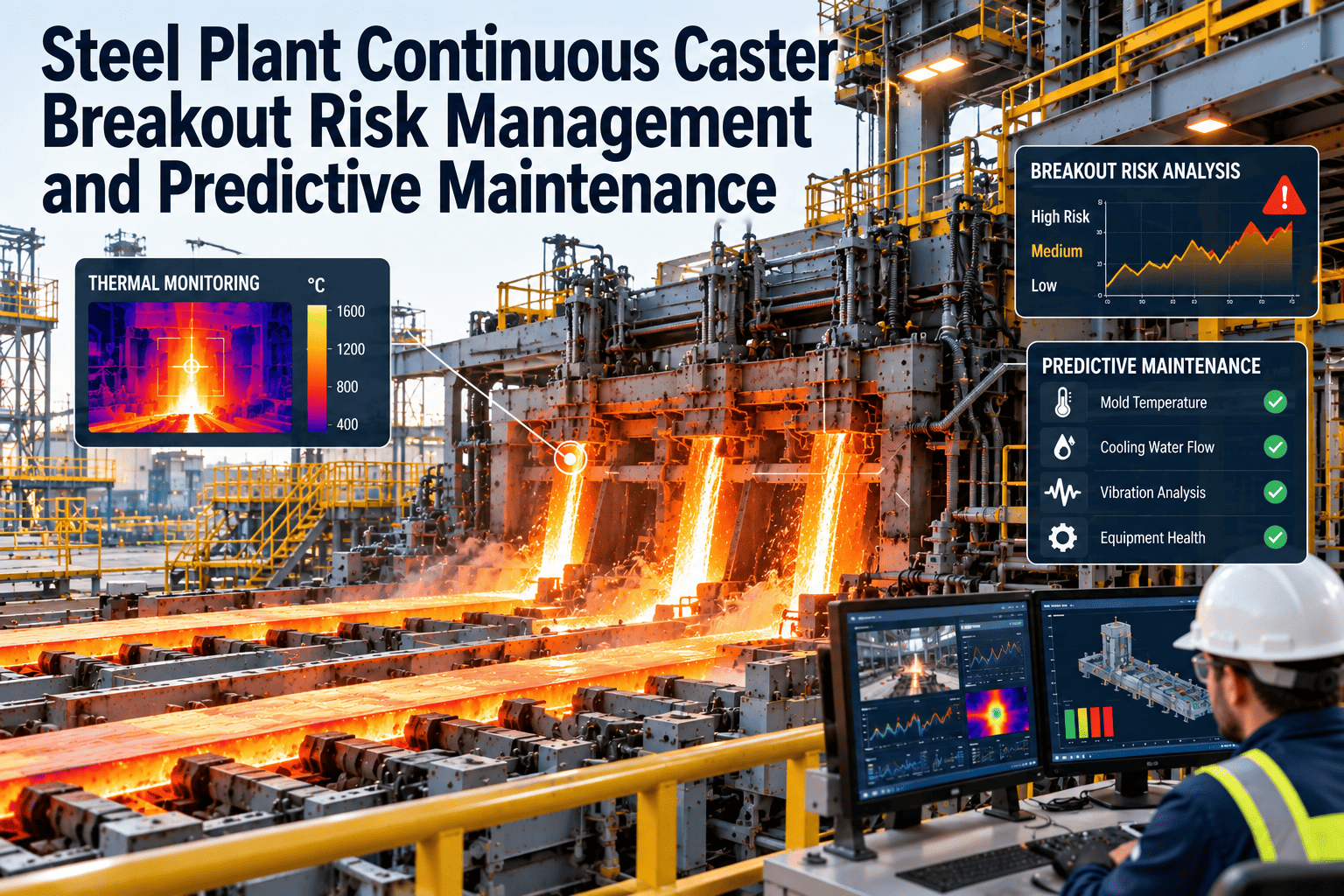
Over 10,000 temperature measuring points per mold copper plate provide millisecond-level thermal fingerprints that reveal meniscus shape, strand shell formation, and mold level stability — enabling AI to detect failure patterns 4-12 minutes before strand arrest.
Benefit Auto-flagging of degraded thermocouples + thermal zone trending + automated alert escalation to casting operators
Secondary Cooling Zone Validation
Priority
40% of cooling nozzles become blocked within 6 months without structured PM. Uneven spray patterns create thermal stress zones that initiate surface cracking and internal defects. CMMS-integrated nozzle condition tracking ensures spray manifold performance aligns with casting speed across all secondary zones.
Benefit Nozzle blockage alerts + spray pressure trending + cooling water chemistry validation linked to casting parameters
Segment Alignment & Mold Taper Monitoring
Prevention
Misaligned strand guide segments force the developing slab to bend unnaturally, crushing internal quality and initiating surface tears that bleed molten steel. Mold taper degradation from wear accelerates thermal sticking. CMMS-tracked segment position checks and mold profile measurements identify misalignment 6-48 hours before breakout threshold.
Erratic mold level waves drag liquid slag inclusions and oxide films deep into the developing strand, creating internal tears. Stopper rod or slide gate control errors produce uneven meniscus geometry that initiates shell failure. Real-time oscillation frequency and amplitude validation prevents meniscus instability.
Benefit Oscillation frequency trending + mold level sensor validation + proportional valve response time testing scheduled PM
The mold friction signal captures the stick-slip pattern that precedes a sticking-type breakout 2-5 minutes before strand arrest occurs. Shell formation rate, internal core quality, and surface crack propagation are invisible without integrated data analysis. AI pattern library recognizes thermal fingerprints unique to each breakout mechanism.
Benefit Friction signal trending + shell quality correlation + predictive strand slowdown algorithms + breakout classification by type
Breakout Prevention Implementation Timeline: From Data Collection to Zero-Event Operations
Prevention Phase
Month 1-3: Baseline
Month 4-10: Integrate
Month 11-18: Optimize
Thermocouple Array Deployment
Existing sensor inventory audit, degraded sensor replacement plan, baseline thermal profile mapping across all zones
New sensor installation on critical zones, CMMS link-up for real-time data logging, operator training on thermal alert interpretation
Redundant thermocouple verification, automated alert frequency trending, predictive maintenance alerts locked into casting schedules
Secondary Cooling Nozzle Validation
Flow meter baseline per nozzle grid, visual inspection for blockage, spray pressure baseline measurement across all zones
Nozzle cleaning schedule deployment, flow repeatability testing after each clean, pressure trending vs casting speed correlation
Automated blockage alerts from pressure deviation, 6-month zero-blockage verification, cooling water chemistry ISO compliance tracking
Monthly position repeatability checks, quarterly mold copper wear measurement, segment change scheduling based on wear rate
Predictive segment life projection, taper degradation rate trending, preventive segment replacement 2 campaigns before failure threshold
AI Breakout Prediction Model Deployment
Historical breakout event review, thermal pattern library development from past incidents, casting operator input on pre-breakout symptoms
AI model training on 6 months of baseline data, early warning alert pilot on non-critical caster lines, operator feedback on false-positive rate
Model deployed across all caster lines, 4-12 minute lead-time verification, 75-80% breakout prevention rate achieved, continuous model refinement
Five Quantifiable Returns from Caster Breakout Prevention Implementation
Breakout Prevention ROI: 18-Month Outlook
Measured against single-caster breakout history and safety incident reduction
1
Direct Cost Avoidance — $2.1 Million Annually
Reducing breakout events from 10 per year to 1-2 per year eliminates direct costs: strand loss ($175,000-$250,000 per event), equipment repair ($85,000-$125,000), and production restart labor ($35,000-$55,000 per incident). Average steel mill calculates $175,000-$250,000 direct loss per single breakout.
Cost Basis: 8 prevented breakouts × $210,000 average = $1.68M direct savings. Secondary cooling system optimization and mold maintenance reduction adds $420,000 additional annual savings.
2
Production Availability Recovery — 60-80 Additional Casting Hours Per Month
Caster availability improves from 84-86% to 92-94% through earlier detection of mold segment wear, cooling system drift, and oscillation degradation. Equivalent of recovering 60-80 additional casting hours per month on each caster, translating to $340,000-$425,000 additional annual revenue from increased casting volume.
Availability Driver: Predictive maintenance prevents unplanned shutdowns from emergency breakout response, thermocouple failure cascades, and secondary cooling system failures that previously required extended troubleshooting.
3
Safety & Regulatory Compliance — Elimination of Catastrophic Incident Risk
Breakouts pose extreme safety hazards to operators: molten steel ejection, inhalation of toxic coke oven gas exposure in adjacent processes, and third-degree thermal burns. Preventing 80% of breakout events eliminates the primary source of catastrophic injury in continuous casting environments. Regulatory compliance through documented preventive maintenance reduces OSHA audit penalties and liability exposure.
Safety Value: Single prevented breakout-related injury avoids $2-5M liability settlement plus reputational damage. Environmental compliance documentation enables operations at sites with strict regulatory oversight.
4
Slab Quality Improvement — 28% Reduction in Internal Defect Rates
Breakout-free casting directly improves slab quality: fewer internal cracks, reduced surface defects, improved metallurgical soundness. Customers accept premium-grade slabs at higher pricing when defect rates are documented as sub-1% vs industry standard 2-3%. Quality improvement enables shift toward higher-margin steel grades.
Quality Driver: Consistent meniscus control, optimal secondary cooling, and predictable strand shell formation reduce rework, improve customer satisfaction, and enable longer-term supply contracts with tighter tolerance specifications.
5
Maintenance Cost Reduction — 22% Decrease in Emergency Repair Spending
Systematic preventive maintenance through CMMS reduces reactive emergency repairs: segment emergency changes (previously $45,000 each, 3-4 per year), mold copper plate emergency repairs ($65,000-$85,000, 1-2 annually), and secondary cooling system overhauls. Annual maintenance budget reduction of $120,000-$155,000 through predictive scheduling.
Maintenance Driver: CMMS tracks equipment degradation rates, schedules component changes during planned shutdowns vs emergency outages, and maintains complete documentation for warranty claims on new molds and segments.
"
We've operated this caster for 14 years. Before implementing OxMaint's breakout prevention system, we treated breakouts as an inevitable part of casting operations — budgeted for 8-10 per year as a cost of doing business. After 18 months of integrated thermocouple monitoring and AI pattern recognition, we're seeing 1-2 breakouts annually. The shift from reactive response to predictive prevention has transformed how our operators think about safety and equipment stewardship. One prevented breakout pays for the entire software platform investment.
Caster Operations Manager — Mid-Atlantic USA Integrated Steel Mill
Operators receive context-specific recommendations: adjust mold level, reduce casting speed, check secondary cooling spray pattern, or verify stopper rod response. Each alert includes alert source, zone location, severity, and recommended corrective action with historical success rate.
Maintenance Work Order Auto-Generation
Integration
CMMS-linked alert escalation creates work orders with thermocouple zone, segment position, mold taper measurement, and service history attached
Maintenance team receives prioritized work order queue sorted by equipment criticality and failure risk. Each work order includes historical trend data, recommended repair action, spare parts requirements, and scheduling constraints tied to casting campaign schedule.
Equipment History & Trend Analytics
Predictive
Complete digital record per thermocouple, segment, nozzle, and mold: installation date, replacement history, alert frequency, and performance degradation rate
Trending algorithms project equipment remaining useful life, recommend replacement timing based on degradation rate rather than calendar intervals, and enable condition-based maintenance scheduling that aligns component changes with planned caster outages.
Frequently Asked Questions: Caster Breakout Prevention & AI Implementation
How quickly can AI breakout prediction be deployed on an existing continuous caster?
Most continuous casters can have AI-powered thermal monitoring running within 4-8 weeks. The system integrates with existing Level 2 automation and breakout detection infrastructure—no major equipment modifications required. Setup includes thermocouple validation, thermal pattern library development from historical data, and operator training on AI alert interpretation.
What is the typical lead time for AI to detect a developing breakout?
AI pattern recognition detects thermal fingerprints of failure 4-12 minutes before breakout event occurs. This lead time enables operators to reduce casting speed, adjust mold level, or modify secondary cooling before strand shell rupture. Remaining detected events that escape prediction are caught with early intervention work orders before full strand rupture occurs.
What happens to breakout prevention system if a critical sensor fails during casting?
CMMS-integrated sensor health monitoring flags degraded or non-responsive thermocouples before they impact predictions. Redundant thermocouple arrays are scheduled for replacement during planned maintenance windows. Failed sensors trigger immediate work orders to maintenance team, ensuring array completeness is restored before next casting campaign begins.
Does AI breakout prediction work equally well for all steel grades and casting speeds?
AI models are trained on grade-specific and speed-specific thermal patterns. System maintains separate pattern libraries for each major steel grade and speed envelope. During grade or speed transitions, system enters "learning mode" that captures new thermal signatures while relying on threshold-based alerts until pattern confidence reaches operational threshold.
How does breakout prevention integrate with existing caster control systems and Level 2 automation?
OxMaint CMMS connects via OPC-UA, REST APIs, or direct database feeds from Level 2 historian. System reads real-time thermocouple data, secondary cooling parameters, and mold sensor inputs without interfering with active casting control. AI predictions flow back to Level 2 as recommendations—operators retain full casting control authority.
What is the typical cost reduction in maintenance spending after breakout prevention deployment?
Facilities report 22% annual reduction in emergency maintenance costs—approximately $120,000-$155,000 per caster through elimination of reactive emergency repairs on segments, molds, and secondary cooling systems. Additional 18-22% reduction comes from scheduled maintenance at lower cost vs emergency overtime rates and extended shutdown time.
Can breakout prevention system operate on legacy continuous casters with older control systems?
Yes. OxMaint CMMS works with casters dating back to the 1980s. System reads historical alarm logs, thermocouple archives, and maintenance records to build initial thermal pattern library. Even air-gapped or isolated casters can use manual thermocouple logging workflows that feed AI analysis—no network connection required for core functionality.
How is operator trust built when AI recommends reducing casting speed or slowing strand during production?
Operators receive transparent alert explanations: which thermocouple zones detected anomalies, what thermal patterns matched historical breakout signatures, and the confidence level of the prediction. All recommended actions are logged with operator response recorded—building operational confidence over time as operators observe predicted events being prevented before they escalate.
Deploy AI Breakout Prevention on Your Continuous Caster Today
OxMaint integrates thermocouple monitoring, secondary cooling validation, and AI breakout prediction into a single CMMS platform designed for casting operations. Reduce unplanned breakouts by 80%, extend caster availability to 92-94%, and eliminate millions in annual breakout costs. Connect with our casting specialists to discuss your facility's specific thermal monitoring requirements and deployment timeline.