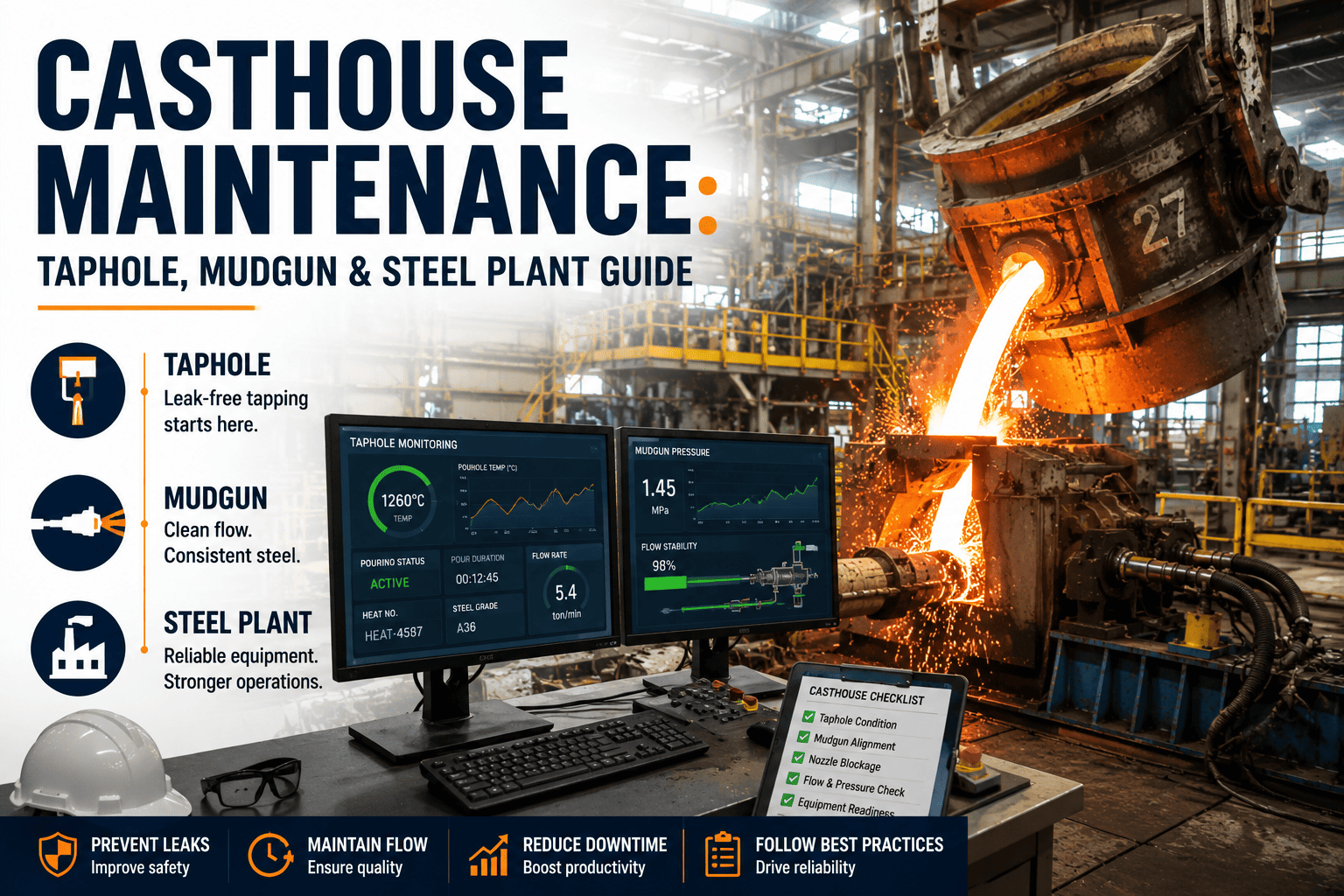
Casthouse operations sit at the convergence of molten metal at 1,500°C, heavy mechanized equipment, and unforgiving production schedules — making maintenance one of the highest-leverage activities in an integrated steel plant. A single delayed taphole drill failure or a mud gun that cannot seal the tap point can idle a blast furnace for hours, with downtime costs routinely quoted between $50K and $200K per hour depending on hot metal throughput. This guide breaks down the four pillars of casthouse maintenance — taphole drills, mud guns, trough and runner refractory, and cast house cranes — and shows how a CMMS shifts work from reactive firefighting to planned, auditable PMs. When you are ready to operationalize these routines, Start Free Trial to deploy Oxmaint in your plant.
Every unplanned taphole event costs your furnace 4–8 hours of lost hot metal.
A blast furnace producing 8,000 t/day loses roughly 1,333 t of hot metal per lost hour — and the casthouse is where most of those hours originate. Structured PM on taphole drills, mud guns, trough refractory, and cast house cranes is the single fastest payback lever in primary metals maintenance.
Where casthouse maintenance hours actually go
Across a typical integrated steel plant casthouse, roughly 70% of unplanned downtime traces back to four asset families. The matrix below maps each pillar to its failure mode, the recommended PM interval, and the risk-weighted priority that should drive your weekly schedule.
| Asset Pillar | Top Failure Mode | PM Cadence | Downtime Risk if Skipped | Priority |
|---|---|---|---|---|
| Taphole Drill | Drill stem jam, rotary head bearing failure | Daily lube · Weekly inspection · Monthly rebuild check | 4–8 hr per event | Critical |
| Mud Gun | Hydraulic leak, clay chamber liner wear | Shift check · 250-hr PM · Quarterly hydraulic test | 6–12 hr (tap channel unsealed) | Critical |
| Trough & Runner Refractory | Erosion, slag infiltration, thermal spall | Per-tap visual · 7-day thickness survey · Campaign overlay | 2–4 hr (metal breakout risk) | High |
| Cast House Crane | Brake fade, wire rope degradation, limit switch drift | Pre-use check · Monthly PM · Annual LOLER-type inspection | Full casthouse shutdown | Critical |
Tiered inspection checklists for the two highest-risk machines
Taphole drills and mud guns operate within 2 m of 1,500°C metal and cannot be inspected casually. The two checklist grids below are organized by frequency — shift, weekly, and monthly — so a planner can assign each tier to the right craft without ambiguity.
Taphole Drill — Shift Checks
Operator · 5 min · per shift- Inspect drill stem for straightness and wear beyond 3 mm
- Confirm rotary head bearing temperature under 65°C with IR gun
- Check air/oil mist lubricator level and flow sight glass
- Verify emergency retraction response under 2 seconds
- Test forward/reverse control logic at low speed
Taphole Drill — Weekly PM
Mechanic · 45 min · weekly- Grease rotary head bearings per OEM chart (typically NLGI #2)
- Torque drill chuck bolts to spec, replace any stretched fasteners
- Inspect feed chain/sprocket for elongation beyond 1.5% pitch
- Drain and sample hydraulic reservoir, check water content below 0.05%
- Calibrate depth sensor against manual tape measurement
Mud Gun — Shift Checks
Operator · 5 min · per shift- Confirm clay pressure at set point (commonly 80–120 bar)
- Inspect nozzle for clay buildup or bore erosion
- Check hydraulic hoses for blisters, weeping, or abrasion
- Verify swing-into-position alignment within ±20 mm
- Test interlock: gun cannot fire with drill in taphole
Mud Gun — Quarterly PM
Mechanic · 3 hr · quarterly- Ultrasonic thickness on clay chamber liner, flag below 8 mm
- Pressure-test hydraulic circuit at 1.5× working pressure
- Replace piston seals if clay blow-by exceeds OEM limit
- Calibrate pressure transducer against certified deadweight
- Review cycle count log — schedule rebuild at 8,000 cycles
Predict runner life before a breakout proves you waited too long
Runner and trough refractory is the slowest-moving but costliest consumable in the casthouse — a single main runner reline on a high-output furnace can exceed $45,000 in material and labor. The rule below converts weekly thickness surveys into a remaining-life estimate so you can schedule the reline inside a planned casthouse window instead of an emergency one.
- Tm — minimum safe lining thickness (mm), typically 80 mm for main runner
- Tc — current measured thickness (mm) from weekly UT survey
- W — mean wear rate per tap (mm/tap), established from last 3 campaigns
- R — remaining taps before mandatory reline
At 10 taps/day, that is roughly 49 days of campaign life — enough to lock the reline into the next planned 16-hour casthouse outage instead of reacting to a slag breakout that would cost 4–6 hours and a 20-tap production loss.
The cost of paper-based PM — and what a CMMS recovers
A 180-asset casthouse relying on paper logs and Excel PM schedules typically spends $42,000 per year on avoidable emergency callouts, duplicate parts, and missed inspections. The table below contrasts the same operation under a disciplined CMMS workflow — the numbers are drawn from typical mid-tier integrated plant benchmarks.
| Metric | Paper / Excel-Based | CMMS-Driven | Annual Delta |
|---|---|---|---|
| Planned vs. unplanned work ratio | 45 / 55 | 82 / 18 | +37 pts planned |
| Mean time to repair (MTTR) — taphole drill | 3.4 hr | 1.6 hr | −53% |
| Missed PMs per quarter | 21 | 2 | −90% |
| Emergency callout cost / year | $42,000 | $9,200 | −$32,800 |
| Refractory life per campaign (taps) | 1,150 | 1,360 | +18% |
| Audit traceability (ISO 55000 ready) | Partial / manual | Full digital trail | Compliant |
A 180-asset casthouse spending $42K/yr on emergency callouts, $310K/yr on refractory, and losing 140 production hours/yr to unplanned casthouse events deploys Oxmaint CMMS. Within 6 months the plant reports a 53% drop in MTTR, 18% longer runner campaigns, and full ISO 55000 traceability — payback achieved in under 4 months on a ~$22K annual subscription.
Turn your next casthouse outage into a planned event.
Deploy Oxmaint CMMS in your steel plant and shift 80%+ of casthouse maintenance to planned, auditable PMs — with full ISO 55000 traceability.
Five questions plant engineers ask before deploying a CMMS in the casthouse
How often should taphole drill PM be performed in a steel plant casthouse?
A tiered schedule works best: a 5-minute operator shift check covering drill stem, bearing temperature, lubrication, and emergency retraction; a 45-minute weekly mechanic PM focused on greasing, torque, feed chain elongation, and hydraulic sampling; and a monthly rebuild readiness review using cycle counts and vibration trends. Plants that skip the weekly tier typically see a 3× higher drill-stem jam rate during tap campaigns.
What is the recommended mud gun maintenance interval on a blast furnace?
Shift-level checks should confirm clay pressure (80–120 bar), nozzle condition, and hydraulic hose integrity, while a 250-hour PM covers seal inspection and hydraulic circuit testing. The most critical quarterly task is ultrasonic thickness measurement of the clay chamber liner — once it drops below 8 mm, schedule a rebuild. Track cycle counts and rebuild at 8,000 cycles to avoid an in-tap failure that can leave the taphole unsealed for 6–12 hours.
How does a CMMS improve casthouse maintenance over spreadsheets?
A CMMS like Oxmaint converts static PM checklists into triggered work orders tied to meter readings, tap counts, or calendar dates — so no inspection is missed when a shift is short-staffed. It also captures thickness surveys, vibration data, and parts usage in one auditable trail, which is essential for ISO 55000 compliance. Most plants reach an 80/20 planned-to-unplanned ratio within 6 months, versus the 45/55 typical of spreadsheet-driven casthouse maintenance. You can Book a Demo to see a casthouse-specific workflow.
What thickness surveys should be done on trough and runner refractory?
Perform a 7-day ultrasonic thickness survey on the main runner hot face during peak campaign, with per-tap visual inspections for slag infiltration and spalling. Track wear rate per tap across the last three campaigns and use the formula R = (Tm − Tc) ÷ W to calculate remaining taps. This typically extends campaign life by 15–20% versus fixed-interval relines and eliminates the 4–6 hour losses associated with emergency breakouts.
How quickly can a steel plant deploy Oxmaint for casthouse maintenance?
Most mid-size casthouses with 150–250 assets go live in 3–4 weeks: asset hierarchy import takes one week, PM checklist configuration another week, and the third week is spent training operators and mechanics on mobile work orders. A 14-day free trial is enough to pilot PM scheduling on one taphole drill and one mud gun — Start Free Trial to begin immediately with no credit card required.
Stop paying for casthouse downtime you could have planned for.
Join the integrated steel plants using Oxmaint to cut casthouse MTTR by 50%+ and extend refractory campaigns by 18% — with full ISO 55000 audit trails.
Free 14-day trial · No credit card