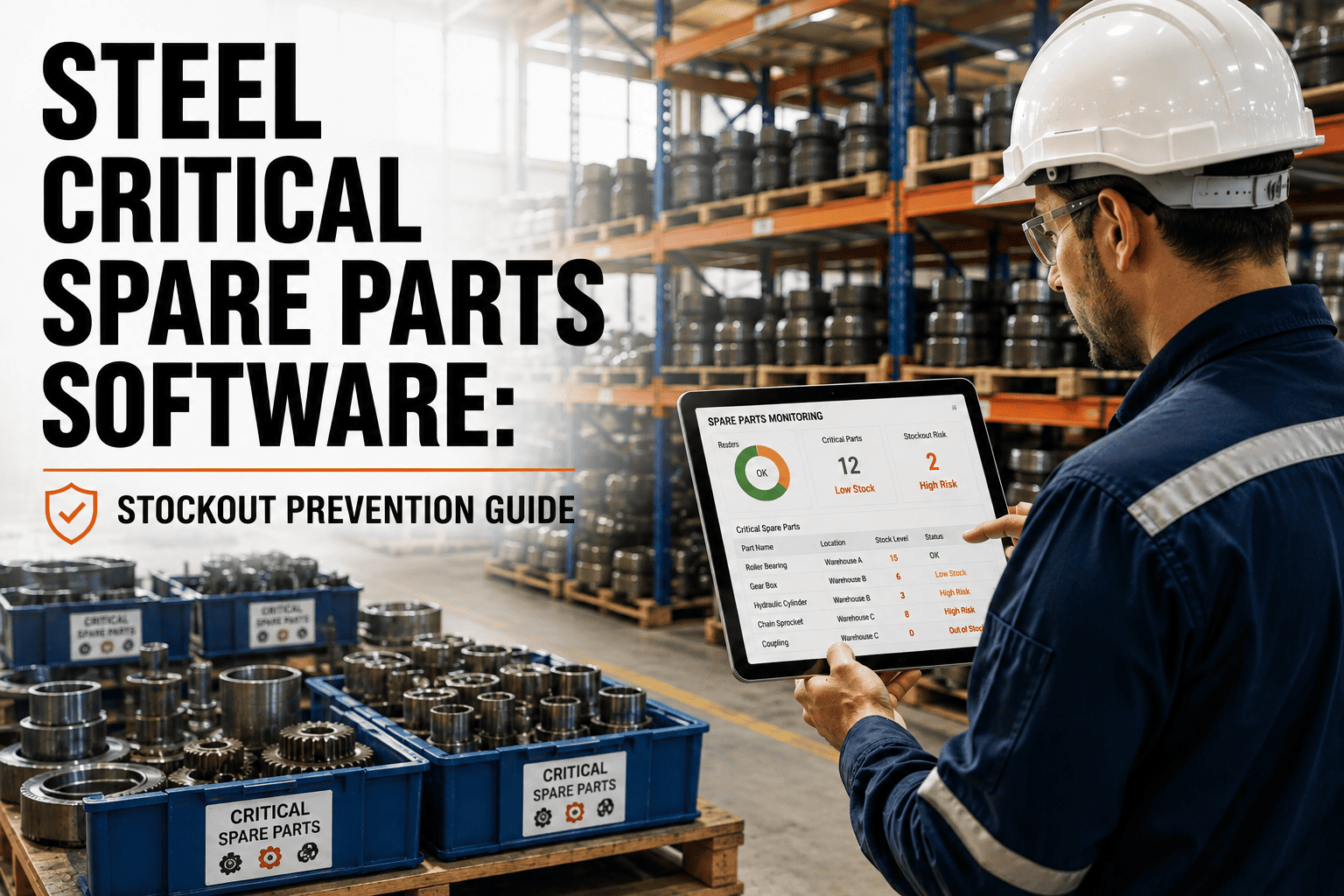
Every steel plant has a story about the part that was not on the shelf. A gearbox seal, a hydraulic servo valve or a drive module goes missing from stores, a line stops, and procurement pays for air freight and overtime to fix a problem that was visible weeks earlier. These purchases feel unavoidable in the moment, yet most trace back to a handful of fixable causes in stocking rules, data and planning. This guide shows how maintenance and stores teams cut emergency buying with better MRO inventory control, and you can book an Oxmaint demo to see the workflow on your own spares.
Steel Plant Emergency Spare Purchasing Reduction for MRO Inventory Control
Move critical parts from last-minute purchases to planned, reserved and correctly stocked inventory, so a failure becomes a scheduled repair.
Stocked and reservedPart on shelf, linked to the job
Planned purchaseOrdered inside normal lead time
Expedited purchasePremium freight, rushed approvals
Emergency buyLine stopped, any supplier, any price
Each step down the ladder adds cost, risk and downtime. The goal is to stay on the top two steps.
Why emergency purchases keep happening
| What stores and planners see | The usual root cause |
|---|---|
| Critical part missing when the job starts | Stocking decision based on consumption history, which is near zero for rare but severe failures |
| Same part ordered twice under different codes | Duplicate item records and weak cataloguing |
| Stock shows available but the bin is empty | Issues not recorded, no cycle counts, parts borrowed for other jobs |
| Planned shutdown delayed by waiting for material | Parts lists built late, no reservation against the work order |
| Supplier quote arrives after the line has stopped | Lead times in the system are outdated or never recorded |
| Overstocked shelves and still no critical spare | Money spent on fast movers while strategic spares were never defined |
Decide what deserves stock: the criticality and lead-time matrix
Consumption history alone misleads. A spare that has never been used may still be the most important item in the store.
Lead time vs consequence
Low consequence
Medium consequence
High consequence
Long lead time
Review case by case
Stock or pool with a partner
Hold as a critical spare
Medium lead time
Order on demand
Min and max stock
Stock with a reorder point
Short lead time
Vendor managed or direct
Order on demand
Min and max stock
Combine three classification lenses
ABC by value
Ranks items by annual spend. It tells you where purchasing attention and cycle counts pay off most.
XYZ by demand pattern
Separates steady use from lumpy or sporadic demand. It guides how much statistical forecasting can be trusted.
VED by criticality
Vital, essential and desirable. It reflects what a stockout does to production, safety and the environment.
How the lenses change decisions
- A vital item with sporadic demand is a strategic spare, whatever its price.
- A desirable item with steady demand can use a simple min and max rule.
- A high-value essential item should be reviewed for pooling, repair or vendor stock.
Stop paying premium prices for parts you could have planned
Link spares to assets, jobs and reservations in one place, and see shortages before the shutdown starts.
Know the type of spare before choosing a policy
| Spare type | Steel plant examples | Typical policy |
|---|---|---|
| Strategic or insurance spares | Main drive motors, large gearboxes, mill stand components, ladle crane parts | Hold on site or pooled, tied to a named asset and reviewed yearly |
| Repairable rotables | Gearboxes, pumps, hydraulic cylinders, servo valves | Track as serialised items with repair status and turnaround time |
| Fast-moving consumables | Filters, seals, bearings, fasteners, lubricants | Min and max rules with regular replenishment |
| Shutdown kits | Gasket sets, wear plates, refractory-related items, valve rebuild kits | Built from the shutdown scope and reserved before the work window |
| Obsolete or slow items | Parts for retired equipment or earlier designs | Review for disposal, return or a documented reason to keep |
Set reorder logic that reflects real variability
Reorder point
=
Demand during lead time
+
Safety stock
- Use the supplier's actual delivery performance, not the quoted lead time.
- Raise safety stock where lead time varies or where the consequence of a stockout is severe.
- For sporadic demand, use criticality and failure history instead of an average that hides rare events.
- Recalculate after any change in supplier, maintenance strategy or equipment condition.
Rules written once and never revisited become a source of stockouts. Schedule an annual review for vital items and a lighter review for the rest.
The stockout prevention workflow
1
Forecast demand from the plan
Preventive maintenance tasks and shutdown scope show which parts will be needed, and when.
2
Check stock and lead time
Compare required parts with available quantity, open orders and supplier lead time.
3
Reserve and order early
Reserve what exists and raise purchase requests for the gap, with a need-by date.
4
Issue and kit
Pick parts to the job, record the issue and stage kits before the work window.
5
Return and learn
Record returns, note any shortfall and feed the lesson back into stocking rules.
Before and after: what changes in daily work
Reactive stores
- Parts requested after the failure
- Stock levels trusted without counts
- Critical spares known only to long-serving staff
- Purchasing chases quotes under pressure
- Shutdown kits assembled in the final week
Planned stores
- Parts reserved from the work order
- Cycle counts focused on high-value and vital items
- Critical spares listed per asset
- Purchasing works to need-by dates
- Shutdown kits staged weeks ahead
Alternatives to holding every spare yourself
Repair instead of replace
Send rotables for refurbishment and track turnaround so the cycle is predictable.
Pooled or shared spares
Share expensive standby units across similar lines or sister plants, with clear ownership.
Consignment stock
Suppliers hold stock on site and are paid on use, which reduces tied-up capital.
Supplier agreements
Agree response times and priority supply for vital items before a failure occurs.
Standardisation
Reduce motor, bearing and valve variants so one spare covers many assets.
Equivalents and substitutions
Record approved alternatives so a shortage does not stop the job.
Clean data comes first: an item master audit
- Merge duplicate part records and keep a single description standard.
- Link each part to the assets that use it through a bill of materials.
- Record manufacturer, part number, approved alternatives and supplier lead time.
- Mark vital items and explain the reason in the record.
- Count high-value and vital bins on a fixed schedule, and fix every variance.
- Require every issue, return and transfer to be recorded against a job.
- Flag items with no movement for a defined period for review.
Measure progress with a small set of KPIs
| KPI | What it shows | How to use it |
|---|---|---|
| Emergency purchase share | Portion of purchase orders raised as urgent or after a failure | Review the top causes monthly and fix the stocking rule behind each |
| Stockout rate on vital items | How often a requested vital part is unavailable | Raise safety stock or secure a supplier agreement |
| Job readiness | Share of planned jobs with all parts reserved before the start date | Track weekly for shutdown scope and routine work |
| Expedite cost | Premium freight and rush charges | Report by asset and cause, not only in total |
| Inventory accuracy | Match between system count and physical count | Target the bins that cause most stockouts |
| Slow-moving share | Stock value with no recent movement | Decide to keep, return or dispose with a written reason |
A 90-day starting plan
Days 1 to 30
Find the pain
List the last year of emergency purchases, tag each with asset and cause, and identify the repeat offenders.
Days 31 to 60
Fix the basics
Clean the item master for vital parts, link them to assets and set realistic lead times.
Days 61 to 90
Plan ahead
Reserve parts from preventive tasks and the next shutdown scope, then track job readiness weekly.
Common mistakes that keep the emergency cycle alive
| Mistake | Why it hurts | Better practice |
|---|---|---|
| Cutting stock value across the board | Savings target removes critical spares along with dead stock | Reduce slow and duplicate items first, protect vital items explicitly |
| One minimum for every part | Ignores lead time, consequence and demand pattern | Set rules by class and review vital items individually |
| Parts requested only when the job starts | Leaves no time for ordering or repair of rotables | Build parts lists into preventive tasks and shutdown scope |
| Free access to the store without records | System stock drifts away from physical stock | Controlled issue against a work order, with regular counts |
| Treating supplier lead time as a constant | Real delivery varies and surprises the planner | Record actual receipts and update lead times from history |
| Ignoring repair turnaround | A repairable unit away for months leaves the line exposed | Track repair status and keep a standby for vital rotables |
Linking spares to the maintenance strategy
Inventory follows strategy. If the strategy for an asset is condition-based, spares should be ready when the condition alert arrives.
Preventive tasks
Predictable parts such as filters, seals and lubricants can be reserved weeks ahead of the due date.
Condition-based tasks
A rising trend triggers a parts check, so the likely repair kit is staged before the stop.
Run to failure assets
Low-consequence items should be cheap and easy to source, not stocked at length.
Shutdown scope
Every scope item carries a parts list, with long-lead items ordered first.
Questions for the monthly stores and maintenance review
- Which jobs were delayed this month because a part was not available?
- Which urgent purchase orders were raised, and what was the cause?
- Which vital items fell below their minimum, and was a reorder already in progress?
- Which parts were issued without a work order reference?
An illustrative walk-through: a hydraulic servo valve
This example is illustrative and not a customer case. It shows how the pieces fit together.
- Step 1The valve controls a critical hydraulic function, has a long supplier lead time and no stocked equivalent. It is marked vital.
- Step 2The record shows the failure history, the supplier repair option and a typical turnaround for refurbishment.
- Step 3The team decides to hold one standby unit and send failed units for repair, so the standby is always replenished.
- Step 4A condition alert on the valve raises a notification, the standby is reserved and the change is planned into the next stop.
- Step 5The failed valve is logged as a rotable in repair, and the cost and findings are recorded on the work order.
Who owns inventory decisions
Reliability engineer
Defines vital items, failure modes and the spare needed for each critical asset.
Maintenance planner
Attaches parts lists to jobs, reserves stock and raises requests with need-by dates.
Stores and purchasing
Maintain accurate counts, supplier terms and replenishment cycles.
Finance
Reviews carrying cost against downtime risk, so stock decisions reflect the real trade-off.
When nobody owns the vital spares list, it decays quietly. Name an owner for each critical asset and review the list after every major failure.
Supplier performance and lead time discipline
- Record promised and actual delivery dates for every order, then compare them quarterly.
- Share your critical item list with key suppliers so they understand which orders cannot slip.
- Agree escalation contacts and response times for urgent requests before they are needed.
- Document approved alternative suppliers for vital items, with quality checks completed in advance.
- Use blanket orders or call-off agreements for repeat consumables, to shorten the purchasing cycle.
Fast emergency procurement is a symptom of weak planning. Strong supplier agreements reduce its cost, but they do not replace good stocking rules.
Handling obsolete and slow stock without losing critical spares
Questions before disposal
- Is the parent equipment still in service?
- Is the item the only spare for a vital asset?
- Can it be returned, sold or reused elsewhere?
- Is there a long lead time to replace it?
Good outcomes
- Retire items tied to decommissioned assets
- Keep vital insurance spares with a written reason
- Return surplus to suppliers where terms allow
- Reuse parts across similar equipment
How Oxmaint helps maintenance and stores work together
- Asset management links each spare to the equipment that needs it.
- Inventory tracks stock levels, minimums, locations and usage per job.
- Work orders and preventive maintenance carry parts lists, so needs appear ahead of time.
- Mobile workflows let technicians record issues and returns where the work happens.
- Reports show repeat shortages, usage trends and emergency purchases by asset.
Start with the twenty parts that caused the most pain last year. A small, accurate list beats a large, doubtful one.
Frequently asked questions
How many critical spares should a steel plant hold?
There is no fixed number. Base it on consequence of failure, lead time and whether repair or pooling is possible.
Can emergency purchasing be eliminated completely?
No, but it can be reduced sharply by fixing repeat causes. Start tracking them by asset and part.
Is ABC analysis enough for MRO stock?
Not on its own, because low-value parts can stop a line. Add criticality and demand pattern to the decision.
How do preventive tasks help inventory planning?
They show future parts demand and allow reservations before the job. Book a demo to see the link.
What is the fastest first step?
Review last year's urgent purchases, group them by cause and fix the top three stocking rules first.
Make the next shutdown a parts-ready shutdown
Bring your spares, assets and work orders into one view and turn urgent buying into planned purchasing.