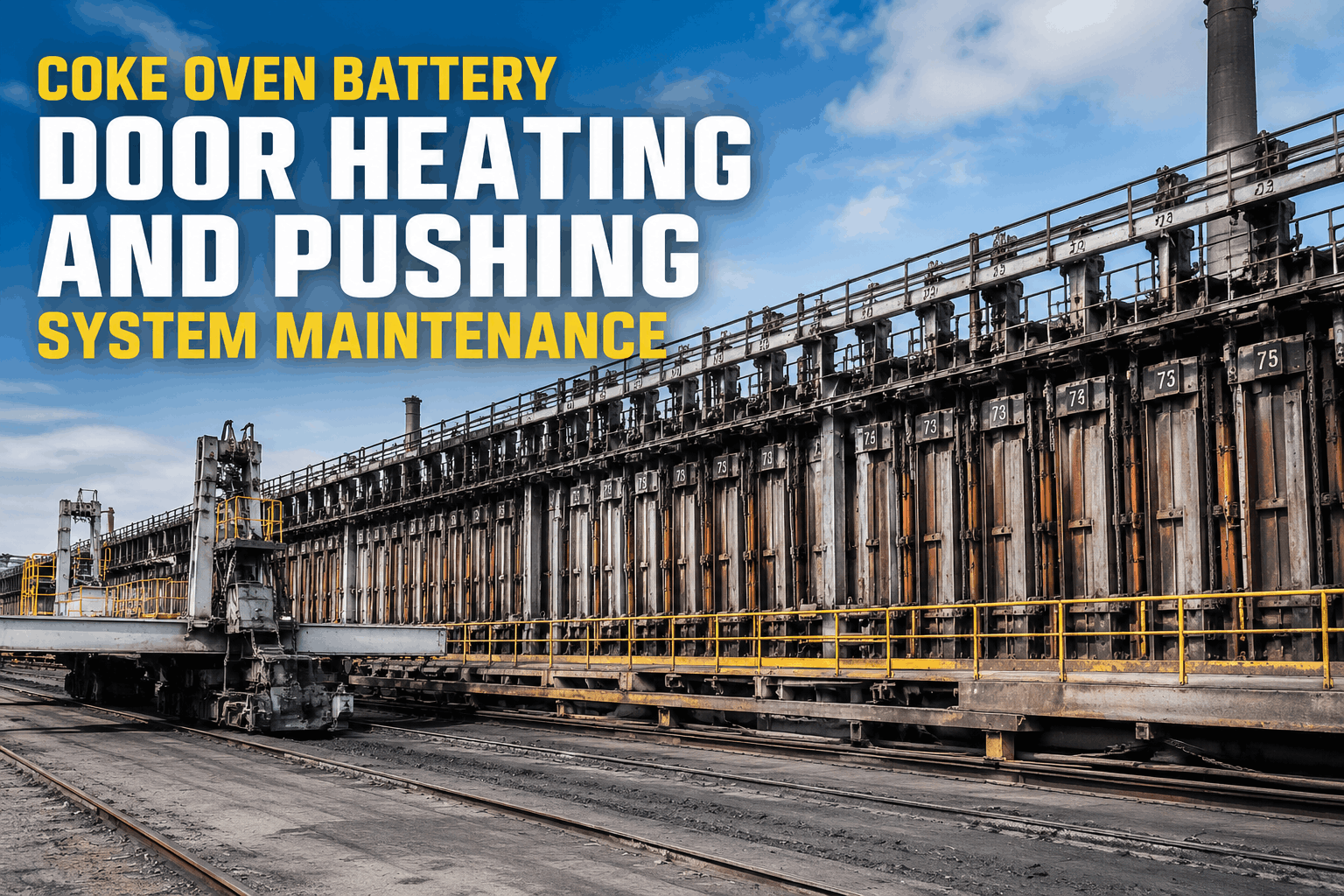
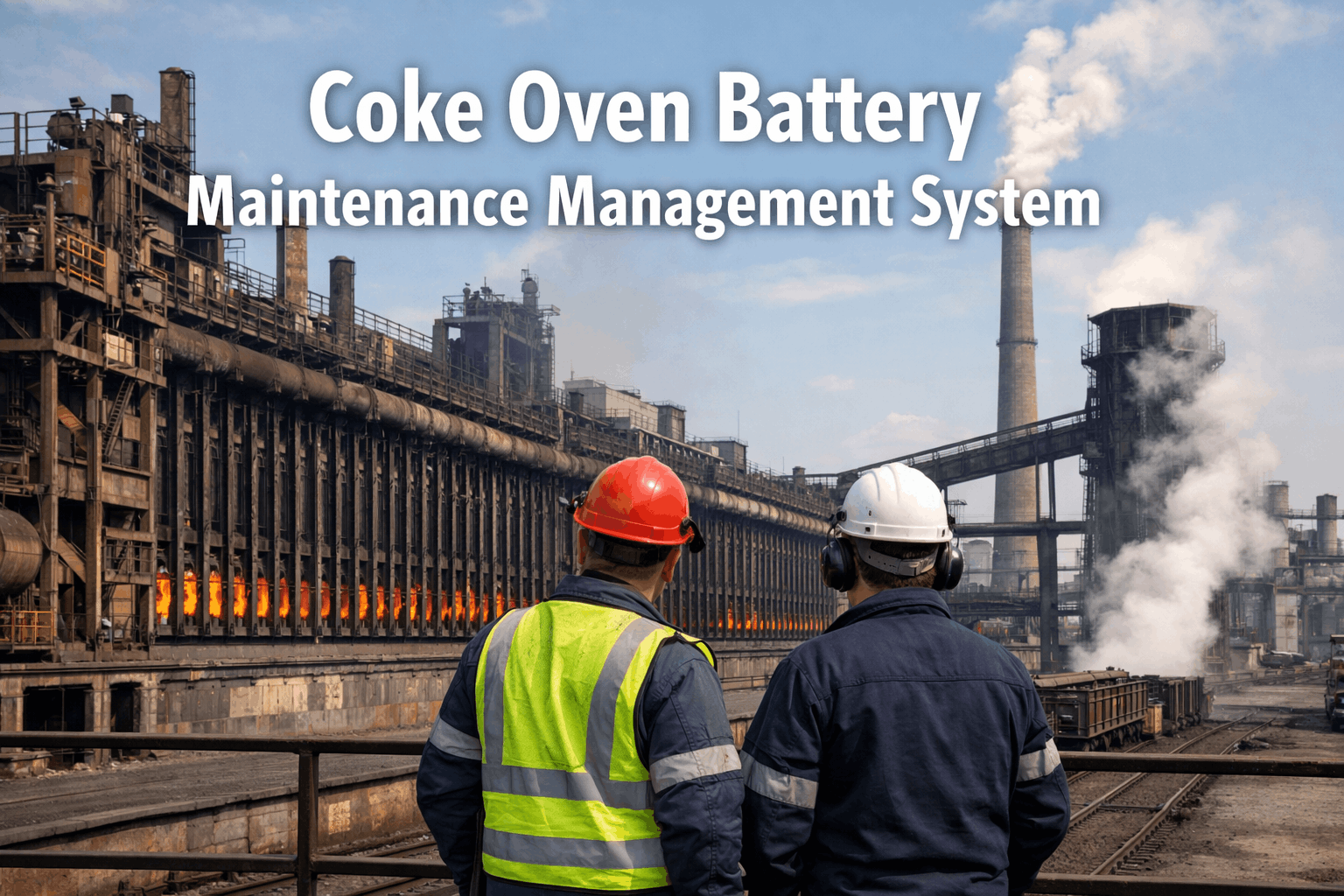
In integrated steel plants, the coke oven battery sits at the critical upstream junction between coal preparation and blast furnace ironmaking. When battery reliability slips — through degraded door seals, uneven flue temperatures, or pusher machine failures — the consequences compound quickly across the entire production chain. This article examines the four maintenance domains that determine coke battery performance, the operational and compliance risks of managing them reactively, and how maintenance management software is changing how ironmaking teams approach battery health. Book a demo to see how Oxmaint.ai tracks door seal condition, heating flue data, and pusher equipment reliability across your full battery.
Coke Oven Battery Maintenance: Door Seals, Heating Systems & Pushing Equipment
A practical guide for plant managers, maintenance heads, and operations directors managing battery-scale coke plant operations across integrated steel facilities.
The Operational Challenge at Battery Scale
Managing a coke oven battery means maintaining 40 to 60 individual ovens simultaneously — each with its own door assembly, heating profile, coal charge, and push schedule. At this scale, any degradation in one oven that goes untracked creates a ripple effect: increased emissions, reduced coke quality uniformity, and elevated mechanical risk to the pushing equipment that serves the entire battery.
The core operational challenge is not the complexity of any single maintenance task — door luting, flue temperature measurement, and pusher alignment checks are well-understood procedures. The challenge is tracking them systematically across every oven, every shift, with enough data fidelity to identify patterns before they become failures. Maintenance management software purpose-built for industrial asset management addresses exactly this gap.
Compliance Exposure
Environmental agencies cite door seal and standpipe emissions as primary violation triggers. Without oven-level inspection records, teams cannot defend their maintenance frequency during regulatory audits.
Production Loss
Oven jams caused by misaligned pusher equipment force unplanned stoppages that cascade into blast furnace feed shortfalls. Recovery from a single serious jam can take 6–12 hours of productive pushing time.
Quality Variance
Non-uniform flue temperature distribution produces inconsistent coke quality across the battery. Cold flues result in under-carbonised coal that affects blast furnace burden permeability and reduces overall ironmaking efficiency.
Asset Degradation
Silica brick refractory operates under sustained thermal stress. Without flue temperature trending, refractory degradation is invisible until a hot spot or structural crack forces an emergency shutdown.
Door Seal Condition & Frame Management
Coke oven door maintenance is the most visible and most compliance-sensitive domain in battery operations. Visible emissions from door seals during the pushing and quenching cycle are directly observable by regulatory inspectors and are among the most frequently cited violations in coke plant environmental audits across the USA, UK, and Germany.
Effective door seal management requires tracking condition at the individual door level — not at the battery aggregate level. Knife edge sharpness, door frame warp, luting compound application history, and the frequency of re-luting required per oven all need to be recorded systematically. Teams that use digital work order systems eliminate the shift-handoff gaps where door defects are reported verbally but never formally recorded or tracked to closure.
Knife edge and seating surface condition scoring per oven door, luting compound batch tracking with application timestamps, door frame gap measurement at four cardinal points, and pusher-side vs. coke-side condition comparison to identify asymmetric wear patterns that signal structural alignment issues requiring engineering review.
The correlation between luting frequency and door condition scores across the battery is data that only becomes visible when records are maintained digitally. Ovens requiring more than two re-luting events per coking cycle indicate frame or gasket defects that corrective work orders should address before the next push. This level of per-oven analysis is not possible with paper-based logging at battery scale.
Heating Flue Temperature Distribution
Uniform flue temperature distribution is the primary determinant of coke quality and coking time consistency across the battery. A well-operated battery maintains flue temperatures between 1,100°C and 1,200°C, with oven-to-oven variation held within ±15°C of the target profile. Deviations beyond this tolerance indicate combustion system problems that, if left uncorrected, compound into quality failures and refractory damage.
The challenge with flue temperature management is data volume. A full battery temperature survey requires an optical pyrometer reading at every flue of every oven — potentially several hundred individual readings per shift. When these readings are recorded on paper forms filed in a control room binder, the data is effectively invisible. Deviation patterns that would be immediately apparent in a digital trending system take weeks to emerge from manual log review.
Primary Combustion Failure Causes
Blocked or eroded underfiring nozzle tips, fouled regenerator checker bricks, and incorrect coke oven gas to blast furnace gas blending ratios are the three primary drivers of flue temperature anomalies in battery operations.
Typical Detection Lag
Without digital trend analysis, cold flue conditions typically persist for 48 hours or more before being identified through coke quality sampling — by which time several push cycles of under-carbonised material have already entered the blast furnace charge.
Maintenance heads deploying predictive maintenance software with flue temperature trending can configure automatic deviation alerts when any oven reading falls outside the target profile. Technicians receive mobile notifications to investigate the specific oven rather than waiting for the next planned survey round — a shift from reactive to condition-based maintenance that is measurable in both coke quality metrics and refractory service life.
Pusher Machine & Quencher Car Reliability
The pusher machine is the highest-wear piece of capital equipment in battery operations. It performs hundreds of push cycles per day across the length of the battery, and its mechanical condition directly determines whether coke is discharged cleanly or whether an oven jam event occurs. Ram alignment, leveler bar tip profile, door extractor latch engagement, and guide rail wear all require structured inspection intervals tied to push-count thresholds rather than calendar-based schedules.
Oven jamming events — where coke does not discharge freely and the pusher ram must be retracted under load — are the most damaging operational failure mode at the pushing side. Beyond the immediate production stoppage, jamming events subject the oven silica brick lining to mechanical shock loads that accelerate refractory degradation. Maintenance teams that track pusher alignment and leveler bar wear through a structured CMMS with push-count triggers reduce oven jamming incidents by over 40% within the first quarter of deployment.
Quencher car maintenance is often treated as lower priority relative to the pusher machine, but nozzle wear and uneven water distribution produce hot spots that create steam explosion risks and degrade coke moisture uniformity — a quality parameter that directly affects blast furnace burden permeability. Structured nozzle inspection intervals and per-push water consumption logging are the minimum required tracking disciplines.
Byproduct Plant & Gas Collection System
The standpipe, gooseneck, and hydraulic main form the gas collection boundary between the oven and the byproduct recovery system. Maintaining the integrity of this boundary is both a safety and a compliance obligation. Standpipe cap water seals that run dry, gooseneck swivel joints with worn sealing surfaces, and hydraulic main aspiration pressures that deviate from setpoint all represent gas leakage pathways that regulatory inspectors treat as primary violations.
The byproduct plant also determines the recovery efficiency of coal tar, benzene, ammonium sulphate, and light oil — revenue-generating streams whose yield is directly affected by gas collection system condition. Operations directors who monitor aspiration pressure trends and standpipe condition through real-time asset management software can maintain the gas pressure balance that maximises both safety and byproduct recovery yield.
Gooseneck riser pipe wall thickness monitoring during planned outages, hydraulic main pressure recording at two-hour intervals, and standpipe water seal level checks every shift are the core inspection disciplines that form a defensible maintenance record for this domain. Each activity requires a timestamped record attributed to a named technician and stored in a system that survives shift rotations and personnel changes without knowledge loss.
How Digital Maintenance Management Transforms Battery Operations
The transition from paper-based to digital maintenance management in coke plant operations is not about replacing experienced maintenance technicians — it is about giving them tools that make their knowledge systematic and their actions traceable. Oxmaint.ai is an AI-powered CMMS built for industrial asset management at the equipment and oven level, not a horizontal platform adapted for heavy industry use.
Oven-Level Work Order Management
Create, assign, and close corrective and preventive work orders at the individual oven number level. Filter the full battery by zone, equipment type, condition status, or priority from a single dashboard — giving maintenance heads complete backlog visibility without manual log compilation.
Mobile Inspection with Offline Capability
Technicians complete door seal, flue temperature, and pusher inspection rounds directly on mobile with photo attachments and GPS timestamps. Offline sync enables battery-top data entry in low-connectivity environments — with all records uploading automatically when connectivity is restored.
Condition Trending & Predictive Alerts
Flue temperature readings, door condition scores, and pusher alignment measurements are trended over time per oven. Configurable thresholds trigger automatic alerts when any parameter approaches its critical limit — enabling the shift from reactive to predictive maintenance scheduling at the battery level.
One-Click Compliance Audit Reports
Every inspection, luting event, and corrective action is stored with technician attribution and timestamp. Regulatory reports can be filtered by date range, oven, or maintenance category and exported in formats suitable for EPA and local authority submissions — without hours of manual data compilation.
Paper-Based vs. Digital Coke Battery Maintenance Tracking
The operational gap between manual log books and a structured CMMS software platform shows up most clearly when maintenance heads need to answer two questions under audit pressure: what was the condition of each oven door on a specific date, and what corrective actions were taken? With paper-based systems, answering either question requires hours of log book retrieval. With Oxmaint.ai, it takes seconds.
| Maintenance Area | Paper-Based Tracking | Oxmaint.ai |
|---|---|---|
| Door Seal Records | Handwritten shift logs with no per-oven trend history | Per-door digital condition scores with full inspection history |
| Flue Temperature Surveys | Paper forms filed in binders, no deviation flagging | Mobile entry with automatic deviation alerts against target profiles |
| Pusher Machine Inspection | Calendar-based checklist, no push-count triggers or photo records | Push-count-triggered PM schedules with photo evidence and history |
| Compliance Reporting | Manual compilation from multiple binders before each audit | One-click export with technician attribution and date filtering |
| Corrective Work Orders | Verbal shift handoff, frequently lost between teams | Digital assignment with priority, deadline, and closure tracking |
Swipe horizontally to compare on mobile
Tracking 56 ovens on paper was simply impossible — we were always behind on door repairs and had no way to prove inspection frequency during agency audits. Oxmaint.ai gave us oven-level visibility we had never had before. Compliance reports that used to take days now take minutes.— Maintenance Head, Integrated Steel Plant, Midwest USA
Bring Digital Maintenance Tracking to Your Coke Battery
Oxmaint.ai is trusted by maintenance teams at integrated steel plants to manage battery health, reduce compliance risk, and build a defensible audit trail — without adding administrative burden to your technicians.
Frequently Asked Questions
Can Oxmaint.ai track individual oven door conditions across a battery of 50+ ovens?
Yes. Oxmaint.ai allows asset hierarchies to be configured at the oven level. Each door carries its own maintenance history, condition score timeline, and linked work orders — making it straightforward to identify recurring problem ovens and prioritise repair resources based on actual condition data rather than blanket scheduling.
How does the platform handle flue temperature data entry during battery rounds?
Technicians use the Oxmaint mobile app to enter flue readings per oven during battery rounds, with offline sync for low-connectivity battery-top environments. Readings are automatically compared against configured target profiles, and deviations trigger automated corrective work order creation for engineering follow-up.
Does Oxmaint.ai support push-count-triggered maintenance scheduling for pusher machines?
Yes. Preventive maintenance schedules for pusher machines, door extractors, leveler bars, and quencher cars can all be configured using push-count triggers in addition to calendar-based intervals. Automated work orders are generated and assigned to the responsible team before each maintenance window.
What compliance reporting capabilities does the platform provide for coke plant audits?
Every inspection event, luting record, and corrective action is stored with technician attribution and a precise timestamp. Maintenance heads can generate reports filtered by date range, oven number, or maintenance category. Book a demo to see the compliance reporting module in detail.
How long does implementation take for an existing coke plant operation?
Onboarding includes asset data migration from existing spreadsheets and paper logs. Most operational coke plant teams are fully active on Oxmaint.ai within two weeks of starting their free trial, with oven-level asset structures, PM schedules, and inspection templates configured for their specific battery layout.
How is Oxmaint.ai different from a generic CMMS for coke plant use?
Oxmaint.ai is an AI-powered industrial maintenance management platform, not a horizontal CMMS retrofitted for heavy industry. Per-oven condition scoring, push-count-triggered maintenance, mobile offline inspections with photo evidence, and one-click regulatory reporting are built into the platform's core workflows — not available only as custom add-ons.
Start Managing Coke Battery Maintenance With Precision
Door seal compliance, heating system reliability, pusher equipment integrity, and gas collection safety — Oxmaint.ai gives your maintenance team the digital infrastructure to manage all four domains with the rigour that modern ironmaking demands.