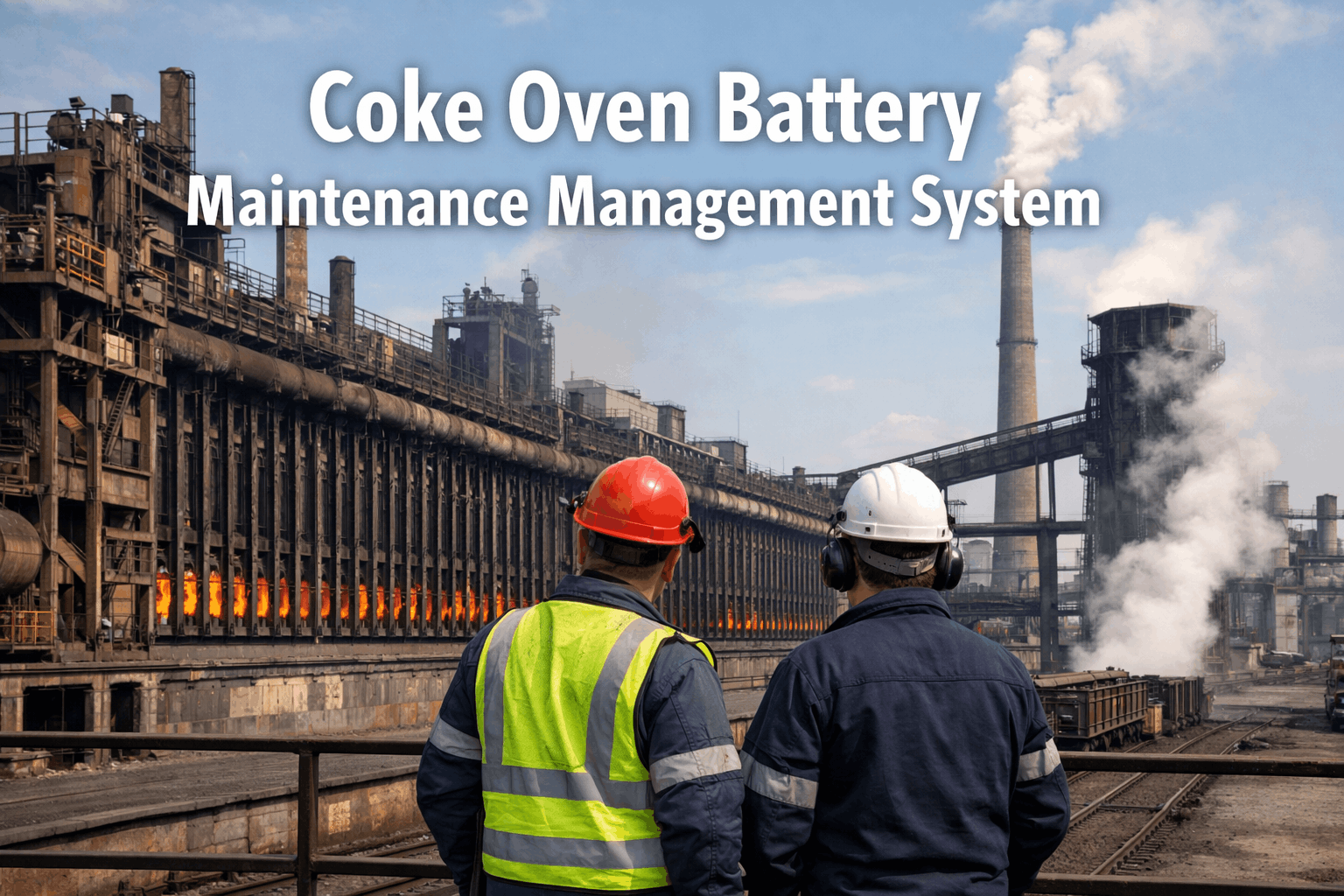
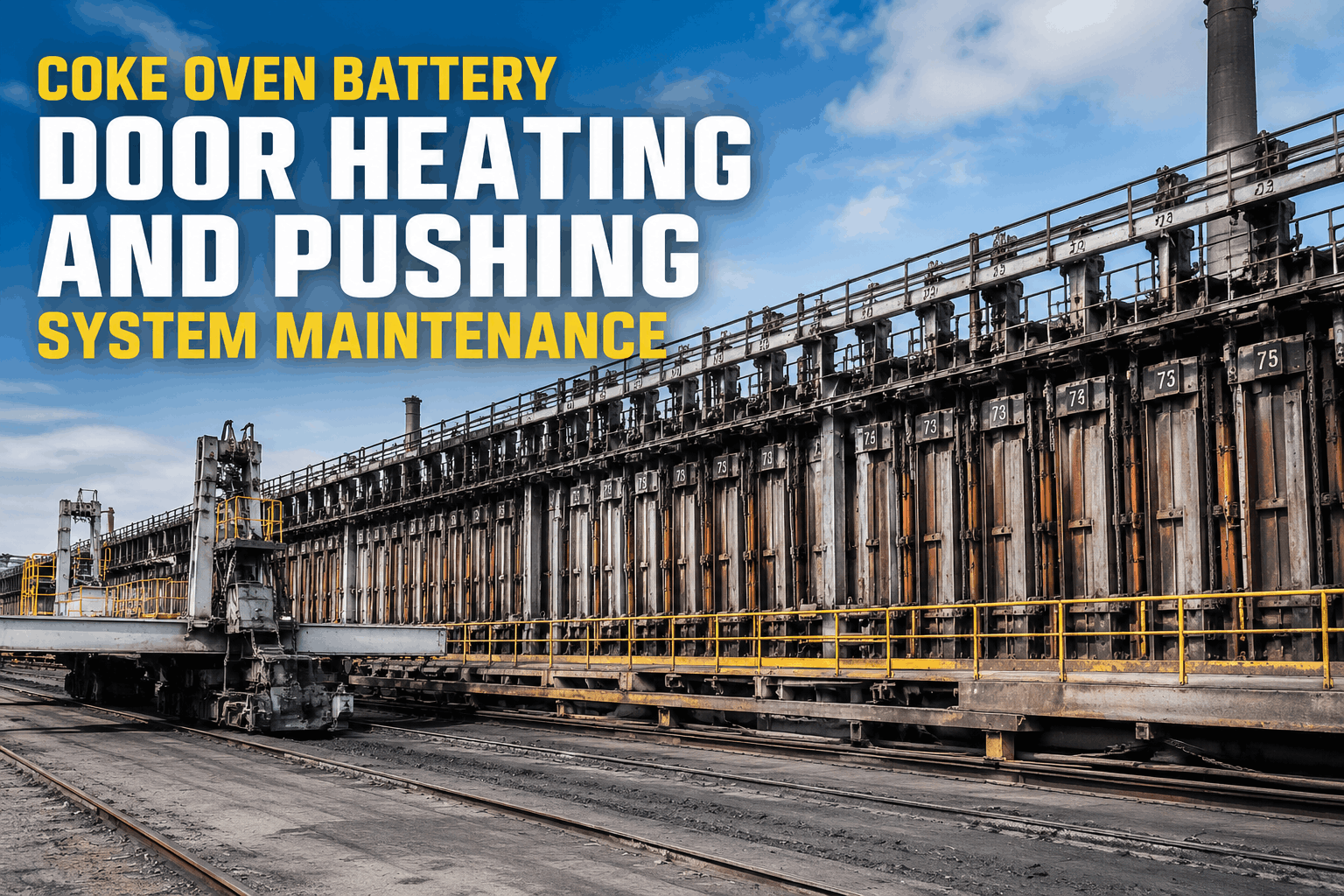
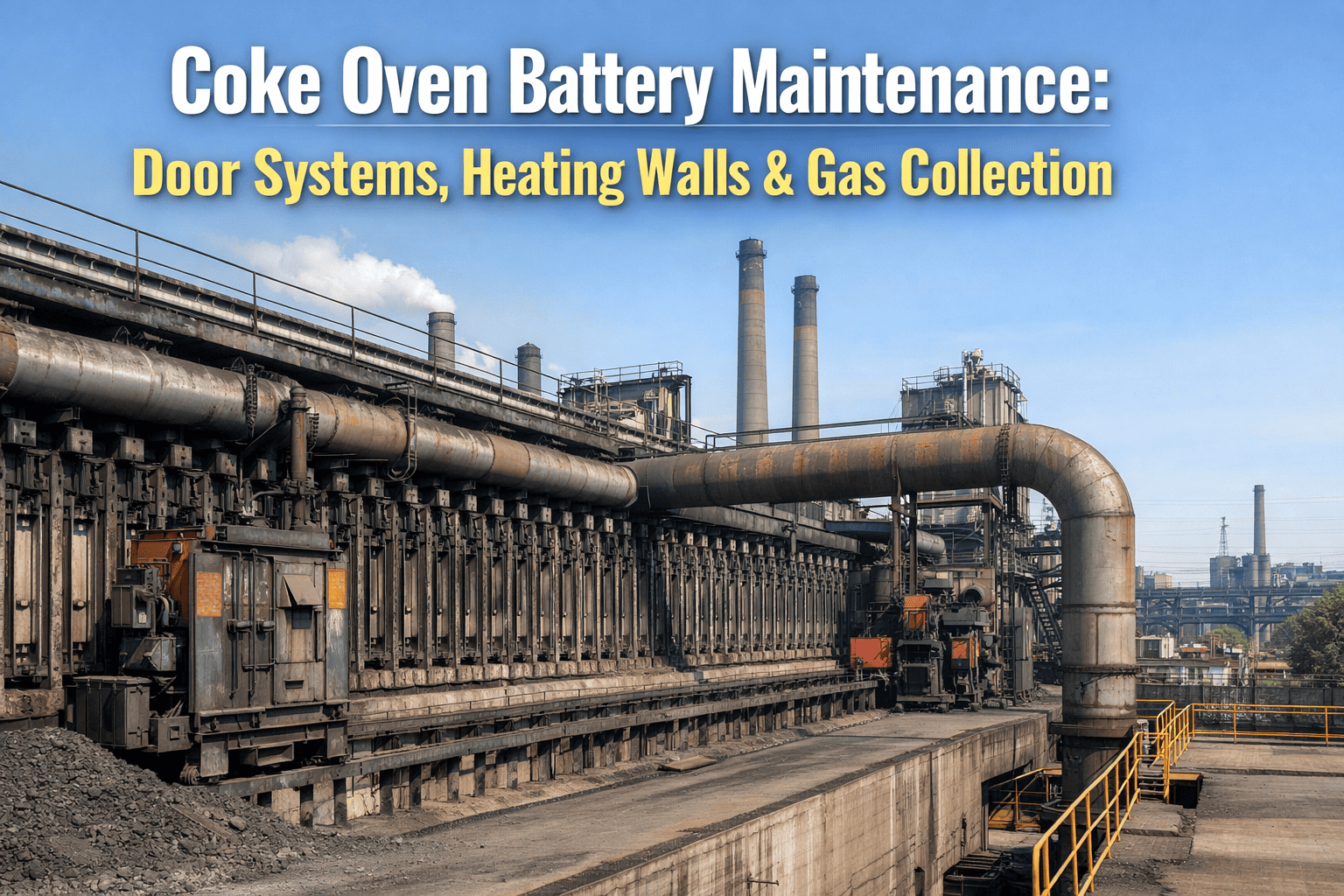
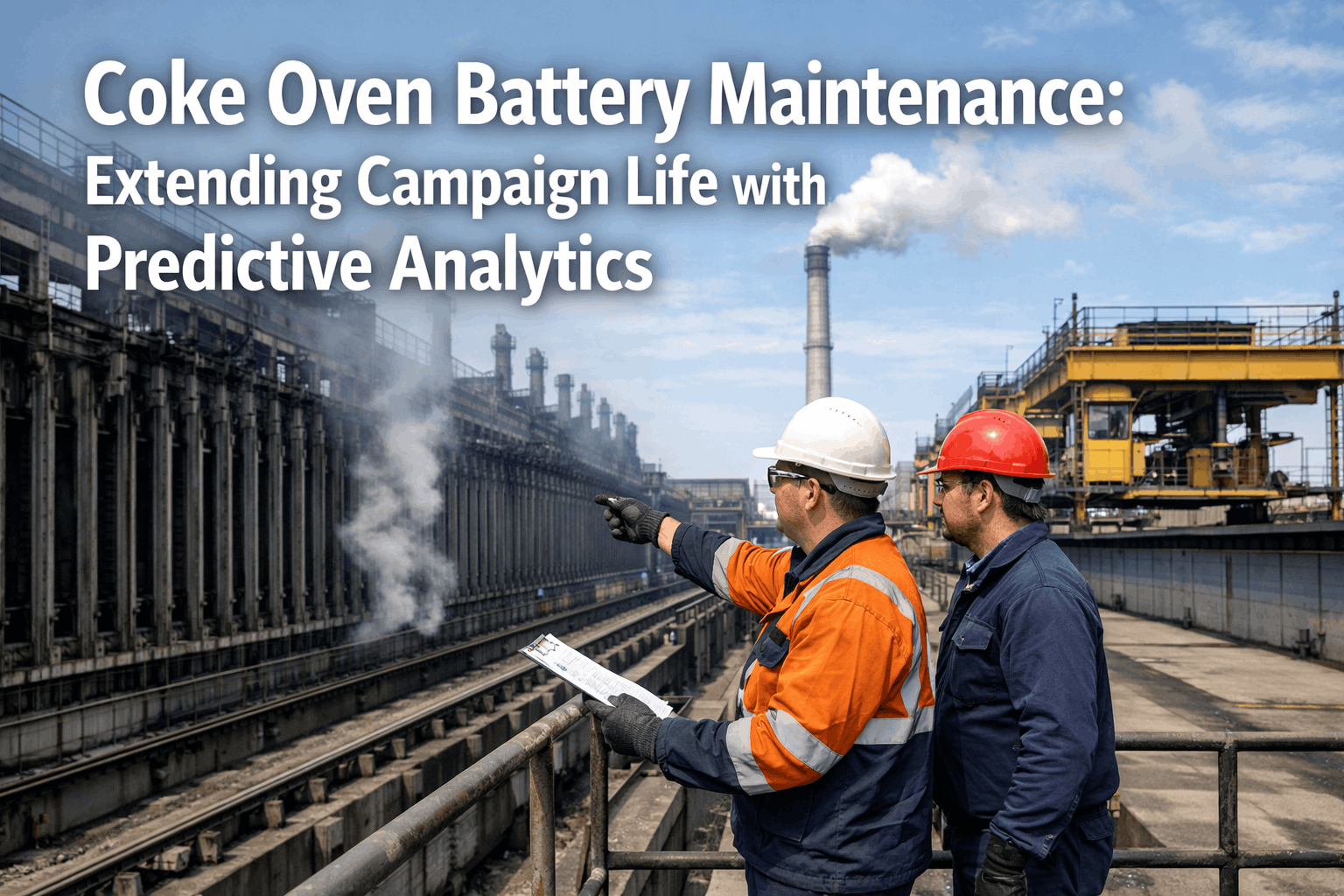
A coke oven battery is the most maintenance-intensive, environmentally sensitive, and operationally unforgiving asset in an integrated steel plant. It runs 24 hours a day, 365 days a year, for 25–40 years without a full shutdown. You can't stop it. You can't cool it down. You can't open it up and inspect it the way you inspect a rolling mill or a pump. Every repair happens while the battery is hot — 1,000–1,100°C hot — with coking cycles continuing in adjacent ovens while your crew works on the one that's failing. Miss a maintenance window and the damage compounds. Ignore a leaking door and the emissions violation arrives before the repair crew does. Let a wall crack propagate and you lose an oven for the rest of the battery's campaign — permanently reducing capacity by 1/60th to 1/80th of total output. There is no asset in steelmaking where the gap between good maintenance and bad maintenance produces a larger financial and operational difference. A well-maintained battery produces consistent coke quality for 30–40 years. A poorly maintained battery becomes an environmental liability, a production bottleneck, and a $500M–$1B premature replacement decision within 15–20 years.
A coke oven battery has 60–80 individual ovens, each cycling every 16–24 hours.
That's 1,000–1,800 coking cycles per day across the battery.
Each cycle involves charging, heating, pushing, and quenching — four mechanical events stressing every component.
Over a 30-year campaign, that's 10–20 million individual cycles.
And every single one of them needs to go right.
What Makes Coke Oven Maintenance Unlike Anything Else in the Plant
Can you shut it down for maintenance?
No. A coke oven battery operates continuously for its entire 25–40 year campaign. Cooling a battery takes weeks and causes irreversible thermal damage to the silica brickwork — once cooled, most batteries cannot be reheated to service. Every repair, every inspection, every component replacement happens at operating temperature. Your maintenance crew works in ambient temperatures of 50–80°C beside oven walls at 1,100°C.
Can you inspect the inside?
Only between pushes — a window of 20–45 minutes while the oven is empty before the next charge. Through oven doors, through charging holes, and through standpipe openings. You're looking at refractory walls that should be flat, uniform, and intact — but may be spalling, cracking, leaning, or developing carbon deposits that reduce oven width and eventually prevent the coke from being pushed out at all.
What happens when a repair is delayed?
Damage accelerates exponentially. A hairline wall crack allows raw gas to leak into the heating flue, altering combustion patterns, overheating adjacent brickwork, and expanding the crack. What was a $5,000 hot repair becomes a $50,000 partial wall rebuild in weeks, and a permanently lost oven in months. Leaking doors that aren't sealed cause visible emissions that trigger regulatory enforcement within hours in many jurisdictions.
What does a lost oven actually cost?
An oven taken out of service permanently loses 1.2–1.7% of battery capacity (on a 65-oven battery). Over a 20-year remaining campaign at $300/ton of coke, a single lost oven costs $3M–$8M in lost production. Most failing batteries have 5–15 lost ovens — representing $15M–$120M in cumulative lost capacity that proper maintenance would have preserved.
The Seven Systems That Keep a Battery Alive
A coke oven battery isn't one machine — it's seven interdependent systems, each with unique failure modes, inspection requirements, and maintenance strategies. Failure in any one system cascades into the others. OxMaint tracks all seven systems in a single integrated platform.
1
Oven Walls & Brickwork
The structural foundation — and the one thing you cannot replace
Silica brick walls 100–120mm thick separating each oven chamber from the heating flues on either side. These walls endure 1,000–1,100°C temperatures, thermal cycling stress from every push, mechanical impact from charging and pushing equipment, and chemical attack from coal tar and volatile compounds. Wall failure is the primary cause of oven loss and the primary driver of battery end-of-life.
Track: Wall condition ratings per oven (A/B/C/D scale), crack locations and progression, carbon buildup measurements, wall thickness surveys, repair history per oven per wall
2
Heating System
Uniform heating = uniform coke. Non-uniform heating = cracks, stickers, and lost ovens
Gas burners or regenerative heating flues distribute heat evenly across and along each oven. Blocked flues, damaged checkerwork, leaking crossovers, and plugged nozzles create hot spots and cold spots — producing inconsistent coke quality, accelerating brickwork deterioration in overheated zones, and creating underpushing conditions in underheated zones where the coke isn't fully carbonized.
Track: Flue temperature profiles per oven (top, middle, bottom), cross-wall temperature differentials, burner nozzle condition, checkerwork flow resistance, gas distribution uniformity
3
Oven Doors & Frames
The most visible maintenance problem — and the fastest regulatory trigger
Each oven has two doors (pusher side and coke side) that must seal against 1,100°C internal pressure while being removed and replaced every coking cycle. Door sealing surfaces warp, door plugs erode, sealing springs weaken, and luting compounds degrade — producing visible emissions that violate environmental permits. A leaking door is both an emissions violation and a safety hazard (raw coke oven gas contains benzene, toluene, and hydrogen).
Track: Door leak rates per oven per side, door seal replacement history, frame condition surveys, luting material consumption, emissions observations linked to specific doors
4
Pushing & Charging Equipment
The machines that stress the brickwork 1,000+ times per day
Pusher machine, charging car, coke guide, and quench car — the mobile equipment that executes each coking cycle. Misaligned pushing rams damage oven walls. Off-center charges create asymmetric loading. Excessive pushing force from hard-push conditions (carbon buildup narrowing the oven) accelerates wall cracking. These machines must be maintained to protect the brickwork as much as to maintain their own function.
Track: Pushing force per oven per push (trending identifies developing hard-push conditions 2–4 weeks before they become critical), ram alignment measurements, charging car leveling, coke guide positioning accuracy
5
Gas Collection & Byproduct System
Where environmental compliance meets process safety
Standpipes, goosenecks, collecting mains, and aspiration systems capture raw coke oven gas during carbonization. Leaks in this system release carcinogenic compounds (benzene, benzo[a]pyrene) and explosive gases (hydrogen, methane). Standpipe caps that don't seal, gooseneck joints that corrode, and collecting main connections that crack are simultaneously environmental violations, safety hazards, and process efficiency losses.
Track: Standpipe cap condition per oven, gooseneck integrity inspections, collecting main pressure and leak surveys, aspiration system performance, emissions monitoring data linked to specific collection point defects
6
Battery Structure — Buckstays, Tie Rods & Foundation
The steel skeleton holding everything together against thermal expansion
Buckstays are vertical steel columns on each side of the battery connected by tie rods through the brickwork. They resist the thermal expansion force of 60–80 ovens trying to push outward as they heat. Spring-loaded or hydraulically compensated, these systems must maintain precise compression on the brickwork. Insufficient buckstay pressure allows brick joints to open (gas leaks, structural instability). Excessive pressure crushes brickwork. Foundation settlement shifts the entire battery geometry.
Track: Buckstay spring tension measurements, tie rod elongation, battery vertical and horizontal alignment surveys, foundation settlement monitoring, buckstay column condition
7
Refractory Repair & Hot Maintenance
Surgery on a patient you can't anesthetize
Hot repairs — ceramic welding, spraying, brick replacement at operating temperature — are the intervention that extends battery life from 15 years to 35+ years. Every crack patched, every spall repaired, every carbon deposit removed extends the oven's productive life. But hot repair is a specialized skill performed in extreme conditions. Quality varies dramatically between crews and methods, and poor-quality repairs fail within months, wasting material and the precious access window.
Track: Repair type and location per oven, material consumed per repair, repair longevity (time to re-inspection or re-repair), crew and method effectiveness comparison, repair cost per oven trending over battery life
Seven Systems. Sixty-Plus Ovens. Thousands of Data Points. One Platform.
OxMaint integrates coke oven battery maintenance across every system — wall condition tracking, heating profiles, door management, pushing force trending, emissions compliance, structural monitoring, and hot repair scheduling. Complete battery lifecycle management from a single dashboard.
Pushing Force: The Single Most Important Number on the Battery
If you can only monitor one thing on a coke oven battery, monitor the pushing force on every oven on every push. Here's why.
Normal push
15–25 tons
Oven walls smooth, coke properly carbonized, normal taper. Healthy oven, healthy push.
Elevated push
25–35 tons
Early warning. Carbon buildup narrowing the oven, slight wall irregularity, or undercoking from heating issues. Investigate within 1–2 cycles. Carbon removal or coking time adjustment usually resolves it.
High push
35–50 tons
Urgent. Significant carbon deposits, wall damage restricting oven width, or seriously undercooked charge. Risk of sticker (coke jammed, can't be pushed). Oven must be taken offline for inspection and intervention before next charge.
Hard push / sticker
50+ tons or failed push
Emergency. Coke cannot be pushed or requires maximum force risking wall damage. Sticker events damage walls, can warp pusher rams, and force the oven out of sequence. Repeated stickers on the same oven signal wall failure in progress — potential permanent oven loss.
The CMMS tracks pushing force for every oven on every push, trending the data over weeks and months. A gradual rise from 20 tons to 28 tons over 6 weeks on Oven 34 is invisible to operators (the push still "works") but clearly visible in the data — triggering investigation and carbon removal before the oven reaches sticker territory. Without trending, the first signal is the sticker itself.
Environmental Compliance: The Maintenance Problem That Becomes a Legal Problem
Coke oven emissions are regulated more tightly than virtually any other source in steelmaking. The compounds released — benzene, benzo[a]pyrene, particulate matter, hydrogen sulfide, ammonia — are carcinogenic, toxic, or both. Regulatory agencies don't send warnings. They send inspectors with cameras, and the fines start accumulating per violation per day.
Door leaks
40–60% of total battery emissions
Door seal maintenance, frame straightening, plug replacement, luting discipline. The CMMS schedules door seal replacement by condition (leak rate measurement) and tracks which specific doors on which specific ovens are the chronic leakers that need frame repair rather than just new seals.
Charging emissions
15–25% of total battery emissions
Stage charging technique, aspiration system performance, charging hole lid condition, and charging car alignment. The CMMS tracks aspiration pressure, lid seal integrity per charging hole, and charging emission observations linked to specific car and technique variables.
Topside leaks
10–20% of total battery emissions
Standpipe cap sealing, charging hole lid maintenance, and collecting main joint integrity. Each topside emission point is mapped to a specific oven and component, enabling targeted repair rather than battery-wide inspection sweeps.
Pushing emissions
10–15% of total battery emissions
Complete carbonization verification (no green pushes), coke guide seal to oven face, and quench car travel time minimization. The CMMS links pushing emissions observations to specific oven coking times, identifying ovens where the heating profile needs adjustment to ensure complete carbonization.
Oven-by-Oven Health Dashboard: Seeing the Battery as 65 Individual Patients
The fundamental shift in coke oven battery maintenance is moving from "battery-level averages" to "oven-level specifics." A battery average of 22-ton pushing force hides the fact that Oven 12 is at 38 tons and Oven 47 is at 44 tons. A battery-average door leak rate of 3% hides the 6 doors leaking at 15%+ that are driving 80% of the total emissions. The CMMS maintains an individual health profile for each oven.
#12
C
38t ▲
PS 8%
±15°C
WATCH
#14
B
24t →
CS 6%
±12°C
GOOD
#15
D
47t ▲▲
PS 14%
±28°C
CRITICAL
ROI: Coke Oven Battery Maintenance Management System
$8.5M
Preserved Oven Capacity — Prevented Permanent Oven Losses
Preventing 2–3 permanent oven losses per year through early crack detection, pushing force trending, and timely hot repair — each lost oven = $3M–$8M over remaining campaign life
$3.8M
Extended Battery Campaign Life
Systematic maintenance extends battery life 5–10 years beyond poorly maintained equivalents — deferring a $500M–$1B rebuild decision by years, worth $50M–$100M annually in deferred capital
$2.2M
Emissions Compliance & Avoided Penalties
Targeted door and topside maintenance reduces visible emissions 40–60%, avoiding $50K–$200K per violation per day penalties and potential consent decree costs of $10M+
$1.5M
Hot Repair Material & Labor Optimization
Condition-based repair scheduling reduces repair material waste 20–30% and increases repair longevity by targeting the right repair method to the right defect type
Expert Perspective
A coke oven battery is the longest-lived, most maintenance-dependent asset in steelmaking. The maintenance decisions made today determine whether the battery produces at full capacity for 35 years or becomes a $500M replacement problem at year 20. If you're ready to manage your battery with the precision and data it demands, book a free demo to see how coke oven battery management works on OxMaint.
35 Years of Battery Life. Decided by the Maintenance You Do Today.
OxMaint delivers integrated coke oven battery maintenance management — oven-by-oven condition tracking, pushing force trending, heating profile analysis, door and emissions management, hot repair scheduling, structural monitoring, and campaign life forecasting. One platform for the most demanding asset in your plant.
Frequently Asked Questions
How is pushing force data collected and fed into the CMMS?
Hydraulic pressure sensors on the pusher machine ram cylinders measure the force required for each push. The data is transmitted wirelessly or via the pusher machine's onboard PLC to the CMMS, tagged with oven number, date, time, and coking cycle. Most modern pusher machines already have these sensors for operational control — the integration effort is connecting them to the CMMS for trending and alerting, typically a 2–4 week project.
What wall condition rating system does the CMMS use?
A four-tier rating: A (good — minor wear, no intervention needed), B (fair — localized defects, schedule monitoring), C (deteriorated — active defects requiring planned repair within 1–3 months), D (critical — significant damage, immediate intervention required to prevent oven loss). Each rating has defined criteria for crack size, spall area, wall deflection, and carbon deposit thickness so assessments are consistent between inspectors.
How does the system handle the limited inspection windows on active ovens?
The CMMS schedules inspections within the 20–45 minute window between push and recharge, coordinating with the battery operating schedule. Inspection tasks are pre-defined checklists on mobile devices so inspectors capture data rapidly. The system rotates inspection focus — wall condition one cycle, door seals the next, heating profile the next — building a complete picture over multiple cycles without requiring full inspection in a single window.
Can the system predict when an oven will need to be taken out of service?
Yes, using trend analysis across multiple parameters. When pushing force, wall condition rating, heating uniformity, and repair frequency all trend negatively on the same oven, the system projects the timeline to service limits. This prediction — typically 3–12 months forward — enables planned capacity adjustments rather than sudden oven losses that disrupt production scheduling.
What is a realistic implementation timeline?
Phase 1 (months 1–3): oven registry, baseline condition surveys, pushing force integration, and door condition tracking. Phase 2 (months 3–6): heating profile integration, hot repair tracking, emissions monitoring linkage. Phase 3 (months 6–12): trend analysis active, predictive alerts calibrated, campaign life forecasting operational. Measurable ROI typically appears from month 3 when pushing force trending catches the first developing hard-push conditions before they become stickers.