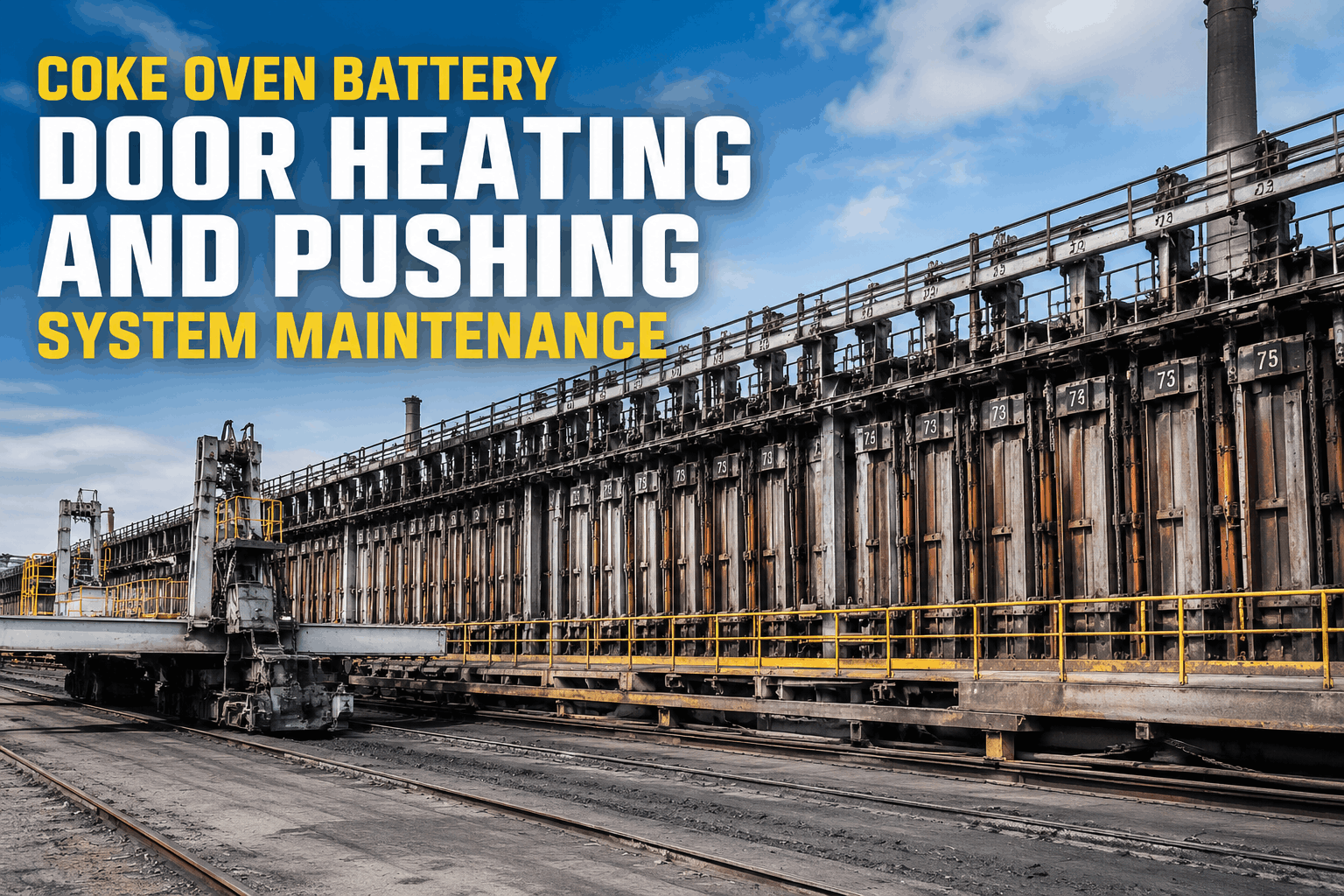
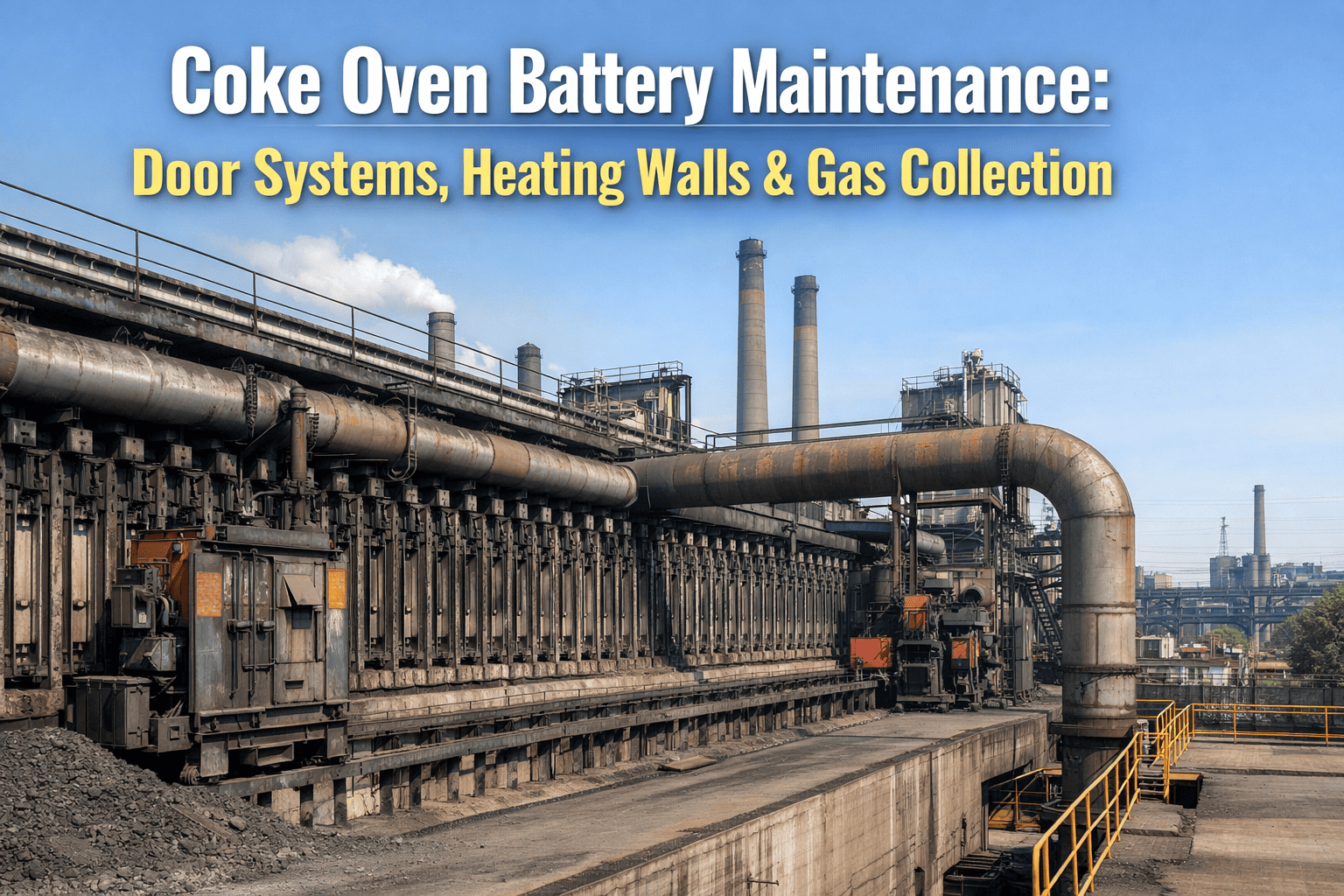
Coke Oven Battery Maintenance: Door Systems, Heating Walls & Gas Collection Guide

By James smith on March 31, 2026

coke-oven-battery-maintenance-door-heating-gas-system

Coke oven battery failures do not happen without warning — they build from deferred inspections, untrended condition data, and repair work that addresses symptoms without identifying the underlying deterioration pattern. When a heating wall finally fails, the cost per oven runs from $800,000 to $2,000,000 in emergency parts, crane time, and lost production. That cost is avoidable. The question is whether your maintenance programme is generating the data to avoid it. Start tracking coke oven battery maintenance with Oxmaint — free trial, no credit card, refractory tracking active from day one.

Refractory Tracking  ·  Preventive Maintenance  ·  Energy & Sustainability

Coke Oven Battery Maintenance: Door Systems, Heating Walls & Gas Collection

A well-maintained coke oven battery reliably produces quality coke for 40 years. A poorly maintained one shuts before year 22. The difference is not the age of the refractory — it is whether the deterioration was tracked, trended, and acted on before it became irreversible. Oxmaint connects your condition survey data, door maintenance logs, gas system records, and by-product plant PM schedules into a single battery management intelligence layer.

Battery Reliability at a Glance
$1.8M
Average cost per uncontrolled heating wall failure — parts, crane time, and lost production
68%
Of premature battery closures caused by refractory damage not tracked until structurally irreversible
40 yrs
Achievable battery life with systematic maintenance vs 18–22 years reactive
15–30%
Of total coke oven heat loss attributable to door seal failures across a battery
Six Maintenance Domains

Every Coke Oven Battery Is Six Maintenance Systems — Each With Its Own Failure Signature

Battery reliability is not a single problem with a single solution. It is six interconnected maintenance domains — each running on its own inspection cycle, each generating its own failure signals, and each capable of cascading into the others when deferred. Oxmaint manages all six from one platform, connecting their records into a unified battery health picture.


DOR
Door Systems — Seals, Frames & Plugs

The highest-frequency, highest-impact maintenance activity on the battery. Door seal integrity determines heat loss, emissions compliance, and coke quality simultaneously. A single persistent leaker costs €8,000–15,000 per year in heat loss and regulatory exposure. Oxmaint tracks door condition by oven number, position, seal type, and inspection outcome — building the defect trend record that drives replacement vs repair decisions.

Inspection: Per push cycle + weekly survey · Regulatory: Emissions compliance

HWR
Heating Wall Refractory — Condition Surveys & Repair

The structural core of the battery — and the primary determinant of operational life. Silica brick creep, carbonisation deposits in heating flues, spalling at crown bricks, and partition wall cracking are all progressively damaging if unmonitored. Oxmaint's Refractory Tracking module scores each boroscope survey finding against a deterioration index, trends scores per oven across consecutive surveys, and generates repair priority work orders when thresholds are crossed. Start free to activate refractory condition tracking per oven.

Inspection: Quarterly boroscope (rotating) + annual full survey · Criticality: Highest

GAS
Gas Collection & Ascension Pipes

The ascension pipes, collecting mains, and liquor seal systems are subject to tar deposition, seal failures, and corrosion that reduce efficiency and create emissions risk. A blocked ascension pipe diverts 100% of that oven's charging gas to atmosphere — an emissions incident, a regulatory event, and a production quality problem simultaneously. Oxmaint tracks cleaning cycle compliance and seal condition per ascension pipe. Book a demo to see gas system cycle tracking.

Inspection: Monthly + after-charging events · Key risk: Tar plug formation

CHG
Charging & Pushing Systems — Ram Alignment

A 72-oven battery on a 16-hour coking cycle executes 54 push events per day. Charging telescopes, levelling bar mechanisms, and pushing ram alignment all require systematic maintenance. Ram misalignment is a primary cause of heating wall damage during push events — the cracking found in subsequent boroscope surveys often traces back to mechanical deviation that went unrecorded. Oxmaint tracks alignment records and mechanical inspection outcomes per machine.

Inspection: Weekly mechanical + monthly comprehensive · Key risk: Wall damage from ram misalignment

BYP
By-Product Plant — ESP, Coolers & Scrubbers

The by-product recovery plant — electrostatic precipitators, primary coolers, benzol scrubbers, and desulphurisation units — requires structured preventive maintenance to maintain COG quality and recovery efficiency. ESP rapping system failures and heat exchanger fouling degrade the calorific value of every cubic metre of COG delivered to the steelworks. Oxmaint manages PM schedules for all by-product plant equipment in the same system as the battery. Sign in to manage by-product plant PM alongside battery maintenance.

Inspection: Continuous process monitoring + scheduled PM · Key risk: COG quality degradation

QCH
Quenching System — Nozzles, Pumps & CDQ

Wet quenching systems require regular nozzle inspection, pump condition monitoring, and sump cleaning to maintain consistent quench water distribution and uniform coke moisture. Blocked nozzles produce localised over-quenching and under-quenching that causes handling and blast furnace burden management problems. CDQ systems have additional heat exchanger and steam drum maintenance requirements where Oxmaint's PM scheduling coordinates maintenance windows within operating cycles. Book a demo to see quenching system maintenance scheduling.

Inspection: Daily pump checks + weekly nozzle survey · CDQ: Heat exchanger intervals per OEM
Stop Filing Condition Survey Results. Start Acting on Them.
Oxmaint's Refractory Tracking module converts boroscope survey findings into scored, trended asset records per oven — automatically generating repair priority work orders when deterioration index scores cross the intervention threshold. No more survey reports that get filed and forgotten.
Why Batteries Fail Early

Six Maintenance Failures That Close Coke Oven Batteries Decades Before Their Time

Premature battery decommissioning is rarely caused by a single catastrophic failure. It is the result of compounding maintenance deficiencies that individually appeared manageable — until the structural damage became irreversible. These are the six patterns that end batteries early.

01
Condition Survey Findings Never Trended
Quarterly boroscope surveys are conducted, findings filed in a paper register, and the survey report never reviewed against previous results. Oxmaint loads survey history into a per-oven deterioration index that makes accelerating damage visible across consecutive surveys — not just in the current report.
02
Door Leaker Data Without Trend Analysis
Door defects are logged per push cycle but never aggregated. A door frame that generates a leaker on 40% of pushes over six months looks like a recurring nuisance — until the trend is plotted and it becomes clear the frame is deforming progressively. Oxmaint tracks leaker frequency per door and per oven position.
03
Gas System Cleaning Cycles Slipped
Ascension pipe cleaning is scheduled on a rotating basis, but schedule compliance is tracked manually. When cycles slip during production peaks, tar deposition accelerates and the next cleaning finds plugs that require forced clearance — damaging the pipe in the process. Oxmaint enforces cleaning cycle compliance with automatic overdue alerts.
04
Ram Alignment Not Recorded After Interventions
Pushing ram alignment is checked at major overhaul but not re-verified after bearing replacements, ram refurbishments, or track repairs. Alignment drift between major inspections generates lateral loading on partition walls during push events — the damage shows up in the next boroscope survey with no obvious mechanical root cause.
05
Oven Repair Costs Never Aggregated
Individual repair work orders are completed and closed. Nobody aggregates the cost per oven. A group of 11 ovens consuming 40% of battery repair spend over three years is invisible in individual work order records — visible only when Oxmaint's oven-level cost analytics reveals the pattern and triggers a capital planning review.
06
By-Product Plant PM Disconnected from Battery Schedule
By-product plant PM is managed separately from battery maintenance — different systems, different teams, different outage windows. When a primary cooler clean and a battery pushing system overhaul both need the same planned outage window, neither team knows. Oxmaint manages both in the same platform, coordinating outage windows automatically.
How Oxmaint Works

From Condition Survey to Capital Decision — How Oxmaint Turns Battery Data into Maintenance Intelligence

1
Condition Survey Conducted and Logged
Boroscope inspection results, door seal survey findings, gas system condition notes, and mechanical inspection outcomes logged in Oxmaint against each oven number and system reference. Photo evidence attached per finding. Survey results are structured, not free-text — enabling aggregation and trend analysis from the first survey entry. Start free to activate digital condition survey templates.
2
Deterioration Index Calculated Per Oven
Oxmaint aggregates survey findings per oven against the configured deterioration index scale — combining refractory condition scores, door defect counts, and gas system findings into a composite battery health score that tracks improvement or decline across consecutive surveys. Accelerating deterioration on a specific oven group becomes visible in the trend before it becomes visible in the damage.
3
Repair Priority Work Orders Generated
Findings above the configured severity threshold automatically generate repair work orders assigned to the appropriate maintenance team — with the survey finding, oven reference, and photo evidence attached. Work orders are prioritised by deterioration impact score and scheduled within the upcoming planned outage window. Book a demo to see repair priority scoring for refractory findings.
4
Cost History Feeds Capital Planning
Every repair work order closed on the battery is recorded against the specific oven asset — accumulating cost history per oven that makes capital investment decisions data-driven. When oven-level cost analytics shows 12 ovens consuming 40% of battery repair spend with accelerating deterioration index scores, the case for a targeted hot repair campaign is built on evidence rather than engineering instinct. Sign in to activate oven-level cost analytics for capital planning.
Maintenance Frequency Guide

Coke Oven Battery Maintenance Schedule — All Six Systems at a Glance

System Daily Weekly Monthly / Quarterly Annual / Major Outage Oxmaint Tracking
Door System Post-push seal check and leaker log Full battery door survey — both sides Door plug replacement programme review Frame and jamb refurbishment; full seal system rebuild Per-push log + leaker trend per door
Heating Wall Refractory IR thermography temperature profile Anomalous flue temperature investigation Quarterly boroscope — rotating oven selection Full battery boroscope survey and repair programme Deterioration index scored per oven
Gas Collection System Collecting main pressure and temperature Ascension pipe condition visual check Ascension pipe cleaning — rotating schedule Collecting main internal inspection and tar removal Cleaning cycle compliance + seal records
Charging & Pushing Pre-use mechanical inspection Telescope and leveller lubrication Full charging car mechanical inspection Telescope replacement; drive rebuilds; ram refurbishment Alignment records + machine inspection history
By-Product Plant Process parameter monitoring ESP operation; scrubber condition check Heat exchanger cleaning; scrubber packing inspection Full ESP overhaul; primary cooler tube bundle replacement PM schedule + condition records per asset
Quenching System Nozzle spray pattern; pump operation Full nozzle array; sump condition check Nozzle replacement programme; water quality analysis Tower structural inspection; full nozzle system rebuild Nozzle condition log + water quality trend

Schedule based on industry best practice across integrated steelworks coke batteries. Specific intervals should be calibrated to your battery's age, construction type, and operational profile. Book a demo to discuss configuring this schedule for your battery in Oxmaint.

Platform Capabilities

What Oxmaint Delivers for Coke Oven Battery Maintenance Teams

Refractory Tracking
Deterioration Index Management Per Oven
Boroscope survey findings scored and trended per oven, per wall, and per heating flue across consecutive surveys. When deterioration index scores cross intervention thresholds, repair priority alerts and work orders generate automatically. The data is already in the surveys — Oxmaint connects it into the early warning system your battery needs.
Door Programme
Per-Push Door Defect Logging and Trend Analysis
Door condition registered by individual door frame and plug assembly ID number. Per-push defect logging and weekly survey results aggregated into leaker frequency trends by oven position and door side — identifying systematic frame problems versus incidental seal wear. Replacement trigger criteria configured as automatic work order generators.
PM Scheduling
Battery-Wide PM Scheduling Against Outage Calendar
Full preventive maintenance schedule across all six battery domains generated and managed against the planned outage calendar. PM tasks sequenced to maximise work density during planned outage windows while maintaining daily and weekly inspection compliance during production. By-product plant and battery maintenance coordinated in the same system.
Cost Analytics
Oven-Level Cost History for Capital Decisions
Every repair work order recorded against the specific oven asset — accumulating repair cost, labour hours, and parts consumed per oven over the battery life. Capital investment cases for hot repair campaigns, door system replacement programmes, and selective oven rebuild are built from actual cost history rather than engineering estimates. Sign in to activate oven-level cost analytics.
Mobile Field
Offline Mobile Inspection and Work Order Capture
Technicians capture boroscope findings, door condition results, and gas system observations on mobile devices in battery-top and basement environments with no connectivity. Photo evidence attached at point of capture. Data syncs on reconnect. Timestamp integrity preserved from the moment of observation — not when the technician returns to the office.
Lifecycle Phases
Phase-Specific Maintenance Programme Management
Battery maintenance requirements change significantly across lifecycle phases — from commissioning stabilisation (years 1–5) through peak production, maturity and targeted repair, life extension, and end-of-life planning. Oxmaint's PM scheduling adapts to each phase, increasing boroscope survey frequency and repair work order trigger sensitivity as the battery ages through its operational profile. Book a demo to configure your battery's lifecycle phase programme.
Before vs After

Paper-Based Battery Maintenance vs Oxmaint — The Operational Gap

Maintenance Activity Without Structured Tracking With Oxmaint CMMS
Refractory condition surveys Filed in paper register — trends invisible across consecutive surveys Scored per oven, trended automatically — deterioration acceleration detected early
Door leaker management Per-push log only — no aggregation or trend analysis per door Leaker frequency trended per door frame — systematic problems identified and prioritised
Gas system cleaning cycles Schedule tracked manually — compliance gaps appear during production peaks Automatic overdue alerts — cleaning cycle compliance visible across full battery
Ram alignment records Checked at major overhaul — drift between inspections unrecorded Recorded per intervention — alignment trend linked to wall damage events
Oven repair cost visibility Individual work orders only — no aggregation per oven Complete cost history per oven — high-cost oven clusters identified for capital review
Battery and by-product plant coordination Managed separately — outage conflicts discovered at planning stage Both in same system — outage windows coordinated across all six domains
Capital investment justification Engineering judgement — "this oven group has been troublesome for years" Data-backed — deterioration index trend, cost history, and remaining life model per oven
Common Questions

Coke Battery Maintenance Teams Ask Us These Every Week

How does Oxmaint calculate the deterioration index from boroscope survey findings?
You configure the deterioration index scale for your battery's specific silica brick specification and construction type — assigning severity scores to finding types (carbonisation depth, spalling area, crack width, flue temperature deviation). When survey results are entered, Oxmaint applies the configured scoring, aggregates per oven, and plots the index trend across consecutive surveys. When any oven group shows three consecutive periods of increasing score, the system generates a capital alert. Start free to configure your battery's deterioration index scale.
What is the recommended boroscope survey frequency for a battery in the life extension phase (years 25–35)?
For a battery in the life extension phase, a minimum of one full battery boroscope survey per year is recommended — with the highest-risk oven group surveyed at six-month intervals. Following any unplanned oven event (cobble, pushing failure, gas incident), the adjacent oven group should be surveyed within 30 days. Oxmaint structures the rotating survey programme to ensure every oven is covered within the annual cycle, with risk-weighted frequency for the most vulnerable groups. Book a demo to see rotating boroscope survey scheduling for a mature battery.
At what point does Oxmaint recommend transitioning from continued monitoring to hot repair on a heating wall?
Hot repair consideration is triggered when the following conditions combine: multiple consecutive heating flues showing carbonisation deposit depths above 50mm with confirmed temperature distribution irregularity; visible crown brick spalling through the ascension pipe opening; confirmed through-wall cracks with inter-chamber gas communication; or a deterioration index score that models three-year repair cost as exceeding the modelled value of continued production from that oven. Oxmaint's refractory tracking combines all four indicators into the oven condition score that generates the repair recommendation. Sign in to configure hot repair trigger criteria for your battery.
Can Oxmaint manage by-product plant assets alongside coke oven battery maintenance?
Yes. Primary coolers, electrostatic precipitators, benzol scrubbers, desulphurisation units, and all associated pumps and heat exchangers are registered in the same asset registry and PM scheduling system as the coke oven battery. Battery managers see the total coke plant maintenance programme — battery-side and by-product plant — in one dashboard, schedule coordinated outage windows, and track total coke production maintenance cost at plant level. Book a demo to see integrated battery and by-product plant maintenance management.
How does Oxmaint connect door maintenance records to environmental compliance reporting?
Oxmaint links door defect records, leaker frequency data, and repair programme execution records to environmental compliance reporting. When a formal emissions audit requires documentation of the door maintenance programme, Oxmaint generates a structured record showing survey frequency, defect rates per survey period, repair completions, and door condition trend across the compliance period. This traceability is specifically valuable under BREF requirements for integrated steelworks coke oven battery operation, where the regulator expects demonstrable evidence that door maintenance investment is systematically managed. Sign in to configure door maintenance to emissions compliance linkage.
Every Untrended Survey Result Is Data That Cannot Save Your Battery Retroactively
The deterioration trend that determines whether your battery reaches year 40 or shuts at year 22 is already visible in your condition survey records — if someone is connecting them, scoring them, and trending them per oven. Oxmaint makes that process automatic from your first survey entry. Free trial. No implementation fees. Refractory tracking active from day one.

Share This Story, Choose Your Platform!