Steel Plant Transformer Oil Testing and DGA Checklist
By Alex Jordan on June 13, 2026
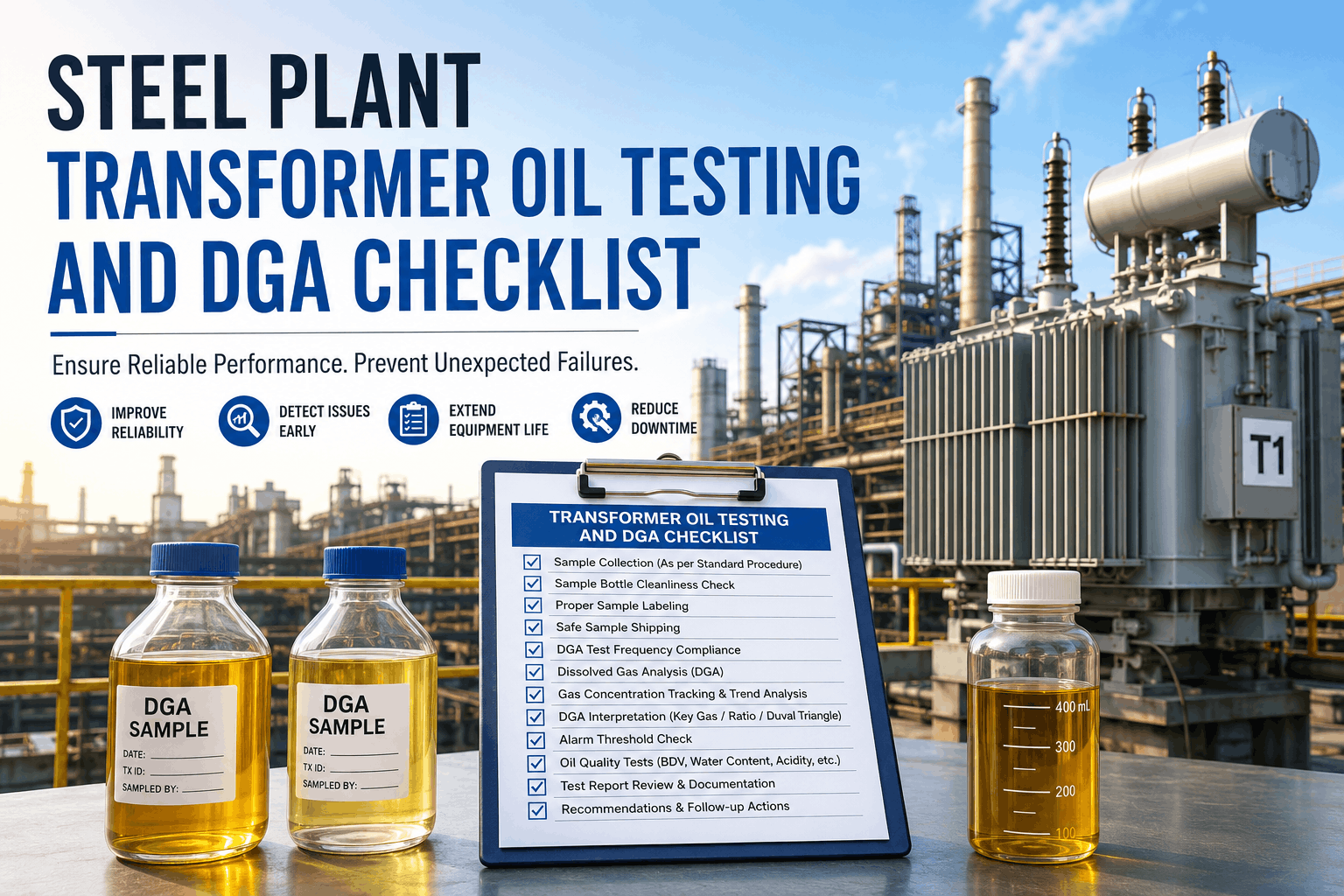
Dissolved Gas Analysis (DGA) is the most powerful predictive diagnostic tool for assessing power transformer health without opening equipment for intrusive inspection. When transformer oil is analyzed for trace quantities of dissolved gases — hydrogen, methane, ethane, ethylene, acetylene, carbon monoxide, and carbon dioxide — the gas concentrations and trends reveal internal faults: arcing, partial discharges, thermal degradation, and incipient winding failures. Utilities and large industrial power consumers using systematic DGA testing protocols prevent 70% of catastrophic transformer failures before they occur. Industries relying on critical power (petrochemicals, steel mills, data centers, hospitals) that wait for failure — rather than testing oil condition proactively — face extended outages, massive replacement costs ($500K–$2M+ per transformer), and safety hazards. This comprehensive DGA and transformer oil testing checklist guides your maintenance team through IEEE standards-compliant sampling procedures, gas interpretation methodology, trending analysis, and maintenance decision rules that extend transformer asset life by decades and prevent emergency outages. Using a digital maintenance platform like Oxmaint to track DGA trends, oil analysis results, and predictive diagnostics ensures that test results drive timely maintenance decisions rather than sitting in filing cabinets unanalyzed.
Master Transformer Diagnostics with DGASystematic oil testing, gas trend analysis, and condition-based maintenance workflows — integrated in Oxmaint for predictive transformer health monitoring at scale.
DGA accuracy depends entirely on proper sampling technique. Contaminated, oxidized, or improperly preserved samples yield misleading gas concentrations and false diagnostic conclusions. Standardized sampling procedures following ASTM D6595 and IEEE C57.104 are critical control points.
2. DGA Interpretation & Fault Detection Methods
DGA interpretation is both science and art. Laboratory reports provide individual gas concentrations, but identifying the underlying fault — thermal fault, electrical discharge, arcing — requires applying IEEE C57.104 diagnostic methods: key gas method, ratio method, and Duval triangle. Each method highlights different fault signatures.
3. Oil Quality Testing & Condition Assessment
DGA identifies electrical faults, but transformer oil also deteriorates chemically over time. Simultaneous oil quality testing — dielectric strength, dissipation factor, water content, acidity — provides complete condition picture and guides oil replacement decisions.
DGA and oil quality testing produce data; actionable maintenance decisions require clear decision rules and knowledge of remediation options. Different combinations of DGA results, oil quality metrics, and failure history suggest different maintenance actions: continue monitoring, accelerate testing frequency, perform oil treatment, or plan replacement.
Transform Transformer Maintenance with DGAIEEE-compliant oil sampling, automated DGA interpretation, oil quality tracking, and predictive maintenance workflows — all integrated to maximize transformer asset value.
1. How frequently should power transformers be tested for DGA?
Standard practice for critical transformers: annual baseline testing. Transformers showing elevated gases: 6-month intervals. Equipment in ALERT/ALARM status: monthly or quarterly testing. Test frequency depends on transformer age, criticality, and failure history — not one-size-fits-all schedule.
2. What is the cost difference between DGA testing and transformer replacement?
DGA testing costs $500–2,000 per sample. Preventive oil reclamation (treatment): $50–150K. Transformer replacement: $500K–2M+ depending on size/voltage/specs. DGA allows facility to extend equipment life by detecting faults early — preventing catastrophic failure and unplanned replacement.
3. Can DGA testing be performed on transformers while they are in service (energized)?
Yes — oil samples are collected from the drain valve on live transformers without removing equipment from service. This is major advantage of DGA: non-intrusive, cost-effective condition monitoring without operational downtime. Always follow OSHA electrical safety procedures when sampling live equipment.
4. What does C2H2 (acetylene) in DGA results indicate?
Acetylene (C2H2) is the "alarm gas" — indicates high-temperature arcing inside the transformer. Even trace acetylene (>1 ppm) signals critical fault. Presence of C2H2 requires urgent investigation and likely equipment removal from service within days to prevent catastrophic failure.
5. How accurate is DGA for predicting transformer failures?
IEEE studies show DGA identifies 70–80% of incipient faults before catastrophic failure. Combined with oil quality testing (BDV, DF, TAN), trending analysis, and supplementary diagnostics (thermography, winding resistance), DGA-based condition monitoring achieves 90%+ fault prediction accuracy.
6. What is the difference between DGA Key Gas method and Duval Triangle method?
Key Gas method identifies single dominant gas exceeding thresholds (simpler, faster diagnosis). Duval Triangle method plots gas ratios on triangular diagram for more nuanced fault classification. Both methods are valid; many utilities use both in parallel for maximum diagnostic confidence.
7. Can transformer oil be reclaimed indefinitely or does end-of-life eventually occur?
Oil reclamation extends service life 5–10 years with each treatment cycle. However, repeated thermal cycling causes irreversible oxidation — eventually TAN, DF, and BDV decline below acceptable levels. Most transformers reach economic end-of-life 30–50 years regardless of maintenance.
8. Who should interpret DGA results — facility engineering or third-party specialist?
Laboratory typically provides initial interpretation. Facility engineers should understand DGA methodology to challenge results, track trends over time, and make maintenance decisions. Many utilities hire specialized consultants for critical transformers or complex interpretations — DIY DGA reading without expertise risks wrong maintenance decisions.
"We implemented systematic DGA testing across our petrochemical refinery's transformer fleet 5 years ago. DGA caught an incipient fault in a 50-year-old critical transformer — the gas concentrations were starting to climb. We performed oil reclamation and installed advanced monitoring. That single DGA-driven decision probably saved us $1.2M in emergency replacement costs. Now we track all DGA results in Oxmaint with automated trending analysis. We've deferred replacement of three additional transformers through proactive condition monitoring." — Electrical Engineering Manager, Gulf Coast Refinery, Texas
Robert Torres, Electrical Engineering Manager | Gulf Coast Refinery Complex, Texas, USA
Unlock Transformer Asset Value with DGAOxmaint's DGA tracking, IEEE-compliant interpretation, oil quality trending, and predictive maintenance workflows turn test data into actionable equipment decisions.