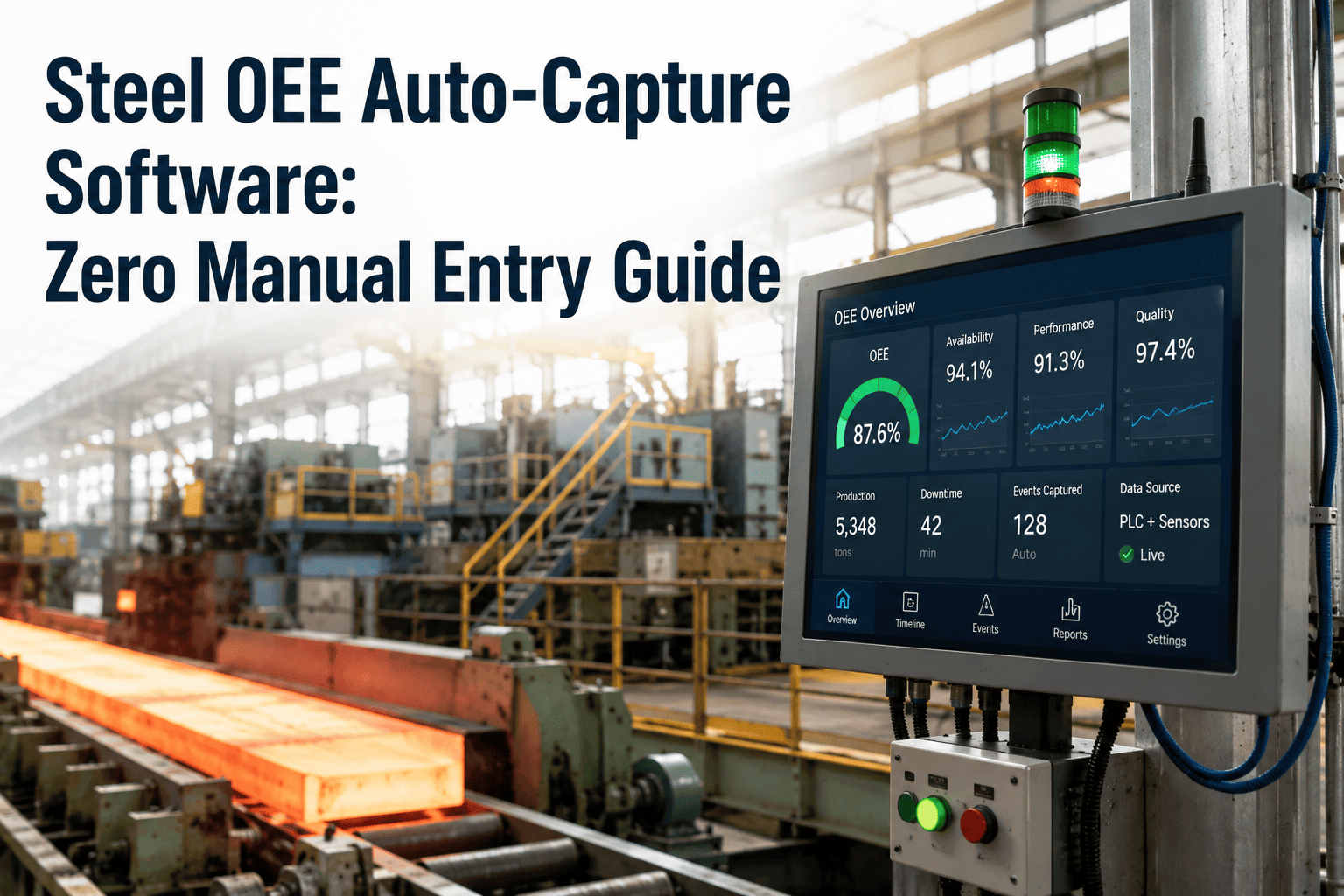
OEE is one of the most powerful metrics in manufacturing—when used correctly. It reveals hidden capacity, exposes systematic losses, and provides a clear roadmap for improvement. But when implemented poorly, OEE becomes a misleading number that hides problems, creates false confidence, and wastes improvement efforts. The difference between effective and ineffective OEE often comes down to avoiding common mistakes that plague manufacturing operations. Modern OEE tracking systems help eliminate many of these errors through automated data collection and standardized calculations, but understanding these pitfalls is essential for any manufacturer serious about improvement.
This guide covers the most common OEE mistakes in manufacturing and shows you how to avoid them so your OEE metrics actually drive meaningful improvement.
The 10 Most Common OEE Mistakes
Calculation Mistakes
Calculation errors are the most damaging OEE mistakes because they produce numbers you can't trust. Every decision based on flawed calculations leads you in the wrong direction. Talk to our specialists about implementing accurate OEE tracking.
Using Average Cycle Time Instead of Ideal Cycle Time
High ImpactUsing your typical production speed (what you usually achieve) as the baseline for Performance calculation.
Using the ideal cycle time—the fastest speed your equipment can achieve under optimal conditions, per manufacturer specs.
Counting Reworked Parts as Good Parts
High ImpactA part fails inspection, gets reworked, passes second inspection, and counts as a "good part" in Quality calculation.
Only first-pass yield counts. If a part needed rework, it's a defect—even if it eventually ships to the customer.
Excluding "Planned" Downtime That Could Be Reduced
Medium ImpactChangeovers take 45 minutes and are labeled "planned" so they don't count against Availability.
Include changeovers in Availability. A 45-minute changeover that could be 15 minutes represents 30 minutes of improvement opportunity.
Ignoring Small Stops and Speed Losses
Medium ImpactOnly tracking downtime events over 5 minutes. Smaller stops are "just normal operation."
Capture all stops and speed losses. Twenty 30-second stops per hour equals 10 minutes of lost production—every hour.
How Calculation Errors Compound
Flawed Calculation
Accurate Calculation
Get Accurate OEE Calculations
Oxmaint automatically calculates OEE using industry-standard methodology—ideal cycle times, first-pass quality, and complete downtime tracking built in.
Implementation Mistakes
Even with correct formulas, poor implementation undermines OEE effectiveness. These mistakes relate to how you collect data and involve your team.
Relying on Manual Data Collection
Paper-based tracking and end-of-shift reporting produce incomplete, inaccurate data. Operators forget events, round numbers, and miss small stops entirely. Manual systems typically capture only 60-70% of actual downtime.
Excluding Operators from Implementation
When OEE is imposed from above without operator involvement, you get resistance, poor data quality, and missed insights. Operators know their machines better than anyone—exclude them and you lose critical knowledge.
Creating Too Many Downtime Reason Codes
Systems with 50+ reason codes overwhelm operators. They pick the first option that seems close, use "Other" constantly, or stop logging reasons altogether. Data becomes unusable for root cause analysis.
Setting Unrealistic Downtime Thresholds
Requiring operators to log every stop over 10 seconds buries them in data entry. They spend more time documenting than producing—and start ignoring the requirement.
Usage Mistakes
You can calculate OEE perfectly and collect great data—then waste it all by using the metric incorrectly. These mistakes turn OEE from an improvement tool into a meaningless number or, worse, a weapon. Oxmaint's analytics help you avoid these pitfalls with actionable insights built into every dashboard.
Focusing Only on the OEE Score
Obsessing over the single OEE percentage while ignoring Availability, Performance, and Quality individually. An 75% OEE could mean balanced factors—or it could mask a serious Quality problem offset by high Availability.
Comparing Incomparable Processes
Ranking machines or plants by OEE when they run different products, have different changeover frequencies, or serve different purposes. A line with 12 changeovers daily will never match one with 2 changeovers.
Using OEE as a Blame Tool
Publishing shift rankings and punishing low performers creates fear, data manipulation, and gaming. Operators learn to hide problems rather than expose them. OEE becomes a weapon instead of a diagnostic.
Measuring Without Acting
Tracking OEE religiously but never using the data to drive improvement. Dashboards show the same problems month after month. People stop paying attention because nothing ever changes.
Calculating Plant-Wide OEE
Averaging OEE across an entire facility produces a meaningless number. You can't improve "the plant"—you improve specific machines, lines, and processes. Aggregation hides actionable detail.
Chasing 85% OEE as the Only Goal
"World-class" 85% OEE becomes the target regardless of context. Some processes can achieve 90%+; others legitimately operate at 70%. Arbitrary targets drive wrong behaviors.
How to Avoid These Mistakes
Schedule a consultation to implement OEE correctly from the start.
For Accurate Calculations
For Effective Implementation
For Meaningful Usage
Implement OEE the Right Way
Oxmaint helps manufacturers avoid common OEE mistakes with automated data collection, standardized calculations, and actionable analytics that drive real improvement.
Frequently Asked Questions
How do I know if my OEE calculations are accurate?
Check three things: (1) Performance rarely hits 100%—if it does, your ideal cycle time is probably too slow. (2) Quality matches first-pass yield—not final yield after rework. (3) Availability includes all stops—changeovers, cleaning, and planned maintenance should reduce Availability, not be excluded.
Should breaks and lunches be included in OEE?
It depends on whether they could be productive time. If you could run during breaks but choose not to, include them. If equipment physically can't run (cooling required, regulations prohibit), exclude them. Be consistent and document your approach.
What's the right number of downtime reason codes?
Start with 10-15 codes covering major categories: equipment failure, changeover, material wait, quality hold, etc. Add codes only when data shows a specific category needs breakdown. Fewer well-used codes beat many rarely-used ones.
Is it ever okay to compare OEE across different machines?
Yes, but carefully. Compare machines running similar products with similar changeover frequency under similar conditions. Better yet, compare each machine to its own historical performance—trend improvement over time rather than ranking against dissimilar equipment.
How do I get operators to buy into OEE tracking?
Three keys: (1) Explain the "why"—OEE helps improve their work environment, not punish them. (2) Involve them in design—reason codes, thresholds, displays. (3) Act on their input—when data reveals problems, fix them. Nothing builds buy-in like seeing OEE drive actual improvements.