Computer Vision vs Manual Inspection in Manufacturing

By oxmaint on January 21, 2026

computer-vision-vs-manual-inspection-in-manufacturing

Manufacturing quality control is at a crossroads. With the global machine vision market projected to grow from USD 20.4 billion in 2024 to USD 41.7 billion by 2030, manufacturers worldwide are questioning whether traditional manual inspection can keep pace with modern production demands. The reality is stark: human inspectors miss up to 40% of defects, while computer vision systems achieve 97-99% accuracy. For manufacturers seeking to eliminate quality escapes, reduce costs, and scale operations, understanding the true differences between these inspection methods has never been more critical. OXmaint's maintenance management software integrates AI-powered inspection capabilities to help you make this transition seamlessly—start your free trial today to see the difference.

The Accuracy Gap: Manual vs Computer Vision
Why human inspection can no longer compete with AI precision
Manual Inspection
60-80%
Detection Accuracy
Fatigue after 20-30 minutes
20-40% defects missed
Inconsistent between shifts
10-50 parts per hour
VS
Computer Vision
97-99%
Detection Accuracy
24/7 consistent operation
Less than 3% false positives
Self-learning algorithms
1,000+ parts per hour
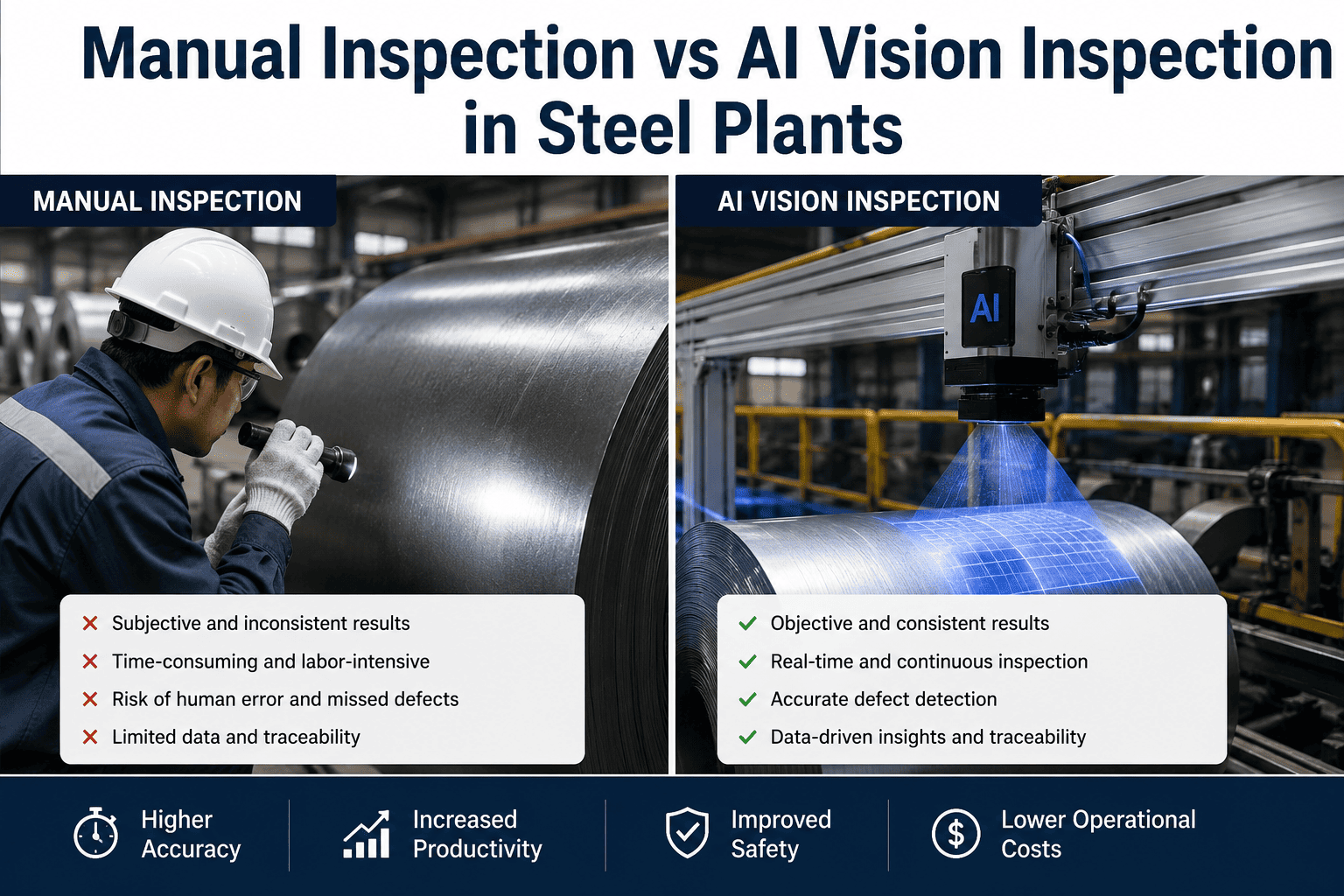
Computer vision delivers 40% higher accuracy while processing 20x more parts
Want to see these accuracy improvements in your facility?
Book a Free Demo

Why Manual Inspection Falls Short in Modern Manufacturing

Manual inspection has served manufacturing for over a century, but today's production environments expose its fundamental limitations. According to research from Sandia National Labs, even the best human inspectors catch only 80% of defects at peak performance. Two inspectors working in tandem achieve just 96% combined. The problem compounds when you factor in fatigue, which studies show begins degrading inspection accuracy within 20-30 minutes of repetitive visual tasks.

Human inspectors face challenges that no amount of training can overcome. Microscopic defects under 0.5mm routinely escape detection. Subtle color variations, surface inconsistencies, and dimensional deviations often fall below the threshold of human perception. When production lines run at hundreds of parts per minute, manual inspection becomes a bottleneck that forces manufacturers to choose between throughput and quality. OXmaint's CMMS platform helps manufacturers bridge this gap by integrating AI-powered inspection directly into maintenance workflows.

The 5 Critical Limitations of Manual Inspection
01
Fatigue Factor
Accuracy drops 25-40% after first hour of inspection. Extended shifts multiply error rates exponentially.
02
Speed Constraints
Manual inspection requires 2-5 minutes per complex part. Production lines demanding 100+ units per minute overwhelm human capacity.
03
Subjectivity Issues
Different inspectors interpret standards differently. Same inspector may judge identical defects inconsistently across shifts.
04
Scale Limitations
Expanding inspection capacity means hiring and training more staff. Labor costs compound while consistency decreases.
05
Documentation Gaps
No visual record of inspector decisions. Impossible to audit past inspections or identify systematic errors.

The cost implications extend beyond missed defects. Manual inspection labor for a single production line can exceed $100,000 annually per inspector. When defective products escape to customers, warranty claims averaging $50,000-$125,000 per incident compound the financial burden. Ready to eliminate these quality gaps? Schedule a demo with OXmaint to see how AI inspection integration works in your environment and start saving immediately.

Tired of Manual Inspection Limitations?
OXmaint's maintenance management software connects AI-powered inspection to automated work orders, eliminating the gaps that cost you money.

How Computer Vision Transforms Quality Control

Computer vision inspection combines high-resolution cameras with AI algorithms trained on millions of defect images. These systems analyze products at production speed, detecting anomalies invisible to the human eye while maintaining perfect consistency across every inspection. Unlike human inspectors who tire and vary, computer vision systems deliver identical precision on the first part of a shift and the millionth.

Computer Vision Inspection: How It Works
From image capture to instant decision in milliseconds
1
Image Capture
High-resolution cameras capture product images at production speed (600+ parts/minute)
2
AI Processing
Deep learning algorithms analyze images against trained defect patterns
3
Classification
Defects identified, classified by type, severity measured with precision
4
Action Trigger
Automated alerts, work orders, and process adjustments initiated instantly
Total Processing Time: Under 100 milliseconds

Modern AI inspection systems learn continuously. Unlike rule-based traditional AOI (Automated Optical Inspection) systems that require constant manual tuning, deep learning models adapt to product variations, lighting changes, and new defect types automatically. This self-improving capability means inspection accuracy increases over time rather than degrading. Try OXmaint free and experience how our platform turns inspection data into actionable maintenance insights.

Ready to automate your inspection workflow?
Schedule Your Demo

Head-to-Head: Complete Comparison

Manual vs Computer Vision: The Complete Breakdown
Factor
Manual Inspection
Computer Vision
Detection Accuracy
60-80%
97-99.5%
Inspection Speed
10-50 parts/hour
1,000+ parts/hour
False Positive Rate
15-25%
Under 3%
Consistency
Varies by inspector and shift
100% consistent
Minimum Defect Size
0.5mm+ visible
0.1mm detectable
Operating Hours
8-12 hour shifts
24/7/365
Documentation
Manual logging, incomplete
Automatic full traceability
Annual Cost per Line
$100K-$200K labor
ROI in 6-18 months
Swipe to see more

The numbers speak for themselves. Manufacturers using OXmaint's integrated inspection and maintenance platform report dramatic improvements across every metric. Don't let outdated manual processes hold your production back—book your personalized demo and see exactly how these improvements translate to your facility.

See the Accuracy Difference for Yourself
OXmaint's AI-powered inspection integration detects defects your manual processes miss. Our 30-minute demo shows real detection comparisons using your product types.

The ROI Equation: Why Manufacturers Are Switching

The financial case for computer vision inspection builds from multiple savings streams. Eliminating two manual inspector positions saves approximately $100,000 annually in direct labor costs. Reducing false rejections from typical manual rates of 12,000 per week to under 250 cuts rework costs dramatically. Preventing even one major defect escape worth $50,000-$125,000 can fund a significant portion of system implementation.

ROI Calculator: What Manufacturers Save
Annual savings for a typical mid-size manufacturing operation
Labor Cost Reduction
Eliminating 2 inspection positions
$100,000
False Rejection Savings
95% reduction in unnecessary rework
$85,000
Defect Escape Prevention
Avoided warranty claims and returns
$150,000
Throughput Improvement
20x faster inspection, no bottlenecks
$75,000
Yield Improvement
0.5-1% yield gain from early detection
$90,000
Total Annual Savings:
$500,000+
Typical payback period: 6-18 months

Beyond direct cost savings, computer vision enables capabilities impossible with manual inspection. Real-time process monitoring identifies equipment issues before they produce defective batches. Statistical process control data feeds continuous improvement initiatives. Complete inspection records satisfy regulatory requirements while enabling rapid root cause analysis when issues arise.

Calculate your potential savings with OXmaint
Start Your Free Trial

OXmaint's maintenance management software maximizes these savings by connecting inspection results directly to maintenance actions. When a defect pattern indicates equipment degradation, OXmaint automatically generates work orders and alerts maintenance teams—turning reactive quality issues into proactive maintenance opportunities. Schedule a demo to see this integration in action.

Industry Applications: Where Computer Vision Excels

Industries Transforming with Computer Vision
Automotive
Weld inspection, paint defects, component alignment, safety part verification
Defect escape rates below 10 PPM
Electronics
PCB inspection, solder joint analysis, component placement, micro-crack detection
Thousands of components per minute
Steel and Metals
Surface cracks, scratches, pits, inclusions, scale detection at 600m/min
98%+ accuracy vs 60-70% manual
Pharmaceutical
Pill inspection, packaging verification, label accuracy, contamination detection
FDA compliance documentation
Food and Beverage
Foreign object detection, fill level verification, packaging integrity, label positioning
Zero contamination tolerance
Aerospace
Critical component inspection, composite material analysis, precision measurement
Six Sigma quality standards

No matter your industry, OXmaint's maintenance management platform adapts to your specific inspection and quality requirements. Our team has helped manufacturers across all these sectors implement AI-powered inspection with measurable results. Book a consultation to discuss your industry-specific challenges.

Which Industry Are You In?
OXmaint serves automotive, electronics, steel, pharmaceutical, food and beverage, and aerospace manufacturers. Let us show you how computer vision inspection integrates with your specific processes.

Implementation: Getting Started with Computer Vision

Transitioning from manual to computer vision inspection follows a proven path that minimizes risk while demonstrating value quickly. Smart manufacturers start with pilot programs on single production lines, measuring performance against baseline metrics before expanding.

Typical Implementation Timeline
Week 1-2
Assessment
Production line analysis, camera positioning, lighting requirements, baseline data collection
Week 3-4
Setup and Training
Hardware installation, AI model training on your products, defect classification configuration
Week 5-6
Validation
Parallel operation with manual inspection, accuracy verification, system optimization
Week 7-8
Production
Full autonomous operation, performance monitoring, continuous improvement activation

OXmaint's CMMS platform connects directly with computer vision systems, automatically generating work orders when defects are detected. This integration transforms inspection data into actionable maintenance tasks, ensuring defects trigger immediate response rather than accumulating in reports. The result: faster resolution, better traceability, and continuous process improvement driven by real inspection data.

Start your implementation journey today
Sign Up for Free

Our implementation specialists guide you through every phase, from initial assessment to full production deployment. Most manufacturers see measurable improvements within the first month and full ROI within 6-18 months. Schedule your free consultation to get a customized implementation roadmap for your facility.

Making the Right Choice for Your Operation

While computer vision delivers superior performance for most manufacturing applications, hybrid approaches combining automated and human inspection serve certain scenarios effectively. Complex assemblies requiring contextual judgment, highly variable custom products, and low-volume specialty manufacturing may benefit from human oversight of AI-flagged items. The key is matching inspection methods to production requirements rather than defaulting to familiar but inferior approaches.

Decision Guide: Which Approach Fits Your Needs?
Choose Computer Vision When:
High-volume production (100+ units/hour)
Consistent, repeatable products
Microscopic defect detection required
24/7 operation needed
Regulatory traceability requirements
Cost reduction is priority
Consider Hybrid Approach When:
Complex assemblies need judgment
High product variability
New product introduction phase
Subjective quality criteria
Low volume, high value items
Transitioning from manual systems

Not sure which approach is right for your operation? OXmaint's team can help you evaluate your production requirements and recommend the optimal inspection strategy. Book a free consultation to discuss your specific situation and get expert guidance on your quality control transformation.
Not Sure Where to Start?
Our inspection specialists will analyze your current processes, identify improvement opportunities, and create a customized implementation plan—all at no cost to you.
Frequently Asked Questions
How much does computer vision inspection cost compared to manual inspection?
Initial computer vision systems range from $3,200 for basic 2D camera systems to $30,000-$60,000 for advanced AI-powered platforms. However, annual labor costs for manual inspection typically exceed $100,000 per inspector per line. Most manufacturers achieve positive ROI within 6-18 months through labor savings, reduced scrap, and prevented defect escapes. Schedule a demo to get a cost analysis specific to your operation.
Can computer vision completely replace human inspectors?
For most high-volume, standardized manufacturing, yes. Computer vision handles repetitive inspection tasks with superior accuracy and consistency. However, many manufacturers transition human inspectors to higher-value roles: managing exceptions flagged by AI, process optimization, and quality engineering. Complex assemblies may still benefit from human judgment on AI-identified items. OXmaint's platform supports both fully automated and hybrid approaches—try it free to see which works best for you.
What accuracy can we expect from AI-powered inspection?
Modern computer vision systems achieve 97-99.5% detection accuracy compared to 60-80% for human inspectors. False positive rates drop from 15-25% with manual methods to under 3% with AI. Systems continue improving over time as they learn from additional data. Want to see these accuracy levels on your products? Book a live demo.
How long does implementation take?
Typical implementations complete in 4-8 weeks from assessment to full production. This includes camera setup, AI model training on your specific products, validation against manual inspection results, and integration with existing systems. OXmaint's platform accelerates this process with pre-built CMMS integration. Sign up today to start your implementation journey.
Does computer vision work with existing production equipment?
Yes. Computer vision systems integrate inline without modifying conveyors or production equipment. Cameras mount at inspection stations, connecting to your existing infrastructure through standard industrial protocols. Most installations complete during scheduled maintenance windows with minimal production impact. Talk to our team about integrating with your specific equipment.
Transform Your Quality Control with OXmaint
Join manufacturers using OXmaint's maintenance management platform with integrated AI inspection to achieve 97%+ defect detection while cutting quality costs by 60-75%. See how automated inspection connects directly to maintenance workflows for faster resolution and continuous improvement.

Share This Story, Choose Your Platform!