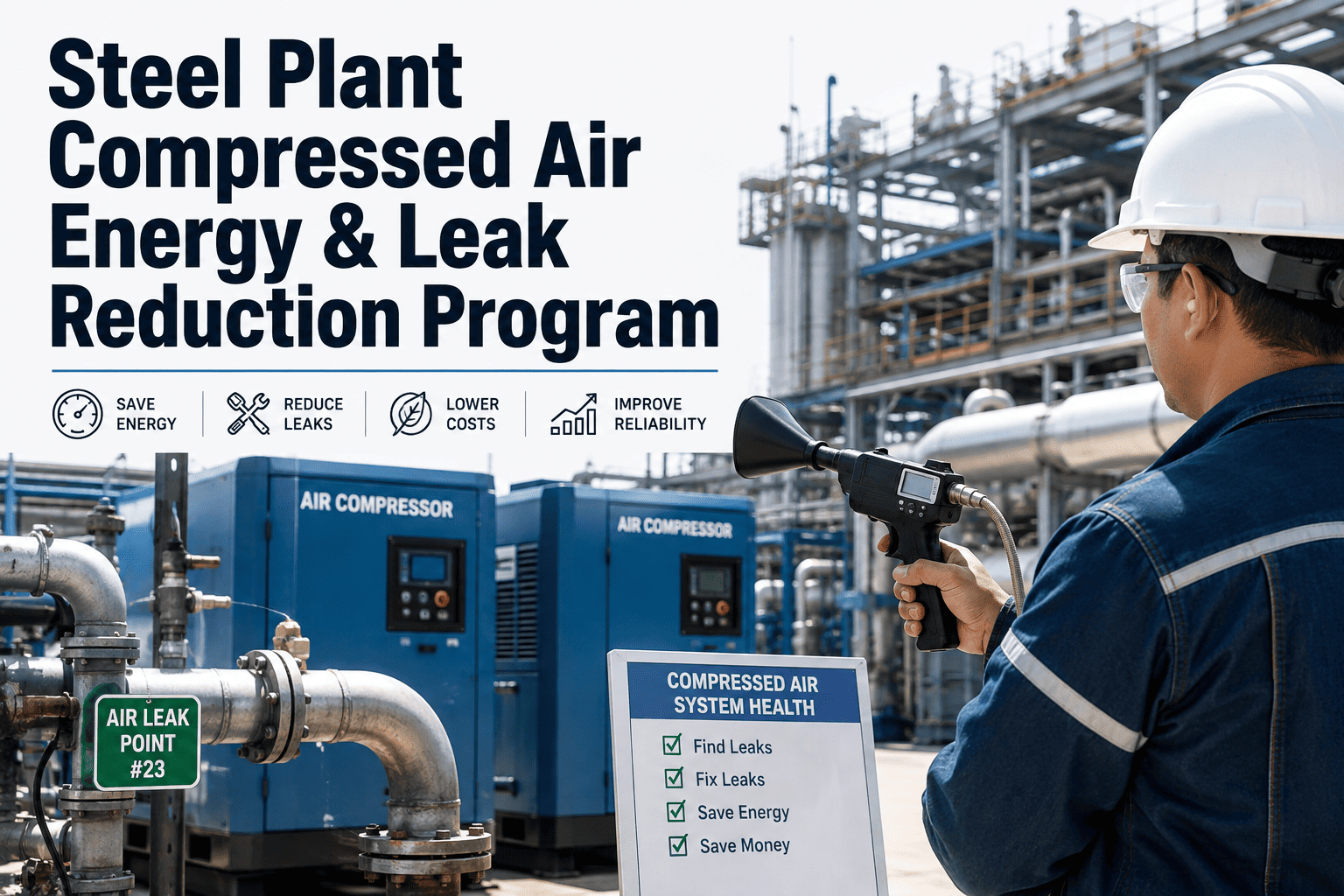
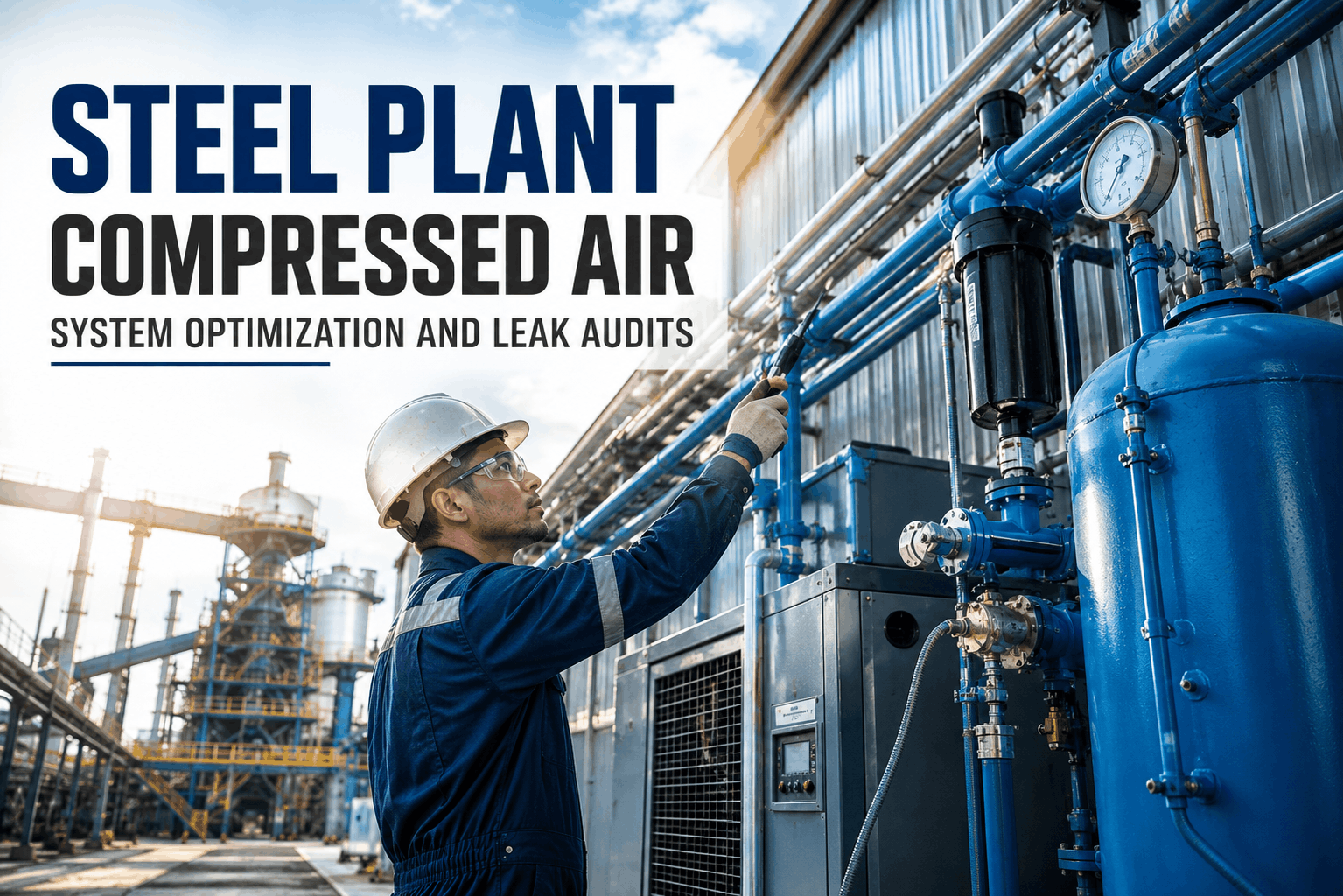
Compressed air is the most expensive utility in a steel plant per unit of delivered energy — yet it remains the most neglected. While electricity costs $0.03-0.05 per kWh at the meter, delivering that same energy as compressed air costs $0.18-0.30 per kWh by the time it reaches the point of use. In a typical integrated steel mill, compressed air systems consume 15-25% of total electricity, generating annual costs of $3-12 million depending on plant size and operating pressure. The worst part: industry studies consistently show that 25-35% of that compressed air never does useful work — it escapes through leaks, feeds inappropriate applications, or runs at pressures far higher than needed.
That means your steel plant is likely burning $750,000 to $4 million every year on air that disappears into the atmosphere. Unlike furnace or rolling mill energy, compressed air waste is almost entirely recoverable through maintenance. No capital projects, no shutdowns, no new compressors — just systematic detection, repair, and intelligent maintenance management. Oxmaint's CMMS turns your compressed air system from a hidden cost center into a controlled, measurable, and continuously optimized utility.
The Anatomy of Compressed Air Waste in Steel Plants
Compressed air waste in steel manufacturing doesn't come from a single source — it leaks from every joint, valve, and connection in miles of piping across your facility. Understanding where the waste occurs reveals where the savings hide. Here's a complete breakdown of the six primary waste categories and their financial impact:
System Leaks
Pipe joints, quick-connect fittings, hose connections, valve stems, and flange gaskets. A single 1/4-inch leak at 100 PSI wastes 100+ CFM — equivalent to $12,000-$18,000 per year in electricity. Most steel plants have 200-500 active leaks at any time.
Artificial Demand (Over-Pressure)
Running the entire system at 110 PSI when most applications need 80-90 PSI. Every 2 PSI of excess pressure increases energy consumption by approximately 1%. Plants routinely over-pressurize by 15-25 PSI to compensate for pressure drops caused by undersized piping or clogged filters.
Inappropriate End Uses
Using compressed air for cooling, blowoff, drying, or personnel cooling when blowers, fans, or dedicated systems cost 5-10x less. Common in steel plants: using shop air to cool bearings, blow scale off conveyors, or dry parts after quenching.
Compressor Inefficiency
Poorly maintained compressors operating at 15-25% below rated efficiency. Fouled intercoolers, worn intake filters, degraded oil separators, incorrect loading/unloading sequences, and compressors running unloaded but consuming 25-40% of full-load power.
Condensate & Treatment Losses
Failed or stuck-open drain traps continuously dumping compressed air. Undersized or poorly maintained dryers allowing moisture into pneumatic equipment, increasing wear and air consumption at actuators and cylinders.
Distribution Pressure Drops
Undersized headers, corroded piping, dead legs, excessive fittings, and clogged inline filters create pressure drops of 5-15 PSI between compressor discharge and point of use, forcing the system to run at higher discharge pressures to compensate.
The Real Cost of a Single Compressed Air Leak
Most steel plant operators underestimate the cost of compressed air leaks because they're invisible and inaudible above ambient noise. This table reveals the true annual cost of leaks at common operating pressures — costs that multiply across the hundreds of leaks present in a typical steel plant:
Stop Paying for Air That Disappears
Oxmaint manages your entire compressed air optimization program — from leak detection scheduling to compressor PM to pressure monitoring — turning invisible waste into documented savings.
How Oxmaint Optimizes Your Compressed Air System
Compressed air optimization isn't a one-time audit — it's a continuous cycle of detection, repair, monitoring, and improvement that must be embedded in your maintenance management system. Here's how Oxmaint makes it systematic:
Leak Detection & Repair Tracking (LDAR)
Schedule quarterly ultrasonic leak surveys as recurring PM tasks. Each detected leak is tagged with GPS location, estimated CFM loss, severity rating, and photo. Repairs auto-generate work orders with priority based on leak cost, and verification inspections confirm repairs held. Build a living leak map of your entire facility that shows progress over time.
Compressor PM Optimization
Automated PM schedules for every compressor: intake filter changes, oil analysis, separator element replacement, intercooler cleaning, belt tensioning, and bearing inspection. Trigger by running hours, not just calendar dates, to match actual usage.
Pressure & Flow Baseline Tracking
Establish pressure and flow baselines at key points in the distribution system. Oxmaint flags when pressure drops exceed thresholds, indicating new leaks, filter blockages, or piping restrictions that need maintenance attention.
Specific Power Monitoring (kW/100 CFM)
Track your system's specific power — the kW consumed per 100 CFM of delivered air. World-class systems achieve 18-20 kW/100 CFM. Most steel plants run 22-28 kW/100 CFM. Oxmaint trends this KPI against maintenance events to prove savings.
Drain Trap & Treatment PM
Schedule inspection and testing of every condensate drain trap, auto-drain valve, and air dryer in the system. Failed-open traps are silent energy thieves, each wasting 25-50 CFM continuously. Track dryer dewpoint performance and filter differential pressure.
Energy Savings Documentation
Every leak repair, compressor service, and pressure optimization is logged with before/after energy data. Generate quarterly savings reports for management with verified dollar amounts, ROI calculations, and trending analysis.
Zone-by-Zone Compressed Air Audit Checklist
Every area of a steel plant uses compressed air differently and wastes it differently. This zone-by-zone checklist covers the specific maintenance actions that eliminate waste in each production area. Use it as a starting template in Oxmaint's digital inspection system:
Compressed Air System Benchmarks: Where Do You Stand?
These benchmarks represent documented performance levels from steel plants worldwide. Knowing where you fall on each scale reveals your highest-priority optimization targets:
5 Steps to Eliminate Compressed Air Waste
This is the proven optimization roadmap that steel plants follow with Oxmaint's compressed air management program. Most plants see measurable results — and hard dollar savings — within the first 30 days:
Baseline Audit & Leak Survey
Conduct a comprehensive ultrasonic leak survey across all zones. Measure system pressure profile, compressor loading, and specific power (kW/100 CFM). Import all data into Oxmaint to establish baseline performance and quantify waste.
Priority Leak Repair Blitz
Repair the top 20% of leaks by CFM loss first — these typically represent 80% of leak-related waste. Generate work orders in Oxmaint with severity-based priority. Verify each repair with follow-up ultrasonic confirmation and log confirmed savings.
Compressor & Treatment System PM
Execute full PM on all compressors: filter replacement, oil analysis, intercooler cleaning, separator service, and belt inspection. Service all dryers and test every drain trap. Optimize compressor sequencing to eliminate unloaded running time.
Pressure Optimization & End-Use Audit
Reduce system discharge pressure in 2 PSI increments while monitoring point-of-use pressures. Identify and eliminate inappropriate compressed air uses. Install engineered nozzles to replace open blowoff tubes. Each 2 PSI reduction saves ~1% of total compressor energy.
Continuous Monitoring & Quarterly Re-Survey
Establish quarterly leak surveys as permanent PM tasks. Monitor specific power trends monthly. Track leak recurrence rates by zone and equipment type. Use Oxmaint dashboards to report savings to management and drive continuous improvement.
Recover Every Dollar Lost to Compressed Air Waste
Join steel plants that have cut compressed air costs by 25-40% through systematic leak management, compressor optimization, and pressure control. Your savings start with a single survey.
Frequently Asked Questions
How much can a steel plant realistically save on compressed air?
Documented results show 25-40% reduction in compressed air energy costs through systematic leak repair, compressor PM, and pressure optimization. For a steel plant spending $5M/year on compressed air electricity, that translates to $1.25-$2.0M in annual savings. The first leak survey alone typically identifies $300K-$1.5M in recoverable waste, with repair costs under $25K — delivering payback in under 30 days.
Why do leaks recur after they've been repaired?
Compressed air leaks are inherently recurring — vibration, thermal cycling, and normal wear continuously create new leak points. Industry data shows leak rates return to pre-repair levels within 6-12 months without ongoing management. This is exactly why Oxmaint schedules quarterly re-surveys as permanent PM tasks: consistent detection and repair keeps leak rates below 10% indefinitely rather than allowing them to creep back to 25-35%.
Can we reduce air pressure without affecting production?
Yes, when done systematically. Most steel plants over-pressurize by 15-25 PSI to compensate for distribution losses. The correct approach is to fix the losses first (leaks, clogged filters, undersized piping), then reduce discharge pressure in 2 PSI increments while monitoring point-of-use pressures. Oxmaint tracks pressure readings at critical application points to ensure production requirements are always met during optimization.
How does Oxmaint track individual leak repairs and savings?
Each detected leak is logged as an asset-linked work order with location, estimated CFM loss, calculated annual cost, and photo documentation. When the repair is completed, the technician logs the fix type and confirms the repair via ultrasonic re-test. Oxmaint calculates verified savings per repair and aggregates them into quarterly reports showing total recovered CFM, kW saved, and dollar savings — giving you audit-ready proof of ROI.
What's the ROI timeline for compressed air optimization?
Compressed air optimization delivers the fastest ROI of any energy project in a steel plant. The initial leak survey and repair blitz typically pays back in 15-30 days. Full system optimization (including compressor PM, pressure reduction, and end-use corrections) achieves complete ROI within 2-3 months. Ongoing savings compound annually as quarterly surveys prevent waste from returning, delivering a sustained 25-40% reduction in compressed air energy costs year after year.