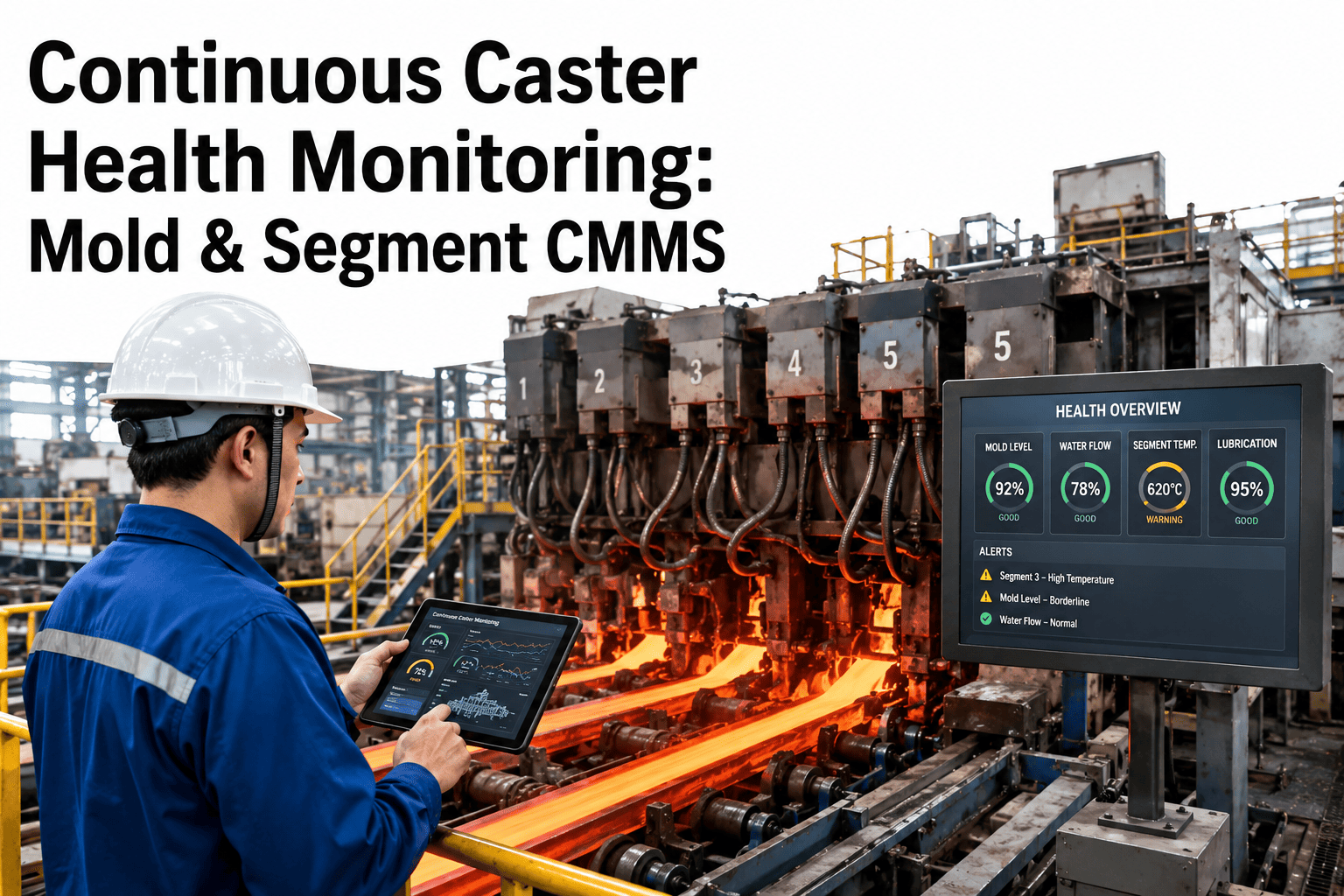
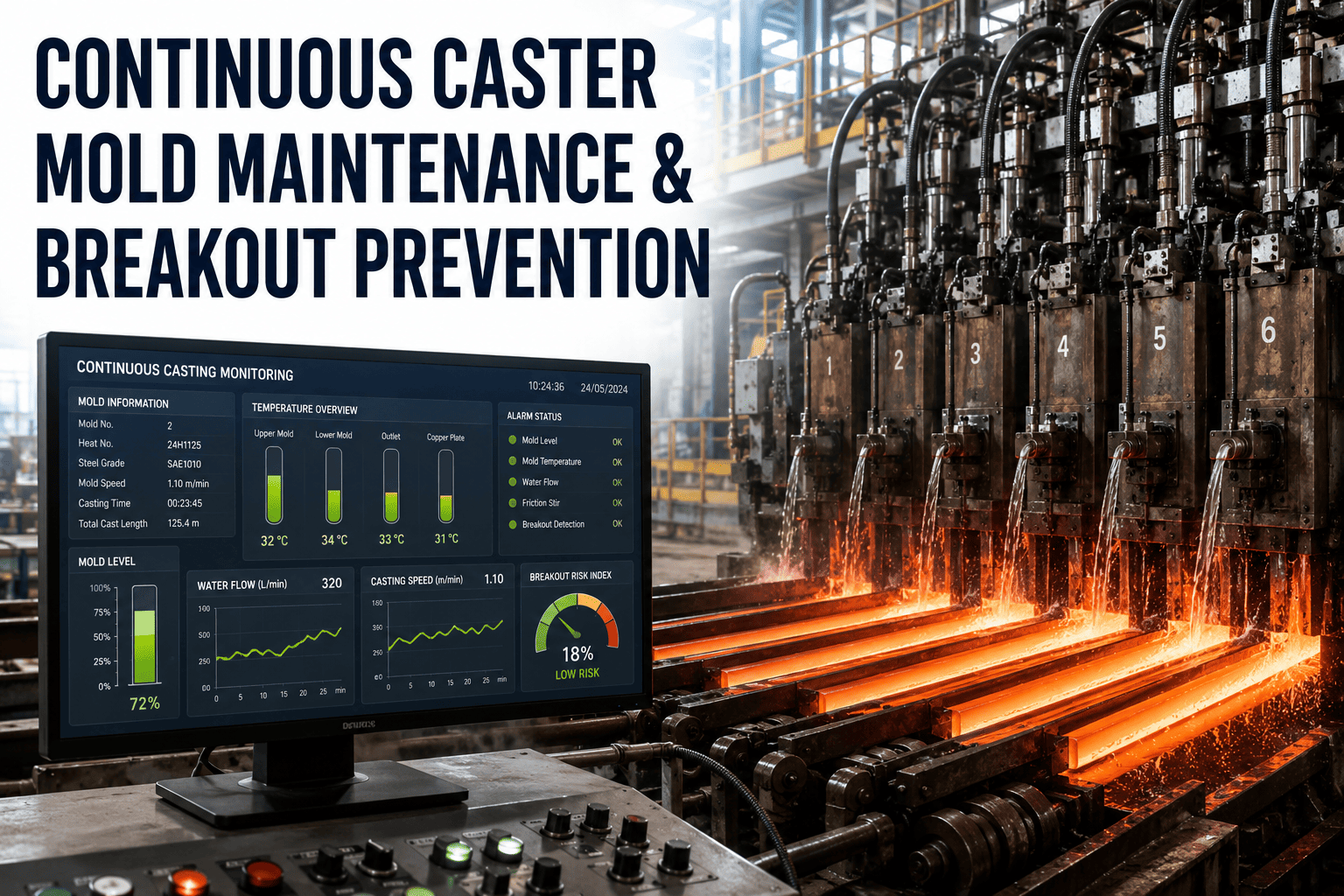
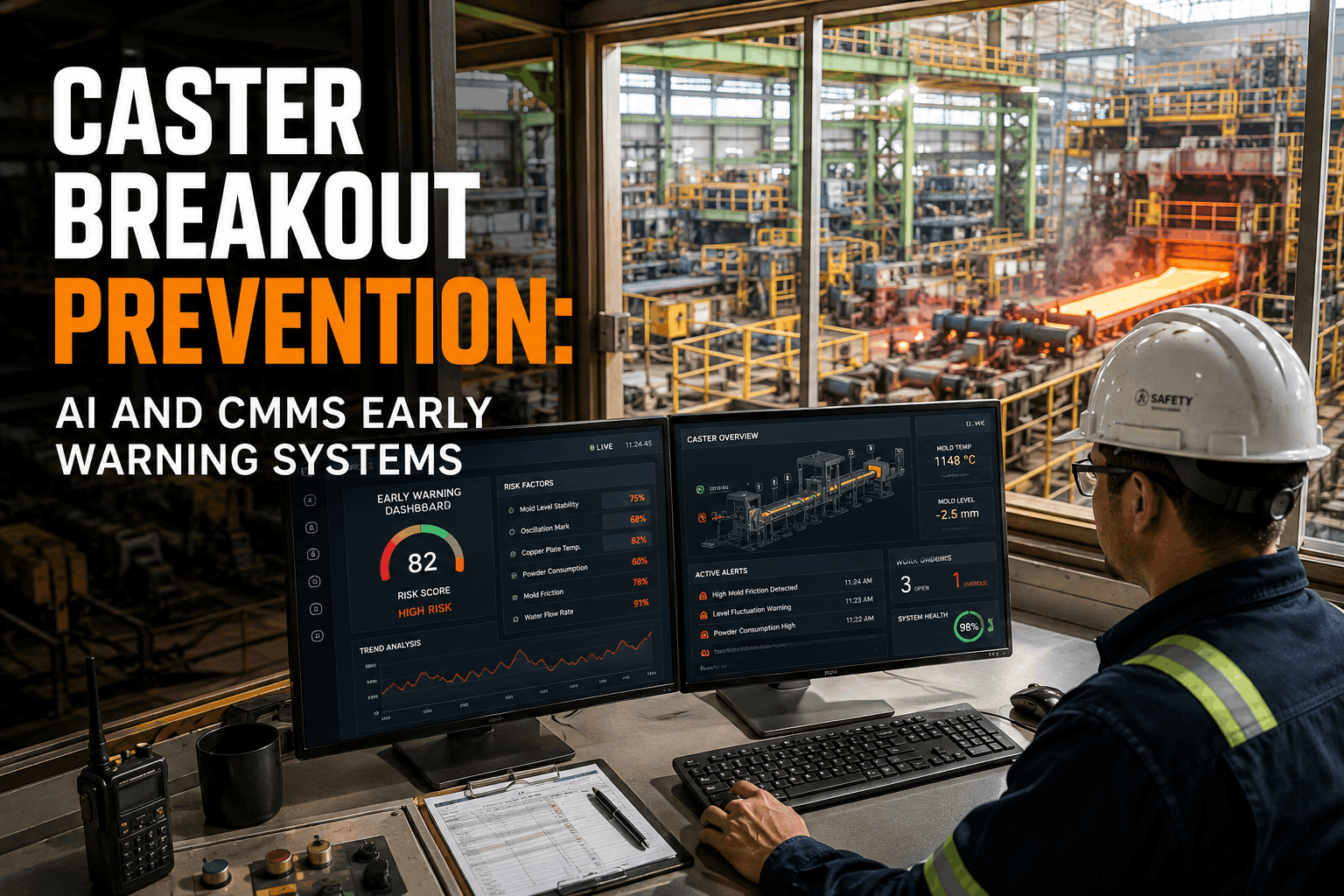
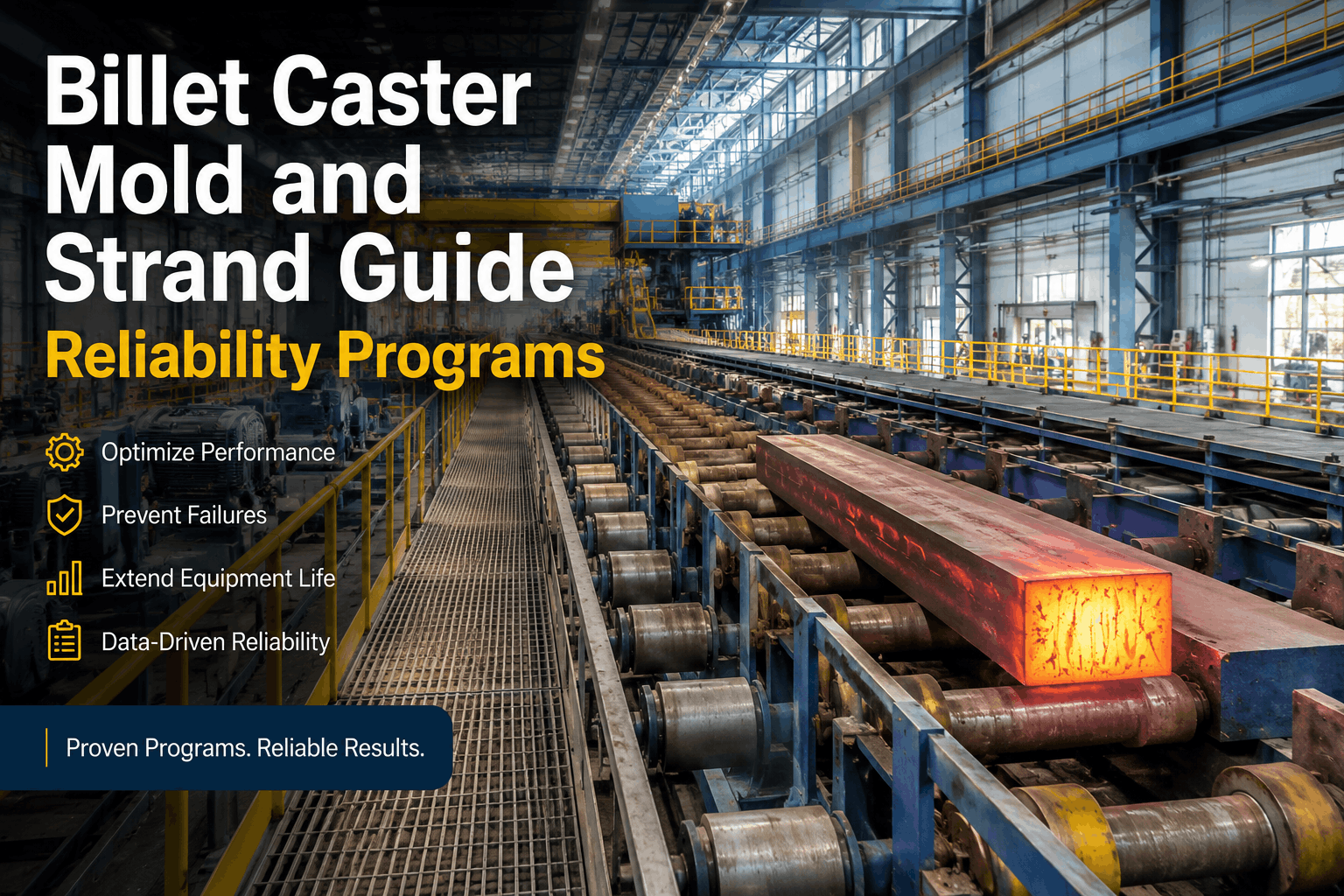
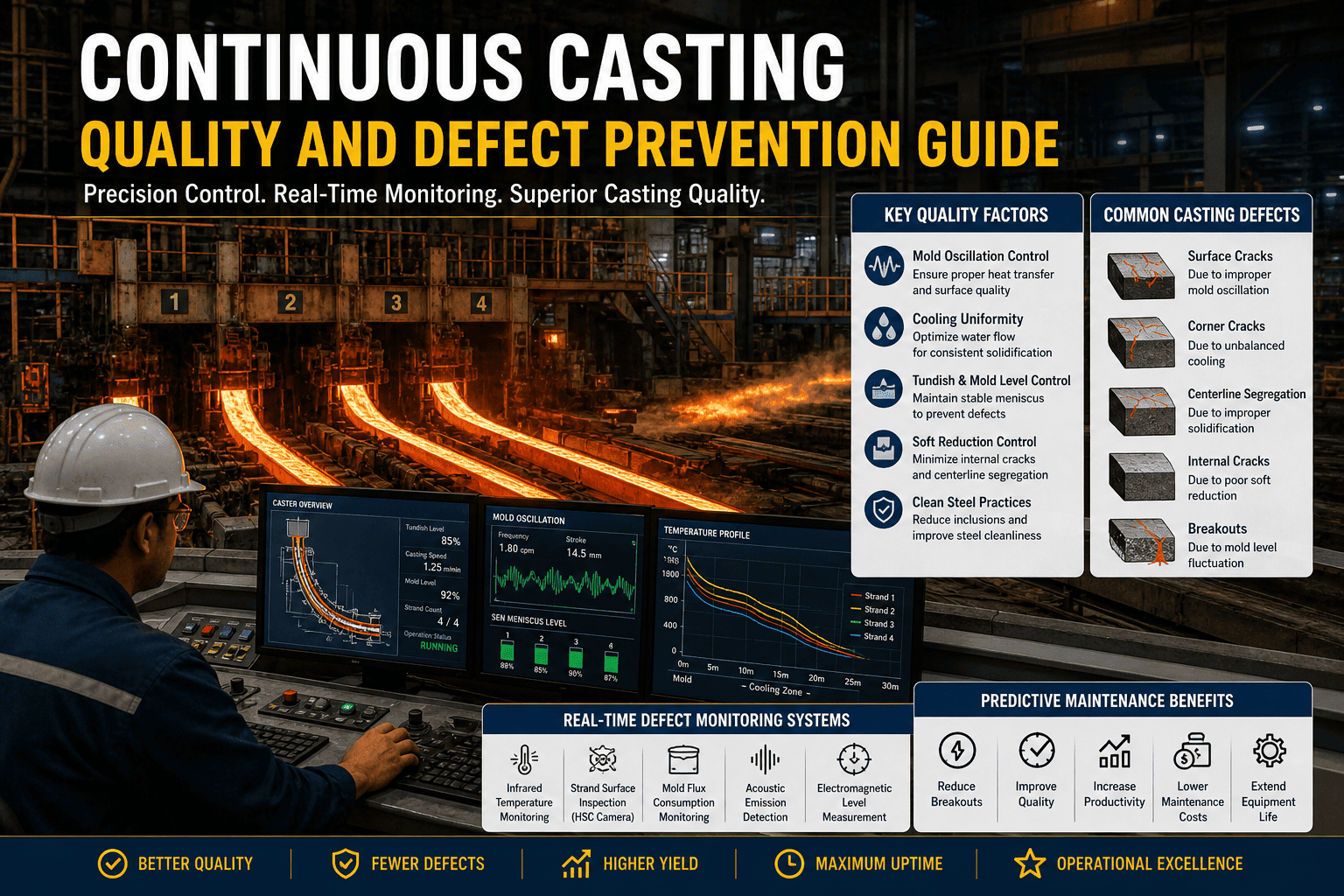
A breakout — liquid steel escaping through the solidifying shell in the continuous caster — is the most catastrophic single event in steelmaking. Beyond the immediate safety hazard, a breakout causes multi-day production losses, refractory damage, and equipment repair costs that dwarf the entire annual maintenance budget of the affected strand. The vast majority of breakout events are preventable. They are preceded by detectable degradation in mold taper, oscillation performance, segment alignment, and secondary cooling uniformity — all measurable and manageable with structured CMMS-based maintenance. This guide covers the critical disciplines across mold, strand guide, and cooling systems that separate casters that run safely from those that don't. Book a demo to see how Oxmaint.ai supports caster maintenance teams.
Continuous Caster Maintenance: Mold, Segments & Strand Guide Management
For steelmaking engineers and operations directors managing slab, bloom, or billet casters — a structured digital maintenance system is the difference between a caster that runs reliably and one that becomes a breakout risk every campaign.
The Maintenance Challenge in Continuous Casting
A continuous caster operates across hundreds of interdependent components — mold plates, oscillation drives, strand guide rolls, segment frames, and secondary cooling nozzles — each of which must be tracked individually to prevent systemic failure.
Mold Wear Is Silent Until It Isn't
Mold copper plate taper narrows progressively with each heat. When taper loss exceeds the allowable tolerance, the strand shell forms unevenly — creating the thin spots that cause breakouts at the mold exit. Most operations discover taper problems during post-campaign teardown, long after the damage is done. Teams using per-sequence mold measurement tracking identify taper deviation trends before they reach critical thresholds.
Segment Misalignment Compounds Invisibly
Strand guide segment alignment determines whether the solidifying strand remains straight and properly supported through the curved and straightening zones. Segment roll wear, frame distortion from thermal cycling, and bearing failures accumulate gradually — until misalignment creates the bulging, rhomboidity, and internal cracks that degrade downstream product quality. A CMMS with segment-level tracking enables maintenance teams to trend roll gap measurements and catch misalignment before it manifests in cast product.
Secondary Cooling Failures Drive Quality and Safety Risk
Blocked or failed spray nozzles create uneven cooling profiles that generate thermal stresses — leading to surface cracking, internal porosity, and temperature non-uniformities that cause straightening cracks in sensitive steel grades. Teams who schedule a demo can see how nozzle condition tracking and cooling water chemistry monitoring are structured within the platform's maintenance workflows.
Critical Maintenance Domains: Mold, Segments & Cooling
Three interconnected maintenance domains must be tracked systematically to prevent breakouts and maintain cast product quality across every sequence.
Mold Oscillation & Copper Plate Condition
Breakout-CriticalThe mold is the first and most critical containment zone in the caster. Copper plate taper, oscillation stroke and frequency, lubrication system performance, and thermocouple response times are the four maintenance parameters that define mold health on a per-sequence basis. Digital tracking of these parameters across each sequence — with automatic flagging when any value drifts outside the acceptable window — is the foundation of breakout prevention for mold-to-breakout correlation analysis.
Strand Guide Segment Alignment & Roll Condition
Quality-CriticalStrand guide segments support and shape the solidifying strand from mold exit through the curved and straightening zones. The mechanical condition of segment rolls, bearings, and frame alignment directly determines internal strand quality — with misalignment tolerances measured in tenths of a millimetre across segments that may span 15–20 metres of machine length. Maintenance teams using digital segment tracking software build a per-segment condition database that enables targeted maintenance investment rather than blanket campaign replacement.
Secondary Cooling Zone & Water System Health
Process & Safety CriticalThe secondary cooling system comprises hundreds of individual spray nozzles distributed across the cooling zones below the mold. Each nozzle's flow rate, spray pattern, and directional consistency must be maintained to achieve the uniform cooling profile that produces defect-free strand. A single blocked nozzle zone can create the localised hot streak that generates transverse surface cracks — a defect class only detected during downstream inspection, long after the strand has been processed. For teams implementing preventive maintenance scheduling, nozzle condition tracking integrated with cooling water chemistry monitoring provides the complete picture of secondary cooling system health.
Prevent Breakouts Before They Happen
Oxmaint.ai gives caster maintenance teams per-sequence mold tracking, segment-level roll gap history, and structured cooling nozzle inspection workflows — all accessible from mobile on the caster floor.
How Oxmaint.ai Works for Caster Maintenance Teams
Built for industrial asset management at component level — not a generic platform adapted for steelmaking use.
Sequence-Level Mold Dashboard
Log taper measurements, oscillation data, and copper plate condition per sequence. Trend against campaign benchmarks and trigger alerts when readings approach the breakout risk threshold — before the next heat starts.
Mobile Inspection on the Caster Floor
Technicians complete segment teardown inspections, nozzle flow tests, and cooling circuit checks on mobile with photo attachments and offline sync — no manual transcription, no lost records between shifts.
Segment Roll Gap Trend Analysis
Track roll gap measurements at every segment position across campaigns. Start a free trial to configure your caster's segment structure and get automatic wear rate projections and replacement interval planning.
Breakout Risk Pattern Recognition
Correlate multi-parameter histories — mold taper, oscillation, segment alignment, and cooling — to identify the pre-failure indicators that preceded past events. Book a demo to see the breakout prevention workflow.
Paper Logs vs. Oxmaint.ai: Caster Maintenance Tracking
The operational cost of manual tracking in caster operations is measured in missed taper deviations, undetected segment wear, and cooling failures that a structured CMMS platform prevents.
| Maintenance Area | Manual / Paper-Based | Oxmaint.ai |
|---|---|---|
| Mold Taper Tracking | Measured at campaign teardown only — deviation accumulates undetected across sequences | Per-sequence measurement logs with trend charts and automatic deviation alerts |
| Segment Roll Gap History | Paper teardown sheets, not searchable by segment or roll position | Per-segment digital records with roll position history and wear rate projection |
| Cooling Nozzle Condition | Visual inspection only, no flow rate logging or blockage trend data | Structured nozzle test records with flow rate history and replacement interval tracking |
| Breakout Risk Correlation | Post-event reconstruction from scattered logs — no predictive capability | Parameter trending enables identification of multi-indicator warning patterns before breakout |
| Maintenance Audit Trail | Binder-based records often incomplete, not linked to specific sequences | Sequence-referenced digital history with technician attribution and timestamp |
Swipe to compare on mobile
We had a breakout in the third year of operation and spent three months reconstructing what went wrong from shift logs. When we implemented Oxmaint.ai, the first thing the data showed us was that taper deviation on the narrow face had been drifting outside tolerance for eleven sequences before the breakout — completely invisible in our paper records. That alone justified the entire implementation.— Caster Engineer, Flat Products Mini Mill, Northern Europe
Frequently Asked Questions
Can Oxmaint.ai track mold taper measurements on a per-sequence basis across multiple caster strands?
Yes. Oxmaint.ai supports multi-strand caster configurations with each strand maintaining independent mold measurement records, segment condition histories, and cooling system inspection logs. Mold taper measurements can be logged per sequence with automatic trending against the designed taper profile, and deviation alerts are configurable per strand independently to account for different casting speed and product mix profiles.
How does the platform support segment roll gap tracking across a full machine with 20+ segments?
Each segment is configured as a discrete asset sub-component within the caster hierarchy. Roll gap measurements are entered per segment at each teardown, and the platform maintains a full measurement history per roll position. Wear rate calculations and replacement interval projections are generated automatically. Start a free trial to build your caster's segment register.
Does Oxmaint.ai support nozzle-level tracking for secondary cooling systems?
Yes. Secondary cooling nozzles can be structured at the zone, header, and individual nozzle level within the platform's asset hierarchy. Inspection checklists include flow rate measurement fields and spray pattern assessment criteria. Nozzle replacement histories are maintained per position, enabling identification of zones with above-average blockage or failure rates.
How does Oxmaint.ai help with breakout prevention specifically?
Breakout prevention works through multi-parameter trending and threshold alerting. When mold taper, oscillation performance, or thermocouple response data trends toward warning thresholds, maintenance engineers receive alerts before the next casting sequence begins. The platform's condition history also enables teams to correlate past near-miss events with the maintenance parameter combinations that preceded them. Book a demo to see the breakout prevention configuration.
How long does it take to implement Oxmaint.ai for an existing continuous caster operation?
Most caster operations are fully operational on Oxmaint.ai within 10–14 days of starting their free trial. Onboarding includes caster asset hierarchy configuration, inspection template creation for each maintenance domain, PM schedule setup, and mobile app deployment for floor technicians. Historical taper and segment measurement data from existing spreadsheets can be migrated during onboarding to establish the trending baseline immediately.
Protect Your Caster From the Failures That Are Already Building
Mold taper deviation, segment misalignment, and blocked cooling nozzles do not announce themselves — they accumulate silently until they become a breakout, a quality rejection, or an unplanned shutdown. Oxmaint.ai gives your maintenance team the sequence-level data visibility to catch these failures in progress, not after the event.