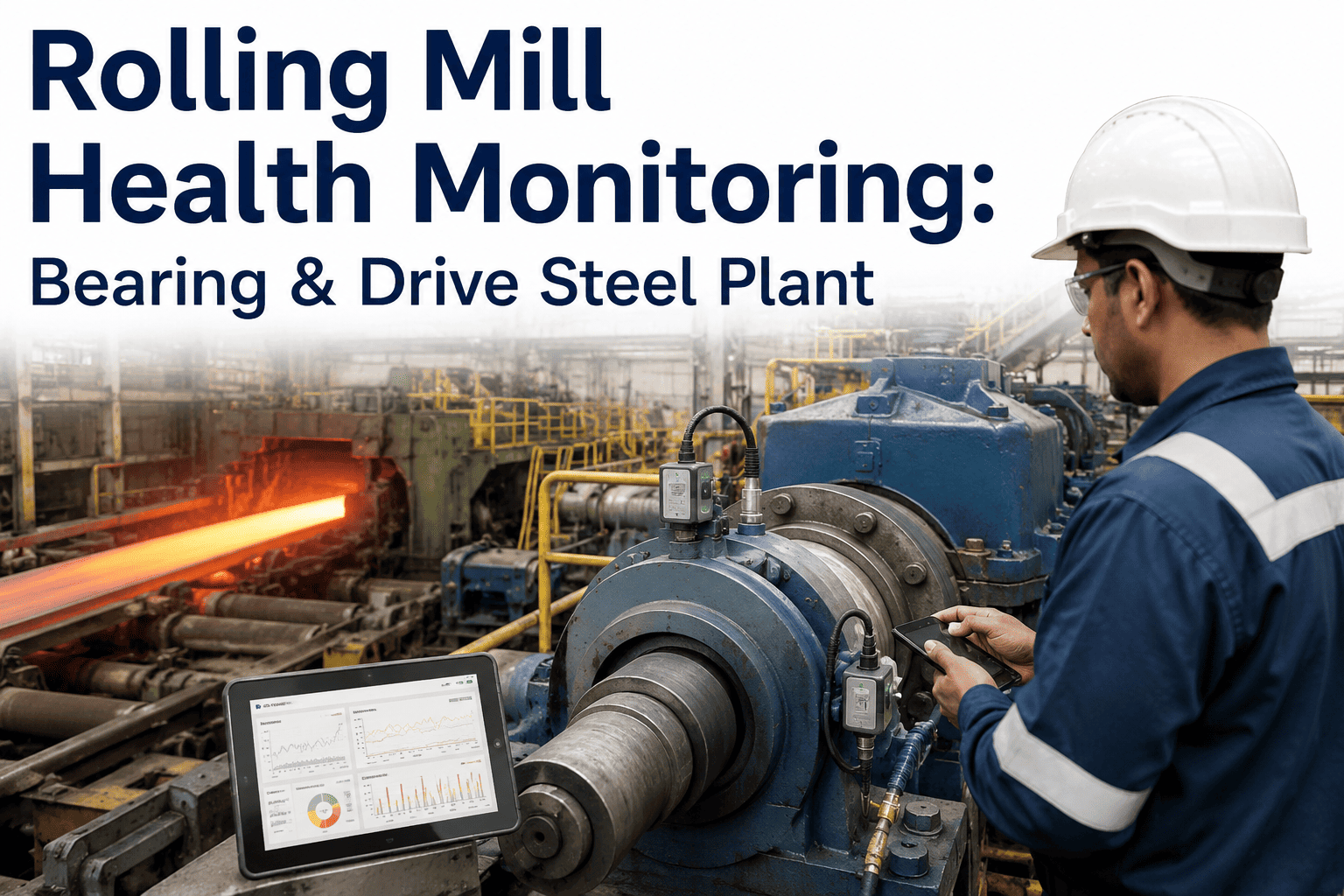
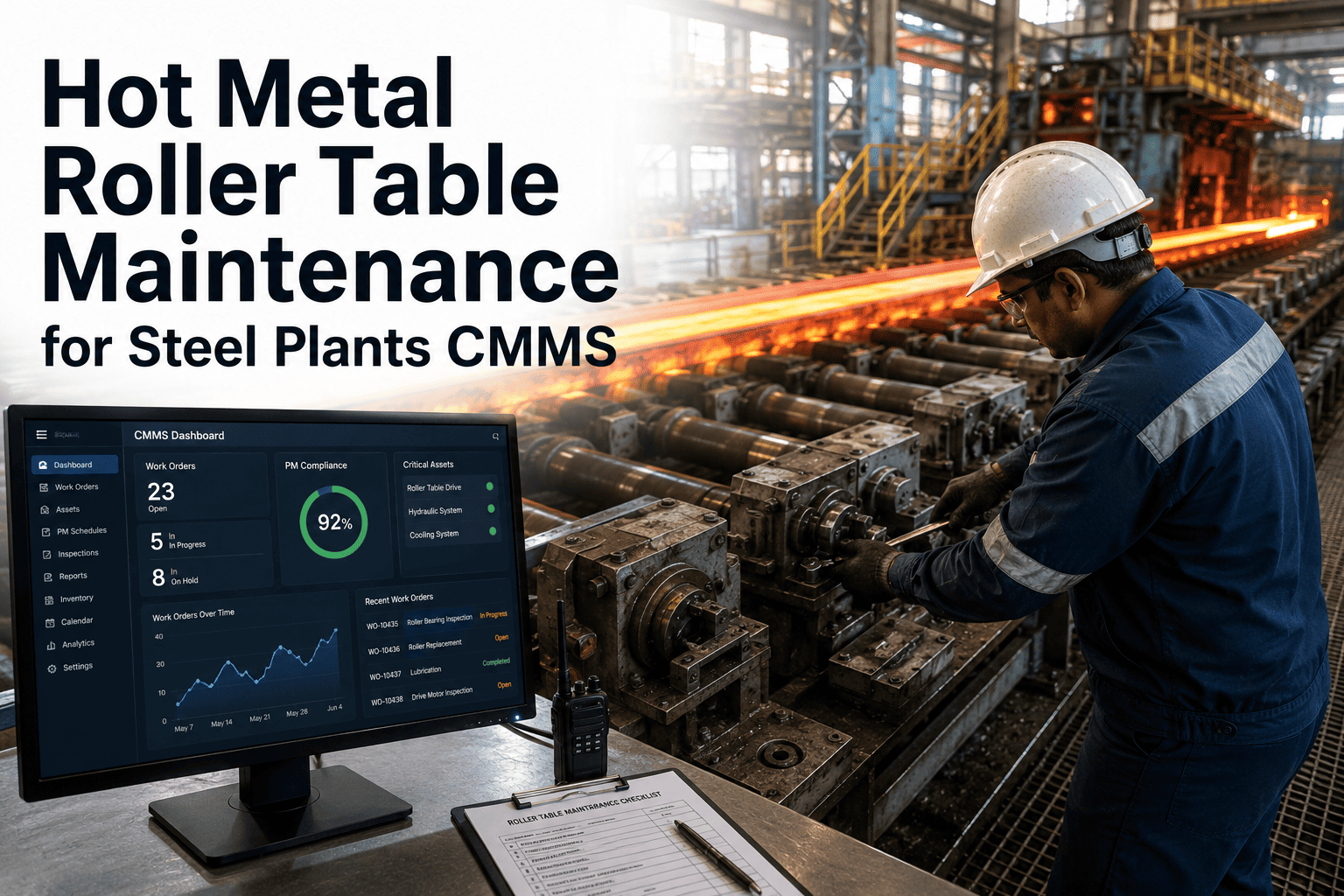
A seized caster roll in the bending zone does not just wear out — it gouges the strand shell while the ferrostatic pressure of the still-liquid core presses against it. Internal cracks form, transverse surface defects appear on the slab, and if the shell is thin enough, the result is a breakout. Every one of those failure sequences begins with a maintenance gap: a lubrication point missed, a bearing load threshold exceeded without a work order, an alignment deviation that accumulated over 3,000 heats without measurement. Start managing strand guide PM in Oxmaint free and close those gaps before they become breakout events.
Caster Strand Guide and Roller Table Maintenance
Roll alignment, lubrication scheduling, bearing condition monitoring, and wear tracking for bending, straightening, and horizontal strand guide zones.
What the Strand Guide Does and Why Each Zone Has Different Maintenance Requirements
Below the mold, the solidifying strand is supported, bent, straightened, and driven through the machine by a series of rolls arranged in containment segments. At exit from the mold, the shell is only 10–25 mm thick while the core remains fully liquid under ferrostatic pressure. The strand guide must support this shell continuously through bending, straightening, and the horizontal runout section until solidification is complete. A typical 2-strand slab caster has 8–20 containment segments per strand, each containing 6–12 roll pairs, water spray nozzles, hydraulic clamping cylinders, and instrumentation — totalling over 1,000 individual components per strand that must be maintained within tolerance.
The maintenance strategy differs by zone. Bending and upper straightening rolls operate closest to the mold, under the highest temperature conditions and with the thinnest strand shell — making seized or misaligned rolls in this zone the highest-risk scenario. Lower straightening and horizontal rolls operate at lower temperatures but carry higher ferrostatic loads. The roller table beyond the torch cutoff carries fully solidified product at high surface temperatures, with different wear mechanisms from the strand guide segments. Sign up for Oxmaint to configure zone-specific PM schedules, inspection triggers, and wear thresholds for your caster configuration.
Bending Zone
Rolls bend the strand from vertical to the casting radius. Shell is 10–25 mm thick. Highest breakout risk from roll seizure or misalignment. Roll spacing 150–250 mm pitch. Bearing inspection monthly, alignment every segment change.
Straightening Zone
Multiple straightening points transition strand from curved to flat. Straightening forces are highest here. Misaligned straightening rolls cause internal cracks in the solidifying strand. Drive motor current monitoring detects seizure.
Horizontal Zone
Strand approaches full solidification. Lower ferrostatic pressure but higher cumulative wear on rolls from long campaign operation. Spray nozzle performance critical here for final solidification quality.
Roller Table
Conveys fully solidified slab at 800–1,000°C surface temperature to torch cut and marking. Motor health, roll rotation, and surface condition determine throughput reliability. No shell integrity risk but production flow impact is direct.
Roll Alignment: The Highest-Return Maintenance Activity on Any Caster
Misaligned guide rolls cause stress and strain in the partially solidified strand, leading to internal cracks and quality downgrades. Laser alignment verification during every planned stoppage costs $20,000–$50,000 per year in measurement activity but prevents bulging-related defects worth $1–3M annually. Despite this return, alignment measurement is underinvested at most caster operations — because the consequence of misalignment appears as a quality problem reported by rolling mills, weeks after the maintenance window where the deviation could have been corrected.
Modern optical alignment systems (OPAL-type) use horizontal laser planes as reference to measure nominal versus actual roll positions automatically, generating test reports for CMMS integration. Book a demo to see how Oxmaint tracks alignment measurement results per segment over campaign history and flags segments approaching deviation limits.
| Alignment Task | Zone | Frequency | Method | Deviation Limit | CMMS Action |
|---|---|---|---|---|---|
| Roll gap measurement | All segments | Every cast sequence start | In-chain SCM / strand checker | ±0.5 mm from design | Work order if out of tolerance |
| Laser alignment survey | Bending, straightening | Every planned stoppage | Optical laser (OPAL-type) | Position deviation per OEM spec | Results logged to segment record |
| Roll rotation check | Bending zone | Every outage | Manual rotation torque check | Any seized roll — immediate | Immediate replacement WO generated |
| Segment frame distortion survey | All segments | Every segment change | Dimensional measurement | Frame distortion per OEM limit | Logged to segment refurb record |
| Pinch roll alignment and pressure | Withdrawal unit | Monthly | Laser + hydraulic gauge | Pressure balance ±5% between rolls | PM calendar trigger — monthly |
| Roller table level survey | Roller table | Quarterly | Level measurement | Roll height deviation ±2 mm | Quarterly PM work order |
Swipe to view all columns on mobile
Lubrication Scheduling: Why Manual Grease Routes Fail Caster Roll Bearings
Caster roll bearings operate in one of the most demanding lubrication environments in steelmaking — high temperature, continuous water spray, scale ingress, and oscillating load from the ferrostatic pressure cycle. Grease depletion in a bending zone bearing can progress to seizure within a single shift. The problem with manual grease routes is that missed points accumulate silently: the technician signs the sheet, the CMMS records the PM as closed, and the bearing that was not reached because steam obscured the fitting is already running dry.
Automated lubrication systems with flow confirmation sensors eliminate missed points and reduce grease consumption by 30–50% through precise dosing versus manual over-application. Where automated systems are not installed, digital route-based lubrication management with mandatory point-by-point confirmation in the Oxmaint mobile app converts a paper sign-off into an auditable per-point record. Sign up for Oxmaint to configure lubrication routes with point-by-point confirmation and automatic work order generation on missed or overdue points.
| Component | Lubricant Type | Frequency | Application Method | Risk if Missed |
|---|---|---|---|---|
| Bending zone roll bearings | High-temp EP grease | Every 8 hrs | Auto lube or manual gun | Seizure within one shift — breakout risk |
| Straightening zone roll bearings | High-temp EP grease | Every 12 hrs | Auto lube or manual gun | Internal crack in slab — downgrade |
| Horizontal segment bearings | High-temp EP grease | Every 24 hrs | Auto lube or manual gun | Accelerated wear — earlier segment change |
| Pinch roll bearings | High-temp EP grease | Every 12 hrs | Auto lube system | Strand drive failure — production stop |
| Withdrawal unit gearbox | Gear oil ISO VG 220 | Oil change every 6 months | Drain and fill procedure | Gearbox wear — vibration and noise |
| Drive roller table bearings | High-temp EP grease | Weekly | Manual gun or auto lube | Roll seizure — conveyor stoppage |
| Dummy bar chain guides | Graphite paste / EP grease | Before each sequence start | Manual application | Chain jam during sequence start — stoppage |
Swipe to view all columns on mobile
Schedule every lubrication point, alignment check, and bearing inspection automatically
Oxmaint PM scheduling connects lubrication routes, segment change intervals, and bearing condition monitoring to your caster asset records — so no point is missed and every trend is tracked.
Roll Wear Tracking: Managing Segment Change Intervals With Condition Data
Segment change intervals range from 2,000 to 8,000 heats depending on zone position and operating conditions. Conservative calendar-based replacement replaces segments early, wasting residual life. Reactive replacement waits until a quality complaint from the rolling mill identifies the worn segment retroactively — after the damage to product has already occurred. Condition-based replacement, driven by wear measurement data logged to each segment's CMMS record, enables intervals that maximise component life without risking product quality or shell integrity.
Roll surface condition — cracking, buildup, wear pattern — is the primary visible indicator of segment condition. Bearing load trending from motor current analysis detects degradation in the drive train. Spray nozzle flow verification confirms cooling effectiveness has not declined. Together, these three data streams allow the maintenance team to make segment change decisions based on actual condition rather than conservative calendar assumptions. Book a demo to see segment condition tracking in Oxmaint.
How Oxmaint Lubrication Management and PM Scheduling Serve Caster Maintenance Teams
Point-by-Point Lubrication Route Confirmation
Each lubrication point on each segment is a mandatory checkpoint in the Oxmaint mobile checklist — technicians confirm each point individually before the route can be closed. Missed points generate immediate alerts. The shift supervisor sees which points were completed and which were skipped before the next sequence starts. Sign up free to configure your lubrication routes in Oxmaint.
Segment Condition History Across the Campaign
Every segment has an asset record in Oxmaint — serial number, zone position, heat count, all inspection findings, roll surface measurements, bearing condition readings, spray nozzle audits, and change history. When a segment is pulled and sent for reconditioning, the full condition history travels with it. When it returns from the roll shop, the record continues from where it left off. Book a demo to see segment record configuration.
Heat-Count and Calendar Dual Triggers
Caster PM tasks trigger from heat count (bearing inspection every 500 heats), calendar (gearbox oil change every 6 months), or condition threshold (bearing temperature rising above limit). All three trigger types run simultaneously per asset. The PM is generated when the first trigger fires — whichever comes first. No spreadsheet coordination required. Start free to configure heat-count triggers for your segments.
Alignment and Wear Reports Ready for Every Outage
When a maintenance window opens, Oxmaint generates the work package automatically — alignment measurements due, lubrication routes overdue, segment change decisions pending based on heat count and condition data, and spray nozzle audits scheduled. The maintenance team arrives at the outage with every task pre-assigned and every threshold visible, rather than assembling the work scope manually from spreadsheets and memory. Book a demo to see outage work package generation.
Frequently Asked Questions
What is the most common cause of internal cracks in continuously cast slabs related to strand guide condition?
Misaligned segment rolls are the leading mechanical cause. When roll gaps deviate from the design profile — wider than design allows bulging of the solidifying shell under ferrostatic pressure, narrower than design creates squeeze forces on the partially solidified strand — both generate internal stress that exceeds the strength of the solidifying steel and opens internal cracks. Bending zone misalignment is most critical because the shell is thinnest there. Straightening zone misalignment causes the second most frequent internal crack events. Regular roll gap measurement using in-chain strand condition monitors and laser alignment surveys at every planned stoppage are the primary preventive measures. Sign up for Oxmaint to log alignment results and trend deviations over campaign history.
How do I determine the right segment change interval for each zone?
Start with the OEM recommended interval as the baseline, then adjust based on three data streams: bearing condition trending from motor current analysis (rising current indicates bearing degradation approaching replacement), roll surface condition measurements at each change (if surfaces are still within limits at the OEM interval, extend cautiously), and spray nozzle audit results (plugging above threshold requires change regardless of heat count). Logging these three data sets per segment in Oxmaint across multiple campaigns builds the fleet-specific condition model that allows intervals to be extended or contracted based on actual experience at your caster and with your steel grades. Book a demo to see how Oxmaint tracks segment condition across campaigns.
What lubricant properties matter most for caster strand guide roll bearings?
The primary requirements are high-temperature stability (continuous operating temperature 150–300°C in bending and straightening zones), water resistance (resistance to washout from secondary cooling spray), extreme pressure performance (bearing loads are high and impact loading from strand behaviour is frequent), and anti-corrosion protection (the environment is steam, water, and hot steel scale). Lithium complex or calcium sulfonate complex greases with EP additives are the most common specification for bending and straightening zone bearings. Application frequency is as important as lubricant selection — even the best grease fails if the interval allows dry running between applications at the temperatures these bearings experience.
How does Oxmaint handle lubrication management for a caster with automated lubrication systems already installed?
Automated lubrication systems deliver grease — Oxmaint manages the verification that they are working correctly. The CMMS PM schedule includes regular checks of auto-lube system reservoir level, flow confirmation sensor status, distribution block function, and nozzle delivery verification. These checks are assigned as route-based digital inspections in the Oxmaint mobile app, completed at each maintenance round with pass/fail results and photo capture for blocked fittings or failed distribution blocks. Where auto-lube and manual points coexist on the same caster, both routes are managed in the same Oxmaint schedule. Start free to configure auto-lube verification routes alongside manual lubrication points.
Connect your strand guide PM — lubrication routes, segment condition, alignment data — in one platform
Oxmaint tracks every roll, every segment, every lubrication point, and every alignment measurement across the full campaign lifecycle of your continuous caster.