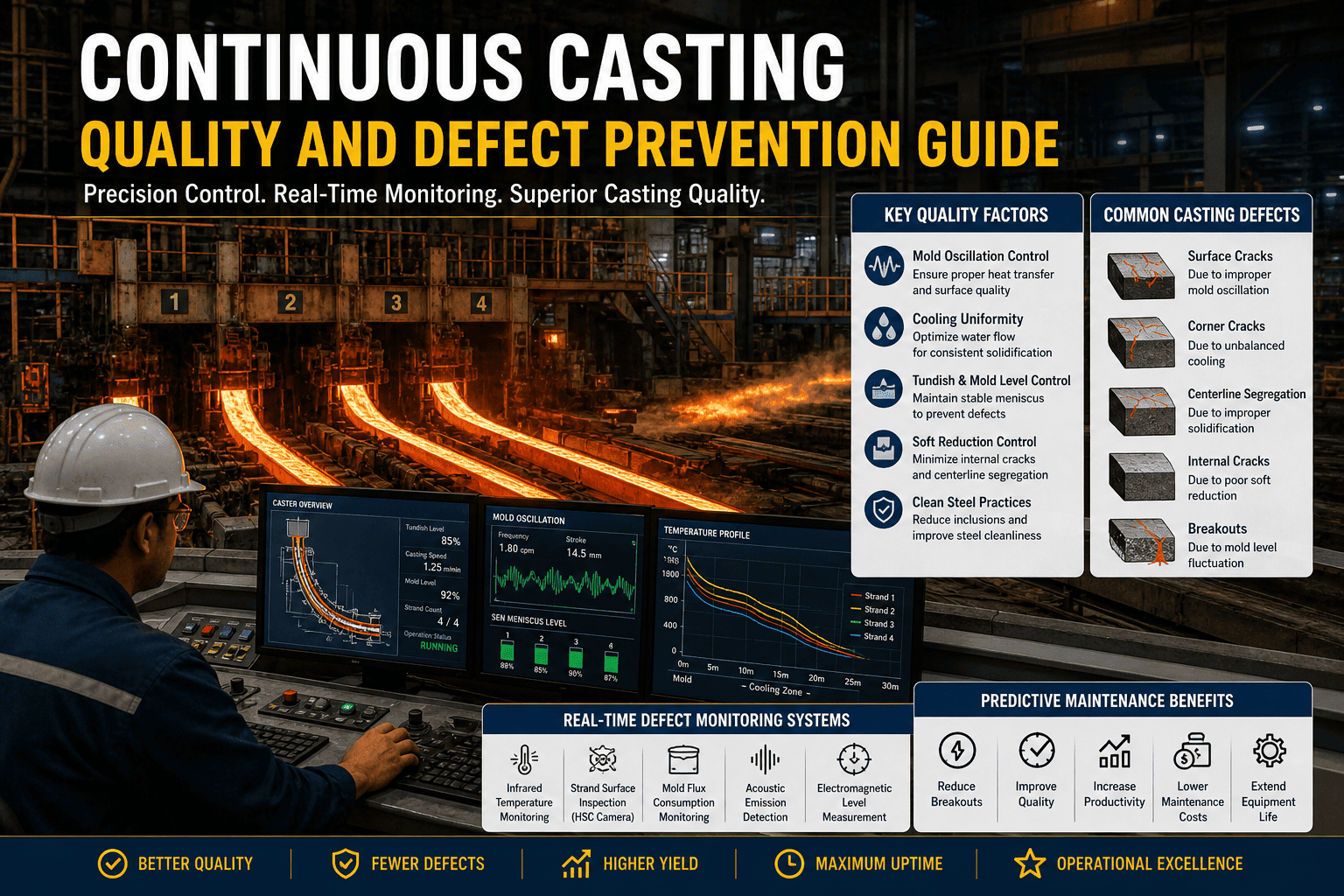
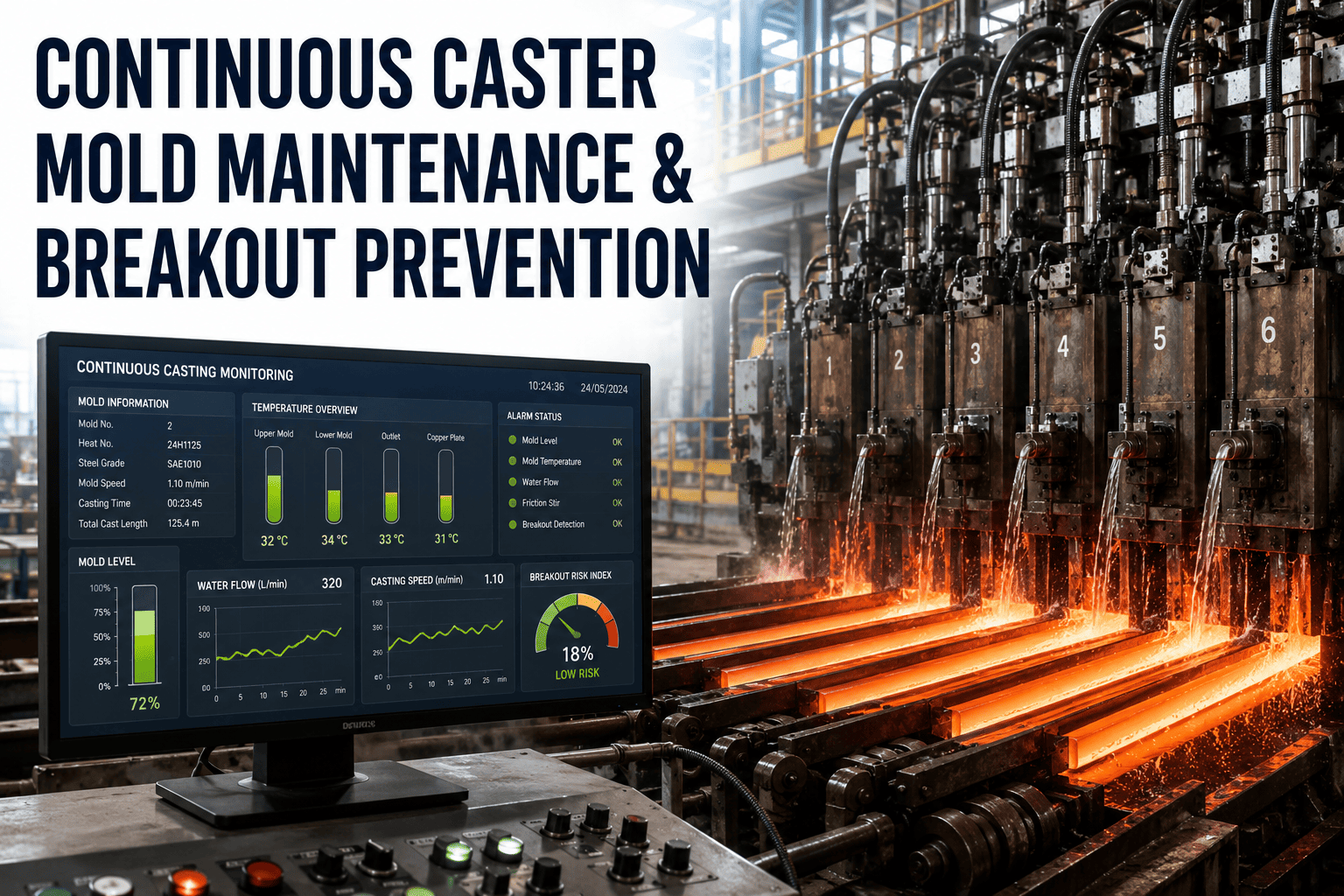
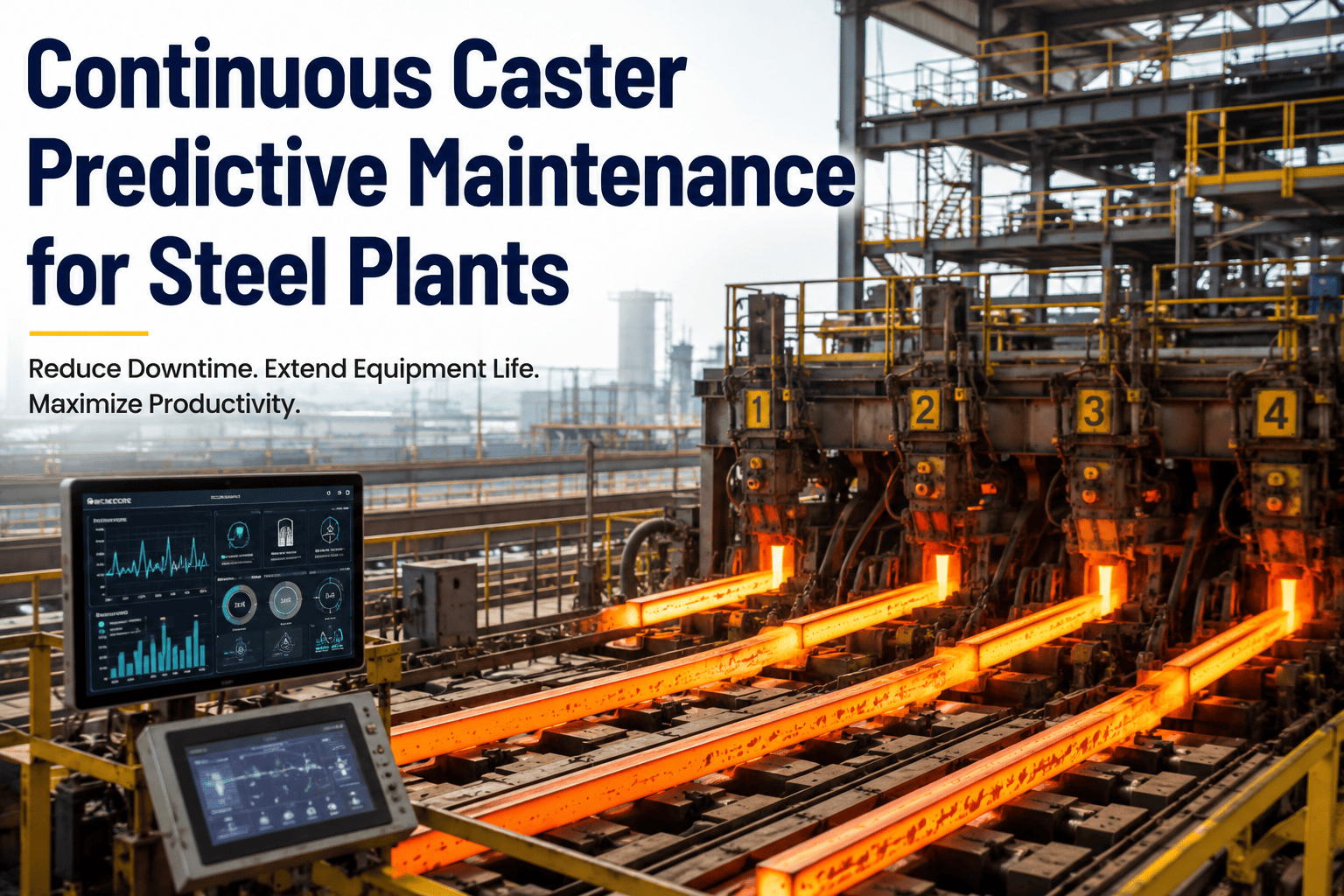
delivers predictive maintenance intelligence for steel plant continuous casting operations, connecting mold oscillation sensors, cooling zone monitors, and breakout detection systems into a unified AI-driven maintenance platform. Steel producers running slab, billet, and bloom casters use OxMaint to reduce surface defects, prevent costly breakouts, and maintain casting quality standards consistently across multi-strand operations — with automated alerts, maintenance logs, and root-cause tracing built in.
Steel Production Processes
Continuous Casting Quality & Defect Prevention
The complete guide to controlling slab, billet, and bloom casting defects using predictive maintenance AI
Mold Zone
Secondary Cooling
Solidification & Cut
87%
of breakouts are predictable with sensor data
$2M+
average cost per major breakout event
6 Types
of critical casting defects to monitor
Defect Classification
The 6 Critical Casting Defects & Their Root Causes
Understanding defect origins is step one. Monitoring the parameters that cause them — in real time — is how OxMaint’s predictive AI closes the gap before a defect reaches your rolled product.
| # |
Defect Type |
Affects |
Primary Cause |
Monitored Parameter |
OxMaint Alert |
| 01 |
Longitudinal Cracks |
Slab |
Uneven mold heat removal, shell thinning |
Mold thermocouple asymmetry |
Real-time |
| 02 |
Transverse Cracks |
Bloom, Billet |
Oscillation mark depth, temperature rebound |
Oscillation stroke & frequency |
Real-time |
| 03 |
Breakout |
All |
Shell thinning, sticker, thermocouple anomaly |
Mold friction & heat flux pattern |
Critical |
| 04 |
Central Segregation |
Billet, Bloom |
Insufficient secondary cooling uniformity |
Spray water flow & pressure |
Predictive |
| 05 |
Slag Entrapment |
Slab |
Mold level fluctuation, casting powder issues |
Mold level sensor variance |
Real-time |
| 06 |
Rhomboidity (Off-Corner) |
Billet |
Uneven mold taper or cooling asymmetry |
Mold taper & shape geometry |
Predictive |
Predictive AI in Action
How OxMaint Prevents Defects Before They Form
OxMaint’s AI engine continuously analyzes sensor streams from your caster to detect the early signatures of defect-forming conditions — often 15–40 minutes before a visible defect or breakout event occurs.
1
Mold Oscillation Monitoring
Continuous tracking of oscillation stroke, frequency, and negative strip time. Deviations from set points auto-generate PM work orders for eccentric drive inspection and lubrication checks, preventing oscillation mark deepening that leads to transverse crack formation.
2
Secondary Cooling Uniformity
Zone-by-zone spray water flow and pressure monitoring with AI-detected nozzle blockage patterns. Uneven cooling causes surface temperature rebound and internal stress — OxMaint flags imbalanced spray rows before segregation or cracking develops in the solidifying strand.
3
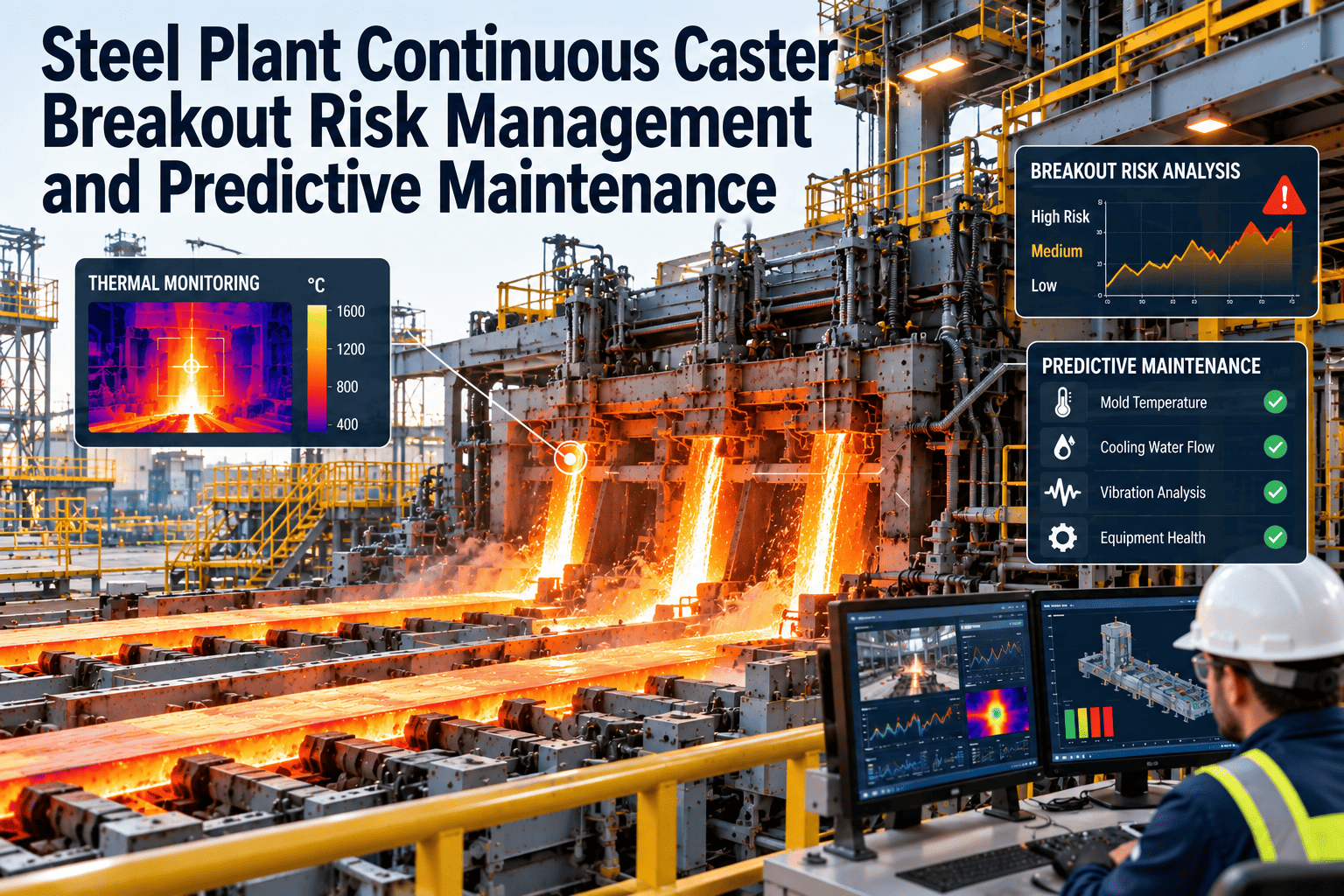
Breakout Prediction
OxMaint’s AI learns the thermocouple heat flux patterns associated with sticker-type breakout precursors specific to your caster. Casting speed is automatically flagged for operator action when a sticking event signature is detected, with full audit log preserved for post-event analysis.
4
Equipment Degradation Tracking
Segment roll wear, guide roll bearing temperature, and withdrawal-straightener torque are tracked over casting heats. OxMaint schedules roll maintenance based on actual condition rather than fixed intervals, extending segment life and preventing strand deformation defects.
Performance Benchmark
Quality Outcomes: Before & After Predictive Monitoring
Breakout Rate
1.8
per 1,000 heats
Without AI monitoring
→
0.3
per 1,000 heats
With OxMaint AI
83% reduction
Surface Defect Rejection
4.2%
slab rejection rate
Manual inspection
→
0.9%
slab rejection rate
With predictive alerts
78% reduction
Mold Change Frequency
Fixed
interval schedule
Preventive only
→
Condition
based scheduling
OxMaint AI-driven
+22% mold life
Prevent your next breakout. Protect your casting quality.
See how OxMaint’s predictive AI works with your existing caster instrumentation.
Maintenance Workflow
Critical Caster Maintenance Tasks OxMaint Automates
| Caster System |
Task |
Frequency |
OxMaint Trigger |
| Mold & Oscillator |
Oscillation amplitude & frequency verification |
Per campaign |
Sensor deviation > 5% |
| Mold & Oscillator |
Oscillator drive lubrication & bearing check |
Weekly |
Vibration signature change |
| Secondary Cooling |
Spray nozzle flow rate validation |
Monthly |
Pressure anomaly detected |
| Secondary Cooling |
Zone valve and actuator inspection |
Quarterly |
Response time lag alert |
| Segment Rolls |
Roll gap setting verification |
Per segment change |
Torque imbalance flag |
| Segment Rolls |
Bearing temperature baseline check |
Per heat |
Temp spike > threshold |
| Mold Copper Plates |
Wear measurement & taper adjustment |
Per mold change |
Heat flux asymmetry |
| Ladle & Tundish |
Refractory lining thickness check |
Per campaign |
Temperature trend deviation |
Expert Review
What Steel Industry Experts Say
“The combination of mold thermocouple data, oscillation monitoring, and AI-driven pattern recognition has fundamentally changed how world-class steel plants approach breakout prevention. Plants that treat this as an afterthought are leaving significant quality yield and safety margin on the table — the data exists, the question is whether you have a system to act on it in time.”
SK
S. Kumar
Continuous Casting Process Engineer, Steel Technology Consulting Group
“Secondary cooling uniformity is underrated as a defect driver. In our experience, most internal segregation and transverse cracking in blooms traces back to inconsistent zone water distribution that was never properly monitored. Real-time nozzle performance tracking paired with predictive alerts is now an essential part of modern caster operations.”
LM
L. Marchetti
Metallurgical Quality Manager, European EAF Steel Producer
FAQ
Frequently Asked Questions
How does OxMaint’s AI learn the specific breakout patterns of our caster?
OxMaint uses a supervised learning model that is trained on your caster’s historical thermocouple and heat flux data. The AI identifies the specific temperature anomaly patterns — such as rising then falling signals in adjacent thermocouple pairs — that precede sticker-type breakouts in your specific mold geometry and steel grades. The model refines its accuracy with each casting campaign, typically reaching high confidence within 60–90 days of operation. To see a demonstration of the breakout prediction interface,
book a technical demo or
start a trial to review the model training process.
Can OxMaint integrate with our existing Level 2 automation system on the caster?
Yes. OxMaint is designed to complement, not replace, existing Level 2 process automation systems. It connects via standard industrial data interfaces including OPC-UA, MQTT, and historian exports from systems such as Siemens, ABB, and Primetals. Sensor data flows into OxMaint for maintenance-focused analytics — pattern detection, work order generation, and compliance logging — while your Level 2 system continues managing real-time process control. Integration scoping typically takes 1–2 weeks for a standard continuous caster.
Schedule a technical call to discuss your plant’s specific automation architecture.
What types of steel grades and caster configurations does OxMaint support?
OxMaint supports all major continuous casting configurations including slab (thick and thin), bloom, and billet casters, across carbon, stainless, HSLA, and special steel grades. The platform is agnostic to caster OEM and scale — from 2-strand mini-mill billets to 8-strand large slab operations. Quality thresholds, alert parameters, and maintenance intervals are all configured per strand, per grade, and per campaign. Visit
oxmaint.ai to explore configuration options or
request a demo tailored to your plant setup.
How does predictive maintenance reduce mold copper plate costs specifically?
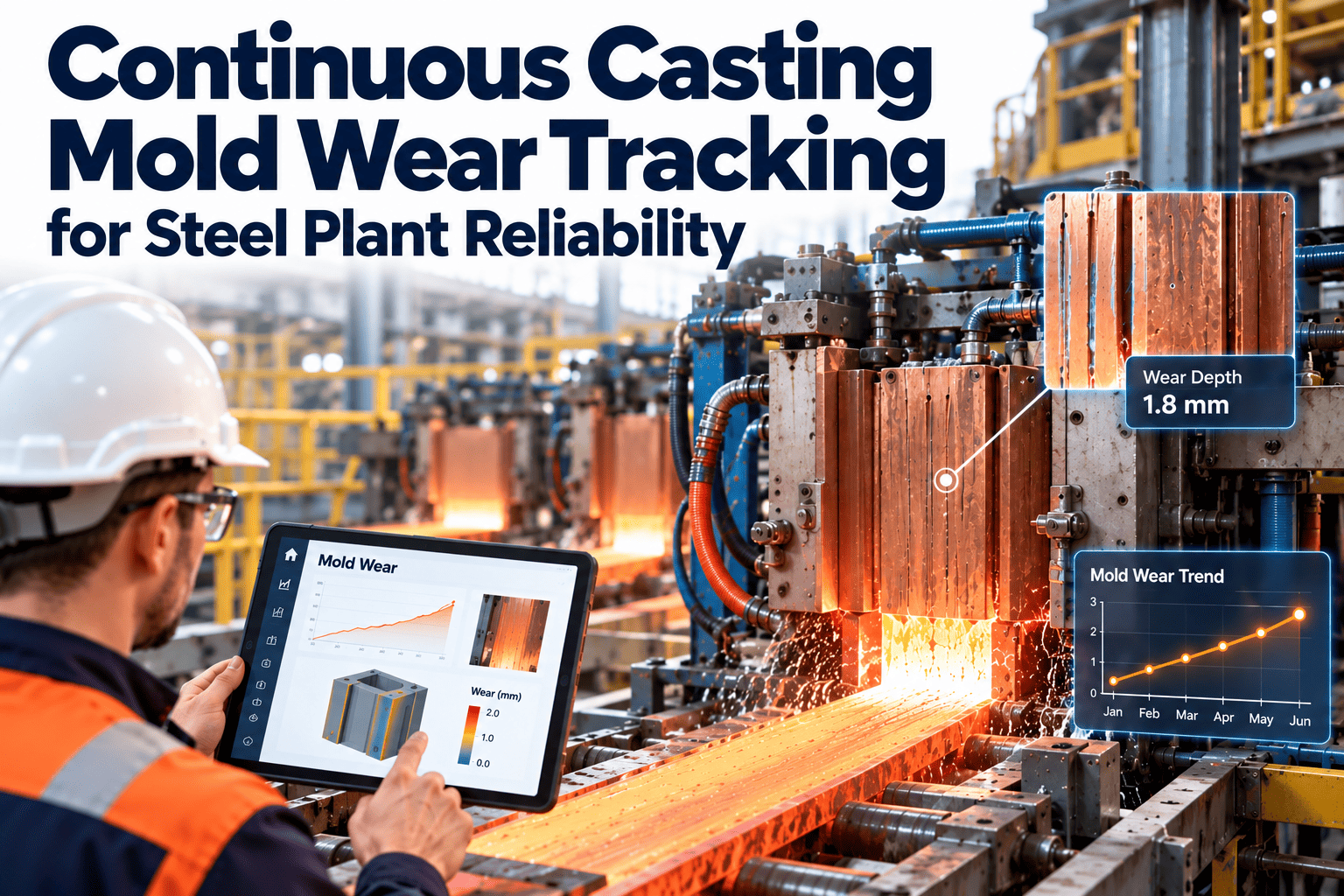
Mold copper plates typically wear unevenly due to asymmetric heat flux and inconsistent casting powder distribution. OxMaint tracks heat flux balance across mold faces using thermocouple data, triggering taper adjustment work orders before off-corner wear becomes irreversible. This condition-based approach extends mold campaign life by 15–25% on average compared to fixed-interval changes, and significantly reduces the risk of breakout caused by shell thinning at worn mold corners. Detailed mold tracking and wear history reports are available in every OxMaint account.
Sign up to explore the mold asset management module.
Stop chasing defects. Start predicting them.
OxMaint connects to your caster sensors and starts delivering predictive insights in days.