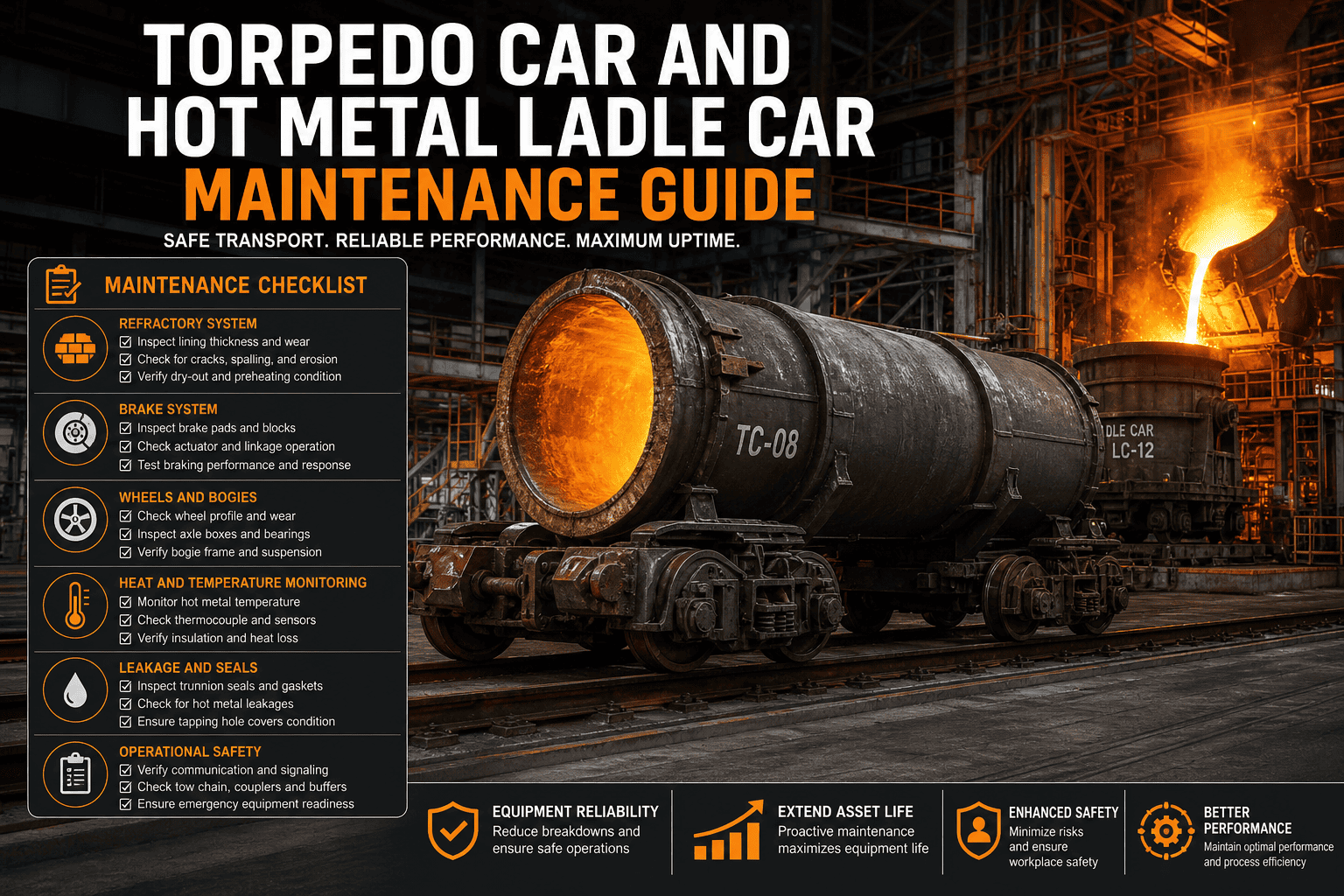
Torpedo cars and hot metal ladle cars are the most safety-critical mobile assets in any integrated steel plant. Carrying up to 350 tonnes of liquid iron at temperatures above 1,400°C, a single refractory breakthrough or brake failure does not result in equipment damage alone — it results in catastrophic personnel risk, furnace shutdowns, and production losses that compound for weeks. Oxmaint Asset Lifecycle Management helps steel plants track heat cycles, refractory condition, brake system compliance, and torpedo car campaign data in one connected platform — so maintenance teams stay ahead of every inspection window, not behind it.
Torpedo Car & Hot Metal Ladle Car Maintenance Guide
Refractory Inspection • Brake System Checks • Heat Tracking • Campaign Management • Safety Compliance
Why Torpedo Car Maintenance Demands a Dedicated System
Unlike fixed process equipment, torpedo cars are mobile assets cycling continuously through filling at the blast furnace casthouse, transport to the steelmaking shop, desulfurization treatment, and tipping — often completing 3–5 full cycles per day per car. Each cycle subjects the refractory lining to intense thermal shock, chemical attack from slag and iron, and physical abrasion. Without a system tracking heat counts, shell temperature trends, and brake performance by individual car number, maintenance decisions default to guesswork — and guesswork with 1,400°C liquid iron is unacceptable.
BF Casthouse Fill
Car receives 250–350 t of liquid iron. Thermal shock to refractory begins here — preheat condition critical.
Hot Metal Transport
Brake system, wheel bearings, and axle condition determine safe transit. Shell temperature monitored by IR cameras en route.
Desulfurization Station
Reagent injection creates turbulence that accelerates slag-line refractory wear. Chemical attack is highest at this stage.
BOF/EAF Tipping
Full tipping cycle stresses the trunnion bearing and tipping mechanism. Residual skull buildup begins after tipping.
Skull Removal & Preheat
Solidified slag skull accumulates and must be removed. Preheat condition before next fill determines refractory thermal stress.
Maintenance Requirements by System
Torpedo car maintenance spans four distinct systems — refractory, mechanical running gear, tipping and trunnion, and safety systems. Each has a different failure mode, different monitoring method, and different consequence when missed. The table below reflects industry maintenance standards for integrated steel plant torpedo car fleets.
| System | Key Failure Mode | Monitoring Method | Inspection Frequency | Oxmaint Feature |
|---|---|---|---|---|
| Refractory Lining | Hotspot / breakthrough | IR thermography — shell scan | Every trip past scanner | Heat Count Tracker |
| Skull Buildup | Capacity reduction / imbalance | Visual + weight monitoring | Per 50–100 heats | Condition Log per Car |
| Brake System | Brake fade / pad wear | Function test + pad measurement | Weekly | PM Work Orders |
| Wheel & Axle Bearings | Bearing spalling / derailment | Vibration + temp monitoring | Monthly / condition | IoT Sensor Integration |
| Trunnion Bearing | Seizure during tipping | Lubrication record + temp | Per 200 tipping cycles | Cycle Counter PM |
| Tipping Mechanism | Hydraulic / actuator failure | Pressure test + seal inspection | Monthly | Scheduled PM Orders |
| Rail Track Interface | Wheel flange wear / gauge deviation | Flange measurement | Quarterly | Asset Lifecycle Record |
| Preheat System | Incomplete preheat / thermal shock | Temperature logging | Per cycle | Heat Log Integration |
Refractory Campaign Management: The Core of Torpedo Car Reliability
Refractory lining condition is the primary determinant of torpedo car safety and operational life. Modern high-alumina and Al₂O₃-SiC-C brick linings can support campaigns of up to 400,000 net tonnes of hot metal without shotcrete maintenance — but only when each car's heat history, shell temperature trends, and slag-line wear are tracked systematically against the designed campaign specification.
Thermal Imaging Monitoring
Two IR cameras mounted on both sides of the rail track scan every car in motion at several hundred frames per second. Shell temperature hotspots above the threshold trigger immediate inspection work orders in Oxmaint — before the car re-enters service.
Heat Count Tracking
Each torpedo car accumulates heat counts recorded against the refractory campaign specification. Oxmaint tracks heat count by car number, generates replacement planning alerts at 80% campaign consumption, and logs all relining events with brick grade and contractor records.
Slag-Line Zone Monitoring
Desulfurization treatment creates intense turbulence that preferentially attacks the slag-line zone. HWI and Saint-Gobain zoned lining designs mitigate this — but maintenance teams must track slag-line wear separately from the main barrel to predict early zone failure accurately.
Preheat Optimization
Torpedo cars must be preheated before receiving liquid iron to prevent metal hardening and thermal shock to the lining. IR cameras can see through preheat flames to monitor actual refractory surface temperature — ensuring minimum preheat temperature is reached before filling without wasting energy on over-preheating.
Track every heat, every inspection, every campaign — by car number.
Oxmaint Asset Lifecycle Management creates individual records for each torpedo car and ladle car, capturing heat counts, shell temperature history, brake records, and relining data in one platform.
Hot Metal Ladle Car Maintenance
Standard hot metal ladle cars handle shorter transport distances and smaller volumes than torpedo cars, but face the same refractory and mechanical challenges at higher cycle frequencies. Their open-top design makes visual slag buildup inspection easier, but also exposes the ladle shell to radiant heat damage that torpedo cars — with their closed design — avoid.
Ladle Shell Inspection
Open-top shells are exposed to radiant heat from liquid iron. Shell distortion, weld crack propagation, and localized overheating must be documented at each relining and after any suspected breakthrough — not just on a calendar schedule.
Trunnion & Tipping Gear
Ladle trunnion bearings support the full weight of the ladle plus liquid iron during tipping. Lubrication record compliance and load-based bearing inspection cycles prevent the seized trunnion failures that strand full ladles and require emergency crane intervention.
Running Gear & Brakes
Ladle cars carrying 100–250 t of liquid iron require reliable brakes and consistent wheel flange condition. Brake pad wear tracking by cycle count and axle bearing condition monitoring by vibration analysis prevent the two most common transport incidents in hot metal handling operations.
Expert Perspective
The most dangerous assumption in torpedo car maintenance is that the refractory is fine because the IR camera did not alarm this trip. Shell temperature scans are a last line of detection — by the time a hotspot appears, the brick has already been significantly compromised. The real prevention happens upstream: accurate heat count tracking by car number, slag-line wear assessment at every relining, and strict preheat temperature compliance before each fill. Plants that treat torpedo car maintenance as a mechanical task rather than a refractory lifecycle management programme are the ones that experience breakthroughs.
Frequently Asked Questions
Every Torpedo Car Deserves Its Own Maintenance Record.
Oxmaint creates individual asset lifecycle records for every torpedo car and ladle car in your fleet — with heat tracking, IR alert logs, brake compliance, and campaign history in one connected CMMS.