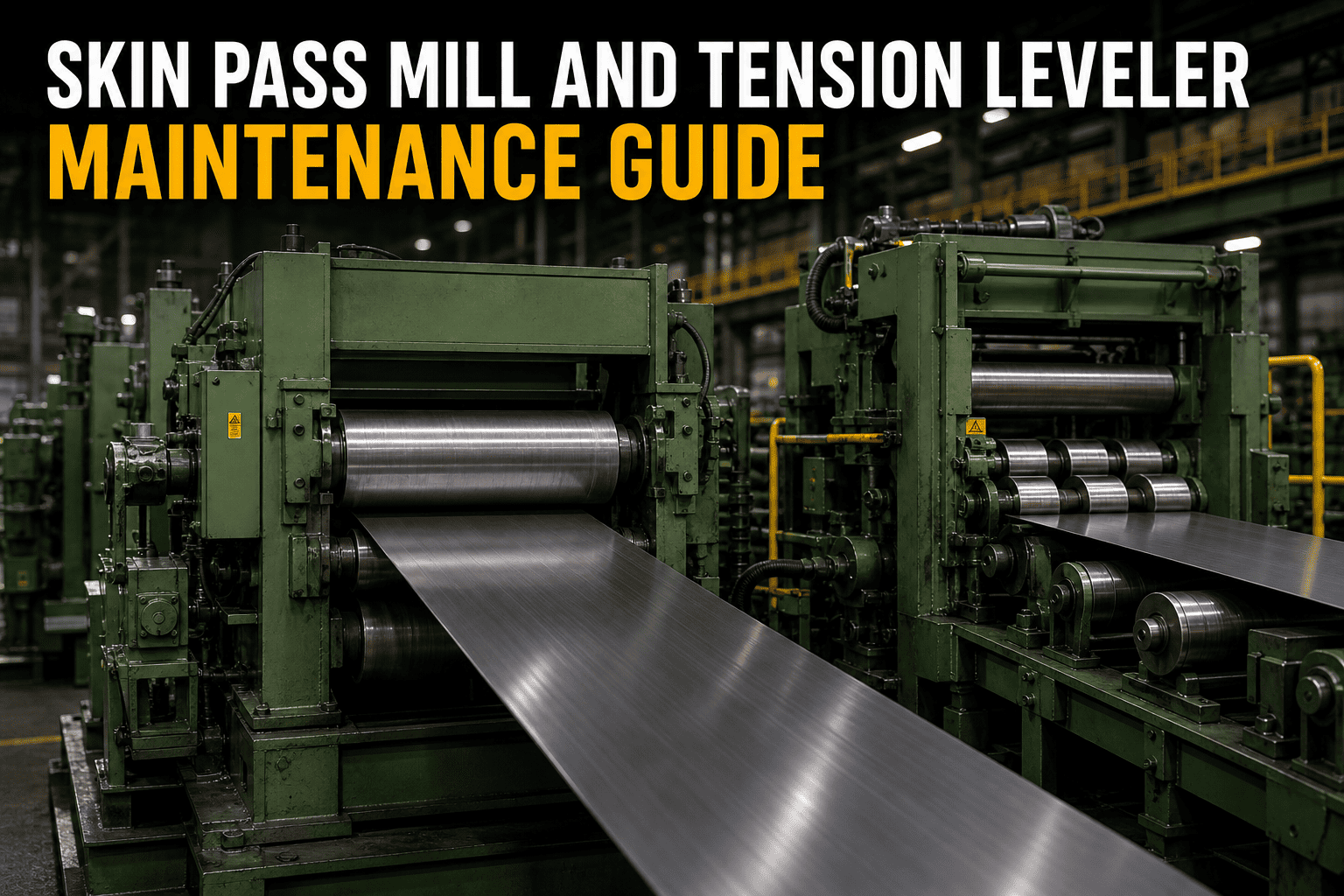
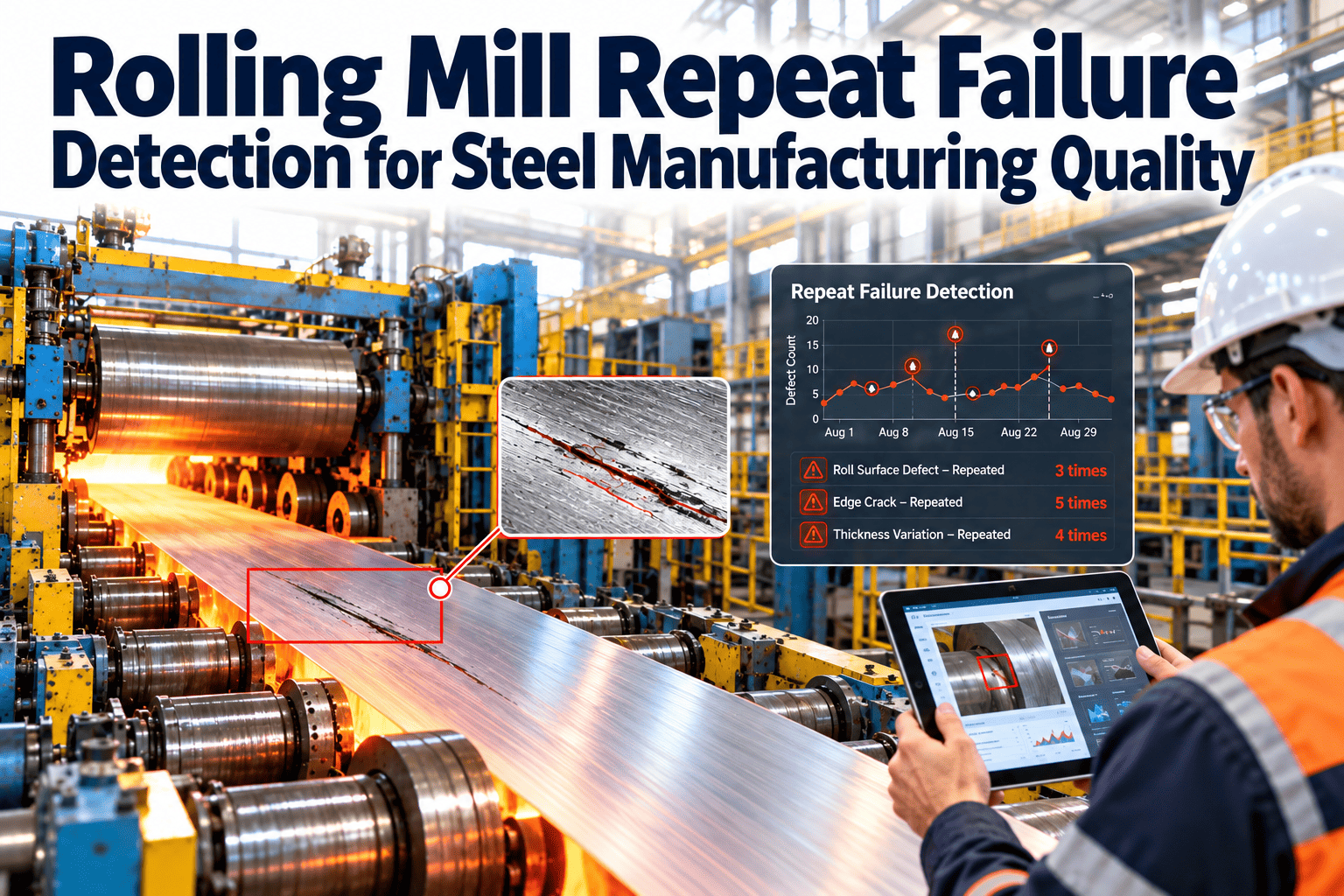
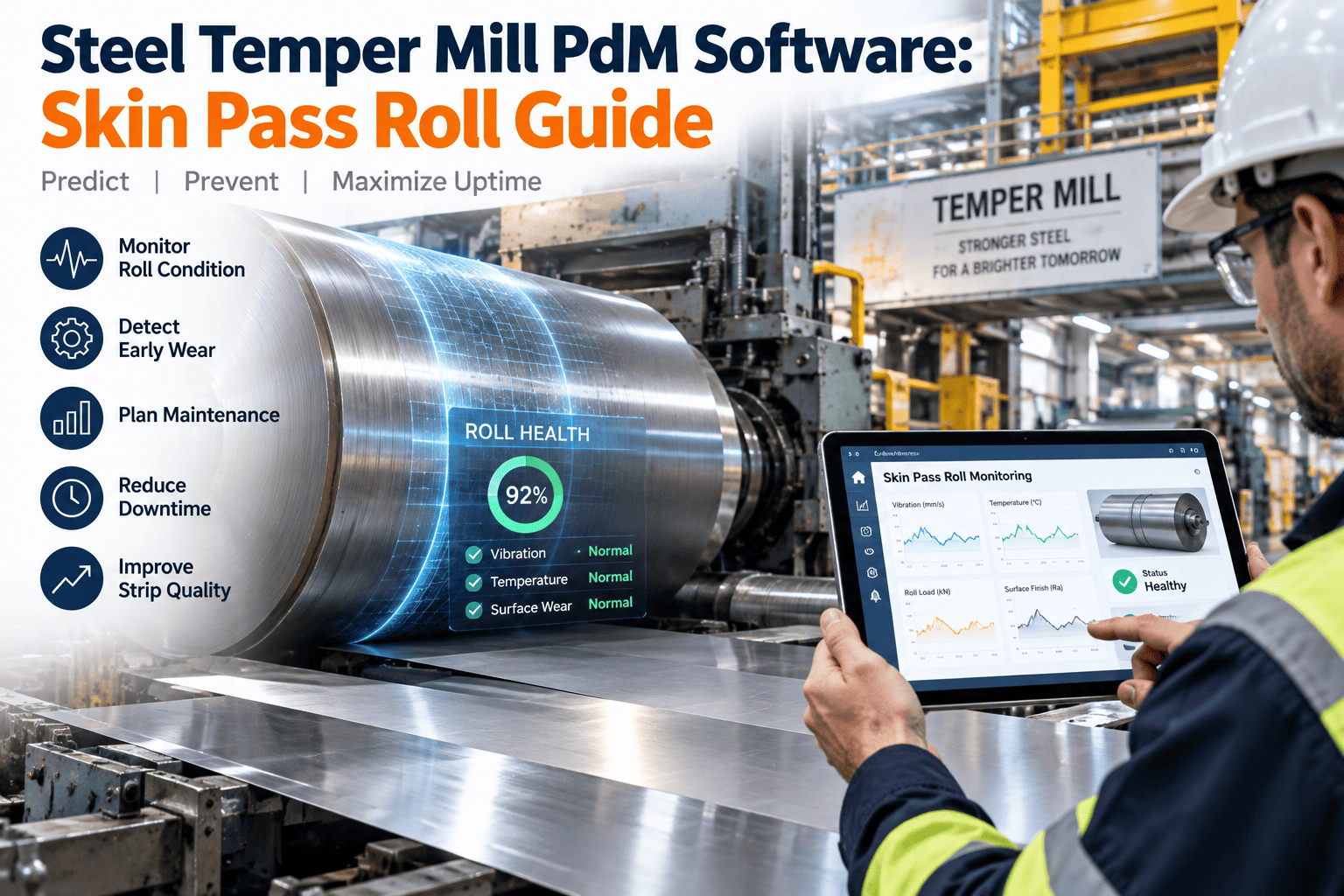
Surface defects and flatness failures at the skin pass mill stage cost finishing lines an estimated $200–$500 per tonne in downgrade and rework. Temper mill rolls, tension bridle bearings, and leveler cassettes all degrade in predictable patterns — yet most plants still rely on shift-change visual inspections and calendar-based roll changes. OxMaint's Preventive Maintenance module transforms these intuition-driven intervals into data-backed schedules that protect strip quality and line availability simultaneously. This guide explains what to track, when to act, and how digital PM changes outcomes in steel finishing.
Steel Finishing · Strip Quality · Preventive Maintenance
Skin Pass Mill and Tension Leveler Maintenance Guide
Yield point elongation, strip flatness, and surface finish are set at the skin pass and leveling stage. When rolls wear and cassettes drift out of alignment, scrap rates climb before any alarm fires. Here is the PM framework that keeps quality in spec.
The Quality Connection
Why Skin Pass Maintenance Directly Controls Strip Quality
The skin pass mill applies 0.5–2% elongation to eliminate yield point elongation and set surface texture. Any variation in roll force, speed ratio, or strip tension translates directly to a quality defect. Understanding this chain is the first step to maintaining it.
01
Roll wear increases surface roughness variation → strip texture out of Ra spec
02
Bearing clearance growth causes force oscillation → flatness deviation and shape defects
03
Tension bridle slip reduces elongation precision → yield point elongation reappears in coil
04
Leveler cassette misalignment → edge wave, center buckle, and coil rejection
PM Schedule
Skin Pass and Tension Leveler: Full PM Reference Table
| Component |
PM Task |
Interval |
Quality Risk if Deferred |
OxMaint Trigger |
| Work rolls |
Surface roughness measurement (Ra) |
Every 80–120 km strip |
Surface texture OOS |
Strip tonnage meter |
| Backup roll chocks |
Bearing clearance measurement |
Every roll change |
Force oscillation, flatness loss |
Tonnage + vibration alert |
| Tension bridle rolls |
Surface condition + slip test |
Weekly |
Elongation out of spec |
Calendar + line speed deviation |
| Leveler cassette |
Alignment check + roll gap |
Every campaign change |
Edge wave, center buckle |
Flatness gauge trigger |
| Hydraulic APC system |
Oil contamination + seal check |
Monthly |
Force control instability |
Calendar + pressure drift |
| Entry/exit steering rolls |
Alignment + bearing lubrication |
Weekly |
Strip camber and tracking |
Calendar |
| Elongation measurement system |
Calibration vs reference coil |
Monthly |
Yield point elongation claim |
Calendar |
Performance Indicators
Four KPIs That Signal Skin Pass Maintenance Is Due
01
Surface Roughness (Ra)
OK: 0.8–1.6 µm
Warn: 1.6–2.0 µm
Change: >2.0 µm
02
Flatness Index (I-units)
OK: <5 I-units
Warn: 5–10 I-units
Reject: >10 I-units
03
Elongation Precision (% error)
OK: ±0.05%
Warn: ±0.1%
Act: >±0.15%
04
Roll Force Variation (kN/mm)
OK: <±3%
Warn: ±3–6%
Inspect: >±6%
Preventive Maintenance · Strip Quality
Stop Reacting to Quality Failures. Start Preventing Them.
OxMaint schedules skin pass PM tasks by strip tonnage, flatness index drift, and surface roughness trend — not just calendar days. When a KPI crosses threshold, a work order fires automatically so your team acts before the coil is downgraded.
Start Free Trial
Book a Demo
Expert Review
What Rolling Mill Engineers Say About Finishing Line PM
"Most skin pass operators change rolls on a tonnage count they set 10 years ago. The real trigger should be Ra measurement combined with elongation spread over the last 20 coils — that tells you when the roll is actually finished."
Rolling Mill Technical Manager
Cold Rolling Complex, Central Europe
"We proved a direct correlation between tension leveler cassette alignment deviation and customer complaints about flatness. Once we started tracking alignment at every campaign change, complaints dropped 70% in six months."
Strip Quality Engineer
Automotive Grade Steel Producer, Southeast Asia
"Hydraulic APC maintenance is chronically under-prioritized. We see more yield point elongation failures from unstable roll force control than from any other single cause — and it is almost always traced back to a delayed oil change or worn seal."
Finishing Line Reliability Engineer
Integrated Flat Product Mill, North America
Before vs After
Digital PM vs Calendar-Based PM: Finishing Line Results
| Metric |
Calendar-Based PM |
Data-Triggered PM (OxMaint) |
| Roll change frequency |
Fixed every 90 days |
Triggered by Ra + tonnage trend |
| Surface texture rejects / month |
8–14 coils |
1–3 coils |
| Flatness failures / month |
12–20 coils |
2–5 coils |
| Unplanned roll shop stoppages |
3–4 / month |
0–1 / month |
| PM compliance rate |
62% |
94% |
| Downgrade cost (automotive grade) |
$380K / year |
$90K / year |
Frequently Asked
Skin Pass and Tension Leveler Maintenance Questions
How do I determine the correct roll change interval for a skin pass mill?
The most reliable roll change trigger is a combination of surface roughness measurement (Ra target and upper limit), cumulative strip tonnage, and flatness index trend over the last 15–20 coils. Calendar-based intervals alone lead to either premature changes that waste roll life or late changes that cause quality failures. Plants using OxMaint's PM module tie roll change work orders to real-time Ra readings from the roughness gauge, reducing unnecessary roll shop interventions by 30–40%.
See how OxMaint schedules roll changes by process data.
What causes yield point elongation to reappear after skin passing?
Yield point elongation returns when the skin pass elongation falls below the specified minimum — typically 0.5–1.0% for deep drawing grades. This happens when tension bridle rolls slip, roll force control is unstable due to hydraulic APC issues, or the elongation measurement system is out of calibration. Each cause has a different PM fix: bridle surface inspection, APC seal and oil checks, and monthly elongation system calibration. OxMaint links each PM task to the relevant quality outcome so technicians understand why the task matters.
Book a demo to see how quality and maintenance tasks are linked.
How often should tension leveler cassettes be inspected for alignment?
Tension leveler cassettes should be checked for roll gap and alignment at every campaign or grade change, and a full geometric measurement should be completed monthly. Misalignment of even 0.1mm between cassette rolls creates an asymmetric bending moment that produces edge wave or center buckle — both of which are difficult to identify as a maintenance problem without structured records. Plants using digital PM records with cassette measurement history resolve flatness complaints twice as fast because the root cause evidence already exists.
OxMaint maintains a full cassette history linked to quality outcomes.
Can OxMaint receive data directly from the skin pass mill's flatness gauge?
Yes. OxMaint integrates with flatness measurement systems (including ABB, Parsytec, and Shapeline gauges) via OPC-UA and MQTT. When flatness index or Ra readings cross a user-defined threshold, OxMaint automatically raises a PM work order linked to the specific roll or leveler asset. This eliminates the delay between quality system alert and maintenance response — the two most common sources of quality failure in finishing lines.
Start a free trial to connect your quality systems.
Preventive Maintenance · Finishing Line Reliability
Connect Strip Quality Data to Maintenance Schedules — Automatically
OxMaint's Preventive Maintenance module links your flatness gauge, roughness tester, and elongation system directly to scheduled PM tasks. Quality KPIs become maintenance triggers. Downgrade costs become a thing of the past.