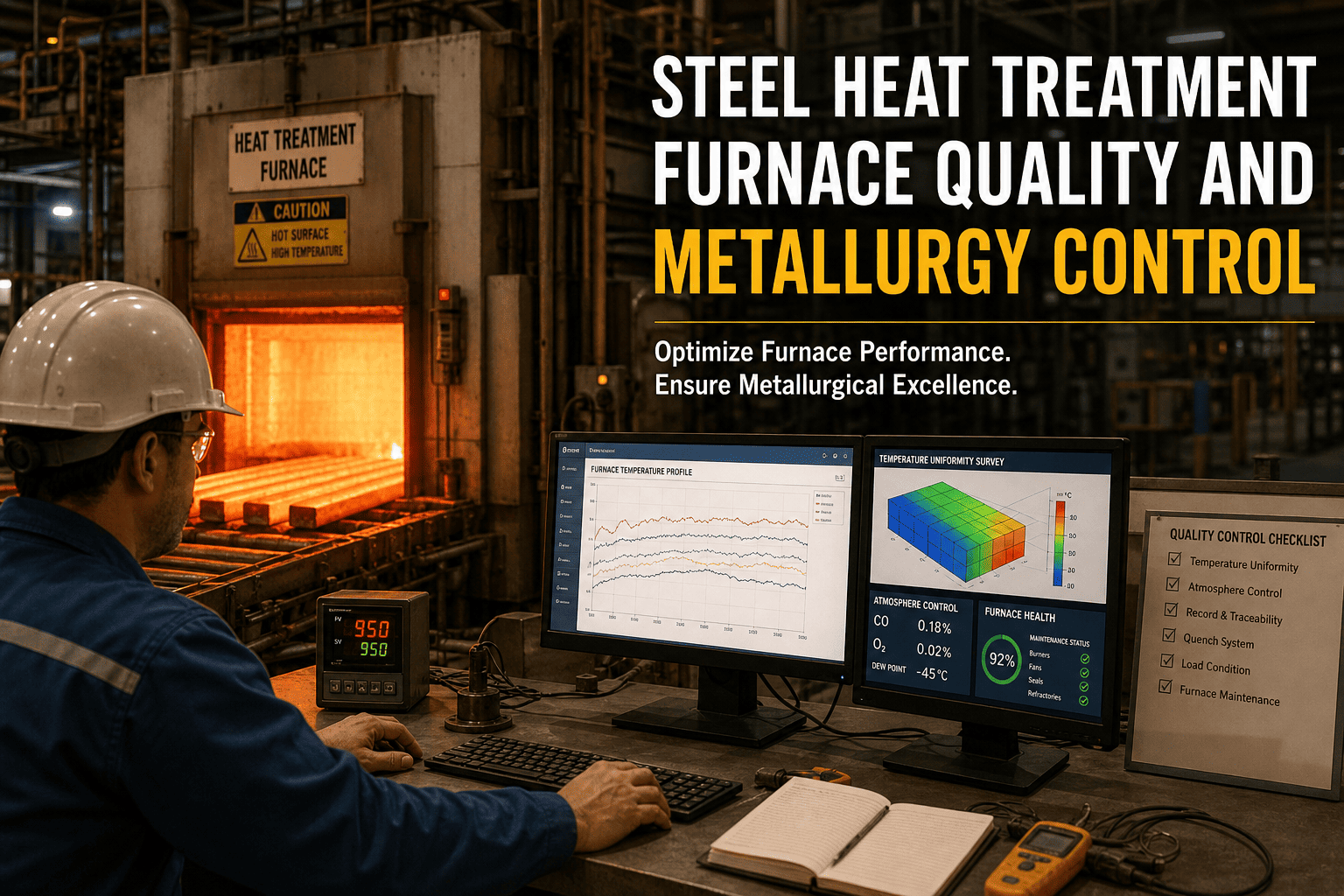
A furnace that holds 850°C at the center and 830°C at the edge produces two different metallurgies from the same heat — and neither may match the customer specification. Temperature uniformity is not a setting, it is a maintenance outcome. Every thermocouple drift, burner imbalance, and atmosphere deviation is a data point a CMMS should capture and act on before the next coil or slab enters the furnace. OxMaint tracks furnace performance, TUS history, and atmosphere chemistry in one auditable system.
ANALYTICS & REPORTING — STEEL METALLURGY
Steel Heat Treatment Furnace Quality & Metallurgy Control
A structured guide to temperature uniformity surveys, furnace atmosphere management, quench-temper monitoring, and preventive maintenance programs that protect steel product metallurgy from raw heat to final properties.
±5°C
Max Allowable Uniformity
AMS 2750 Class 3 tolerance for aerospace heat treatment
23%
Rejections From Temp Drift
Share of heat treatment quality failures traced to non-uniform furnace zones
6 mo
TUS Interval (AMS 2750)
Maximum interval between temperature uniformity surveys for Class 3 furnaces
$320K
Avg. Rework Cost
Per batch rejection event due to out-of-spec metallurgy from atmosphere failure
Heat Treatment Process Map — Where Metallurgy Is Made or Broken
Every heat treatment cycle follows a precise thermal profile — ramp rate, soak temperature, hold time, and cooling rate — matched to the steel grade and target mechanical properties. A deviation at any stage produces a microstructure that cannot be corrected downstream. The furnace is both the most precise and most maintenance-sensitive asset in the plant.
Thermal Cycle Stages — Annealing, Normalizing, Q&T
Stage 1
Charge & Load
Load pattern, thermocouple placement, furnace seal check
Risk: cold spots from poor load distribution
Stage 2
Heat-Up Ramp
Burner firing rate, ramp rate control, zone balancing
Risk: thermal shock, surface oxidation if ramp too fast
Stage 3
Soak / Hold
Temperature uniformity, atmosphere gas flow, time compliance
Risk: decarburization, grain growth if over-soaked
Stage 4
Quench
Quench media type, agitation rate, temperature, transfer time
Risk: soft spots, distortion, cracking from inconsistent quench
Stage 5
Temper
Tempering temperature, hold time, furnace uniformity
Risk: insufficient toughness or brittleness if temp incorrect
Temperature Uniformity Survey (TUS) — What CMMS Must Track
| TUS Parameter |
AMS 2750 Requirement |
Failure Consequence |
OxMaint Action |
| Zone Temperature Variance |
±5°C (Class 3), ±3°C (Class 2) |
Non-uniform microstructure across load cross-section |
TUS result logged per zone; alert if variance exceeds class limit |
| Thermocouple Calibration |
Every 3–6 months per class |
Systematic temperature reading error — all hardness data suspect |
Calibration due date tracked; work order auto-generated 2 weeks before |
| Surveying Thermocouple Count |
Minimum 9 (large furnaces) |
Cold zones undetected, batch rejected post-hardness test |
Survey checklist enforces probe count before sign-off |
| TUS Survey Interval |
Every 6 months (Class 3) |
Certification lapses; customer orders held pending re-survey |
Rolling interval calendar with escalating alerts at 30/14/7 days |
| System Accuracy Test (SAT) |
Monthly or every 3 months |
Process thermocouple accuracy unverified — quality audit failure |
SAT record linked to furnace asset and batch history |
Furnace Atmosphere Control — Parameters That Define Steel Properties
Furnace atmosphere — whether endothermic gas, nitrogen-hydrogen, or vacuum — directly determines whether steel picks up carbon, loses carbon, or maintains its surface chemistry. Atmosphere management is as much a maintenance discipline as temperature control, yet most plants track it on paper. OxMaint structures atmosphere log, gas flow calibration, and dew point trending as formal PM workflows with traceable records.
Carbon Potential (Cp)
Target: ±0.05% of grade spec
Drift causes carburizing or decarburizing — surface hardness off-spec
CMMS: O2 probe calibration + gas ratio adjustment work order
Dew Point
Target: typically -20°C to -40°C
High dew point causes oxidation and scale on bright-annealed surfaces
CMMS: dew point sensor PM + nitrogen purge trigger
Gas Flow Rate
Per furnace zone recipe
Flow drop creates reducing/oxidizing pockets across load width
CMMS: flow meter calibration + mass flow controller check
Furnace Pressure
Slightly positive (0.02–0.05 mbar)
Negative pressure draws in air — catastrophic oxidation of load
CMMS: pressure sensor check + seal inspection trigger
Turn TUS Results and Atmosphere Logs Into Actionable PM Records.
OxMaint links every TUS survey, SAT result, and atmosphere deviation to the furnace asset — so compliance is continuous, not scrambled before audits.
Furnace Asset Health — PM Schedule Reference
| Asset / Component |
PM Frequency |
Key Checks |
Failure if Missed |
| Radiant Tubes / Burners |
Monthly inspection, annual overhaul |
Combustion uniformity, tube integrity, flame shape |
Hot spots, load distortion, refractory damage |
| Refractory Lining |
Annual survey |
Crack mapping, spalling, thermal conductivity |
Heat loss, zone control failure, energy cost surge |
| Quench Tank & Agitators |
Weekly + fluid analysis quarterly |
Oil condition, agitator blade wear, temperature uniformity |
Soft spots, cracking, distortion from inconsistent quench |
| Thermocouples (Process) |
Per AMS 2750 class interval |
Calibration verification against reference standard |
All batch data invalid; customer hold risk |
| Atmosphere Gas Train |
Monthly |
Valve seats, flow meter accuracy, regulator condition |
Carbon potential drift, load surface quality failure |
| Door Seals & Gaskets |
Quarterly |
Leak check, seal compression, hinge alignment |
Atmosphere contamination, pressure instability |
Expert Review
RS
Rajesh Sharma
Metallurgy & Heat Treatment Lead — Integrated Steel Plant
18 years in steel plant heat treatment operations
"Temperature uniformity is the metric most furnace operators cite last and most auditors check first. In my experience, a TUS that goes from a 6-month to a 12-month interval — because no one tracked the due date — is the fastest way to lose a customer qualification. We moved our entire heat treatment record-keeping into a digital CMMS and within the first audit cycle, our sign-off time dropped from three days of data gathering to two hours. The bigger win was operational: when atmosphere deviations were logged per batch instead of per shift, we traced a recurring soft hardness issue to a mass flow controller drifting on night shifts. That single finding paid for the entire system."
★★★★★
Verified Industry Expert
Frequently Asked Questions
What is a Temperature Uniformity Survey and why must it be tracked in a CMMS?
A Temperature Uniformity Survey places calibrated thermocouples at multiple positions inside a furnace to verify that temperature variation across the working zone stays within the class tolerance — typically ±3°C to ±10°C depending on AMS 2750 classification. Without a CMMS, TUS due dates are managed manually, and lapses result in customer holds or audit non-conformances. OxMaint tracks each survey by furnace serial number, records results per zone, and generates the next due date automatically based on AMS 2750 class requirements.
Start free and log your first TUS in OxMaint today.
How does OxMaint handle furnace atmosphere deviation alerts?
OxMaint integrates with atmosphere analyzers, oxygen probes, and dew point sensors through standard protocols. When carbon potential, dew point, or furnace pressure reads outside the recipe-defined band, the system generates a work order automatically — assigning it to the responsible technician with the deviation value, timestamp, and furnace zone recorded. This converts what was a paper excursion log into a traceable maintenance workflow with sign-off and corrective action documentation. All records are searchable by batch, heat number, or date range for audit response.
Book a demo to see a live atmosphere alert workflow.
Can OxMaint link heat treatment records to specific steel batches and heat numbers?
Yes — every heat treatment cycle logged in OxMaint can be tagged to a heat number, batch ID, or customer order. The full record includes the furnace temperature profile, TUS validity status, atmosphere parameters, quench data, and inspector sign-off — all linkable to a material test report or mill certificate. This gives quality teams a single query to retrieve everything an auditor or customer needs, without assembling records across multiple paper binders or spreadsheets. Traceability from furnace to final certification is continuous and automated.
What compliance reports does OxMaint generate for heat treatment operations?
OxMaint produces TUS compliance reports per AMS 2750 class, SAT calibration history, furnace temperature logs per batch, atmosphere deviation records, and quench media inspection history — all with asset traceability and technician sign-off chains. Reports are formatted for Nadcap, customer first-article audits, and ISO 9001 quality management system requirements. Because all data is captured during normal operations, there is no manual data assembly step before an audit.
Start free and run your first compliance export.
Furnace Maintenance Is Steel Metallurgy Management
OxMaint gives heat treatment teams a complete platform for TUS tracking, atmosphere deviation alerts, quench PM, thermocouple calibration schedules, and batch-level compliance records — so every coil that leaves the furnace meets specification.