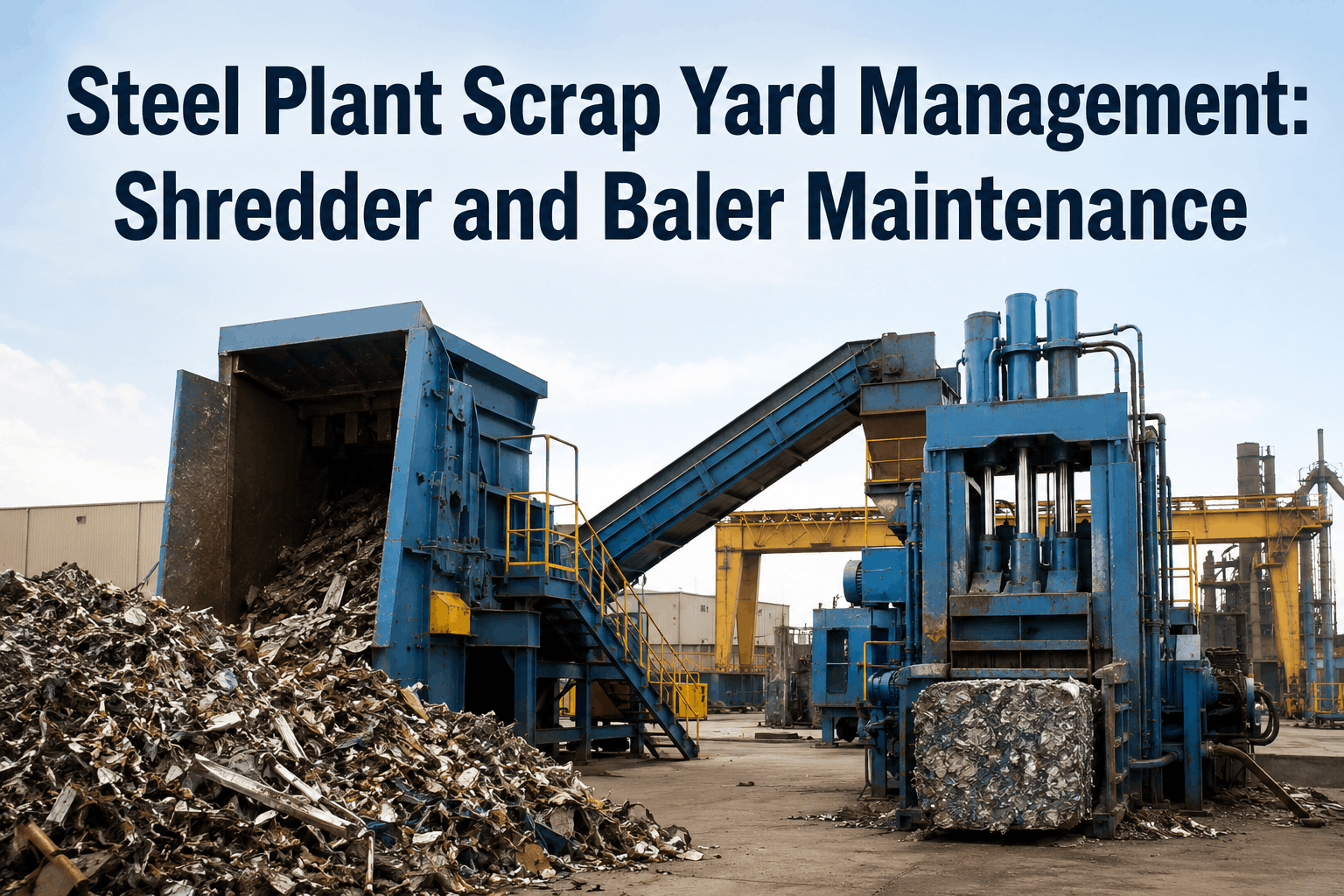
A mid-size steel recycling yard processing 80,000 tonnes of scrap per month was spending $1.2M annually on unplanned shredder downtime — hammer failures, rotor bearing seizures, and baler ram seal blowouts that stopped production with no warning. After deploying OxMaint's Predictive Maintenance AI module, the same yard cut unplanned downtime by 67% within six months, reduced hammer replacement cost by 38%, and recovered $780K in first-year savings. This case study documents exactly how that transformation happened and what any scrap processing operation can replicate.
Case Study · Steel Recycling · Predictive Maintenance AI
Steel Scrap Shredder and Baler Maintenance: From Reactive Chaos to Predictive Control
Rotor bearing failure, hammer wear, and baler hydraulic breakdown are the top three causes of scrap yard downtime. This case study shows how one recycling operation eliminated 67% of unplanned stoppages in 6 months using AI-driven predictive maintenance — and exactly what you can replicate.
67%
Reduction in unplanned downtime
38%
Lower hammer replacement cost
$780K
First-year documented savings
6 mo
Time to measurable outcome
The Problem
What Was Breaking — and Why No One Saw It Coming
Before OxMaint, this scrap yard ran on tribal knowledge and reactive callouts. Technicians knew from experience that shredder rotor bearings ran hot before failure — but that knowledge never became a measurement.
Hammer Wear — Invisible Until Failure
Shredder hammers were changed on a fixed 30-day schedule regardless of actual wear. Heavy material mix months exhausted hammers in 18 days; light months left usable hammers on the floor. Over- and under-replacement cost $420K/year.
Rotor Bearing Seizures — Zero Warning
Rotor bearings were monitored only during quarterly PM shutdowns. Three bearing seizures in 14 months caused an average of 38 hours of production loss each. No vibration trend. No temperature trending. No early warning.
Baler Ram Failures — Weekend Timing
Baler hydraulic ram seals failed unpredictably — most often during weekend high-volume runs when no specialist was on site. Average response time: 6 hours. Average repair time: 9 hours. Premium labor cost per event: $8,000–$14,000.
The OxMaint Deployment
How Predictive Maintenance AI Was Deployed Across the Yard
Week 1–2
Asset onboarding and sensor mapping
All shredder and baler assets registered in OxMaint. Existing vibration sensors on rotor bearings and hydraulic pressure transducers on baler rams connected via OPC-UA. Baseline readings captured for 14 days.
Week 3–4
AI model training on baseline data
OxMaint AI ingested 14 days of vibration, temperature, motor current, and hammer impact frequency data to establish normal operating envelopes for each asset. Alert thresholds set at 1.5 and 2.0 sigma deviation.
Month 2
First predictive alerts and validations
OxMaint flagged rotor bearing 3 with rising vibration trend 11 days before any temperature rise. Maintenance team inspected and found lubrication channel partially blocked. Cleared. No seizure. First validated prediction confirmed ROI potential.
Month 3–6
Hammer replacement optimized by wear scoring
OxMaint's AI built a hammer wear model from motor current draw, throughput rate, and material composition logs. Replacement is now triggered by wear score — not calendar. Average hammer life extended from 30 to 41 days. Replacement cost down 38%.
Results Data
Six-Month Outcome: Before vs After OxMaint
| Metric |
Before OxMaint |
After 6 Months |
Change |
| Unplanned downtime hours/month |
112 hrs |
37 hrs |
-67% |
| Rotor bearing seizures/year |
3 events |
0 events |
-100% |
| Hammer replacement cost/month |
$35,000 |
$21,700 |
-38% |
| Baler emergency callout cost/year |
$96,000 |
$22,000 |
-77% |
| PM compliance rate |
54% |
91% |
+37 pts |
| Mean time between failures (shredder) |
18 days |
49 days |
+172% |
| First-year documented savings |
— |
$780,000 |
New |
Predictive Maintenance AI · Scrap Yard Reliability
Your Shredder Is Already Telling You When It Will Fail. Are You Listening?
OxMaint reads vibration, temperature, motor current, and hydraulic pressure 24/7. When any asset deviates from its normal signature, a work order is created — before the failure, not after. Book a demo and see how fast AI can baseline your equipment.
Start Free Trial
Book a Demo
Expert Review
What Scrap Processing Engineers Say About Predictive Maintenance
"Shredder rotor bearings give you 10–14 days of vibration signal before they fail thermally. If you are not reading that signal continuously, you will always be surprised. Predictive systems that connect to existing sensors pay back in the first bearing event they prevent."
Senior Reliability Engineer
Scrap Processing Group, Western Europe
"Calendar-based hammer replacement is one of the most expensive habits in scrap processing. We ran a six-month study and found our actual optimal replacement window varied from 17 to 44 days depending on material mix. AI-driven scheduling closed that gap completely."
Plant Manager
Integrated Scrap and EAF Facility, Middle East
"The baler is always the asset nobody watches — until it fails on a Saturday night and costs you 15 hours of throughput. Hydraulic pressure monitoring with predictive alerts changed the culture in our yard. Operators started owning asset health instead of just calling maintenance."
Maintenance Operations Director
Multi-Site Recycling Operation, North America
Implementation Checklist
14-Step Checklist: Deploying Predictive Maintenance in a Scrap Yard
Foundation (Week 1–2)
1Inventory all shredder and baler assets with serial numbers and install dates
2Map existing sensors (vibration, temperature, pressure) to OxMaint asset IDs
3Define failure modes for each asset: rotor bearing, hammer, ram seal, drive motor
4Establish baseline data capture period (minimum 10–14 days normal operation)
5Set initial alert thresholds at 1.5 sigma from baseline mean
Operations (Month 1–3)
6Log material mix composition daily to train hammer wear model
7Validate first 3 predictive alerts with physical inspection and record results
8Refine alert thresholds based on false-positive rate from first month
9Connect hammer replacement work orders to AI wear score — not calendar
10Track MTBF before/after for each asset class monthly
Optimization (Month 4–6)
11Review prediction accuracy report — target 80%+ correct alerts
12Expand sensor coverage to secondary assets (conveyors, infeed shears)
13Calculate first-cycle ROI: prevented failures × average downtime cost
14Present KPI report to management with before/after MTBF and cost data
Frequently Asked
Scrap Shredder and Baler Maintenance Questions
How long does it take for predictive maintenance AI to deliver results in a scrap yard?
Most scrap yards see their first validated predictive alert within 3–6 weeks of sensor connection, once OxMaint has established baseline operating signatures. Significant operational impact — measured as a reduction in unplanned stoppages — typically appears in month 2 to 3 as the AI model accumulates enough data to distinguish normal variation from early failure signals. The case study documented in this page achieved a 67% downtime reduction within six months.
Book a demo to discuss your specific asset mix and timeline.
What sensors are needed to run predictive maintenance on a shredder rotor?
At minimum, shredder rotor predictive maintenance requires triaxial vibration sensors on both rotor bearing housings and a motor current monitoring module on the main drive. Temperature sensors add a secondary confirmation layer but are not sufficient on their own because thermal rise typically follows vibration anomaly by 7–12 days. OxMaint can work with sensors already installed, or the implementation team can recommend cost-effective sensor additions based on your asset risk profile.
Start a free trial and connect your existing sensors first.
Can OxMaint's AI predict when to replace shredder hammers based on material mix?
Yes. OxMaint's predictive maintenance AI builds a hammer wear model that correlates motor current draw, throughput rate, and material composition data (entered by the operator at the start of each campaign) to predict remaining hammer life with 80–90% accuracy after 60 days of training data. This replaces fixed-interval replacement schedules with dynamic, condition-based triggers that extend average hammer life by 20–40% depending on material mix variability.
See the hammer wear model in your free trial.
How does OxMaint handle baler hydraulic pressure monitoring and failure prediction?
OxMaint connects to baler hydraulic pressure transducers and monitors both peak pressure during compression cycles and pressure decay rate between cycles. Increasing decay rate indicates seal wear before it reaches failure. OxMaint generates a work order when decay rate trends outside the established normal range — typically 8–12 days before a seal blowout would occur. This gives maintenance teams time to schedule a planned seal replacement during a low-production window instead of responding to an emergency weekend callout.
Book a demo to see the baler monitoring dashboard.
Predictive Maintenance AI · Scrap Yard ROI
$780K Saved in Year One. What Could Your Yard Recover?
OxMaint's Predictive Maintenance AI connects to your existing shredder and baler sensors in days. In weeks, it is predicting failures before they happen. In months, your maintenance team is spending on planned work instead of emergency repairs. Start your free trial and find out your recovery potential.