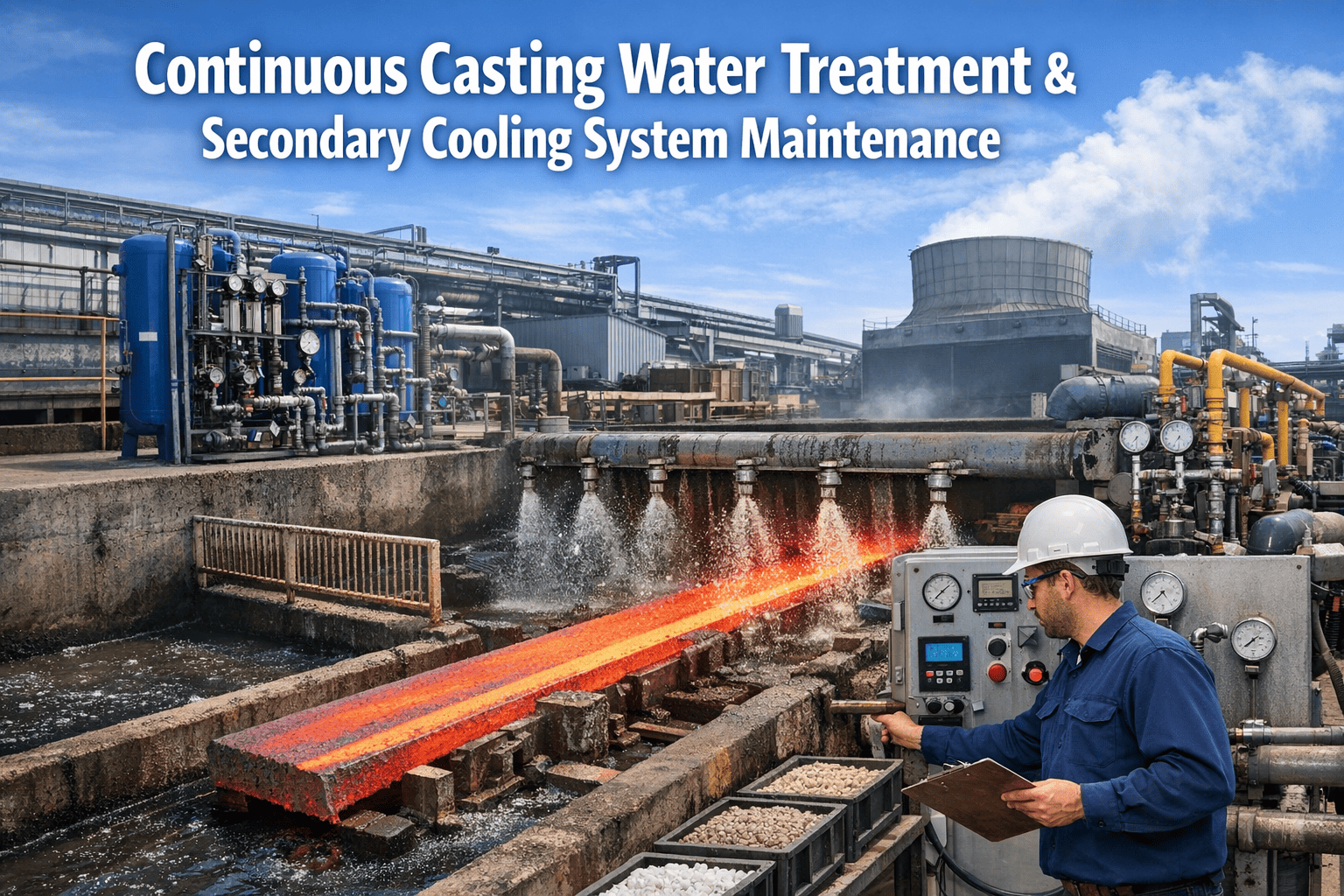
Secondary cooling in continuous casting does more than cool the strand — it controls the temperature gradient that determines whether the solidifying shell cracks, bulges, or segregates. When spray nozzles clog, water chemistry drifts, or scale pit capacity drops, the consequences appear in the product: surface cracks, internal segregation, and breakout risk that starts in the secondary cooling zone long before it shows up at the torch cut. Start managing your caster water systems with Oxmaint PM tracking.
Continuous Casting Water Treatment and Secondary Cooling System Maintenance
A complete maintenance guide for caster water treatment covering secondary cooling zones, spray nozzle inspection and cleaning, scale pit management, water chemistry control, filtration systems, and recirculation loop maintenance — with structured PM tracking using CMMS.
How Secondary Cooling Works and Why Maintenance Determines Cast Quality
The secondary cooling system in a continuous caster extends from the mould exit to the straightener — typically 12 to 25 metres of guided strand travel through multiple cooling zones, each with specific water flow rates, spray patterns, and heat extraction targets. The system operates under a closed-loop recirculation circuit: cooling water is sprayed onto the strand surface, drains through the strand guide frames, collects in the flume, passes through the scale pit for scale and oxide removal, is filtered, conditioned chemically, cooled in the cooling tower, and recirculated to the spray headers.
Every component in this loop has a maintenance requirement. When any component degrades, the consequence is not a visible equipment failure — it is a silent deterioration in heat extraction uniformity that translates directly into strand quality variation. Oxmaint water system PM tracking ensures every inspection task in this loop is scheduled, completed, and trended against the casting quality data.
Zones 1 and 2 have the highest nozzle maintenance priority — incomplete solidification at the mould exit means any cooling non-uniformity here causes shell quality defects that cannot be corrected downstream.
Spray Nozzle Inspection, Cleaning and Replacement Program
Spray nozzle clogging is the highest-frequency maintenance problem in secondary cooling systems. Scale, iron oxide particles, and biological fouling progressively restrict nozzle orifices, reducing flow rate and distorting spray patterns. A nozzle at 80% flow rate delivers the same header pressure reading but distributes water non-uniformly — creating hot bands on the strand that appear as surface cracks in finished product without any visible equipment alarm. Oxmaint tracks individual nozzle service intervals by zone and caster position, triggering inspection work orders at the configured interval regardless of header pressure readings.
A caster operating with 15% of Zone 1–2 nozzles at reduced flow has no visible alarm — header pressure may appear normal, recirculation pump is running, and flow meters show the expected total. The only way to detect the problem is individual nozzle flow testing during the maintenance interval. Plants that skip this testing in favour of header-level instrumentation monitoring are systematically producing quality defects they cannot trace to a maintenance cause. Oxmaint schedules individual nozzle tests by zone and logs per-nozzle flow test results against the caster position for trend analysis.
Secondary Cooling Water Chemistry: Parameters, Targets and Monitoring
Cooling water chemistry in the secondary cooling loop affects three outcomes simultaneously: nozzle clogging rate (hardness and scaling tendency), recirculation system corrosion rate (pH and inhibitor levels), and biological fouling growth rate (biocide residual and conductivity). Drift in any parameter accelerates one or more failure modes. Daily chemistry monitoring with a digital log that triggers alerts when parameters drift outside target range is the minimum standard for a well-managed caster water system. Configure water chemistry threshold alerts in Oxmaint so deviations are escalated to the water treatment technician within the shift, not at the weekly review meeting.
| Parameter | Target Range | Frequency | Below Target | Above Target | Priority |
|---|---|---|---|---|---|
| pH | 7.5 – 9.0 | Daily | Corrosion risk increases | Scale deposition accelerates | Critical |
| Conductivity | 500 – 1500 µS/cm | Daily | Low TDS, potential under-inhibition | High TDS — blowdown required | Critical |
| Total hardness | < 300 mg/L CaCO₃ | Daily | Scale risk low | Scale deposition in nozzles accelerates | Critical |
| Inhibitor concentration | Per supplier spec | Daily | Corrosion and fouling risk rises | Excess cost, potential foam | Critical |
| Chloride | < 200 mg/L | Weekly | – | Accelerated pitting corrosion risk | High |
| Suspended solids | < 50 mg/L | Weekly | – | Nozzle abrasion and clogging accelerates | High |
| Biocide residual | Per supplier spec | Weekly | Biological fouling risk | Potential foaming at tower | High |
| Iron content | < 5 mg/L | Weekly | – | Internal corrosion in recirculation system | High |
| Full lab analysis | All parameters | Monthly | Complete baseline — silica, alkalinity, hardness fractions, biological | Standard | |
Swipe right to see all columns on smaller screens
Scale Pit Maintenance: Collection, Dredging and Drainage
The scale pit is the primary solids separation point in the recirculation loop — receiving the full discharge from the strand guide flume, settling out iron oxide scale and casting powder residue, and returning clarified water to the recirculation system. When the scale pit is under-maintained, suspended solids carry over into the filtration system and return water to the spray nozzles — accelerating nozzle clogging and increasing filter maintenance frequency simultaneously. Scale pit maintenance is simple but must be systematic to be effective.
Sludge Level Monitoring
Measure accumulated sludge depth in the scale pit weekly using a graduated rod or ultrasonic level sensor. Trigger dredging when sludge depth reaches 40% of pit working depth — before sludge carryover into the outlet weir begins. Log measurement date, depth, and responsible operator for each reading in Oxmaint.
Dredging and Sludge Removal
Dredge accumulated sludge from the pit using crane grab, submersible pump, or vacuum tanker depending on site configuration. Record total volume removed per dredging event — increasing volume per event at the same interval indicates an upstream scale generation increase requiring process investigation.
Weir and Baffle Inspection
Inspect overflow weir height, baffle plate condition, and outlet screen condition at every dredging event. Scale accumulation on weir edges or baffle damage bypasses the settling zone — allowing unsettled water with high suspended solids directly to the recirculation outlet. Clean weir faces and record baffle condition against the asset record.
Pit Wall and Floor Inspection
Annual inspection of the pit structural lining for cracking, chemical attack from acidic scale, and inlet channel erosion. Groundwater infiltration through pit wall cracks dilutes the recirculation water and can introduce contaminants. Document any structural defects with photographs and raise a corrective work order in Oxmaint with the assigned repair timeline.
Filtration System and Recirculation Loop Maintenance
The filtration and recirculation system maintains water quality between scale pit and spray headers. Filter media condition, pump health, and heat exchanger or cooling tower performance all determine whether cooled, clean water reaches the spray nozzles at the correct pressure, temperature, and suspended solids level. Degradation in any of these systems compounds: a filter running at 50% capacity increases the suspended solids load reaching the nozzles by a factor that accelerates clogging rates exponentially. Oxmaint tracks all filtration and pump PM tasks on automated schedules with threshold alerting for differential pressure and flow rate deviations.
Secondary Cooling Water System — Inspection Frequency Reference
All maintenance tasks mapped by system, frequency, and responsible role. Deploy these as automated PM work orders in Oxmaint so tasks are created and assigned on schedule without manual coordination.
| System | Task | Frequency | Responsible | Criticality |
|---|---|---|---|---|
| NZL — Nozzle | Zone 1–2 individual nozzle flow test | Every 3 months | Maintenance Tech | Critical |
| NZL — Nozzle | Zone 3–6 individual nozzle flow test | Every 6 months | Maintenance Tech | Critical |
| CHM — Chemistry | pH, conductivity, hardness, inhibitor | Daily | Water Treatment Tech | Critical |
| CHM — Chemistry | Chloride, suspended solids, biocide, iron | Weekly | Water Treatment Tech | High |
| CHM — Chemistry | Full laboratory analysis | Monthly | External Lab | High |
| SPT — Scale Pit | Sludge depth measurement | Weekly | Operator | High |
| SPT — Scale Pit | Dredging and sludge removal | Condition-triggered | Maintenance Team | High |
| FLT — Filter | Differential pressure logging | Daily | Water Treatment Tech | Critical |
| PMP — Pump | Discharge pressure and flow monitoring | Daily | Operator | Critical |
| PMP — Pump | Vibration measurement at bearings | Monthly | Maintenance Tech | High |
| CTW — Cooling Tower | Outlet temperature vs ambient monitoring | Daily | Operator | High |
| CTW — Cooling Tower | Fill and drift eliminator inspection | Monthly | Maintenance Tech | Standard |
Swipe right to see all columns on smaller screens
How CMMS Manages Caster Water System Maintenance
Caster water systems generate daily data from multiple measurement points across chemistry, pressure, flow, and temperature. Without a system that captures, stores, and trends this data automatically, the information is used once for the daily log and discarded — patterns that would predict nozzle clogging, pump degradation, or scale pit overflow become invisible. Oxmaint turns daily water system readings into trend intelligence that drives maintenance decisions before equipment condition deteriorates to the point of quality impact.
Chemistry Threshold Alerts
Configure alert limits for every chemistry parameter — pH, conductivity, hardness, inhibitor, chloride, iron. When a daily reading breaches the threshold, an escalation work order routes to the water treatment technician within the shift, not the next day's review meeting.
Nozzle Service Life Tracking
Every nozzle position in every cooling zone is tracked as an individual asset with a configurable service interval. Work orders for nozzle inspection are auto-created at the zone-specific interval — Zones 1–2 at 3 months, other zones at 6 months — without manual scheduler intervention.
Scale Pit Level Trending
Weekly sludge depth readings logged in Oxmaint build a deposition rate trend per casting campaign. Rising trend rates indicate increased scale generation upstream — a signal for process review before the pit capacity is overwhelmed. Dredging is triggered automatically at the configured depth threshold.
Pump and Filter PM Scheduling
Recirculation pumps and filter systems are tracked as assets with automated PM schedules — daily pressure logging, monthly vibration measurement, annual overhaul. Rising differential pressure trends on filters and rising vibration trends on pumps trigger proactive inspection before equipment fails in service.
Mobile Field Data Entry
Water treatment technicians and maintenance crews log readings on smartphone or tablet during rounds — no paper forms, no retrospective data entry. Numeric fields with threshold validation flag deviations in the field before the technician leaves the area. Offline capability for network-limited zones on the casting floor.
Quality Correlation Records
Water system inspection records are timestamped and linked to the casting schedule so quality events — surface cracks, internal segregation flags from quality inspection — can be correlated with the maintenance state of the water system at the time of production. This closes the loop between maintenance and quality in a way paper logs cannot.
Manage Your Caster Water System with the Same Discipline as Your Strand Guide
Secondary cooling quality determines strand quality. Spray nozzle clogging, water chemistry drift, and scale pit neglect each silently degrade the heat extraction uniformity that controls whether your product meets specification. Oxmaint gives your water treatment and maintenance teams the structured PM program and digital records to keep the system performing at design specification throughout the casting campaign.
Caster Water Treatment Maintenance: Frequently Asked Questions
How often should secondary cooling spray nozzles be inspected and cleaned?
The industry standard for Zone 1 and Zone 2 (foot rolls and upper bending) is individual nozzle flow testing every 3 months — these zones have the highest impact on strand quality and the least tolerance for flow deviation. Zones 3 through 6 should be tested every 6 months as a minimum. In operations casting high-scale-generating grades or with elevated suspended solids in the recirculation water, intervals should be shortened based on observed clogging rates. Oxmaint tracks individual nozzle service intervals by zone and generates inspection work orders automatically at the configured frequency.
What are the most important water chemistry parameters to monitor daily?
The four daily non-negotiables are pH (target 7.5–9.0), conductivity (tracks TDS and guides blowdown frequency), total hardness (scale potential indicator), and inhibitor concentration (corrosion and fouling protection level). These four parameters together cover the primary failure modes of scale deposition, corrosion, and fouling. Chloride, suspended solids, biocide residual, and iron should be tested weekly and supplemented with a full laboratory analysis monthly. Book a demo to see how Oxmaint alerts on chemistry deviations within the shift.
What causes spray nozzle clogging and how can it be reduced without shortening cleaning intervals?
The primary causes are suspended solids carryover from the scale pit and filtration system, calcium carbonate scale deposition from high-hardness water, iron oxide deposition from elevated dissolved iron, and biological fouling from inadequate biocide dosing. Addressing the root cause — tightening scale pit dredging frequency, improving filtration performance, controlling water hardness through blowdown management, and maintaining biocide residual — will extend nozzle service life beyond what cleaning interval management alone can achieve.
How frequently should the scale pit be dredged?
Dredging frequency should be condition-triggered rather than calendar-based — dredge when sludge depth reaches 40% of the pit working depth. In practice, a standard slab caster casting mixed grade programmes typically requires dredging every 4–8 weeks. High-carbon and peritectic grade campaigns generate significantly more scale and may require dredging every 2–3 weeks. Logging the sludge depth weekly in Oxmaint builds a campaign-specific deposition rate that enables scheduling the next dredging event before overflow risk develops.
Can recirculation pump degradation affect spray nozzle performance even if the nozzles are clean?
Yes. Pump impeller wear that reduces head by 10–15% from design will decrease zone supply pressure below the minimum required for correct nozzle spray pattern formation. A nozzle that passes individual flow testing at the test bench but operates below its rated supply pressure on the caster will produce a degraded spray pattern with reduced coverage angle — effectively replicating the quality impact of a partially clogged nozzle. Monthly pump vibration measurement and annual performance curve verification catch this degradation before it affects spray performance.
How quickly can a caster team deploy Oxmaint for water system PM tracking?
Most continuous casting water system maintenance programs are running digital inspection rounds in Oxmaint within 2–3 days of account setup. Asset registers for nozzle positions by zone, chemistry sampling points, filtration systems, pumps, and scale pit are configured from your existing equipment list. Chemistry parameter alert thresholds are set from your water treatment specification. No IT integration is required — the system runs on smartphones your maintenance and water treatment teams already carry. Sign up free and deploy your first water system inspection today.