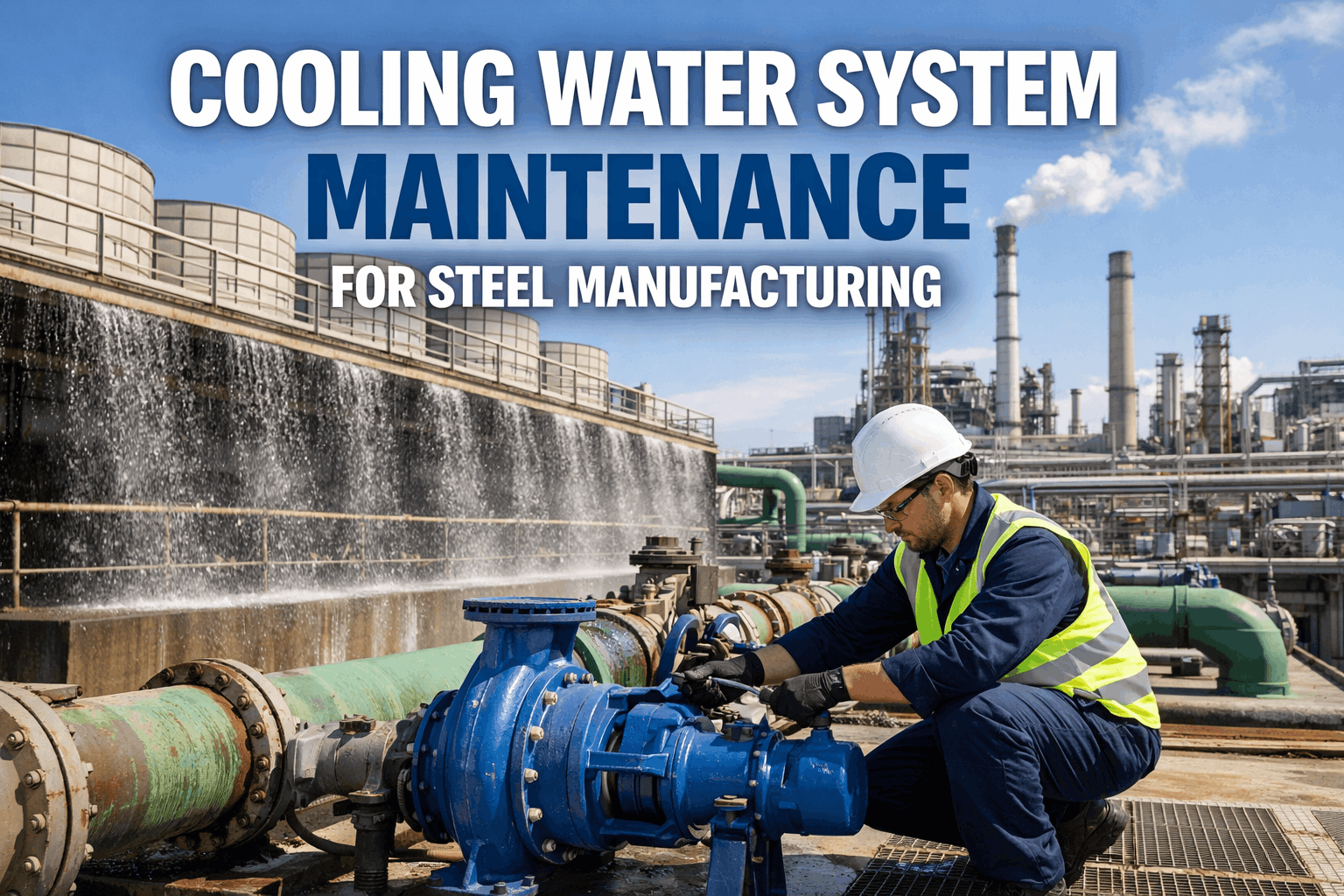
Steel manufacturing is one of the most water-intensive industrial processes on earth—and cooling water is the lifeblood that makes continuous high-temperature production possible. Blast furnaces, electric arc furnaces, continuous casters, rolling mills, and compressor systems all depend on reliable cooling water delivery to operate within safe thermal limits. When cooling water systems fail—whether through pump breakdown, heat exchanger fouling, cooling tower chemistry excursion, or pipe corrosion—the consequences cascade instantly into production. A failed cooling circuit on a continuous caster can force an emergency cast termination. A cooling tower shutdown in summer forces furnace load reduction or complete stoppage. Yet across the industry, cooling water infrastructure is systematically undermaintained—treated as background utility rather than the production-critical asset it actually is. Schedule a free cooling water maintenance assessment with our team and discover exactly where your facility's cooling systems are carrying unmanaged risk that hasn't surfaced as an incident yet.
The Production Cost of Cooling System Failures
The financial exposure from cooling water system failures in a steel plant is rarely appreciated until a major event quantifies it. Unlike a failed sensor or a worn bearing, cooling system failures have a direct and immediate production consequence—and in many cases, the damage extends beyond the cooling system itself into the process equipment it was meant to protect.
Fatal
Risk category when cooling water contacts molten steel — steam explosions are among the most violent failure modes in steelmaking. Any water circuit adjacent to molten metal must be maintained to zero-leak standard.
$2,400/hr
Typical cost per hour of forced production stoppage on a 150-tonne EAF operation when cooling circuit failure forces furnace shutdown. Heat loss, electrode damage, and restart costs compound the direct production loss.
$500K+
Replacement cost of EAF water-cooled panels when inadequate flow or chemistry causes burnthrough. Panel failures from cooling system neglect are among the most expensive single maintenance events in electric steelmaking.
$420K avg
Average regulatory fine for an uncontrolled cooling water discharge event containing suspended solids, oil, or heavy metals above permit thresholds — before legal costs and environmental remediation obligations.
Cooling Water Circuit Types in Steel Plants
A modern integrated steel plant operates multiple distinct cooling water circuits, each serving different process equipment with different temperature requirements, water quality specifications, contamination risks, and failure consequences. Understanding the differences between these circuits is fundamental to designing a maintenance programme that matches control intensity to actual risk.
Closed-loop circuits delivering demineralised water to water-cooled panels, electrode arms, delta frames, and roof sections of electric arc furnaces and oxygen converters. Water contacts steel structures directly adjacent to arcing temperatures exceeding 3,500°C. Flow loss for even seconds risks panel burnthrough and the catastrophic water-to-melt contact that produces steam explosions. Every pump, valve, flow sensor, and temperature probe in this circuit must be treated as safety-critical.
Key Parameters
Flow: continuous alarm monitoring
Temp differential: <20°C max
Pressure: maintained above minimum
Quality: demineralised, conductivity monitored
Critical Maintenance Items
Pump redundancy verification daily
Flow meter calibration monthly
Panel inspection each campaign
Emergency valve function test weekly
High-pressure spray cooling circuits delivering water to the secondary cooling zone of continuous casting machines. Water contacts the solidifying steel strand surface directly, requiring precise flow control at each spray zone to achieve uniform strand cooling and prevent surface cracks, internal segregation, and in the most severe cases, breakout. Nozzle blockage from scale, particulates, or corrosion products is the dominant failure mode — with consequences ranging from surface quality defects to furnace-level incidents.
Key Parameters
Nozzle flow rate verification per campaign
Water pressure at each cooling zone
Turbidity: below 50 NTU
Temperature: ambient to 35°C max
Critical Maintenance Items
Nozzle replacement on tonnage trigger
Strainer backwash daily
Drum filter condition weekly
Pump seal inspection monthly
Open-circuit evaporative cooling towers serving hydraulic power units, compressors, gas cooling systems, and electrical equipment throughout the plant. Operating in warm environments with high mineral concentration from evaporative loss, these systems are simultaneously vulnerable to scale formation, corrosion, biological fouling, and Legionella proliferation. Chemistry management, basin maintenance, and fill pack condition are interlinked maintenance disciplines that must be executed with documented regularity to maintain both operational performance and public health compliance.
Key Parameters
pH: 7.0–8.5 daily
Conductivity: per cycles of concentration
Biocide residual: per programme
Legionella culture: quarterly minimum
Critical Maintenance Items
Daily chemistry monitoring
Basin inspection and cleaning quarterly
Fill pack inspection annually
Drift eliminator condition biannually
High-pressure descaling circuits operating at pressures exceeding 200 bar to remove surface scale from hot-rolled steel before and between rolling passes. Scale pit systems settle and recover the iron oxide fines that descaling generates. Descaling pump wear, nozzle erosion, and scale pit accumulation are the dominant maintenance drivers — with worn nozzles delivering incorrect spray patterns that leave scale on the steel surface, causing surface defects and accelerated roll damage. Scale pit pump wear rates are among the highest in the facility.
Key Parameters
Descaling pressure: 180–220 bar
Nozzle spray pattern verification
Scale pit level: continuous monitoring
Pump discharge pressure trending
Critical Maintenance Items
Nozzle replacement: tonnage-triggered
Scale pit pump impeller inspection monthly
Header pressure drop monitoring daily
Sump level and pump run-time daily
Scrubber water from blast furnace gas cleaning carries coke dust, zinc compounds, alkaline particulates, cyanide traces, and dissolved ammonia at elevated temperatures. Slag quench water carries thermal load and suspended particulates from rapid slag solidification. Both circuits generate contaminated water that requires treatment before recycling or discharge. Equipment handling these streams corrodes and scales aggressively — and any uncontrolled discharge is an immediate regulatory compliance incident with significant financial and legal consequences.
Key Parameters
pH: daily sampling
Suspended solids: daily
Cyanide and zinc: weekly
Effluent quality before discharge
Critical Maintenance Items
Venturi scrubber nozzle weekly inspection
Thickener rake torque monitoring
Effluent analyser calibration monthly
Sludge pump impeller wear monthly
CMMS for Cooling Systems
Connect every cooling circuit PM schedule, chemistry log, and compliance record in Oxmaint — so nothing is missed, nothing is late, and nothing is undocumented.
From EAF panel flow alarms to cooling tower Legionella records — one platform, complete visibility across all circuits, automatically generating the work orders and compliance documentation your team needs.
Predictive Maintenance for Cooling Water Equipment
Cooling water systems generate rich operational data — flow rates, pressures, temperatures, chemical parameters, and pump performance metrics — that provide early warning of developing failures long before they become production-affecting events. The challenge is building the monitoring infrastructure and CMMS integration to convert that data into timely maintenance actions rather than letting it pass unobserved through a historian until an incident forces a retrospective analysis.
Vibration signature analysis, bearing temperature trending, and motor current draw monitoring detect impeller wear, cavitation onset, bearing degradation, and mechanical seal deterioration in cooling water pumps. Given the abrasive and corrosive nature of most steel plant cooling streams — particularly scale pit and scrubber water — pump wear rates are high and early detection enables scheduled replacement during planned maintenance windows rather than emergency breakdown response.
Monitor
Vibration RMSBearing tempMotor ampsDischarge pressure
Continuous monitoring of temperature differential and pressure drop across shell-and-tube and plate heat exchangers detects fouling accumulation before it degrades heat transfer performance to the point of process impact. Rising differential pressure at constant flow rate is the earliest indicator of scale or biological fouling building on heat transfer surfaces. Automated alerts at defined fouling factor thresholds trigger planned cleaning interventions before any production consequence materialises.
Monitor
ΔT inlet/outletΔP across bundleFouling factor calc
Trending of pH, conductivity, turbidity, suspended solids, and specific contaminant concentrations across each cooling circuit reveals scale index trajectory, corrosion potential, and biological growth risk before these conditions cause equipment damage. Automated dosing systems with feedback control maintain chemistry within specification continuously, generating the compliance records required for environmental audits and Legionella risk management documentation.
Monitor
pHConductivityTurbidityLSI index
Continuous monitoring of cooling water flow and temperature differential across every water-cooled panel in the EAF is a safety-critical maintenance function — not an optional enhancement. Flow reduction below minimum threshold or temperature differential exceeding the design limit indicates a developing panel condition requiring immediate investigation. Instrument calibration compliance and redundant measurement on critical circuits are the maintenance programme elements that ensure this monitoring never provides false assurance.
Monitor
Panel flow rateΔT per panelOutlet tempPressure drop
For blast furnace scrubber and scale pit water circuits, thickener rake torque monitoring and underflow density trending detect sludge compaction and mechanical bearing degradation before the more severe failure — rake arm collapse — occurs. Clarifier overflow turbidity trending alerts to floc formation problems indicating dosing issues or upstream chemistry changes before they propagate to effluent discharge quality problems with regulatory consequences.
Monitor
Rake torqueUnderflow densityOverflow turbidity
Online analysers at final discharge points monitoring pH, suspended solids, oil content, and key contaminants provide the last line of defence before a consent exceedance reaches the receiving watercourse. Analyser calibration schedule compliance and verification against grab sample analysis are maintenance-critical functions — an out-of-calibration instrument at the discharge point eliminates the plant's early warning system entirely while giving false confidence about compliance status.
Monitor
pHSuspended solidsOil contentCOD
Automated Monitoring Integration
When a chemistry threshold is breached or a pump vibration exceeds its alarm limit, Oxmaint generates the work order automatically — before the failure happens.
Connect your cooling system instrumentation to Oxmaint AI and replace reactive breakdown maintenance with condition-based intervention triggered by the data your plant is already generating.
63%
Of cooling system failures are preceded by detectable warning signals that proper monitoring would have caught
40%
Reduction in cooling-related unplanned downtime with digital PM and chemistry tracking in place
98%
Effluent compliance rate achievable with properly managed automated monitoring and chemistry control
Maintenance Programme Structure by Circuit Priority
An effective cooling water maintenance programme in a steel plant is not a uniform schedule applied across all circuits — it is a risk-stratified programme that applies monitoring intensity and maintenance frequency proportional to the production, safety, and environmental consequence of each circuit's failure. This table provides the baseline structure that should be customised to each facility's specific equipment and operating conditions.
Flow and ΔT alarms verified; pump status; standby pump test
Emergency valve function test; flow meter calibration check
Full instrument calibration; standby pump run; circuit integrity check
Panel visual inspection; full system pressure test; pump overhaul
Caster Spray CoolingProduction
Strainer backwash; pressure at zones; drum filter status
Nozzle spot check; pump discharge pressure log
Pump seal condition; water quality analysis
Full nozzle flow verification; heat exchanger inspection; system flush
Cooling TowersLegionella Risk
pH, conductivity, biocide residual; dosing pump output
Visual inspection; microbiological dip slide; blowdown check
Full chemistry analysis; corrosion coupon check; fill pack visual
Basin clean; Legionella culture; fill pack inspection; risk assessment review
Descaling CircuitsProduction
System pressure; scale pit level; pump run status
Nozzle pattern check on sample set; pump discharge trending
Scale pit pump impeller wear; header pressure drop analysis
Full nozzle replacement programme; pump overhaul; pipe inspection
BF Scrubber WaterEnvironmental
pH; suspended solids; effluent quality; thickener rake torque
Scrubber nozzle visual; sludge pump condition; decanter check
Full effluent analysis; pump impeller wear; clarifier overflow turbidity
Thickener full inspection; effluent system audit; analyser calibration
Common Cooling Water Maintenance Failures in Steel Plants
These failures repeat across steel facilities worldwide. Each is a systemic gap in maintenance programme design or execution — not a random event — and each is preventable with the structured monitoring approach and digital management tools available today.
EAF Panel Flow Monitoring Instruments Left Out of Calibration
Flow and temperature differential instruments on EAF water-cooled panel circuits are safety-critical devices. An out-of-calibration flow meter that reads acceptable flow when actual flow is below minimum gives operators false confidence that panels are protected when they are not. Strict calibration schedules with documented results verified against independent measurement must be treated as non-negotiable — not deferred when production pressures compete for maintenance time.
No Legionella Risk Management Programme for Cooling Towers
Operating cooling towers without a documented, regularly reviewed Legionella risk assessment and control scheme is both a regulatory breach and a serious public health risk. In many jurisdictions it is a criminal offence. A steel plant's cooling towers serve as potential sources of aerosol exposure for both plant workers and surrounding communities. This failure mode is entirely preventable and results in both criminal liability and significant regulatory enforcement action when an incident occurs.
Caster Nozzle Replacement Deferred Beyond Safe Interval
Production pressure is the most common justification for delaying caster spray nozzle replacement programmes — the caster is running and nozzle replacement requires a maintenance stop. Progressive cooling non-uniformity from worn nozzles degrades product quality before it reaches breakout risk, meaning the first visible production consequence appears after the safety window may already have been exceeded. Nozzle replacement must be triggered on a tonnage-based criterion, not deferred until a quality complaint drives action.
Chemical Dosing System Failures Undetected for Extended Periods
When a chemical dosing pump fails or chemical supply runs out, the water chemistry that depends on it drifts out of specification silently — often for days — before a sampling event detects the excursion. Scale, corrosion, and biological fouling can all advance significantly in the interval between the dosing failure and its detection. Dosing pump output verification must be a daily task, not a monthly maintenance event, to catch failures before they produce measurable chemistry excursions.
Cooling Water Assets Absent from CMMS Asset Register
Cooling water pumps, heat exchangers, dosing systems, cooling towers, and online analysers are frequently maintained informally or managed by a water treatment contractor with no integration into the main CMMS. This creates complete management invisibility — no PM schedules, no work order history, no failure pattern data, and no compliance documentation trail for regulators. These assets must be in the CMMS as first-class maintained assets, not managed on contractor spreadsheets that operations management cannot interrogate.
No Emergency Diversion Capability for Treatment Upsets
A cooling water treatment plant with no emergency holding or diversion capacity has only two options when treatment performance drops below discharge standards — continue discharging non-compliant water or stop the process that generates the water flow. Neither option is acceptable. Emergency retention capacity, diversion to holding ponds, and clear emergency response procedures for treatment plant upsets must be designed into the facility and regularly tested as part of the maintenance programme.
Cooling Water KPIs for Steel Plant Maintenance Managers
Measuring cooling water system performance with quantitative metrics transforms maintenance management from reactive incident response into proactive risk reduction. These indicators give maintenance managers and operations leadership the data they need to identify deteriorating circuits before they trigger production disruptions, environmental incidents, or safety events.
100%
EAF Panel Flow Instrument Calibration Compliance
Non-negotiable target. Any lapse in calibration compliance for safety-critical cooling instruments must trigger immediate escalation — not acceptance as a routine maintenance shortfall. This is the single most important cooling water KPI in an EAF steelmaking operation.
98%+
Effluent Consent Compliance Rate
% of discharge samples meeting all permit parameter limits. Any exceedance must trigger immediate plant investigation.
Above 95%
Cooling Tower Chemistry Compliance
% of daily chemistry readings within specification for all parameters including biocide residual and pH range.
Above 98%
Caster Nozzle Availability Rate
% of installed caster spray nozzles meeting design flow at each check. Below 95% triggers urgent intervention.
Trending up
Pump MTBF by Circuit
Average operating hours between unplanned pump failures per circuit type. Declining MTBF signals accelerating wear or chemistry damage.
Below design
Heat Exchanger Fouling Factor
Calculated fouling resistance based on ΔT and flow vs clean baseline. Rising factor indicates cleaning intervention required.
Zero
Legionella Culture Positive Results
Any positive Legionella result triggers immediate corrective action protocol regardless of count level.
Frequently Asked Questions
01
What is the most critical cooling water circuit in a steel plant from a maintenance perspective?
The EAF water-cooled panel circuit is universally the most critical cooling water system in an electric arc furnace steel plant from both a safety and maintenance perspective. The consequences of panel circuit failure are immediate and potentially fatal — water contacting the arc environment or molten steel creates explosive steam events. Unlike other cooling circuit failures that produce gradual production impacts, panel circuit failures are high-speed, high-consequence events that may leave no time for operator response. Maintenance of this circuit must prioritise instrument reliability, pump redundancy, and emergency response capability over any other consideration. In blast furnace steelmaking, the equivalent critical circuit is the tuyere and blast furnace shell cooling circuit, which operates under similar failure consequence conditions.
02
How frequently should cooling tower water chemistry be tested in a steel plant?
Steel plant cooling towers should be monitored daily for pH, conductivity, total dissolved solids, and biocide residual. Due to high evaporation rates, variable process heat loads, and the risk of contamination from process upsets, daily monitoring is the minimum justified by the operational and health risk profile. Weekly analysis should include hardness, alkalinity, corrosion inhibitor concentration, and microbiological dip slide testing. Monthly comprehensive analysis covering all Legionella risk indicators, corrosion coupon assessment, and deposit analysis should be conducted by a specialist water treatment chemist. Legionella culture frequency depends on risk assessment outcome but should be at minimum quarterly, and more frequently during summer months, after system shutdowns, or following process changes that affect water temperature. All results must be documented with dated records and deviation actions recorded in the CMMS — paper chemistry logs that are not integrated with the maintenance management system create compliance documentation that fails under regulatory audit scrutiny.
03
How does a CMMS improve cooling water maintenance management in a steel plant?
A CMMS delivers three specific improvements to cooling water maintenance that paper and spreadsheet systems cannot provide. First, it makes cooling water assets visible in the same maintenance framework as production assets — with PM schedules, work order histories, and failure records that give management the same insight into cooling system health as they have into furnace and rolling mill condition. Second, it enables condition-based maintenance triggers — connecting instrument readings for chemistry, flow, pressure, and temperature to automatic work order generation when parameters breach defined thresholds, ensuring treatment responses happen within hours of a chemistry deviation rather than days. Third, it provides the compliance documentation infrastructure that regulators require — timestamped chemistry records, maintenance action logs, calibration certificates, and Legionella monitoring records that can be generated in minutes for regulatory audit rather than assembled manually over days from paper files.
04
What spare parts should a steel plant hold for cooling water systems?
Critical cooling water spare parts should be prioritised based on failure consequence and supplier lead time. For the EAF panel circuit — the highest consequence circuit — complete spare pump assemblies for each pump model must be held on-site; no lead time is acceptable for this circuit. For caster spray cooling, nozzle kits for every installed nozzle type and size should be held in sufficient quantity to support a complete campaign replacement without waiting for procurement. For cooling towers, dosing pump diaphragm and valve ball kits for every dosing pump model are essential given the frequency of dosing pump failures and the immediate chemistry impact of a dosing system outage. For heat exchangers, gasket sets for every plate heat exchanger size in the facility and tube plugs for shell-and-tube units prevent multi-day downtime from seal failures. Chemical treatment stocks — inhibitors, biocides, and pH adjustment chemicals — must be maintained at a minimum 30-day buffer to prevent chemistry excursions during supply delays.
Start Managing Properly
Every Cooling Circuit in Your Steel Plant Is a Production Asset. Maintain It Like One.
Oxmaint gives your maintenance and environmental teams a unified platform to track every pump, every chemistry record, every compliance log, and every PM task across all your cooling water circuits — with digital workflows, automated condition alerts, and the audit-ready documentation trail that regulatory compliance and public accountability require.
EAF Panel Circuits
Safety-critical monitoring · Instrument calibration tracking · Redundancy verification
Caster Spray Cooling
Tonnage-triggered nozzle PM · Strainer management · Quality alert thresholds
Cooling Towers
Daily chemistry records · Legionella programme management · Dosing system tracking
Effluent Treatment
Analyser calibration records · Discharge compliance log · Emergency diversion protocols
Descaling & Scale Pit
Pump wear trending · Nozzle replacement programme · Pressure monitoring