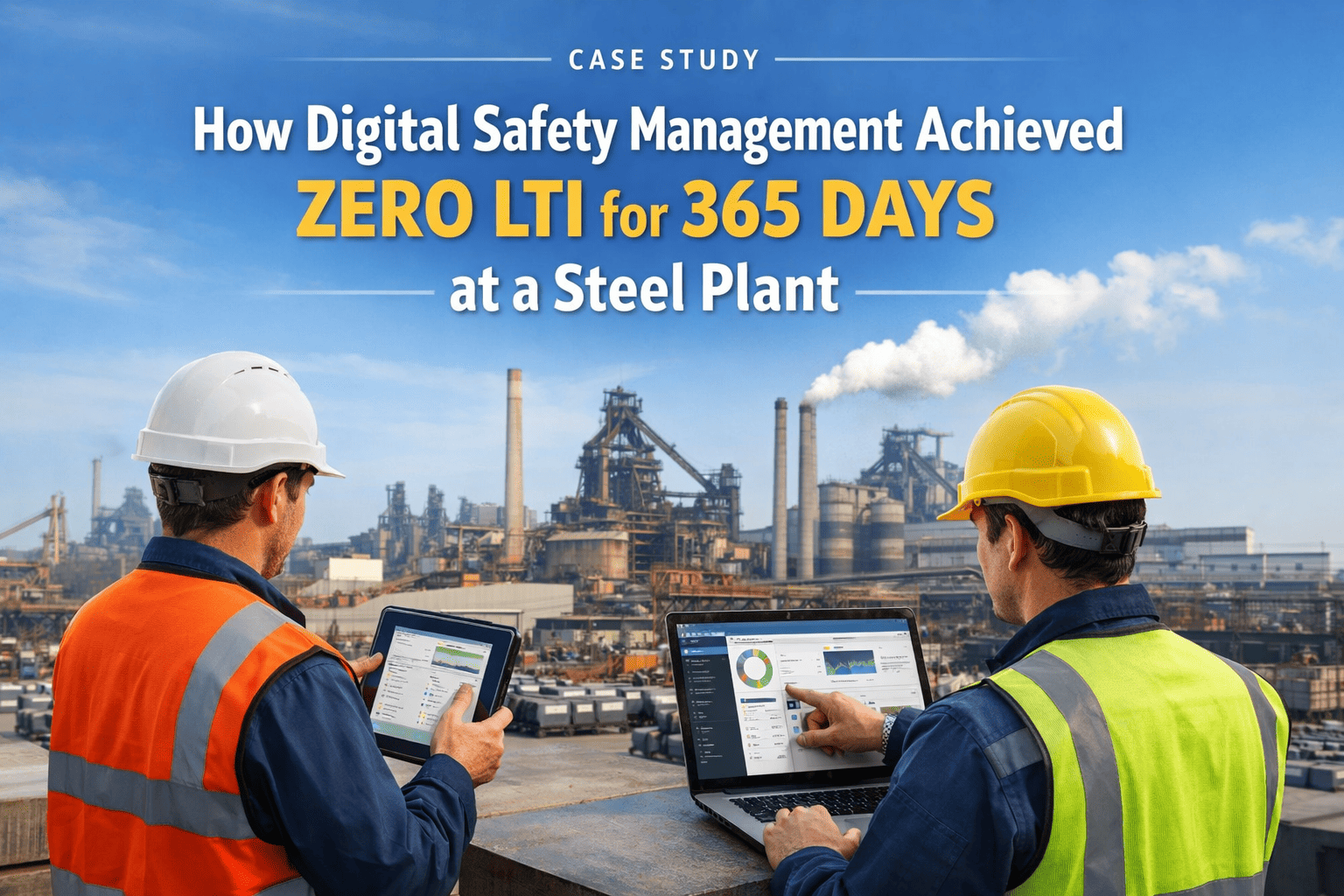
How Digital Safety Management Achieved Zero LTI for 365 Days at a Steel Plant

By James smith on April 8, 2026

digital-safety-management-zero-lti-steel-plant

A mid-size integrated steel plant with 1,200 workers and three operating shifts faced a safety crisis that many heavy industry facilities know well — paper permits scattered across departments, near misses going unlogged, and an LTIFR sitting at 2.4 per million hours worked, well above the global steel industry average of 0.76. Within 12 months of deploying OxMaint's digital safety management and permit-to-work system, the plant achieved zero Lost Time Incidents for 365 consecutive days — a milestone that reshaped its entire safety culture and compliance posture. This case study walks through exactly what changed, what the numbers looked like before and after, and how digital safety management drove that transformation.

Case Study · Steel Industry · Safety Management · 2024 Data
How Digital Safety Management Achieved Zero LTI for 365 Days at a Steel Plant
From LTIFR 2.4 to zero lost time incidents in 12 months. Here is how one steel plant eliminated paper permits, built a proactive hazard culture, and documented every near miss — before it became an accident.
365
Days of Zero Lost Time Incidents
2.4 → 0
LTIFR Reduction (per million hours)
340%
Increase in Near Miss Reporting
91%
Permit Compliance Rate Achieved
What the Plant Looked Like Before OxMaint

Paper-based safety systems create invisible failure points. Permits get signed without verification. Near misses go unreported because filing a paper form feels like extra work. Hazard inspections happen on schedule rather than when conditions actually change. The plant's situation in 2023 was not unusual for the steel industry — it was the industry average.

Before OxMaint
Paper permits issued without real-time hazard checks
Near miss reporting rate below 12% of actual incidents
No digital audit trail for high-risk work authorizations
Safety inspections completed on calendar, not on condition
Contractor competency checks done manually per shift
LTIFR of 2.4 — more than 3x the global steel industry benchmark
After 12 Months with OxMaint
Digital permits with mandatory hazard verification before approval
Near miss reports up 340% — hazards caught before incidents
Full audit trail on every permit, inspection, and corrective action
Condition-triggered safety inspections on critical equipment
Automated contractor certification validation at permit issuance
LTIFR of 0 — 365 consecutive days without a lost time incident
Steel Plant Safety by the Numbers

Understanding this plant's transformation requires context. The global steel industry has made meaningful progress on safety over two decades, but incidents remain a serious and costly reality. The data from World Steel Association's 2025 report reveals the scale of the challenge — and the opportunity.

Safety Metric Global Steel Average (2024) This Plant Before This Plant After OxMaint
LTIFR (per million hours) 0.76 2.4 0.00
Near Miss Reporting Rate ~25% of incidents Below 12% Above 52%
Permit Compliance Rate ~60–70% industry avg ~54% 91%
Safety Inspection Closure Rate ~65% 48% 88%
Contractor Incident Rate Higher than employees 2.1× employee rate 0.3× employee rate
Source: World Steel Association Safety and Health Data Report 2025. Plant data compiled from OxMaint system logs and client-reported KPIs over a 12-month deployment period.
How the Transformation Happened — Quarter by Quarter

Safety culture does not change overnight. The plant's path to zero LTI was structured in four deliberate phases, each building on the previous. What follows is the real implementation timeline, with measurable outputs at each stage.

Q1
Digital Foundation — Permits and Hazard Registry
The plant moved all permit-to-work processes onto OxMaint. Hot work, confined space entry, electrical isolation, and work at height permits were digitized with mandatory pre-task checklists. A site-wide hazard register was built from historical paper records and supplemented with initial mobile inspections. Every permit now required supervisor digital sign-off with timestamped location data.
Result: Permit compliance jumped from 54% to 74% in 8 weeks
Q2
Near Miss Program Launch and Contractor Integration
The plant launched a mobile near miss reporting program through OxMaint's field app. Workers submitted observations from the shopfloor without paperwork — reports took under 90 seconds to file. Simultaneously, contractor qualification records were migrated into the system, and permit issuance was gated on verified certifications. Two contractors were flagged in the first week with lapsed confined space qualifications.
Result: Near miss submissions increased 220% in the first 30 days of the program
Q3
Proactive Hazard Identification and Corrective Action Tracking
With 90+ days of digital incident and near miss data, the plant's safety team began using OxMaint's reporting dashboard to identify recurring hazard locations and equipment types. Corrective actions were assigned digitally with owner names and deadlines. The closure rate on safety findings improved from 48% to 81% — hazards that previously sat unresolved for weeks were now tracked to completion. The plant reached 180 consecutive days without an LTI at the end of this quarter.
Result: Corrective action closure rate up 33 percentage points; 180-day LTI-free milestone reached
Q4
Safety Culture Maturity and 365-Day Milestone
The final quarter focused on embedding the system into shift handover routines and management review cycles. Safety dashboards became standard agenda items in weekly leadership meetings. The permit audit trail provided full documentation for regulatory inspections without manual report compilation. On the 365th day, the plant completed its first full year with zero lost time incidents — and formally reported this milestone to ISO 45001 auditors with complete digital evidence.
Result: Zero LTI for 365 days. ISO 45001 audit documentation completed in 4 hours, not 4 days
Your Plant's Zero LTI Journey Starts with One Digital Permit
OxMaint replaces paper permits, manual inspections, and disconnected safety records with a single digital platform your team will actually use. No hardware changes. No IT project. Live in days.
Where Incidents Were Actually Coming From

Once digital records replaced paper, patterns became visible for the first time. The plant's safety team ran a root cause analysis on the previous 24 months of incidents using OxMaint's data import tools. The findings were consistent with broader industry research on steel plant incident causation.

38%
Permit System Failures
Work started before permits were fully authorized. Controls were assumed rather than verified. Paper trail was incomplete or missing entirely at the time of incident investigation.
27%
Unlogged Precursor Events
Near misses and minor incidents that preceded the LTI had not been formally reported. The hazard was known informally but never entered into any corrective action system.
21%
Contractor Competency Gaps
Workers assigned to high-risk tasks held expired certifications or had not completed site induction requirements. Manual checks at shift start missed these gaps under time pressure.
14%
Unclosed Corrective Actions
Hazards identified in previous inspections had open corrective actions that were never formally closed. The same equipment or location was involved in a subsequent incident weeks later.
Key Insight
Every single one of these four root causes is directly addressed by a digital safety management system. None of them require new equipment, new processes, or new people — they require visible, trackable, and enforced digital workflows where paper workflows failed silently.
Which OxMaint Capabilities Drove the Most Safety Improvement

Not every feature of a safety platform delivers equal value in a heavy manufacturing environment. These four capabilities generated the clearest and most measurable impact for the steel plant over its 12-month deployment.

01
Digital Permit-to-Work with Mandatory Hazard Gates
Every permit type — hot work, confined space, LOTO, work at height — required completion of a hazard checklist before moving to approval status. The system blocked issuance if prerequisites were incomplete. This single change eliminated the most common permit failure mode: assumed compliance.
Impact: Permit compliance rate from 54% to 91%
02
Mobile Near Miss Reporting
Workers submitted near miss observations from any mobile device in under 90 seconds, with photo attachment and location tagging. Reports went immediately to the relevant supervisor with a 24-hour acknowledgment requirement. The friction barrier to reporting was removed, and the culture shifted from reactive to proactive within one quarter.
Impact: Near miss reports up 340% in 12 months
03
Contractor Certification Gating
Contractor records — including site inductions, confined space training, electrical certifications, and medical fitness — were held in OxMaint and automatically verified at permit issuance. If a certification was expired or missing, the permit was blocked. Supervisors received an automated alert rather than relying on memory checks under shift pressure.
Impact: Contractor incident rate reduced to 0.3× employee baseline
04
Corrective Action Tracking and Escalation
Every inspection finding and near miss generated a corrective action with an assigned owner and deadline. Overdue actions escalated automatically to the safety manager's dashboard. The team shifted from managing incidents after the fact to closing hazards before incidents occurred — exactly the behavioral change that proactive safety culture requires.
Impact: Corrective action closure rate from 48% to 88%
What Safety Professionals Say About Digital Safety Systems
★★★★★
The near miss program was the biggest culture shift we have ever achieved. Once workers saw that reports actually led to corrective actions — tracked and closed in the system — they started reporting everything. That is when the LTI rate started its real decline.
SK
Sunil K.
HSE Manager, Integrated Steel Plant, India
★★★★★
Paper permits were giving us a false sense of control. We thought we had authorization systems in place. OxMaint showed us how many permits were being signed without the actual hazard controls being verified. That visibility alone changed the way our supervisors thought about their role.
MR
Marcus R.
Plant Safety Director, Electric Arc Furnace Facility, South Africa
★★★★☆
The ISO 45001 audit that used to take our safety team four days of document pulling and manual reporting now takes one afternoon. The audit trail in OxMaint is exactly what auditors want to see — timestamped, linked to specific permits and corrective actions, and exportable in minutes.
LN
Lena N.
EHS Compliance Lead, Steel Rolling Mill, Germany
The Cost of One LTI vs. the Cost of Prevention

Safety investment is often discussed in moral terms. It should also be discussed in financial terms. A single lost time incident at a steel plant carries costs that extend well beyond the direct medical and compensation claims — and the numbers make the case for digital safety management without requiring a single ethical argument.
Cost of One LTI Event
Direct medical and compensation $45K – $180K
Investigation and corrective actions $25K – $80K
Lost productivity and overtime $30K – $120K
Regulatory fines and legal exposure $50K – $500K
Insurance premium increase (3-year view) $60K – $200K
Total: $210K – $1.08M per event
Annual OxMaint Platform Cost
Digital permit-to-work system Included
Mobile inspection and near miss reporting Included
Contractor competency management Included
Corrective action tracking and dashboard Included
Audit-ready compliance reporting Included
One prevented LTI covers multiple years of platform cost
Start Preventing Incidents Before They Happen
OxMaint gives your safety team digital permits, mobile near miss reporting, contractor certification gating, and corrective action tracking — everything this steel plant used to reach zero LTI. Deploy on your site in days, not months.
Questions Safety Managers Ask Before Getting Started
How long does it take to deploy OxMaint's digital permit-to-work system in a steel plant?
Most steel plant deployments are live within 5 to 10 working days. The permit templates for hot work, confined space, electrical isolation, and LOTO are pre-configured for heavy manufacturing environments and can be customized without IT involvement. The steel plant in this case study issued its first digital permits in week two of deployment, with full team adoption by the end of the first month. Start your free trial and see how quickly your team can go live.
How does digital safety management actually improve near miss reporting rates?
The primary barrier to near miss reporting in industrial environments is friction — paper forms, end-of-shift submissions, and perceived lack of follow-up. OxMaint's mobile reporting removes all three barriers. Workers file observations in under 90 seconds from the shopfloor. Every report goes immediately to the responsible supervisor with a mandatory acknowledgment window. When workers see that reports lead to visible corrective actions, reporting culture shifts within weeks rather than years. This plant's 340% increase in near miss reports is consistent with what OxMaint sees across heavy industry deployments. Book a demo to see the mobile reporting flow in action.
Can OxMaint support ISO 45001 certification and regulatory audits?
Yes, and this is one of the most consistent operational benefits reported by plants using OxMaint. The system maintains a complete, timestamped digital audit trail for every permit, inspection, near miss, and corrective action. Regulatory inspection documentation that previously required days of manual compilation can be exported in hours. The plant in this case study completed its ISO 45001 audit documentation in one afternoon using OxMaint's compliance reporting module. Try the platform free and explore the compliance reporting dashboard.
Does OxMaint handle contractor safety management, not just employee permits?
Contractor management is fully integrated into OxMaint's permit-to-work system. Contractor records including site inductions, role-specific certifications, and medical fitness requirements are held in the platform and automatically verified at permit issuance. If any qualification is expired or missing, the permit is blocked and the issuing supervisor receives an alert. This functionality directly addressed 21% of this plant's historical LTI root causes — contractor competency gaps that manual checks were consistently missing under shift pressure. Book a demo to see contractor certification management in practice.
What does zero LTI actually require from a safety management system?
Achieving and sustaining zero lost time incidents in a steel plant requires four interconnected capabilities: enforced permit-to-work processes that cannot be bypassed, a near miss reporting system with genuinely low friction, automated tracking of corrective actions to closure, and real-time visibility for supervisors and safety managers across all active work. This is not about adding more paperwork or more checklists — it is about replacing a system where gaps were invisible with one where every hazard is tracked from identification to closure. OxMaint is built specifically to provide all four capabilities in a single platform. Start your free trial and deploy on your highest-risk work activities first.

Share This Story, Choose Your Platform!