
Direct reduction is the fastest-growing segment of ironmaking — and the centerpiece of steel's decarbonization future. Global DRI production reached 140.8 million metric tons in 2024, with MIDREX plants alone producing 76.2 Mt (54.1% of total DRI, 80.1% of shaft furnace output). The DRI market is valued at approximately $43.7 billion in 2025, projected to reach $70.6 billion by 2032 at a 7.1% CAGR. Top-performing DRI modules achieve 99.4-99.6% plant availability and operate 8,000-8,700+ hours per year — numbers that are only possible with world-class maintenance programs. A DRI shaft furnace operates continuously at 900-1,050°C with reducing gases (H₂ + CO > 90%), processing millions of tons of iron ore pellets through a complex system of reformers, shaft furnaces, heat recovery equipment, gas scrubbers, and briquetting machines. Natural gas accounts for approximately 60% of a DRI plant's operating expenses, making energy efficiency — which depends directly on equipment condition — a critical profit driver.
Managing DRI plant maintenance requires coordinating across specialized equipment under extreme conditions: high-temperature reformer tubes with limited catalyst life, shaft furnace refractory subject to thermal cycling, complex gas handling systems, and material handling equipment processing abrasive iron products. Oxmaint CMMS provides the maintenance management infrastructure for DRI operations — from reformer tube tracking and shaft furnace refractory monitoring to gas system maintenance, briquetting press service, and shutdown planning that achieves the 99%+ availability these plants demand. Schedule a demo.
Maintained to 99%+ Availability
or H₂ Feed
900-950°C
Reduction Zone
Discharge
Product
DRI Technologies: Maintenance Profiles Compared
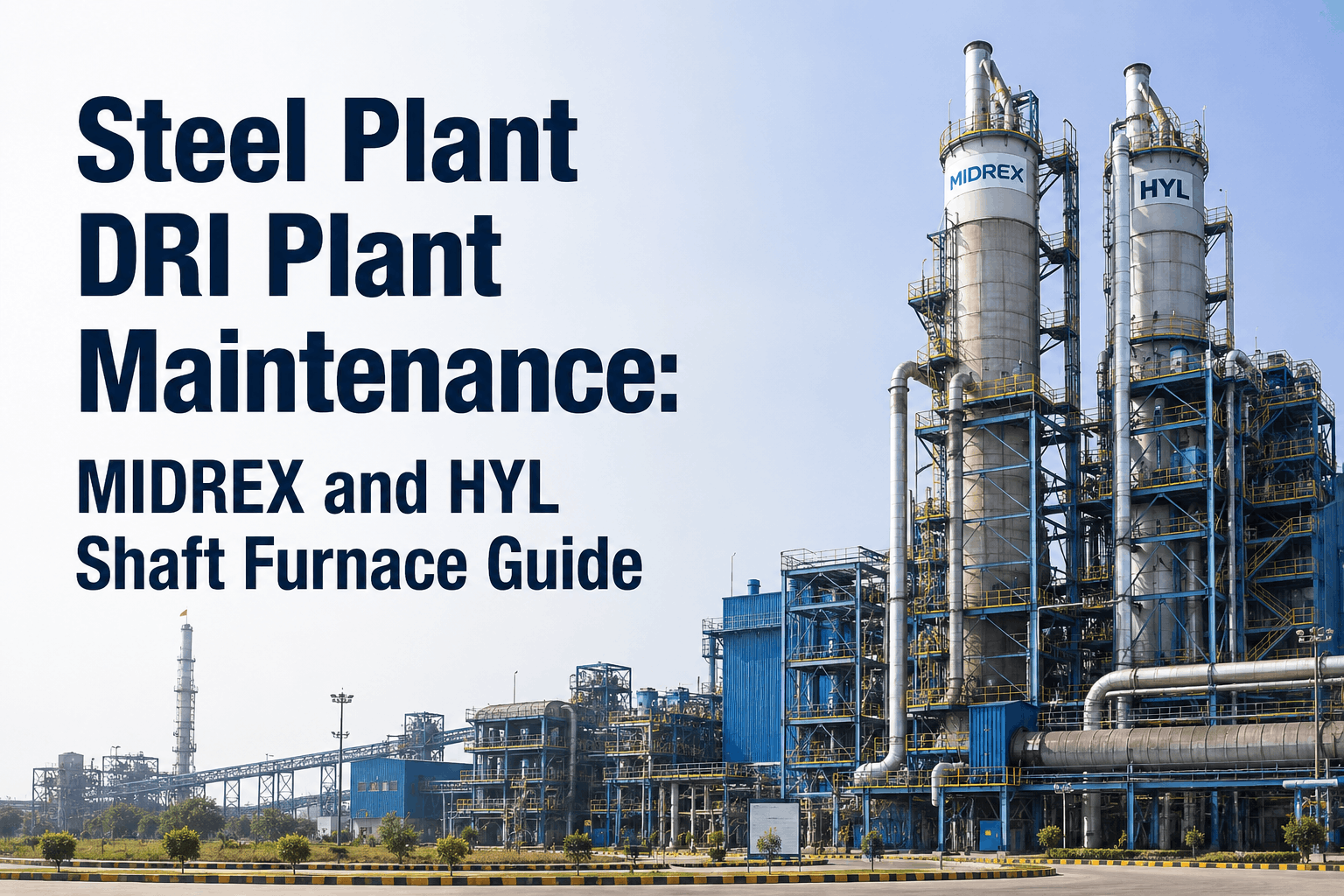
The two dominant DRI technologies — MIDREX and Energiron (HYL) — share core principles but have different equipment configurations that affect maintenance approach:
Critical Equipment Zones and Maintenance Requirements
A DRI plant has six interconnected equipment zones, each with distinct failure modes and maintenance demands:
Gas Reformer System
The reformer converts natural gas (or hydrogen blend) into reducing gas at 900-950°C through nickel catalyst tubes. Reformer tubes are the single most expensive and critical maintenance item — they operate near metallurgical limits with a finite life of 10-15 years. Individual tube failure can cause unplanned shutdown.
Shaft Furnace
The core reduction vessel where iron ore pellets are reduced to metallic iron by counter-current flow of hot reducing gas. Operates continuously with gravity-fed burden column. Shaft diameters range from 5.5m to 7.5m. Internal refractory must withstand both high temperature and abrasive movement of the iron burden.
Gas Handling & Heat Recovery
Complex network of gas coolers, scrubbers, compressors, heat exchangers, and ductwork that cleans, cools, reheats, and recirculates process gas. Top gas contains dust, moisture, and CO₂ that must be removed before recycling. Energy efficiency depends on heat recovery effectiveness.
Material Handling & Feed System
Conveyors, screens, bins, and feeders that transport iron ore pellets from storage to shaft furnace top and DRI product from discharge to storage, EAF, or briquetting. Materials are abrasive and in the case of HDRI, extremely hot. Screening systems must maintain proper size distribution.
Briquetting / Product Handling
HBI plants use high-pressure roller presses to compact hot DRI at 700°C+ into dense briquettes for safe shipping. Briquetting rolls are high-cost wear items operating under extreme pressure and temperature. HDRI systems require refractory-lined transfer chutes to deliver hot DRI directly to adjacent EAF.
Utilities & Control Systems
Water treatment, cooling water, compressed air, electrical distribution, and plant-wide DCS/PLC. Modern DRI plants are highly automated with hundreds of sensors feeding real-time optimization. Instrument calibration directly affects process stability and product quality.
Achieve 99%+ Availability Across Your DRI Plant
Oxmaint tracks every critical asset — reformer tubes, shaft furnace refractory, compressors, briquetting rolls — with automated PM scheduling, condition monitoring integration, and shutdown planning tools.
Maintenance Planning: Daily Rounds to Major Turnarounds
DRI plants operate continuously for campaigns of 12-18+ months between major shutdowns. Maintenance is structured in tiers:
Operator Rounds & Online Monitoring
Targeted Inspections
Condition Assessment
Major Planned Turnaround
Hydrogen-Ready Maintenance: Preparing for the Transition
The DRI industry is transitioning from natural gas to hydrogen — the core pathway to green steel. This introduces new maintenance requirements:
Higher Operating Temperatures
Hydrogen reduction is endothermic (absorbs heat), requiring higher gas temperatures. This accelerates thermal degradation of refractory, increases reformer tube stress, and demands more frequent inspection. Maintenance intervals for thermal equipment may shorten by 15-25%.
Hydrogen Embrittlement Risk
High-temperature hydrogen attacks carbon steel, causing decarburization and cracking. Piping, vessels, and fittings require upgraded metallurgy (Cr-Mo steels, stainless) and more frequent NDT to detect hydrogen-induced cracking before failure.
Modified Water Management
Hydrogen reduction produces water vapor instead of CO₂, dramatically increasing moisture in the gas circuit. Enhanced gas cooling and water removal systems are needed. Water treatment and condensate handling maintenance volumes increase substantially.
Sealing & Leak Detection
Hydrogen is the smallest molecule — it leaks through seals that contain larger molecules perfectly. All gas circuit connections require upgraded sealing and systematic leak detection. Hydrogen burns invisibly, requiring specialized flame detectors.
From Natural Gas Today to Hydrogen Tomorrow — Maintain It All
Oxmaint's flexible asset tracking adapts as your DRI plant transitions to hydrogen — tracking new inspection requirements, adjusted intervals, and hydrogen-specific safety protocols.
What the CMMS Must Track for DRI Plant Reliability
Frequently Asked Questions
What are the most critical maintenance items in a DRI plant?
The most critical items ranked by impact: Reformer tubes — single most expensive component, operating at 900-950°C with 10-15 year life; tube failure forces unplanned shutdown and a full tube set replacement is a multi-million dollar investment. Shaft furnace refractory — lining withstands continuous high temperature and abrasive burden movement; failures create hot spots that can progress to shell damage. Process gas compressors — primary electrical consumers; bearing or impeller damage stops the entire plant. Catalyst charge — nickel catalyst deactivates over 5-7 years, reducing efficiency and increasing energy costs. Briquetting rolls (HBI plants) — high-pressure, high-temperature rolls requiring periodic reconditioning. Top plants achieve 99.4-99.6% availability by tracking these items with condition-based monitoring.
How often do DRI plants shut down for major maintenance?
DRI plants operate continuously for 12-18+ month campaigns between major turnarounds. Top MIDREX plants achieve 8,000-8,700+ hours annually (91-99%+ availability), with the 2024 record being 8,726 hours at Jindal Steel Sohar. Turnaround scope includes reformer tube inspection and replacement, catalyst evaluation (5-7 year cycle), shaft furnace refractory repair, bustle pipe rebuild, compressor overhaul, briquetting roll reconditioning, complete instrument calibration, and safety valve testing. Duration is typically 2-4 weeks. Some multi-module plants like Hadeed schedule modules in alternating months to maintain continuous supply.
What is the difference between MIDREX and Energiron (HYL) maintenance?
MIDREX uses an external catalytic reformer with hundreds of nickel catalyst tubes — making tube integrity and catalyst management the primary focus. Operates at near-atmospheric pressure. Accounts for ~67% of global DRI capacity. Energiron (HYL) Zero Reformer variant eliminates the external reformer, performing in-situ reforming inside the shaft furnace. Operates at higher pressure (~6 bar), requiring pressure vessel integrity management, higher-spec sealing, and pressurized gas circuit compressor maintenance. Includes CO₂ removal system (amine or PSA) adding chemical handling maintenance. Both share needs for shaft furnace refractory, material handling, gas cleaning, and product handling maintenance.
How does hydrogen transition affect DRI plant maintenance?
Key impacts: Higher thermal stress — hydrogen reduction is endothermic, requiring higher temperatures that accelerate refractory and equipment degradation; intervals may shorten 15-25%. Hydrogen embrittlement — requires upgraded metallurgy (Cr-Mo or stainless) and more frequent NDT. Increased water management — hydrogen produces water vapor instead of CO₂, increasing moisture handling demands. Sealing requirements — hydrogen's small molecular size requires upgraded seals and systematic leak detection. Safety systems — hydrogen burns invisibly, requiring specialized flame detectors and updated safety instrumented systems. MIDREX Flex technology enables operation on any natural gas/hydrogen mix for gradual transition.
How does CMMS software improve DRI plant reliability?
CMMS is essential for 99%+ availability: Reformer tube lifecycle management — individual tube tracking with wall thickness history and remaining life predictions. Condition monitoring integration — vibration, temperature, and performance data trended to predict failures. Turnaround planning — scope management, critical path analysis, spare parts pre-staging, and cost tracking to minimize shutdown duration. Campaign tracking — monitoring hours since last turnaround and identifying the limiting factor for the next shutdown. Catalyst management — tracking age, activity trends, and replacement timing. Safety and compliance — permit-to-work, relief valve testing, gas detection calibration, and environmental documentation. Spare parts optimization — managing long-lead items like reformer tubes and catalyst that must be on-site before turnarounds.
Build the Maintenance Program Your DRI Plant Demands
Join DRI operators using Oxmaint to achieve world-class availability — with reformer tube tracking, turnaround planning, condition monitoring integration, and flexibility for both natural gas and hydrogen operations.





-maintenance-and-shaft-furnace-reliability.png)
