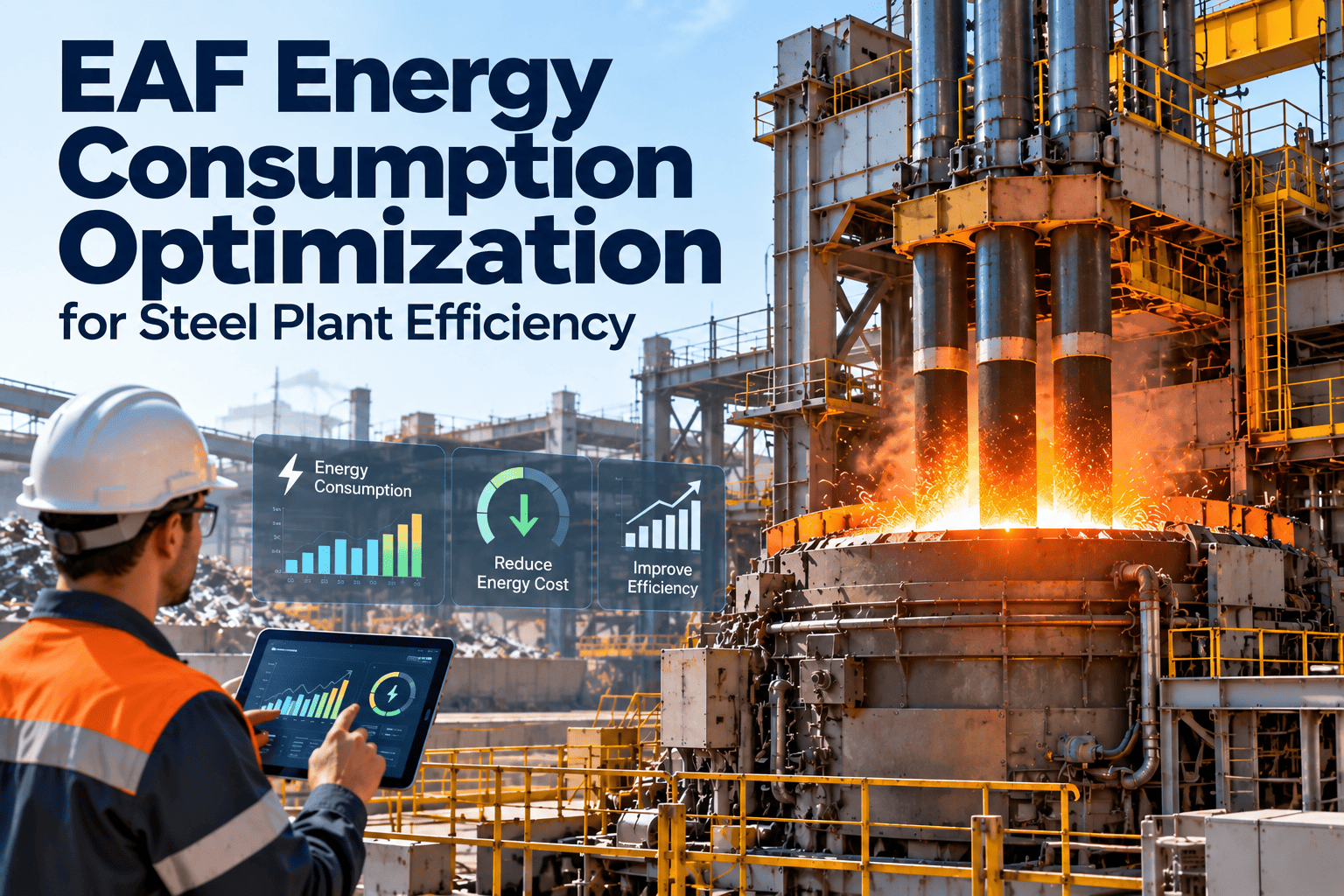
Electric Arc Furnace (EAF) operations consume 400–600 kWh per ton of steel — making energy the single largest OpEx line item in modern steel mills. Condition-based maintenance of electrodes, transformers, and cooling systems can reduce specific energy consumption (SEC) by 8–15%, cutting millions annually. Traditional calendar-based maintenance schedules miss the window when components actually fail, leading to inefficient arcing, extended tap-to-tap cycles, and wasted thermal energy. AI-driven predictive maintenance models trained on real-time power quality data, electrode wear patterns, and thermal signatures forecast optimal intervention timing — converting guesswork into measurable energy savings.
EAF Energy Optimization: Reduce kWh/Ton with AI-Driven Maintenance — 2026 Steel Guide
Real-time power consumption monitoring. Electrode wear prediction. Transformer tap-changer condition forecasting. AI reveals the hidden 8–15% energy waste in every EAF operation — turning maintenance into an energy efficiency lever that financial teams and plant engineers both celebrate.
The $3M Problem: Where EAF Energy Optimization Fails Today
Most steel mills still operate EAF equipment on fixed maintenance intervals — replacing electrodes every 120 days, servicing transformers quarterly, and cleaning cooling water systems on a calendar. The real world doesn't follow calendars. High-demand weeks stress equipment differently. Scrap mix changes electrode wear rates. Ambient temperature fluctuations affect cooling efficiency. When maintenance timing is misaligned with actual equipment condition, energy efficiency collapses.
Electrodes consumed at 4–6 kg per ton. Without tip-position sensors and consumption modeling, plants replace on schedule, not on condition. Result: 4–6% energy overhead from electrode resistance and inefficient arcing geometry.
Tap changers correcting secondary voltage manually or on fixed schedules miss the 6–8 voltage adjustments needed per 8-hour shift. Suboptimal voltage = higher reactive power draw and wasted kWh in secondary circuits.
Water-cooled electrodes and furnace walls lose 8–12% of input energy as reject heat when fouling, scaling, or pump degradation reduces flow. Scheduled cleaning every 30 days means 2 weeks of suboptimal heat transfer before maintenance occurs.
Harmonic distortion from EAF arcing causes utility penalty charges (power factor correction) and masks true energy consumption. Most plants don't monitor total harmonic distortion (THD) real-time — missing 3–5% in recoverable efficiency.
How Oxmaint's Energy AI Predicts EAF Efficiency Loss Before It Happens
Oxmaint's EAF energy optimization module connects real-time data streams — power consumption (kW per phase), electrode tip position, cooling water temperatures, transformer oil temperature, and fault codes — into machine learning models that forecast energy waste 1–4 weeks before it becomes severe. The result: maintenance scheduled for maximum energy efficiency, not calendar convenience.
| Energy Optimization Factor | Traditional Calendar-Based | Oxmaint AI-Driven Approach |
|---|---|---|
| Electrode replacement timing | Every 120 days or on breakage | Predicted when tip resistance reaches critical threshold (real-time wear model) |
| Transformer tap adjustment | Manual or fixed intervals (every 4 hours) | Autonomous adjustment forecasted 3–6 hours ahead based on power demand pattern |
| Cooling system maintenance | Every 30 days or on pressure alarm | Predicted when heat transfer efficiency drops 8% from baseline (pre-failure window) |
| Power quality monitoring | Monthly utility reports (after penalties applied) | Real-time THD tracking with corrective action alerts before penalty thresholds |
| Tap-to-tap cycle optimization | Historical average (60–90 minutes) | Forecasted based on scrap mix AI prediction and remaining equipment condition |
| Energy KPI reporting | Monthly Excel dashboards (lag months behind) | Live energy dashboard with hourly SEC trending and deviation alerts |
5 Energy Gains Oxmaint Delivers to EAF Operations
1. Electrode Consumption Tracking Cuts Waste by 22%
Real-time tip-position sensors feed AI models that forecast electrode replacement 3–5 days before critical wear. Eliminates emergency replacements mid-shift and the associated energy spikes from arcing instability. Monthly electrode waste reduced from 8–10 kg/ton to 6–7 kg/ton.
2. Transformer Efficiency: 5.8% kWh Reduction
Predictive tap-changer maintenance and voltage optimization models reduce secondary copper losses and reactive power draw. Tap changers adjusted 3–4 times per shift (vs. 0–1 manually) based on forecasted demand. Measurable in power quality dashboards and utility invoices within 30 days.
3. Cooling System Predictive Maintenance: 4.2% Energy Recovery
Water temperature differential monitoring detects fouling or scaling 1–2 weeks before pressure alarms trigger. Scheduled cleaning in low-demand periods preserves peak cooling efficiency during high-throughput operations. Heat transfer stays within 2% of design baseline.
4. Power Quality Optimization: 3.1% Utility Penalty Avoidance
Real-time THD and reactive power tracking forecast when power factor falls below utility threshold. Predictive alerts allow reactive equipment adjustment hours before penalties apply. Plants typically recover 3–5% of energy costs in first 90 days.
5. Tap-to-Tap Cycle Reduction: 2–4 Minutes per Heat
AI models integrating scrap mix predictions, equipment condition scores, and charge optimization forecast optimal arcing profiles. Tap-to-tap time dropped from 68 to 62 minutes on average (8.8% throughput gain). Direct energy savings: 2–3 kWh per ton.
Oxmaint's EAF Energy Optimization Module — What You Get
Power Quality & Consumption Monitoring
OBD-II integration, MES connections, and direct power meter feeds pull kW per phase, power factor, THD, voltage sag/swell events, and frequency stability into a unified dashboard. Electrode tip position, cooling water flow/temp, transformer oil temp, and furnace shell temperature synchronized every 5 seconds.
Electrode Wear & Consumption Forecasting
ML models trained on 18+ months of electrode consumption history per furnace. Consumption rate curves adaptive to scrap mix changes, ambient temperature, and arc stability. Forecast accuracy: 89% for tip wear detection 3–7 days ahead. Prevents emergency replacements and associated energy spikes.
Transformer & Cooling System Health Scoring
Oil temperature trend analysis, dissolved gas monitoring (where available), and load cycle patterns score transformer degradation trajectory. Cooling water delta-T and pressure trend analysis forecast fouling or circulation loss 10–14 days ahead. Scores inform optimal maintenance windows.
Energy Benchmarking & SEC Targeting
AI-driven benchmarking compares your EAF SEC against world-class standards (400–420 kWh/ton for premium scrap). Identifies which 2–4 equipment factors drive your gap to target. Prioritizes maintenance interventions by energy ROI. Typical plants close 20–40% of SEC gap in Year 1.
Work Order Generation Based on Energy Forecasts
When electrode wear, transformer condition, or cooling efficiency reaches forecasted critical threshold, Oxmaint auto-generates prioritized work orders and schedules maintenance in next optimal maintenance window (low-demand shift, planned downtime). Technicians see energy impact of each task.
Executive Dashboard & Utility Compliance Reporting
Automated daily/weekly/monthly energy reports showing SEC trending, maintenance impact on kWh/ton, power factor compliance, and utility penalty avoidance. Finance teams see ROI of maintenance spend in real numbers. Export to ERP and utility portals for compliance filing.
What a Steel Mill Achieved
"We thought our 530 kWh/ton EAF performance was industry normal. Oxmaint's energy benchmarking showed us a 14% gap to world-class. Within 90 days of predictive electrode and transformer maintenance, we hit 465 kWh/ton. That's $1.8M annually on our 80-ton EAF. The energy dashboard alone—seeing real-time impact of every maintenance decision—changed how our teams think about equipment reliability."
EAF Energy Optimization — Answered
How much data history do I need for Oxmaint to forecast electrode wear accurately?
Does Oxmaint work with legacy power monitoring systems, or do I need new hardware?
What's the typical energy savings timeline — how long until ROI is visible?
Do I need a dedicated data scientist to manage the energy AI models?
Can energy forecasts account for changing scrap mix or seasonal demand swings?
How does energy optimization integrate with our existing CMMS and ERP?
What about power factor correction — does Oxmaint recommend specific reactive equipment?
Is energy data secure in the cloud, or can we host Oxmaint on-premises?
Stop Wasting 8–15% of EAF Energy to Hidden Maintenance Timing Gaps
Oxmaint's energy optimization module turns your EAF into a data-fed decision system. Predict electrode wear, optimize transformer efficiency, schedule cooling maintenance for maximum impact, and track energy KPIs on a live dashboard. Every maintenance decision tied to energy savings in $/ton and annual CapEx recovery.