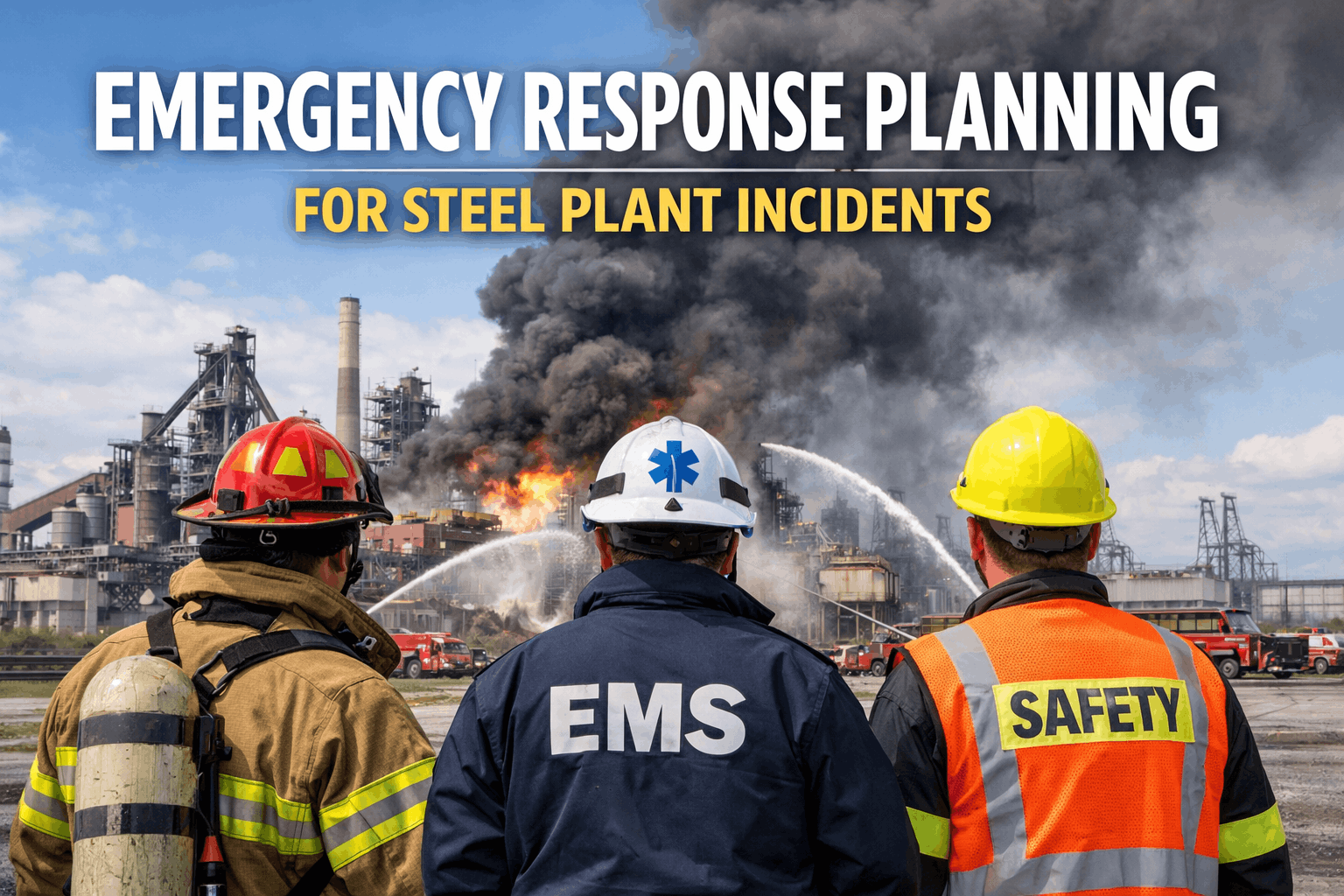
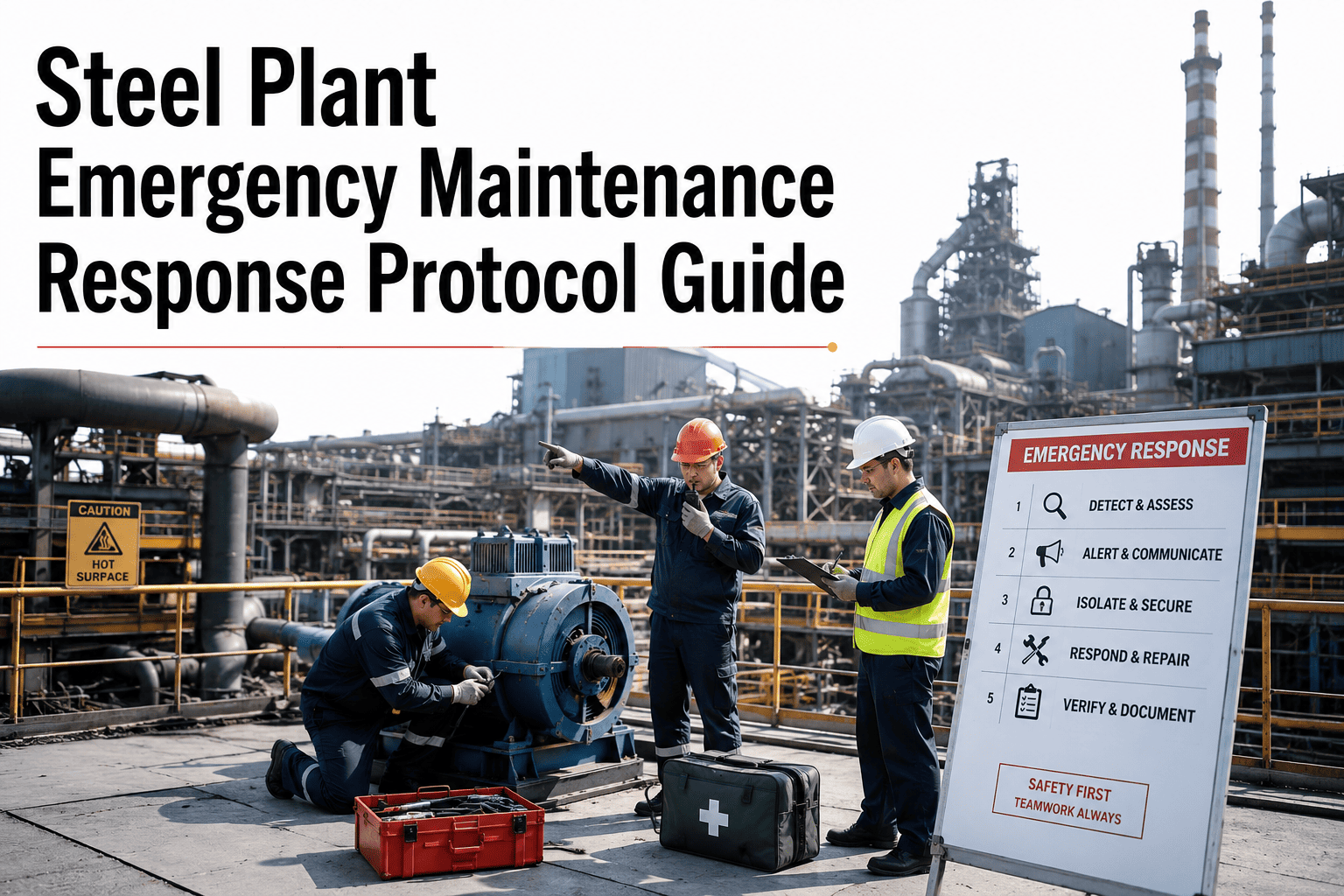
When a molten metal spill ignites a hydraulic system, when a gas line ruptures adjacent to an active furnace bay, when a worker is struck by a crane load in a congested melt shop—the next four minutes determine whether that incident becomes a manageable emergency or a catastrophic event with fatalities, regulatory intervention, and permanent reputational damage. Emergency response planning in steel manufacturing is not a binder on a shelf. It is a living operational system that defines who does what, in what sequence, with what resources, the moment an alarm sounds. Most plants have emergency plans. Far fewer have plans that have been tested, updated after each drill, digitally accessible from the plant floor, and genuinely integrated with the maintenance and asset systems that hold critical facility information. Schedule a free emergency preparedness review with our steel plant safety specialists and find out whether your current plan would actually work under pressure.
Why Emergency Planning Is Different in Steel Manufacturing
Steel plants concentrate hazard scenarios that most industrial facilities never face simultaneously. Molten metal at temperatures exceeding 1,600°C operates meters away from high-pressure hydraulic systems, combustible gas networks, overhead crane travel paths, and electrical systems carrying thousands of amperes. The speed at which a localized incident can cascade into a multi-hazard emergency is measured in seconds, not minutes. Generic industrial emergency response frameworks consistently fail in steel environments because they were not designed for the specific physics, chemistry, and operational complexity that define this industry.
Steel Plant Emergency Hazard Categories
Each category requires distinct response protocols, specialized equipment, and trained personnel
Molten Metal Incidents
Ladle failures, tap hole breakouts, runner overflow, mold level exceedance, crane drops
Combustible Gas Releases
Natural gas, coke oven gas, BF gas, hydrogen, propane—ignition or toxic exposure risks
Electrical Incidents
Arc flash, electrocution, transformer failures, high-voltage cable faults, MCC fires
Chemical Releases
Hydrochloric acid, ammonia, chlorine, fluxes—toxic vapor clouds, chemical burns, IDLH atmospheres
Structural & Mechanical
Crane collapse, structural failure, conveyor entrapment, hydraulic system rupture, vessel explosion
Confined Space Emergencies
Personnel trapped in vessels, pits, tunnels—oxygen-deficient atmospheres, toxic gas accumulation
Digitize Your Emergency Response From Detection to Investigation
Oxmaint connects your emergency procedures, asset data, LOTO records, and incident investigation workflows in one platform—so your response team has everything they need the moment an alarm sounds.
Incident-Specific Response Protocols for Steel Plant Hazards
Generic fire evacuation procedures do not address the specific hazards your facility generates. Each major hazard category in a steel plant requires a distinct response protocol developed around the specific physics and chemistry of that hazard—with trained, equipped response teams who have practiced under realistic conditions. The following protocols represent minimum required content for each hazard type; site-specific procedures must incorporate actual facility layouts, asset locations, and available resources.
Severity: Critical
Molten Metal Spill or Runout
Immediate Actions
1Sound evacuation alarm and clear all personnel from affected bay immediately—no exceptions
2Do not attempt water application to molten metal—steam explosion risk is fatal
3Isolate all combustible hydraulic lines in the spill path using emergency hydraulic shutoffs
4Overhead crane operators halt movement—crane travel over active spill zone prohibited
5Activate dry sand or dry chemical containment—never use water-based suppression
Critical Assets Needed
Dry sand containers, dry chemical extinguishers, thermal PPE (aluminized suits), emergency hydraulic isolations, blast shields
Severity: Critical
Combustible Gas Release
Immediate Actions
1Evacuate all personnel from the release zone and establish 100m exclusion perimeter minimum
2Eliminate all ignition sources in the area—no vehicles, no electrical switching, no radio in zone
3Isolate gas supply at main isolation valve—location must be marked on emergency response maps
4Continuous atmospheric monitoring using calibrated gas detectors—LEL readings reported to IC
5Do not re-enter until LEL drops below 10% and remains stable for 15 minutes
Critical Assets Needed
Multi-gas detectors, intrinsically safe radios, gas isolation valve locations, foam applicators if ignited, SCBA units for response personnel
Severity: High
Electrical Arc Flash or Electrocution
Immediate Actions
1Do not touch victim until electrical source is confirmed isolated—responder death risk
2Qualified electrical worker isolates energy at the upstream disconnect—not at the local device
3Verify zero voltage with a properly rated meter before entering the hazard zone
4Initiate patient care only after confirmed isolation—AED, burn treatment, CPR as required
5Activate emergency shutdown for all connected electrical systems in the affected switchgear lineup
Critical Assets Needed
Voltage testers, arc-rated PPE, insulated rescue hooks, AED, upstream isolation breaker locations, qualified electrical personnel on call
Severity: High
Hazardous Chemical Release (HCl, Ammonia)
Immediate Actions
1Evacuate downwind of release—wind direction determines safe evacuation routes; consult facility map
2Self-contained breathing apparatus required for any responder within 50m of active release
3Isolate chemical supply at source isolation valve and confirm valve closed
4Activate deluge system or water curtain if available to suppress vapor cloud dispersion
5LEPC and 911 notification mandatory for releases above EPCRA reportable quantities
Critical Assets Needed
SCBA units, chemical splash suits, IDLH atmospheric monitors, isolation valve locations, SDS sheets, LEPC contact information, decontamination station
Severity: High
Confined Space Rescue
Immediate Actions
1Do not enter to rescue without SCBA and attendant—multiple fatality scenarios begin with untrained entry
2Test atmosphere at multiple levels before any entry—oxygen, LEL, CO, H₂S
3Isolate all energy sources connected to the space—mechanical, electrical, steam, gas
4Activate confined space rescue team—non-entry retrieval system deployed first if victim is reachable
5EMS standby at entry point with ALS capability before any entry rescue is attempted
Critical Assets Needed
Multi-gas meter, SCBA, retrieval system with tripod, entry harnesses, communication system, confined space emergency procedures, trained rescue team
Severity: High
Crane Failure or Load Drop
Immediate Actions
1All clear bay immediately—structural integrity of overhead systems cannot be assessed from below
2Power to runway electrification isolated from below at designated runway disconnect
3Assess for secondary hazards—dropped load impact damage, fire, spilled hot material
4Structural engineer assessment required before personnel re-enter bay under damaged runway
5Crane locked out and tagged for inspection—no further operation until root cause confirmed
Critical Assets Needed
Runway power isolations, structural assessment contacts, crane maintenance records in CMMS, rescue equipment if personnel are trapped under load
Emergency Response Team Structure and Role Assignments
An emergency response plan is only as strong as the team trained to execute it. Steel plant emergency teams require a formal structure that defines who is in command, who performs which functions, and who backs up whom when primary responders are not on shift. Role clarity prevents the dangerous improvisation that occurs when multiple people try to command simultaneously or when critical functions go unassigned because everyone assumed someone else had them.
Command
Incident Commander
Overall authority for all emergency response decisions. Activates ICS structure, authorizes resource deployment, controls entry/exit from hazard zone, coordinates with external agencies, and bears documentation responsibility for all command decisions.
Required: ICS 100/200, Facility ERP training, senior operations leadership
Safety
Safety Officer
Monitors incident scene for responder safety hazards. Authority to halt any operation that poses immediate danger to response personnel. Independent from Incident Commander—reports directly to IC but can stop operations unilaterally.
Required: Industrial hygiene knowledge, PPE expertise, OSHA 300/400-level training
Operations
Operations Section Chief
Directs all tactical operations within the hazard zone. Manages response teams, resource allocation, and tactical priorities. Primary link between Incident Commander's strategy and the personnel executing the response.
Required: Hazard-specific technical knowledge, team management experience, tactical ICS training
Liaison
Liaison Officer
Single point of contact for external agencies—fire department, EMS, HAZMAT team, environmental regulators, and law enforcement. Ensures external responders receive accurate facility information and are integrated into command structure appropriately.
Required: Knowledge of facility layout, hazardous materials locations, external agency contacts
Accountability
Personnel Accountability Officer
Maintains real-time accountability of all personnel—who is in the hazard zone, who has evacuated, who is unaccounted for. Critical for rescue prioritization and for preventing responders from entering areas they believe are clear.
Medical
Medical Officer
Coordinates first aid and medical treatment for casualties. Manages triage, patient treatment priority, and handoff to EMS. Ensures first aid resources are staged appropriately based on incident type and potential casualty profile.
Logistics
Logistics Section
Manages emergency equipment deployment, personnel rotation, communication systems, and resource tracking. Ensures response teams have what they need and maintains inventory of emergency resources consumed during the incident.
Documentation
Documentation Coordinator
Maintains the incident log in real time—all decisions, actions, resource deployments, communications, and timeline events. This record becomes the primary evidence document for investigation, regulatory reporting, and legal proceedings.
Your CMMS Holds the Data Your Response Team Needs in a Crisis
Asset locations, energy isolation points, hazardous material inventories, equipment-specific emergency procedures, and contractor contact information—Oxmaint keeps this data current and accessible from any mobile device on the plant floor when every second counts.
Emergency Drill Program: Building Real Capability Through Practice
Emergency plans that have never been tested are hypotheses, not procedures. The gap between a written plan and an executable plan is bridged through a structured drill program that progressively tests response capability from individual skill training through full-scale plant exercises. Steel plants that drill regularly and systematically incorporate lessons learned consistently outperform those that rely on annual tabletop exercises.
Drill Type
Frequency
Scope & Participants
Primary Objective
Documentation Required
Tabletop Exercise
Quarterly
ERP team, shift supervisors, safety leadership—conference room scenario walkthrough
Test decision-making, communication, and role knowledge without deploying physical resources
Scenario record, participant list, action items identified
Evacuation Drill
Bi-Annual
All plant personnel across all shifts—full headcount accountability at muster stations
Verify all personnel can safely evacuate within target time and accountability is achievable
Evacuation time, accountability results, gaps identified per muster station
Functional Drill
Bi-Annual
Response team plus Incident Command—specific hazard type, simulated conditions on plant floor
Test response team tactics, equipment deployment, and ICS activation for one hazard scenario
Drill scenario, timeline, equipment deployed, hot wash findings, corrective actions
Full-Scale Exercise
Annual
Full plant response plus external agencies—fire department, EMS, HAZMAT—multi-scenario
Test complete response capability including external coordination, full ICS activation, and plan adequacy
Full after-action report, regulatory observer sign-off where required, plan update obligations
Equipment Inspection
Monthly
Safety team—physical inspection of all emergency response equipment at each station
Confirm emergency equipment is present, functional, within service dates, and correctly located
Inspection checklist per station, deficiency work orders in CMMS, replacement records
Emergency Response Plan Requirements and Compliance Standards
Steel plant emergency planning obligations span multiple regulatory frameworks with overlapping but distinct requirements. Understanding exactly what each standard demands—and the penalties for non-compliance—is essential for building a program that satisfies regulators, protects workers, and functions when called upon.
OSHA 1910.38
Emergency Action Plans
Written EAP for all facilities with 10+ employees
Procedures for emergency evacuation with escape route assignments
Personnel accountability procedure post-evacuation
Procedures for workers who remain to operate critical systems
Employee training and plan review for each covered employee
OSHA 1910.119(n)
PSM Emergency Planning
Emergency response procedures for releases of covered chemicals
Procedures for handling small and large accidental releases
First aid and emergency medical treatment procedures
Emergency alert and notification systems
Procedures for informing community and response agencies
EPCRA Section 302-304
Community Right-to-Know
LEPC notification for EHS above threshold planning quantities
MSDS/SDS submission to LEPC, fire department, and SERC
Annual Tier II chemical inventory reporting
Immediate release notification within 24 hours for reportable quantities
Coordination with LEPC on emergency planning updates
OSHA 1910.120
HAZWOPER Standard
Emergency Response Plan for hazardous substance releases
40-hour HAZWOPER training for response team members
8-hour annual refresher training for trained responders
Incident Command System structure for response operations
Medical surveillance for personnel with hazardous substance exposure
Emergency Response KPIs for Steel Plant Safety Leadership
Emergency preparedness cannot be verified by reviewing the plan document—it must be measured through response capability metrics that reflect actual team performance, equipment readiness, and plan currency. These KPIs give safety directors and plant managers quantitative evidence of preparedness status and early warning of capability degradation.
100%
ERP Procedure Coverage
All identified hazard scenarios have written response procedures. Zero gaps in scenario coverage is the only acceptable standard—unknown scenarios are the ones that cause fatalities.
<4 min
Evacuation Completion Time
Target time for full personnel evacuation from any plant area to designated muster stations, measured and recorded during each evacuation drill.
100%
Response Team Training Currency
All designated emergency response team members with current certifications. A single expired HAZWOPER certification in an active responder creates both regulatory and liability exposure.
0
Overdue Drill Completions
All scheduled drills completed within the program calendar. Deferred drills are the leading indicator that emergency preparedness is being treated as lower priority than production.
100%
Emergency Equipment Serviceability
All emergency response equipment—SCBA, fire extinguishers, gas detectors, defibrillators—inspected within schedule and confirmed serviceable. Tracked in CMMS as scheduled maintenance.
12 mo
Plan Review Cycle
Emergency Response Plan reviewed and updated at least annually, immediately after any actual incident, and whenever facility changes affect response procedures, hazard inventories, or contact information.
Connect Your Emergency Plan to the Systems That Power It
Emergency response depends on accurate, current information. Oxmaint keeps your asset records, maintenance histories, energy isolation points, hazardous material locations, and equipment serviceability data up to date and accessible—the operational foundation your emergency plan requires to actually work.
Common Emergency Planning Failures in Steel Plants
Steel plant emergency plans fail in ways that are almost entirely predictable. The failures are not random—they cluster around the same organizational patterns across facilities of all sizes. Recognizing these failure modes in your own program before an incident forces the recognition is the entire purpose of a mature safety management approach.
01
Plans That Describe Ideal Conditions That Do Not Exist in the Facility
Emergency plans that reference equipment, personnel, or resources that the plant does not actually have are more dangerous than no plan—they create false confidence that is shattered at the moment of an actual incident. A plan that references a dedicated emergency response team when the facility relies on volunteer first responders with no guaranteed response time, or that calls for foam application equipment that was decommissioned two years ago, will fail predictably. Effective plans are grounded in the actual resources, personnel, and conditions of the specific facility.
02
No Integration Between the Emergency Plan and the Maintenance Management System
Critical emergency response information lives in the maintenance system: energy isolation point locations, hazardous material storage quantities, equipment condition records, recent maintenance history that might affect system reliability during an emergency, and spare parts needed for rapid repair. Emergency responders who cannot access this information—because it lives in a CMMS with no mobile interface and a login that only maintenance staff know—respond to incidents with incomplete situational awareness. Digital integration between emergency procedures and CMMS asset data closes this gap directly.
03
Personnel Accountability Systems That Cannot Scale to Shift Complexity
Steel plants operate multiple shifts with contractors, visitors, and maintenance personnel who may be in different locations across a large facility simultaneously. Paper-based accountability systems that work for 50 people fail catastrophically when 400 people from multiple employers need to be accounted for during an evacuation. The inability to confirm whether a missing person is truly missing or simply failed to check in at the correct muster station has delayed rescue operations. Digital personnel accountability with QR code or badge-scan muster reporting provides real-time headcount from multiple muster points simultaneously.
04
Communication Systems That Fail During the Incidents That Require Them Most
Standard radio systems in steel plants face interference from electric arc furnaces, metal structures, and high-noise environments that make routine communication difficult. Emergency conditions—with additional radio traffic, personnel under stress, and possibly compromised infrastructure—make unreliable communications even worse. Emergency communication planning must account for noise levels that require physical signal protocols, backup communication paths when primary systems fail, and designated communication channels that are kept clear during emergencies. The plant PA system and radios must be tested specifically during emergency drills, not assumed to work because they function under normal operating conditions.
05
External Agency Pre-Coordination That Happens on the Day of an Incident
Local fire departments, HAZMAT teams, and emergency medical services that arrive at a steel plant for the first time during an actual incident face a dangerous orientation deficit: they do not know where the hazardous materials are stored, they do not know which access routes are safe under different incident conditions, and they do not know the facility's specific hazards, processes, or layout. OSHA and EPCRA both require coordination with local response agencies. Annual pre-incident planning meetings, facility walkthroughs with fire department leadership, and shared emergency contact protocols convert external agencies from strangers into effective partners before the incident that tests the relationship.
Frequently Asked Questions
Q
What is the difference between an Emergency Action Plan and an Emergency Response Plan?
An Emergency Action Plan (EAP) under OSHA 1910.38 covers employee evacuation, notification procedures, and accountability. It is required of virtually all employers and focuses on getting employees safely out of harm's way. An Emergency Response Plan (ERP) is a broader document that includes actual hazard-specific response operations—how trained responders will control the hazard, not just evacuate from it. Steel plants with PSM-covered processes, HAZWOPER-covered operations, or significant hazardous chemical inventories require both: an EAP for all employees and a full ERP for trained response personnel. Confusing the two results in compliance gaps on the response side while creating false confidence about overall preparedness.
Q
How often should a steel plant update its emergency response plan?
OSHA requires annual review and update of emergency plans, and mandates updates after any incident that reveals a plan deficiency. Best practice requires updating the plan after every drill that identifies a gap, after any process or facility change that affects hazard scenarios or response resources, after changes in key personnel holding emergency roles, after changes in external agency contacts or capabilities, and whenever threshold quantities of covered chemicals change. Many steel plants default to a once-per-year review that misses mid-year changes. Digital plan management with triggered review workflows ensures updates happen when they are needed, not just on the calendar.
Q
Are steel plants required to have their own fire brigade, or can they rely on the local fire department?
Steel plants are not automatically required to maintain an in-house fire brigade. OSHA 1910.156 only applies if the employer establishes a fire brigade. However, OSHA 1910.38 and 1910.119 require emergency response capability for the hazards present at the facility. If the local fire department cannot respond within a timeframe adequate for the facility's hazard profile—particularly for molten metal incidents, high-voltage electrical fires, or HAZMAT releases—then an in-house capability gap exists regardless of what the plan documents. The decision should be based on hazard analysis, local fire department response time and capability assessment, and the consequences of delayed response for the specific incident scenarios the facility faces.
Q
What role does the CMMS play in emergency response?
A CMMS serves as a critical information resource during emergency response in several ways: it holds current asset locations and specifications that responders need to understand what they are dealing with, it contains energy isolation point documentation needed for LOTO during emergency shutdowns, it records maintenance history that may explain why a component failed, it tracks emergency equipment inspection records that confirm serviceability, and it can document the incident timeline in real time for post-incident investigation. The most effective integration links emergency procedures directly to asset records in the CMMS so responders can pull equipment-specific emergency information by scanning the asset tag from a mobile device at the point of the incident.
Q
What are the OSHA reporting requirements after a serious incident at a steel plant?
OSHA requires that employers report any work-related fatality within 8 hours of occurrence, and any in-patient hospitalization of one or more employees, any amputation, or any loss of an eye within 24 hours—all by calling the OSHA telephone hotline or visiting the nearest OSHA area office. PSM-covered facilities face additional obligations under state and local programs and may trigger EPA RMP reporting requirements if a covered chemical is released above reportable quantities. Environmental releases may additionally require EPA National Response Center notification within 24 hours and state agency reporting. Having pre-populated incident report templates and regulatory contact lists in your digital emergency management system eliminates the confusion about which agencies to notify and within what timeframe during the aftermath of a serious incident.