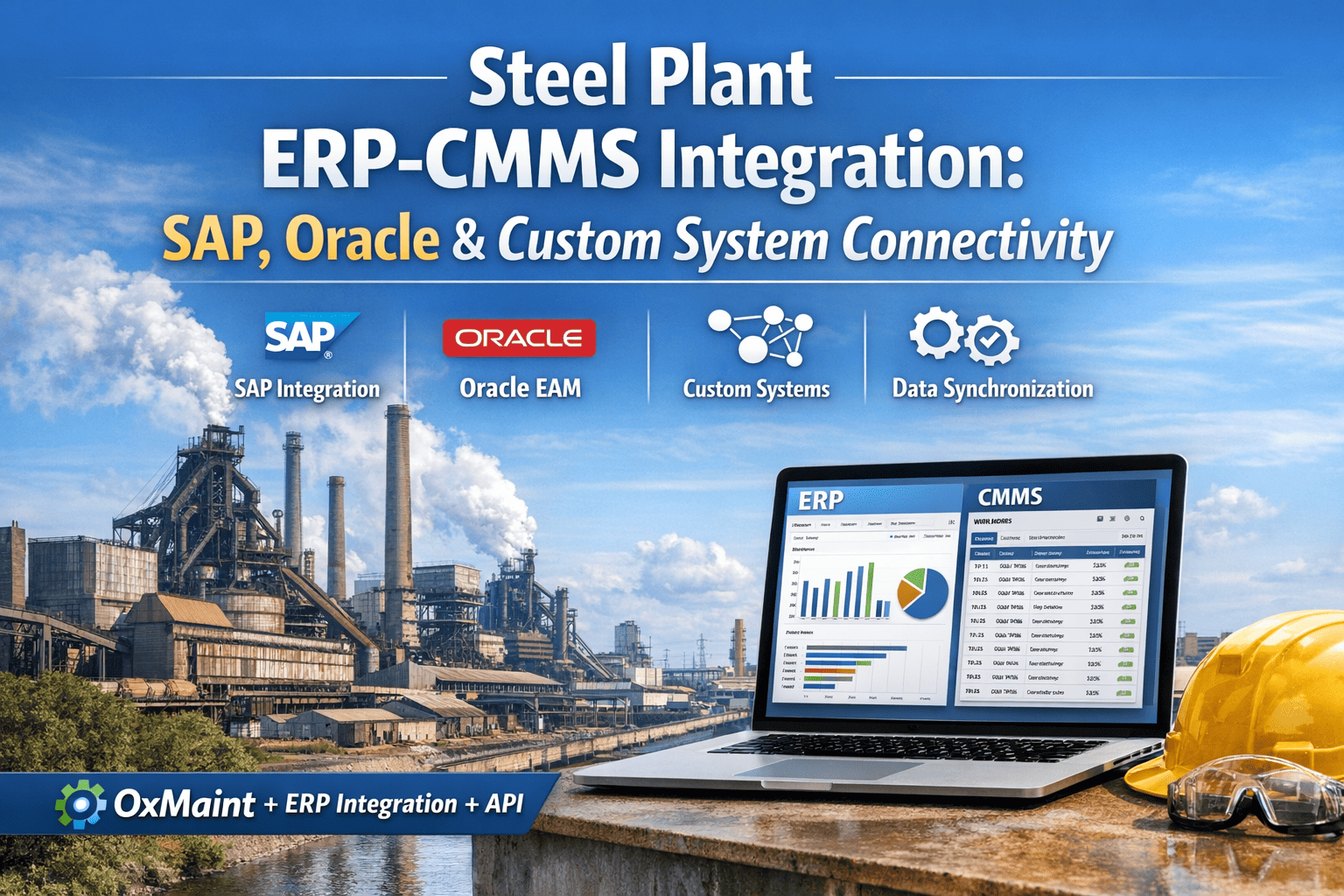
Steel manufacturers in the United States face a critical challenge: maintenance and finance departments operate in silos, creating data blind spots that cost an average of $2.3 million annually per plant. When your CMMS (Computerized Maintenance Management System) doesn't talk to your ERP (Enterprise Resource Planning), you're flying blind on true equipment costs, maintenance ROI, and capital planning. The solution? Seamless ERP-CMMS integration that unifies operational data with financial intelligence. But integration isn't one-size-fits-all—especially in steel manufacturing where blast furnaces, rolling mills, and continuous casters demand real-time data synchronization between maintenance operations and financial systems. This guide breaks down why integration matters, which platforms deliver the best results for US steel operations, and how to calculate your ROI before making the investment.
Why US Steel Manufacturers Need ERP-CMMS Integration
The American steel industry operates under unique pressures—rising labor costs, stringent EPA regulations, global competition, and aging infrastructure. When maintenance and finance systems don't communicate, steel plants suffer from duplicated data entry, delayed purchasing decisions, inaccurate equipment lifecycle costing, and missed opportunities for capital investment optimization. Integration eliminates these gaps by creating a single source of truth across operations and finance.
Invisible Equipment Costs
Without integration, finance teams cannot see true total cost of ownership (TCO) for critical assets like blast furnaces and rolling mills, leading to poor capital budgeting and premature replacements.
Procurement Bottlenecks
Manual purchase requisitions from CMMS to ERP create 3-7 day delays in parts ordering, extending downtime and inflating emergency procurement costs by 20-40%.
Data Entry Duplication
Maintenance technicians log work orders in CMMS while accounting manually re-enters labor hours, parts costs, and vendor invoices into ERP—wasting 15-25 hours per week per plant.
Compliance & Audit Gaps
EPA and OSHA audits require correlation between maintenance records and financial documentation. Disconnected systems create compliance risk and audit preparation nightmares.
Tired of manually bridging maintenance and finance data? Oxmaint integrates seamlessly with major ERP platforms to eliminate data silos and automate procurement workflows.
Key Benefits of ERP-CMMS Integration for Steel Plants
Integrated systems deliver measurable value across operations, finance, and strategic planning. Here are the core benefits US steel manufacturers realize when maintenance and finance systems work as one unified platform.
Top ERP-CMMS Integration Combinations for US Steel Manufacturing
Oxmaint + SAP ERP
Best Overall Integration for Mid-to-Large Steel MillsOxmaint offers native bi-directional integration with SAP S/4HANA and SAP ECC, making it the top choice for US steel plants already running SAP. Work orders automatically sync with SAP PM/MM modules, purchase requisitions flow seamlessly from maintenance triggers to procurement, and actual costs post back to financial controlling in real-time. Unlike competitors requiring expensive middleware, Oxmaint's pre-built SAP connector deploys in days with minimal IT overhead.
Oxmaint + Microsoft Dynamics 365
Best for Mid-Size US Steel OperationsFor US steel plants using Microsoft Dynamics 365 Finance & Operations, Oxmaint provides seamless integration that synchronizes maintenance activities with financial modules. Asset depreciation, warranty tracking, and vendor management flow bidirectionally without custom middleware. Particularly strong for plants under 500 employees seeking modern cloud infrastructure.
IBM Maximo + SAP ERP
Best for Large Multi-Plant Steel CorporationsEnterprise-grade integration suited for Fortune 500 steel manufacturers operating multiple US facilities. Maximo's deep asset lifecycle management combined with SAP's financial power delivers comprehensive visibility. However, implementation requires 9-18 months and dedicated integration specialists, with total costs exceeding $500K.
Fiix + Oracle NetSuite
Best for Growing Steel FabricatorsCloud-native combination ideal for regional steel fabricators and service centers using Oracle NetSuite ERP. Fiix's Integration Hub connects to NetSuite's procurement and accounting modules with pre-built workflows. Strong choice for operations under $100M annual revenue seeking rapid deployment without enterprise complexity.
SAP Plant Maintenance + SAP ERP
Best for SAP-Native Steel OperationsFor steel mills standardized entirely on SAP, native PM module integration eliminates third-party systems entirely. However, SAP PM lacks modern mobile interfaces and predictive analytics that specialized CMMS platforms provide. Requires extensive customization and SAP consultants for steel-specific workflows.
LLumin CMMS+ + Infor ERP
Best for Heavy Manufacturing FocusSpecialized integration for steel manufacturers using Infor LN or Infor CloudSuite Industrial. LLumin's manufacturing-focused architecture pairs well with Infor's process industry modules. Strong SCADA/PLC data integration capabilities make this combination ideal for highly automated US steel facilities.
Quick Comparison: Integration Options at a Glance
| Rank | CMMS-ERP Combo | Best For | Deployment Time | Integration Method | Est. Investment |
|---|---|---|---|---|---|
| #1 | Oxmaint + SAP | Mid-large steel mills | 2-4 weeks | Native connector | $$ |
| #2 | Oxmaint + Dynamics 365 | Mid-size operations | 2-4 weeks | Native connector | $$ |
| #3 | Maximo + SAP | Multi-plant corporations | 9-18 months | Middleware/custom | $$$$ |
| #4 | Fiix + NetSuite | Steel fabricators | 4-8 weeks | Integration Hub | $$$ |
| #5 | SAP PM + SAP ERP | SAP-native plants | 6-12 months | Native modules | $$$$ |
| #6 | LLumin + Infor | Automated facilities | 4-8 weeks | API connectors | $$$ |
Ready to Unify Your Maintenance & Finance Systems?
Oxmaint delivers pre-built integrations with SAP, Microsoft Dynamics, Oracle, and other major ERP platforms—eliminating data silos and automating procurement workflows across your steel operation.
Critical Integration Points Between CMMS and ERP
Successful integration requires data synchronization across multiple functional areas. Here are the essential integration touchpoints that steel manufacturers must establish between maintenance and financial systems.
Asset Master Data
Equipment records, serial numbers, locations, depreciation schedules, and warranties must sync bidirectionally between CMMS asset registry and ERP fixed asset modules.
Work Order Costs
Labor hours, parts consumed, contractor services, and overhead allocation from completed work orders must post to ERP cost centers and controlling modules in real-time.
Procurement Workflow
Purchase requisitions generated from CMMS spare parts needs must automatically create purchase orders in ERP procurement, with goods receipt and invoice verification flowing back.
Inventory Management
Parts inventory levels, reorder points, stock movements, and cycle counts must synchronize between CMMS storeroom and ERP materials management modules to prevent stockouts.
ROI Drivers: What US Steel Plants Gain from Integration
ERP-CMMS integration delivers quantifiable returns across operational efficiency, financial accuracy, and strategic planning. Here are the typical improvements US steel manufacturers achieve within the first 12 months post-integration.
Want to see exactly how much integration could save your plant? Schedule a free ROI assessment with our steel industry integration specialists.
Frequently Asked Questions
What is ERP-CMMS integration and why does it matter for steel plants?
ERP-CMMS integration connects your maintenance management system with your financial/operational ERP platform, enabling automatic data synchronization between maintenance activities and financial records. For steel manufacturers, this eliminates duplicate data entry, accelerates parts procurement by 35-45%, provides real-time equipment cost visibility for capital planning, and ensures audit-ready compliance documentation. Without integration, maintenance and finance operate in silos—leading to delayed purchasing, inaccurate asset costing, and millions in wasted administrative labor annually.
How long does it take to integrate CMMS with ERP in a steel manufacturing environment?
Timeline varies dramatically by solution. Modern cloud platforms like Oxmaint with pre-built SAP or Dynamics 365 connectors deploy in 2-4 weeks including data mapping, testing, and training. Mid-tier solutions using API-based integration typically require 4-8 weeks. Legacy enterprise systems like IBM Maximo or SAP PM often demand 6-18 months due to custom middleware development, extensive testing, and phased rollouts. For US steel plants facing tight operational windows, choosing platforms with native integration capabilities dramatically reduces time-to-value.
Which ERP systems are most common in US steel manufacturing?
The US steel industry predominantly uses SAP (both S/4HANA and legacy ECC), Microsoft Dynamics 365, Oracle E-Business Suite or NetSuite, and Infor CloudSuite Industrial or LN. Large integrated mills typically run SAP or Oracle, while mid-size producers and fabricators often use Microsoft Dynamics or Infor. When selecting a CMMS, verify that it offers pre-built integration capabilities with your specific ERP platform to avoid expensive custom development and extended deployment timelines.
What data should flow between CMMS and ERP systems?
Critical data synchronization includes asset master records with depreciation schedules and warranties, completed work order costs including labor hours and parts consumption posting to financial controlling modules, purchase requisitions automatically converting to purchase orders in procurement, inventory levels and stock movements between CMMS storeroom and ERP materials management, and vendor master data with payment terms and performance metrics. Bidirectional flow ensures both systems maintain a single source of truth while preserving their specialized functions.
What are the typical costs for ERP-CMMS integration in steel manufacturing?
Integration costs vary widely. Cloud platforms with native connectors like Oxmaint typically add $5,000-15,000 to initial setup plus ongoing subscription fees. Mid-tier solutions using integration platforms or APIs range from $25,000-75,000 for implementation. Enterprise systems requiring custom middleware and consultants can exceed $100,000-500,000 depending on complexity and plant size. However, the ROI from eliminating manual processes, reducing procurement delays, and improving financial visibility typically pays back integration investments within 8-12 months for most US steel operations.
Eliminate Data Silos Between Maintenance & Finance
Oxmaint seamlessly integrates with SAP, Microsoft Dynamics, Oracle, and other major ERP platforms—giving your steel plant unified visibility from blast furnace to balance sheet. Deploy in weeks, not months, and start realizing ROI immediately.
.png)