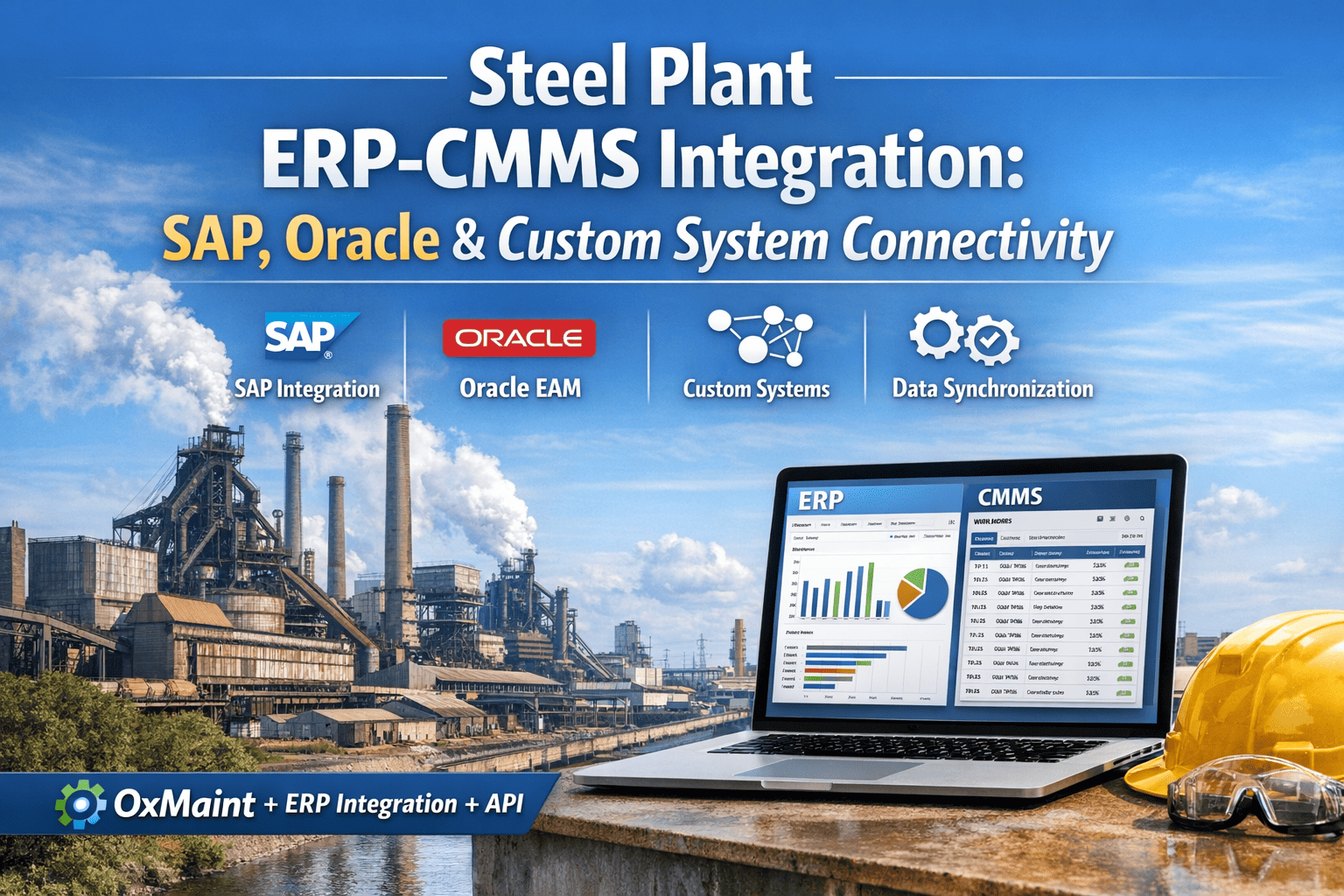
If you run maintenance at a steel plant, you already know the pain. Your ERP tracks finances in one system. Your maintenance team logs work orders in another — or worse, on paper. Procurement has its own spreadsheets. And when the plant manager asks a simple question like "What did we actually spend on that blast furnace this quarter?" — everyone scrambles. This disconnect isn't just frustrating. It's costing steel plants millions every year in avoidable downtime, duplicate work, and blind-spot decisions.
The answer isn't replacing your ERP or buying yet another tool. It's connecting what you already have. ERP-CMMS integration creates a live data bridge between your business systems and your maintenance operations — so every work order, spare part, and cost flows automatically where it needs to go. No manual entry. No reconciliation nightmares. Just one source of truth for your entire plant.
What Exactly Is ERP-CMMS Integration?
Think of it this way: your ERP is the business brain — it handles money, procurement, HR, and supply chain. Your CMMS is the maintenance brain — it manages work orders, preventive schedules, asset histories, and technician workflows. Right now, these two brains probably don't talk to each other. Integration changes that.
When a technician closes a work order in the CMMS, the labor and parts costs flow directly into the ERP's financial module. When spare parts hit reorder level, the ERP automatically processes the purchase order. No one copies numbers between screens. No one reconciles spreadsheets at month-end. It just works.
Why Steel Plants Need This More Than Anyone
Steel isn't like other industries. You're running 24/7 operations at temperatures above 1,500°C with equipment that takes enormous mechanical punishment. A single unexpected failure in a rolling mill or continuous casting unit doesn't just pause one line — it cascades across the entire production chain. Here's what makes steel plants uniquely vulnerable:
The Real Cost of Disconnected Systems
When your ERP and CMMS don't communicate, the consequences aren't theoretical. They show up in your budget, your uptime numbers, and your team's frustration levels every single day.
Hidden Maintenance Costs
Plants spend an average of 10% of their operating budget on maintenance — but without integrated data, nobody knows if that money is being spent wisely or wasted on the wrong assets.
$253M Lost Annually
The average large manufacturing plant loses $253 million per year to unplanned downtime. For steel, where one hour can cost over $1 million, the stakes are even higher.
Spreadsheet Chaos
Planners spend days exporting, collating, and reconciling data just to answer basic questions. When finance challenges the maintenance budget, the team can't produce unified evidence.
Stop Losing Money to Disconnected Systems
Every day without integration is another day of manual data entry, missed failures, and invisible costs. Oxmaint connects your ERP and maintenance in weeks — not months.
What Changes When You Integrate
Integration isn't a buzzword — it's a set of specific data flows that eliminate manual work and give every department the same real-time picture. Here's what actually happens inside a connected steel plant:
| Data Flow | What Happens Automatically | Who Benefits |
|---|---|---|
| Cost Sync | Labor, parts, and contractor costs flow from work orders into ERP cost centers | Finance & Plant Managers |
| Parts Reorder | CMMS triggers reorder → ERP processes PO → delivery status syncs back | Procurement & Technicians |
| Asset Lifecycle | Maintenance history and failure trends enrich ERP records for capital planning | Reliability Engineers |
| Compliance Trail | Every maintenance step auto-documented for safety audits and regulatory checks | Safety & Compliance Teams |
| Dashboard Unification | KPIs like MTTR, MTBF, PM completion visible across all departments in real-time | Everyone |
Want to see these data flows in action at your plant? Schedule a free demo for a personalized walkthrough.
ROI You Can Actually Measure
Steel plant leaders don't invest on promises — they invest on numbers. Here's what industry benchmarks consistently show when ERP and CMMS systems are properly connected:
Based on 2024–2025 industry maintenance reports. Results vary by plant maturity and implementation scope.
See the ROI for Your Steel Plant
These aren't hypothetical numbers. Book a personalized demo and we'll walk you through exactly how Oxmaint delivers measurable savings at plants like yours.
How Oxmaint Makes This Simple
Legacy enterprise systems take 6–18 months to deploy. Oxmaint is a cloud-native, mobile-first CMMS designed for speed — steel plant teams go live in 2 to 6 weeks with phased rollouts. Here's how it works:
Connect Your ERP
Open API architecture integrates with SAP, Oracle, Microsoft Dynamics, and more. Work orders, costs, and asset records sync automatically between systems.
Equip Your Technicians
Mobile-first design with offline capability means your floor team can access work orders, scan QR codes, and log repairs from anywhere in the plant.
Automate Maintenance
Set up preventive and condition-based schedules. Shift from reactive firefighting to proactive reliability — with budgets automatically aligned in your ERP.
See Everything
Unified dashboards give plant managers, finance, and leadership a single source of truth — MTTR, MTBF, PM completion, total maintenance cost per asset.
Before vs. After Integration
Still relying on disconnected systems? Sign up now and start connecting your maintenance data in under 30 minutes.
Frequently Asked Questions
Does Oxmaint integrate with SAP, Oracle, and Microsoft Dynamics?
Yes. Oxmaint provides open API architecture that supports all major ERP platforms. Work orders, spare parts, maintenance costs, and asset records sync automatically — giving both maintenance and finance teams accurate, live data without manual entry.
How long does deployment take at a steel plant?
Oxmaint is fully operational in 2 to 6 weeks with phased rollouts. Compare that to legacy ERP maintenance modules that typically need 6–18 months. Your team starts seeing value from day one.
Can technicians use it on the plant floor?
Absolutely. Oxmaint is mobile-first with offline capability. Technicians access work orders, scan QR codes, log repairs, and update asset status from smartphones — even in low-connectivity zones common in steel plants.
What ROI can a steel plant expect?
Industry benchmarks show maintenance cost reductions of up to 25%, downtime drops of 25–30%, and productivity gains of 15–25%. For plants losing hundreds of thousands per hour of downtime, payback is measured in weeks, not years.
Is it suitable for multi-site steel operations?
Yes. Oxmaint supports multi-site asset management with centralized dashboards, role-based access, and standardized workflows. Manage multiple plants from one platform while keeping location-specific configurations.
Transform Your Steel Plant Maintenance Today
Join the growing number of steel plants unifying their ERP and maintenance operations with Oxmaint. Deploy in weeks, see results from day one, and turn maintenance from a cost center into a competitive advantage.
.png)