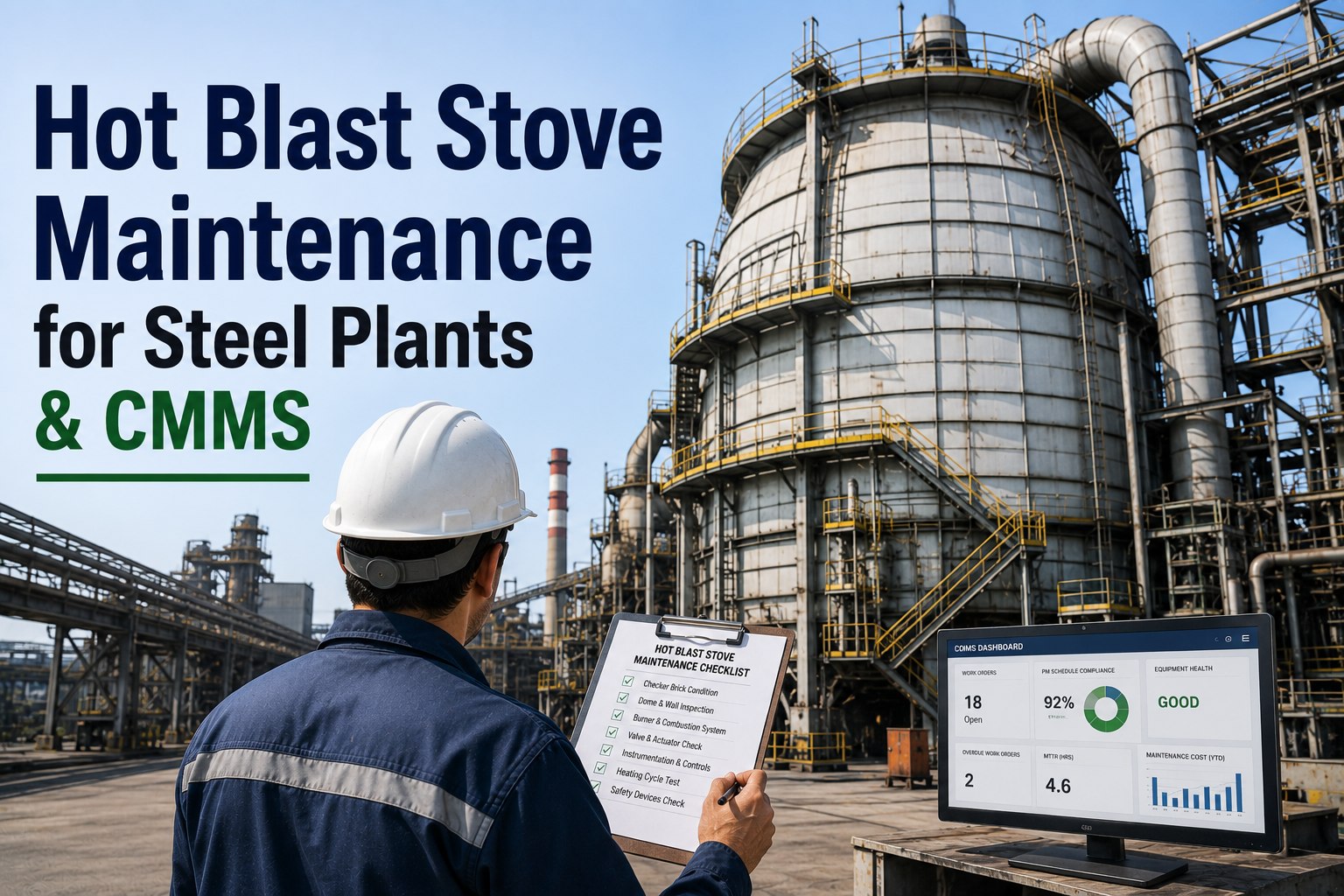
Hot blast stoves sit at the top of the energy-consumption ladder in ironmaking — a single three-stove battery can burn through 25 to 35% of a steel plant's total gas energy budget, making every percentage point of combustion efficiency directly measurable in cash. Their dome refractories, checker chambers, and valve stacks run at extremes that punish drift: a 20 °C slip in dome temperature quietly raises coke rates, while a single leaking hot-blast valve can vent a million cubic metres of enriched gas per month. This guide breaks dome-temperature management, checker-brick condition tracking, combustion tuning and valve PM into a defensible, CMMS-ready program you can deploy in weeks. When you are ready to operationalise it, Start Free Trial and turn the playbook below into scheduled work.
Is a 15 °C dome-temperature drift quietly costing your blast furnace $1.4M a year?
Stoves are the largest energy consumers in the ironmaking chain. Small uncorrected losses in combustion efficiency, checker fouling and valve leakage compound into measurable coke-rate penalties, campaign-life shortening and unplanned blast-furnace stops.
Three figures that reframe stove maintenance from cost centre to profit lever
In a typical 2.5 Mt/y integrated works, the hot blast stove battery consumes more energy than the entire rolling mill. Yet stove PM is still treated as a refractory-only concern rather than an energy-efficiency program. The numbers below are why that has to change.
Worked example — a 180-asset ironmaking plant spending $42K/day on stove gas
A mid-size integrated works running three stoves on a 2.5 Mt/y furnace spends roughly $15.3M per year on blast-furnace gas plus coke-oven-gas enrichment. A CMMS-tracked PM program that recovers 2.5 points of combustion efficiency — through dome-temperature stability, valve leak elimination and checker cleaning — returns approximately $382K per year in fuel savings alone, before counting avoided refractory repairs and reduced unplanned stove changeovers.
The dome-temperature, checker-brick and combustion-efficiency checklist
These are the non-negotiable inspection and condition-tracking tasks for an internal-combustion stove battery. Each one maps to a measurable failure mode and a CMMS work-order template, so nothing sits in a spreadsheet waiting to be forgotten.
Dome Temperature Stability
- Log dome temperature every 5 minutes; flag excursions beyond ±15 °C of setpoint
- Verify redundant thermocouple agreement weekly; replace drifted couples within 48 h
- Track dome-to-blast-temperature delta as an early indicator of refractory wear
- Correlate dome thermal cycles with on/off-ratio and blast duration per campaign
Checker Brick Condition
- Record cold-blast pressure drop across the checker chamber each shift
- Trend pressure-drop rise per month; investigate a 5% month-on-month increase
- Inspect top checker layers via camera every 12 months for slagging, fusion or creep
- Schedule ultrasonic thickness checks on high-temperature zones every 24 months
Combustion Efficiency
- Analyse flue-gas O₂ and CO daily; hold O₂ between 1.5% and 2.5% on gas mode
- Calibrate gas-flow metering orifices quarterly to prevent enrichment drift
- Monitor combustion air-to-gas ratio against stoichiometric setpoint each week
- Log waste-gas temperature trend; a 20 °C rise signals checker fouling or leakage
Valve & Burner Stack
- Stroke all critical valves (hot blast, cold blast, gas, air, chimney, equalising) weekly
- Check seat leakage on hot-blast and gas valves every 90 days with pressure-decay test
- Inspect ceramic burner nozzles annually for cracking, distortion and carbon build-up
- Trend hydraulic actuator pressures and limit-switch timing as leading indicators
| Failure Mode | Leading Indicator | Inspection Cadence | Corrective Window |
|---|---|---|---|
| Checker chamber fouling | Waste-gas temp rise > 20 °C | Daily trend / monthly review | 14 days |
| Dome refractory spalling | Dome-to-blast delta increase > 25 °C | Continuous monitoring | 48 hours |
| Hot-blast valve seat leak | Pressure-decay rate > 0.05 bar/min | 90 days | 7 days |
| Burner nozzle erosion | Flame-pattern asymmetry on camera | 12 months | 30 days |
| Gas-air ratio drift | Flue O₂ outside 1.5–2.5% band | Daily | 24 hours |
| Checker blockage / collapse | Cold-blast ΔP rise > 5% / month | Per shift | 14 days |
A month-by-month PM and inspection schedule for a three-stove battery
This calendar assumes a balanced three-stove operation on staggered on-gas, on-blast and fan-cooling phases. It is engineered to be imported directly into a CMMS as recurring work orders with attached procedures and spare-part kits.
Baseline trend capture
Stand up CMMS logging for dome temp, waste-gas temp, cold-blast ΔP and flue O₂. Verify all instruments within calibration. Establish 30-day baseline before optimisation.
Gas valve leak tests
Pressure-decay test on hot-blast, gas, and chimney valves. Recalibrate gas-flow orifices. Review actuator feedback timing and replace seals showing drift above 0.05 bar/min.
Mid-year efficiency audit
Full combustion-efficiency audit: O₂ trim verification, air-to-gas ratio, waste-gas heat-recovery performance. Action any drift exceeding 1.5 points from baseline efficiency.
Camera & refractory inspection
Cool one stove to fan-cooling phase. Insert high-temperature camera through dome and burner ports. Inspect top checker rows, dome crown, burner throat and combustion-chamber walls.
Ultrasonic thickness survey
On the cooled stove, perform UT thickness checks on high-temperature refractory zones. Compare against campaign-start baseline. Flag any loss exceeding 8% for refractory repair planning.
Campaign plan & budget lock
Aggregate 12 months of CMMS trend data into the annual campaign review. Lock next year's refractory, valve and instrument spend. Rebaseline KPIs and reissue work-order templates.
Why a CMMS converts this playbook into measurable savings
A purpose-built CMMS does three things a spreadsheet cannot: it forces every inspection to a work order, surfaces trend data as leading-indicator alerts, and ties each PM back to a measurable KPI. The result is the difference between a stove battery that drifts and one that holds its efficiency setpoint for the full campaign.
Scheduled work orders, not tribal memory
Every daily, weekly, quarterly and annual task above becomes a recurring CMMS work order with attached procedure, spare-kit list and acceptance criteria. Technicians execute from a mobile device; supervisors sign off against the trend data.
Leading-indicator alerts on trend data
Wire dome-temperature, ΔP, flue-O₂ and valve-decay data into the CMMS as condition triggers. A 5% month-on-month ΔP rise or a 15 °C dome excursion auto-generates a corrective work order before the failure mode matures.
KPI accountability from board to burner deck
Roll every work order and asset record into live dashboards for combustion efficiency, dome-temperature stability, valve-leak rate and refractory thickness. Plant leadership sees energy savings in dollars; crews see PM compliance on their shift.
Audit-ready history for ISO 55000 alignment
Every inspection, repair, calibration and deviation is timestamped, attributed and stored against the asset. When internal audit or a customer compliance review arrives, the full stove-battery history is one report away.
"After moving stove PM into Oxmaint, our dome-temperature stability band tightened from ±22 °C to ±9 °C and we cut unplanned valve swaps from four per year to one. The energy team finally has a number they can defend at the monthly review."
Turn this stove PM playbook into scheduled, auditable work today
Import the full 12-month calendar, checklist templates and KPI dashboards into Oxmaint in under a week — then watch dome-temperature stability and combustion efficiency move in the right direction.
Five questions steel-plant reliability teams ask before deploying a stove CMMS
How often should dome temperature be logged and reviewed?
Dome temperature should be logged continuously at five-minute intervals and trended in the CMMS against setpoint. Supervisors review the daily summary for excursions beyond ±15 °C, while engineers run a monthly statistical review to catch slow drift that single-point checks miss. Pairing continuous logging with monthly trend analysis is what separates a stable stove from one that quietly bleeds efficiency.
What is the single best leading indicator of checker-brick fouling?
Cold-blast pressure drop across the checker chamber is the most reliable leading indicator. A sustained 5% month-on-month rise, confirmed against a stable blast volume, almost always points to top-checker slagging, blockage or creep. Waste-gas temperature rise is a useful corroboration but lags the pressure-drop signal by several weeks, so prioritise ΔP in your CMMS trigger logic.
Can a CMMS really pay for itself on stove maintenance alone?
Yes. On a 2.5 Mt/y furnace, recovering 2.5 points of combustion efficiency through disciplined dome-temperature, valve-leak and checker PM typically returns $300K–$400K per year in gas savings. Most plants recover the full CMMS subscription cost within the first quarter. To see the configuration that delivers this, Book a Demo and we will model it against your stove data.
Which valves need the most frequent PM on a hot blast stove?
The hot-blast, gas, chimney and equalising valves carry the highest criticality because their failure modes include gas leakage, blast loss and unsafe pressurisation. Stroke all four weekly, pressure-decay test the hot-blast and gas valves every 90 days, and trend actuator pressures and limit-switch timing as leading indicators of seal and mechanical wear.
How long does it take to stand up a stove PM program in a CMMS?
A focused team can import the stove-battery asset hierarchy, the full 12-month PM calendar, checklist templates and KPI dashboards in five to ten working days. The fastest path is to start from the pre-built stove template and adapt it to your specific combustion type and valve configuration — you can Start Free Trial and begin importing on day one.
Stop accepting stove drift as normal
Deploy a CMMS-backed PM program that holds dome temperature, combustion efficiency and valve integrity to setpoint — for the full campaign, every campaign.
Free 14-day trial · No credit card