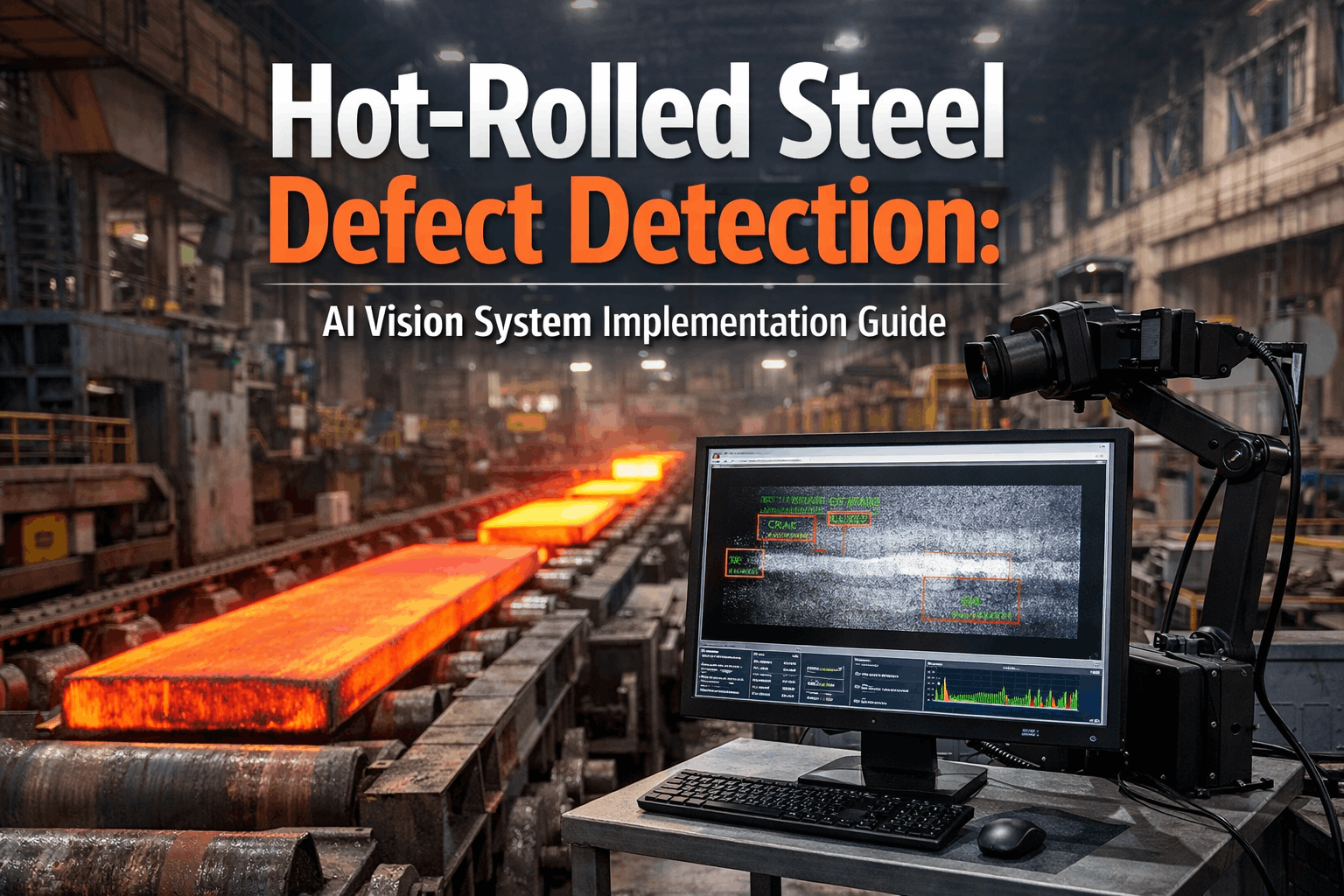
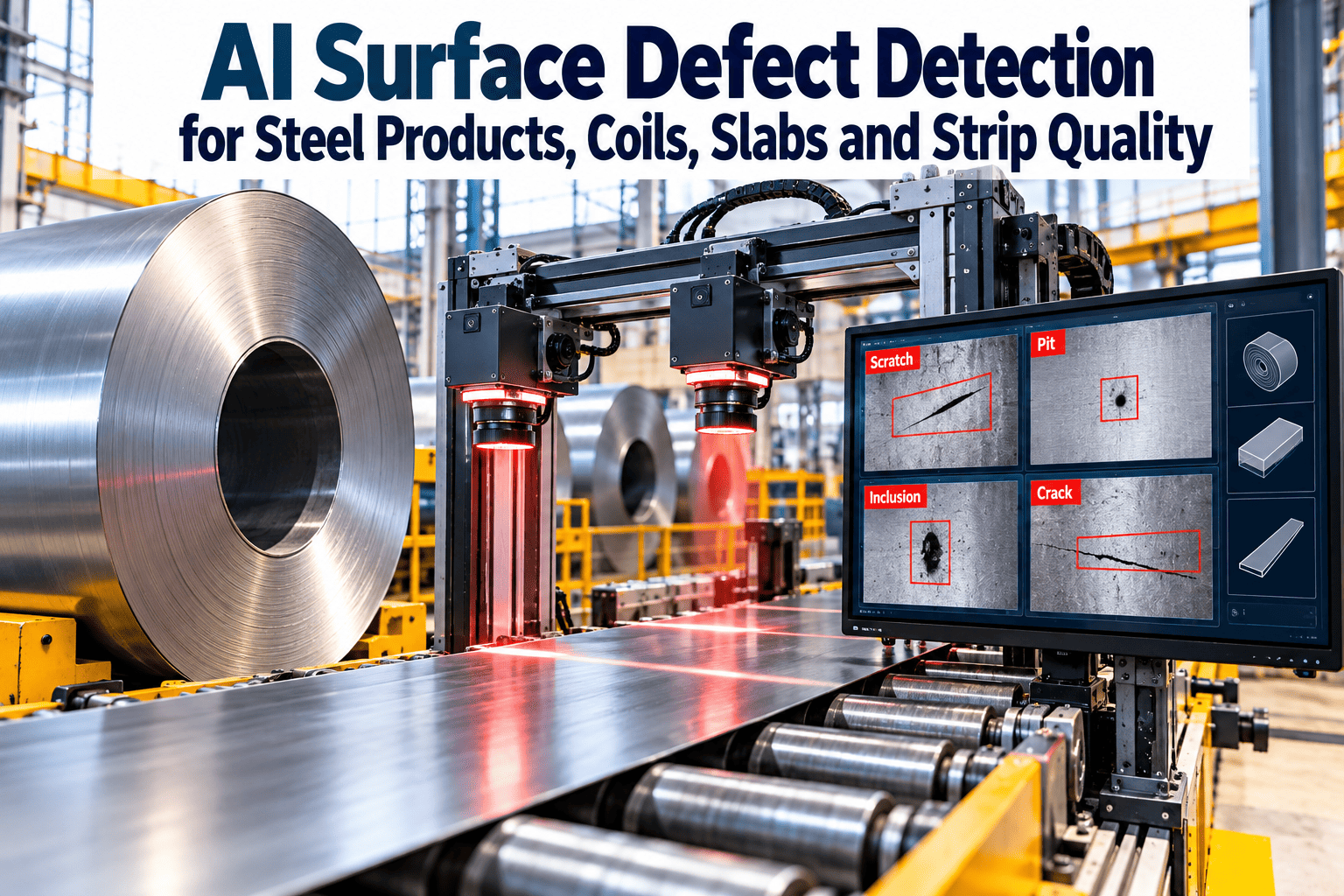
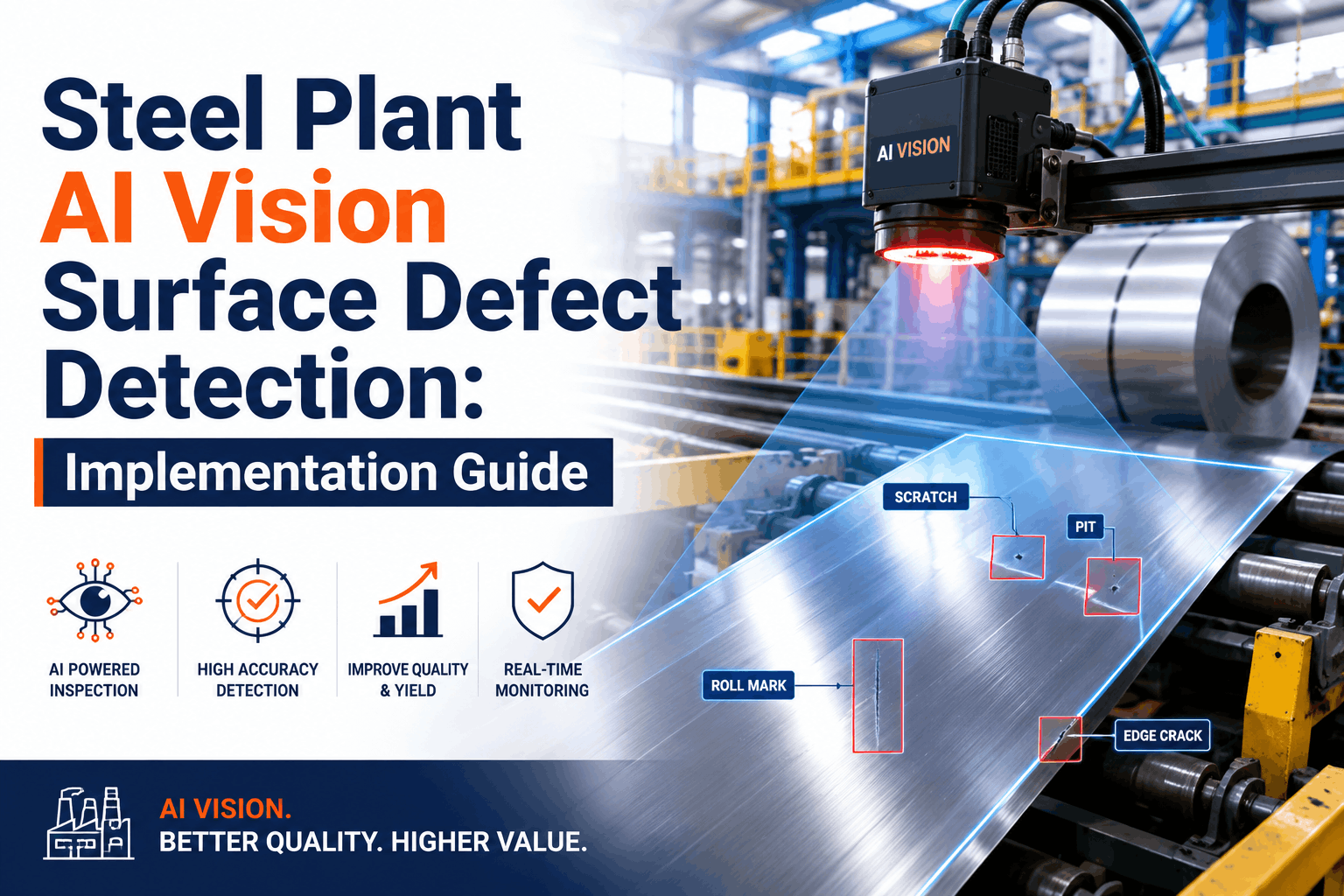
Hot-Rolled Steel Defect Detection: AI Vision System Implementation Guide
By Michael Finn on March 11, 2026
Hot-rolled steel leaves the finishing mill at temperatures exceeding 800°C, travelling at speeds up to 1,200 metres per minute, covered in oxide scale that obscures surface features, surrounded by steam from cooling sprays, and vibrating from the mechanical forces of 6–7 rolling stands compressing a 220mm slab into a 2mm strip in under 30 seconds. These are the conditions under which steel surface quality must be judged — and for over a century, the steel industry has relied on human inspectors standing beside the runout table squinting at a glowing orange strip to make that judgment. The results have been exactly what those conditions predict: detection rates between 50% and 65% for surface defects on hot-rolled product, with the most critical defects — subsurface inclusions, early-stage laminations, and fine longitudinal cracks — being precisely the defects most likely to escape detection because they present the lowest visual contrast against the scaled, glowing surface. A hot strip mill in the Gulf Coast region shipping 2.8 million tonnes annually discovered over a 14-month forensic quality review that 3.7% of all customer-facing coils contained surface defects that had been present at the hot mill exit but were undetected by their 12-person inspection team. The annual cost — customer claims, returned coils, re-inspection labour, emergency downgrades, and two lost automotive qualification programmes — totalled $6.1 million. The most devastating finding was that 78% of the escaped defects fell into just four categories that an AI vision system would have detected with 94%+ accuracy at full line speed.
AI vision systems purpose-built for hot-rolled steel inspection solve the fundamental physics problem that defeats human inspectors: they see through scale, compensate for thermal radiation, operate at any line speed, never fatigue, never vary between shifts, and classify defects in under 50 milliseconds with accuracy levels that improve with every coil processed. But detection alone does not prevent defects from reaching customers — detection must connect to action. When the AI system identifies progressive roll marks building across consecutive coils, that signal must trigger an automatic roll change work order in the CMMS before the next prime-grade coil enters the mill. When inclusion clusters correlate with a specific caster sequence, that connection must reach the melt shop within minutes, not days. Oxmaint delivers the integrated platform that connects AI vision defect data to maintenance execution, process feedback, and quality management — transforming hot-rolled steel inspection from a passive observation exercise into an active defect elimination system. Start your free trial to build the AI vision inspection system that catches what human eyes cannot and prevents what traditional quality programmes never will.
AI Vision Implementation Guide 2026
Hot-Rolled Steel Defect Detection: AI Vision System Implementation Guide
Purpose-built for the harshest inspection environment in steel manufacturing — 800°C+ strip temperatures, 1,200 m/min line speeds, oxide scale, steam, and vibration. This guide covers camera and lighting engineering for hot mill conditions, AI model training on scale-obscured surfaces, real-time defect classification at production speed, CMMS-integrated corrective action workflows, and process feedback architectures that turn defect detection into defect prevention across hot strip mills.
800°C+
Strip Surface Temperature
1,200
Max Line Speed (m/min)
94%+
AI Detection Accuracy
$6M+
Avg Annual Recovery
Why Hot-Rolled Inspection Is the Hardest AI Vision Challenge in Manufacturing
Hot-rolled steel inspection is not simply "machine vision on a production line." It is the most extreme imaging environment in any manufacturing industry — combining physical conditions that would destroy standard camera equipment, optical challenges that defeat conventional image processing algorithms, and process speeds that leave zero margin for computational delay. The five environmental challenges below explain why generic vision systems fail on hot strip mills and why purpose-built solutions require specialised engineering across every component of the inspection architecture.
Thermal Radiation Flooding
Hot strip at 800–1,100°C emits intense infrared and visible radiation that overwhelms camera sensors. Standard industrial cameras saturate immediately. Purpose-built systems use narrow-band optical filters, high-intensity LED illumination that overpowers thermal emission, and specialised sensor calibration to capture surface texture through the thermal glow.
Scale Obscuration
Iron oxide scale forms on the strip surface immediately after descaling, partially or fully obscuring surface defects beneath a rough, variable-thickness coating. AI models must be trained specifically to detect defect signatures through scale — a capability that rules-based machine vision cannot achieve because scale texture varies with temperature, chemistry, and cooling rate.
Extreme Speed Imaging
Strip speeds of 600–1,200 m/min mean a 0.1mm defect passes the camera in 5–10 microseconds. Line-scan cameras must operate at 16,000–32,000 lines per second with sub-microsecond exposure times. Any motion blur, vibration, or timing jitter renders defect features unresolvable — demanding mechanical isolation and precision triggering beyond standard industrial practice.
Steam and Water Interference
Laminar cooling sprays on the runout table create dense steam clouds and water droplets that scatter light and obscure the optical path between camera and strip. Air-knife systems, heated enclosures, and optical path protection are required to maintain clear imaging conditions — adding engineering complexity absent from any other vision application.
Vibration and Strip Flutter
Mechanical vibration from rolling stands, coilers, and runout table rollers combines with aerodynamic strip flutter at high speeds to create continuous relative motion between the camera and inspection surface. Vibration-isolated mounting, high-speed autofocus, and computational image stabilisation are essential to maintain 0.1mm imaging resolution.
The Cost of Missed Defects: Hot-Rolled Quality Escape Cascade
Every undetected defect on a hot-rolled coil enters a value amplification pipeline — gaining cost at every downstream step until it reaches the customer. A surface crack that could have been diverted at the hot mill for $200 in downgrade cost becomes a $45,000 customer claim after cold rolling, coating, slitting, and shipping to an automotive stamper who discovers it during press forming. The cascade below illustrates this value amplification and the intervention points where AI vision breaks the chain. Discover how Oxmaint breaks this chain at every stage.
Hot-Rolled Defect Cost Amplification CascadeHow a $200 diversion decision becomes a $45,000 customer claim
1
Hot Mill Exit — Missed
Surface defect present at hot strip mill exit but undetected by human inspector due to scale, speed, and thermal conditions. Diversion cost if caught: $200.
Cost: $200
2
Pickling & Cold Rolling
Defect propagates through acid pickling and cold reduction. Scale removed reveals defect but now cold-rolled value is embedded. Internal catch cost: $2,800.
Cost: $2,800
3
Coating & Finishing
Galvanising or painting adds $150–300/tonne of value over a defect that will cause coating failure at the customer. Internal catch cost: $8,500.
Cost: $8,500
4
Shipped to Customer
Defective coil shipped, slit, and delivered. Freight, handling, and customer inventory investment added. Recall cost if caught pre-use: $22,000.
Cost: $22,000
5
Customer Press Failure
Defect causes stamping crack, weld failure, or coating delamination during customer fabrication. Full claim with line downtime, scrap, re-sourcing: $45,000+.
Cost: $45,000+
Hot-Rolled Defect Detection: Human vs AI Performance by Defect Type
The performance gap between human inspection and AI vision is widest on precisely the defect types that cause the most expensive customer escapes. The comparison below shows detection rates for the eight most common hot-rolled surface defect categories — demonstrating why AI vision is not merely an incremental improvement over human inspection but a fundamentally different capability level.
Detection Rate Comparison: Human Inspector vs AI Vision on Hot-Rolled Steel
Defect TypeHuman DetectionAI DetectionImprovement
Rolled-In Scale48%94%+46pt
Subsurface Inclusions38%92%+54pt
Longitudinal Cracks55%96%+41pt
Roll Marks62%97%+35pt
Edge Cracks68%97%+29pt
Lamination Signatures32%91%+59pt
Slivers45%93%+48pt
Mechanical Scratches58%96%+38pt
AI Vision Impact Metrics for Hot Strip Mill InspectionMeasured improvements from deployed hot-rolled AI inspection systems
94%
Detection Accuracy
70%
Claims Reduction
45%
Downgrade Reduction
$6M+
Annual Recovery
<3%
False Positive Rate
Hot Mill AI Vision Implementation Roadmap
Deploying AI vision on a hot strip mill requires careful phasing that accounts for the extreme environmental conditions, the need for plant-specific model training, and the critical importance of operator trust in AI classification before transitioning from human to automated inspection. The roadmap below sequences the implementation to build accuracy, confidence, and integration systematically.
01
Site Engineering & Installation Month 1–3
Camera housing design — water-cooled enclosures with optical-grade windows rated for 1,200°C radiant exposureLED lighting array installation — high-intensity narrow-band illumination overcoming thermal radiationAir-knife and steam suppression systems along optical path between cameras and stripEdge computing infrastructure — GPU servers in climate-controlled mill enclosure
02
Data Collection & Model Training Month 3–6
Capture 100,000+ hot-rolled surface images across all product widths, gauges, and grade familiesExpert defect labelling — metallurgists classify and grade each defect image for AI trainingCNN model training on plant-specific hot-rolled data — iterative refinement to 90%+ accuracyScale-pattern compensation training — model learns to distinguish defects from normal scale variation
03
Shadow Mode Validation Month 6–8
AI system operates parallel to human inspectors — all detections logged but no production decisionsAccuracy validation: compare AI detections against human findings and customer-returned coilsFalse positive tuning — reduce nuisance alarms below 3% to build operator confidenceEnvironmental robustness testing across seasonal temperature variation and product mix changes
04
Production Deployment & Integration Month 8–12
AI promoted to primary detection — human inspectors transition to verification and exception handlingCMMS integration: defect patterns auto-generate roll change, descaler, and caster maintenance WOsQuality system integration: real-time coil grading and automatic diversion at coilerProcess feedback: AI defect data feeds rolling and casting parameter optimisation in real time
Catch Every Defect at the Hot Mill — Before It Costs 225x More Downstream
Oxmaint connects AI vision defect data from your hot strip mill directly to CMMS maintenance workflows and process control systems — ensuring every roll mark triggers a roll change order, every inclusion pattern initiates a caster investigation, and every defect stops at the hot mill instead of reaching your customer.
Understanding your current inspection maturity determines investment requirements, implementation timeline, and achievable quality improvement. Most hot strip mills operate at Level 1 — human inspection only — leaving 35–50% of surface defects undetected and costing millions annually in quality escapes.
Level 1: Human Visual Inspection Only
Human Inspectors50–65% DetectionNo Data TrailShift Variation 25%+
Escape rate 2.5–4.5%. Subtle defects (inclusions, laminations, fine cracks) systematically missed. No defect-to-process correlation. Quality knowledge lost with every inspector retirement.
Level 2: Camera + Rules-Based Detection
Camera Systems70–82% Detection15–30% False PositivesBasic Reporting
Escape rate 1.5–2.8%. Major defects detected but high false alarm rates cause operator alarm fatigue. Cannot distinguish scale variation from true defects. No learning capability.
Level 3: AI Deep Learning Vision + CMMS
CNN AI Models94%+ Detection<3% False PositivesCMMS + Process Feedback
Escape rate <0.5%. Defects classified through scale at any speed. Patterns trigger maintenance and process corrections automatically. System accuracy improves with every production hour.
ROI: Human Inspection vs AI Vision for Hot-Rolled Steel
Annual Cost Impact: Single Hot Strip Mill (2M+ Tonnes)Manual inspection vs AI vision system with CMMS and process feedback integration
Manual Human Inspection
Customer quality claims$2.1M – $6.8M/yr
Product downgrade losses$1.2M – $4.5M/yr
Inspection labour costs$600K – $1.4M/yr
Lost process feedback value$800K – $3.2M/yr
Average detection rate50–65%
Annual Quality Cost: $4.7M – $15.9M+
VS
AI Vision + CMMS Integration
AI vision system investment$800K – $1.8M/yr
Claims reduction (70%+)$1.5M – $4.8M saved
Downgrade reduction (45%)$540K – $2.0M saved
Process feedback value$560K – $2.2M saved
Average detection rate94%+
Net Annual Savings: $1.8M – $7.2M+
Five CMMS-Connected Actions Driven by Hot Mill AI Vision Data
AI vision data from the hot strip mill drives five distinct corrective action pathways through CMMS — each one connecting a specific defect pattern to the upstream equipment condition that creates it. These pathways transform the inspection system from passive detection into active defect prevention, ensuring every quality signal triggers the maintenance or process action that eliminates the root cause.
1
Roll Surface Degradation → Automatic Roll Change Scheduling
Progressive roll mark severity increasing across consecutive coils triggers CMMS work order for roll surface inspection and schedules roll change during next planned gap — preventing defective coils from reaching prime-grade customers while maximising roll campaign life.
2
Inclusion Patterns → Caster Process Investigation
Inclusion cluster frequency exceeding threshold per casting sequence correlates with tundish campaign age, ladle practice changes, or mould powder performance. CMMS generates caster investigation work order with defect evidence and sequence correlation data for melt shop team.
AI identifies which strip positions show persistent scale residue — mapping directly to specific descaler header nozzle positions. CMMS generates targeted nozzle replacement work orders for identified positions rather than replacing entire headers — reducing both maintenance cost and descaling defects.
4
Edge Crack Correlation → Slab Conditioning and Mill Setup
Edge crack patterns correlating with specific slab widths, caster sequences, or reheat furnace zones trigger upstream process investigation — connecting hot mill surface quality to slab conditioning practices, edger setup, and reheat furnace temperature uniformity through CMMS workflow.
Every coil automatically graded by AI based on defect type, severity, and location against customer-specific quality specifications. Coils diverted, re-assigned, or approved in real time at the coiler — maximising revenue by matching actual surface quality to the most appropriate order.
Turn Hot Mill Defect Data Into Equipment Improvement Signals
From AI-detected roll marks triggering automatic roll change orders to inclusion patterns driving caster investigations — Oxmaint connects hot strip mill quality intelligence to maintenance execution, ensuring defects are not just detected but permanently eliminated at their source.
CMMS Integration Architecture for Hot Mill AI Vision
The six integration capabilities below describe how Oxmaint connects AI vision inspection data from the hot strip mill to equipment maintenance, process control, and quality management — creating the complete closed-loop system that transforms every detected defect into an equipment improvement opportunity.
01Real-Time Defect Ingestion
Every AI-classified defect streams into CMMS via API — tagged with type, severity, size, strip position, coil ID, grade, and timestamp. The system builds a continuously growing defect-equipment correlation database that becomes more powerful with every production hour.
02Pattern-Based WO Automation
Configurable rules monitor defect trends: roll mark severity increase across 10 consecutive coils triggers roll change WO. Inclusion frequency exceeding 5 per sequence triggers caster investigation. Each pattern maps to specific equipment with assigned owner, priority, and evidence package.
03Equipment-Quality Correlation
Links every maintenance event to quality data before and after the action. When roll change eliminates roll marks — confirmed. When descaler nozzle replacement reduces scale defects — confirmed. The CMMS builds the causal knowledge base that drives predictive quality maintenance.
04Post-Action Verification Loop
After maintenance triggered by quality data, the CMMS monitors subsequent AI vision output to verify defect elimination. If defects persist after repair, the work order re-escalates with updated evidence. Proof of elimination required before work order closure — no false fixes allowed.
05PM Schedule Optimisation
Quality data reveals actual equipment condition intervals that produce defects. Roll change frequency, descaler nozzle replacement intervals, and edger maintenance cycles are optimised based on quality-validated degradation rates rather than conservative time-based schedules.
06Executive Quality-Maintenance Reports
Monthly reports quantifying defect-creating conditions detected by AI, maintenance actions triggered, defects verified as eliminated, customer claims prevented, and downgrades avoided. Proves quality programme and maintenance programme ROI from a single data source.
Frequently Asked Questions
Q. Can AI vision systems detect defects through oxide scale on hot-rolled steel?
Yes — and this is one of the most significant advantages of deep learning AI over both human inspection and rules-based machine vision for hot-rolled steel. Oxide scale forms on the strip surface within seconds of descaling and varies in thickness, texture, and optical properties based on steel grade, temperature, cooling rate, and descaler performance. Human inspectors struggle because scale obscures defect contrast, and rules-based systems fail because scale texture triggers constant false alarms. Deep learning CNN models are trained specifically on hot-rolled surface images with scale present — learning to distinguish the visual signatures of true defects (cracks, inclusions, roll marks) from normal scale variation. The AI effectively "sees through" scale by recognising the subtle texture disruptions, shadow patterns, and contrast differences that defects create within the scale layer. Detection accuracy through scale typically reaches 91–96% depending on defect type, compared to 35–65% for human inspectors under the same conditions.
Q. How do cameras survive the extreme heat environment at the hot strip mill exit?
Cameras for hot strip mill inspection use multi-layered thermal protection systems. The camera sensor itself is housed in a water-cooled stainless steel enclosure that maintains internal temperature below 40°C even when exposed to 1,200°C radiant heat from the strip. The optical path uses a high-temperature glass window with anti-reflective coating, protected by a continuous compressed air curtain that prevents scale dust and water droplet deposition. An air-knife system positioned between the camera and strip clears steam from the optical path. The camera enclosure is mounted on vibration-isolated brackets to decouple it from mill mechanical vibration. LED lighting units use similar water-cooled enclosures with focused beam optics that overpower thermal radiation from the strip. Complete camera protection systems are rated for continuous operation at ambient temperatures up to 80°C with radiant heat exposure from surfaces up to 1,200°C, and typical maintenance intervals are 6–12 months for window cleaning and air system filter replacement. Sign up for Oxmaint to manage your hot mill AI vision inspection system maintenance.
Q. How long does it take to train an AI model specifically for hot-rolled steel defect detection?
Training a production-grade AI model for hot-rolled steel defect detection requires 8–16 weeks of focused effort after camera installation. The process follows four stages. Stage 1 (weeks 1–4): image collection — capturing 100,000+ surface images across the full product mix, including all steel grades, strip widths, gauge ranges, and seasonal temperature variations. Stage 2 (weeks 4–8): expert labelling — metallurgists and quality engineers classify and grade each defect image, building the labelled dataset that teaches the AI what each defect type looks like through scale at various temperatures. Stage 3 (weeks 8–12): model training — CNN architecture training with iterative refinement, data augmentation for rare defect types, and hyperparameter optimisation to achieve 90%+ accuracy. Stage 4 (weeks 12–16): validation and tuning — shadow mode comparison against human inspection and known defect samples, false positive reduction below 3%, and environmental robustness testing. Total elapsed time from camera installation to validated model: 4–6 months. Book a demo to discuss your specific product mix and training timeline.
Q. What is the total implementation cost and timeline for hot mill AI vision?
A complete hot mill AI vision implementation for a single hot strip mill typically costs $1.5M–$3.5M in capital investment covering camera systems (4–8 camera units for full-width top and bottom coverage), LED lighting arrays, water-cooled enclosures, air-knife systems, edge computing infrastructure (GPU servers), network connectivity, and AI software platform licensing. Annual operating costs (maintenance, model updates, platform subscription) range from $300K–$600K. Total implementation timeline is 10–14 months from project approval to full production deployment with CMMS integration. The phased approach includes: months 1–3 for site engineering and installation, months 3–6 for data collection and model training, months 6–8 for shadow mode validation, and months 8–12 for production deployment and system integration. Most hot strip mills achieve full ROI within 10–14 months of production deployment through reduced customer claims, lower downgrade rates, and recovered process feedback value. Typical annual savings of $4M–$8M against a $2M–$4M total annual cost produces ROI multiples of 3x–9x.
Q. How does AI vision data from the hot mill connect to CMMS for maintenance improvement?
AI vision data connects to CMMS through five automated pathways that turn quality signals into maintenance actions. First, defect pattern monitoring — when roll mark severity increases across consecutive coils, the CMMS auto-generates a roll change work order with defect evidence, severity trend data, and recommended timing. Second, equipment correlation — inclusion clusters correlating with specific caster sequences trigger melt shop investigation work orders with heat-by-heat defect mapping. Third, position-specific maintenance — scale residue patterns mapping to individual descaler nozzle positions generate targeted nozzle replacement orders. Fourth, post-action verification — after maintenance is completed, the CMMS monitors subsequent AI vision data to confirm the defect pattern has been eliminated before closing the work order. Fifth, PM optimisation — quality data reveals the actual equipment degradation rates that produce defects, enabling maintenance intervals to be adjusted based on quality impact rather than conservative calendar schedules.