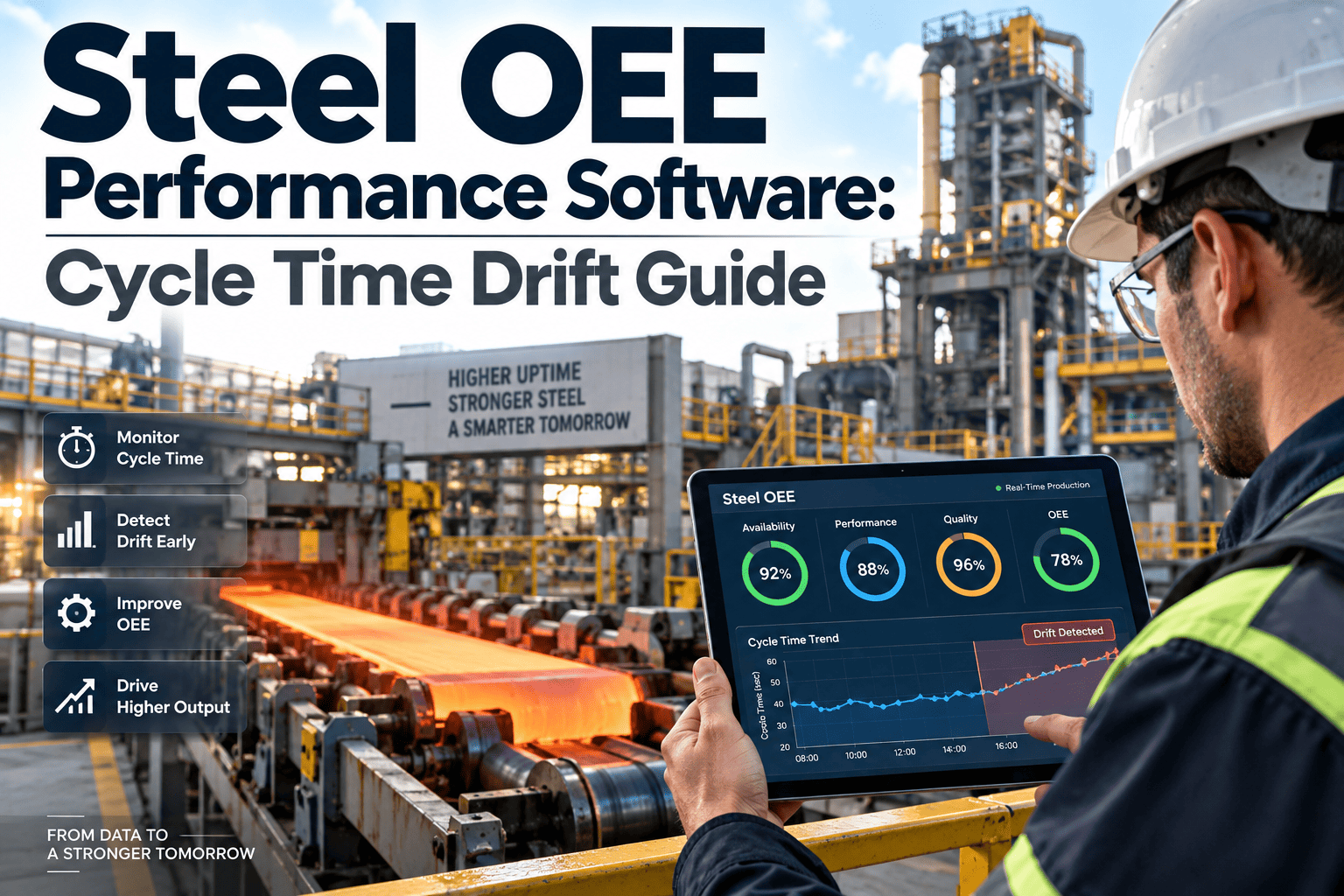
Performance is the silent killer of OEE. While unplanned downtime screams for attention and quality defects trigger immediate action, performance losses quietly drain 10-20% of your production capacity. A line rated for 100 units per hour limping along at 85? That's $500K+ in lost margin annually—and most operations don't even know it's happening.
The Performance component of OEE measures how actual production speed compares to theoretical maximum. It captures all the speed losses, micro-stops, and inefficiencies that prevent equipment from running at designed capacity. Improving performance KPI isn't about running faster—it's about eliminating the friction that's slowing you down.
Understanding Performance Losses
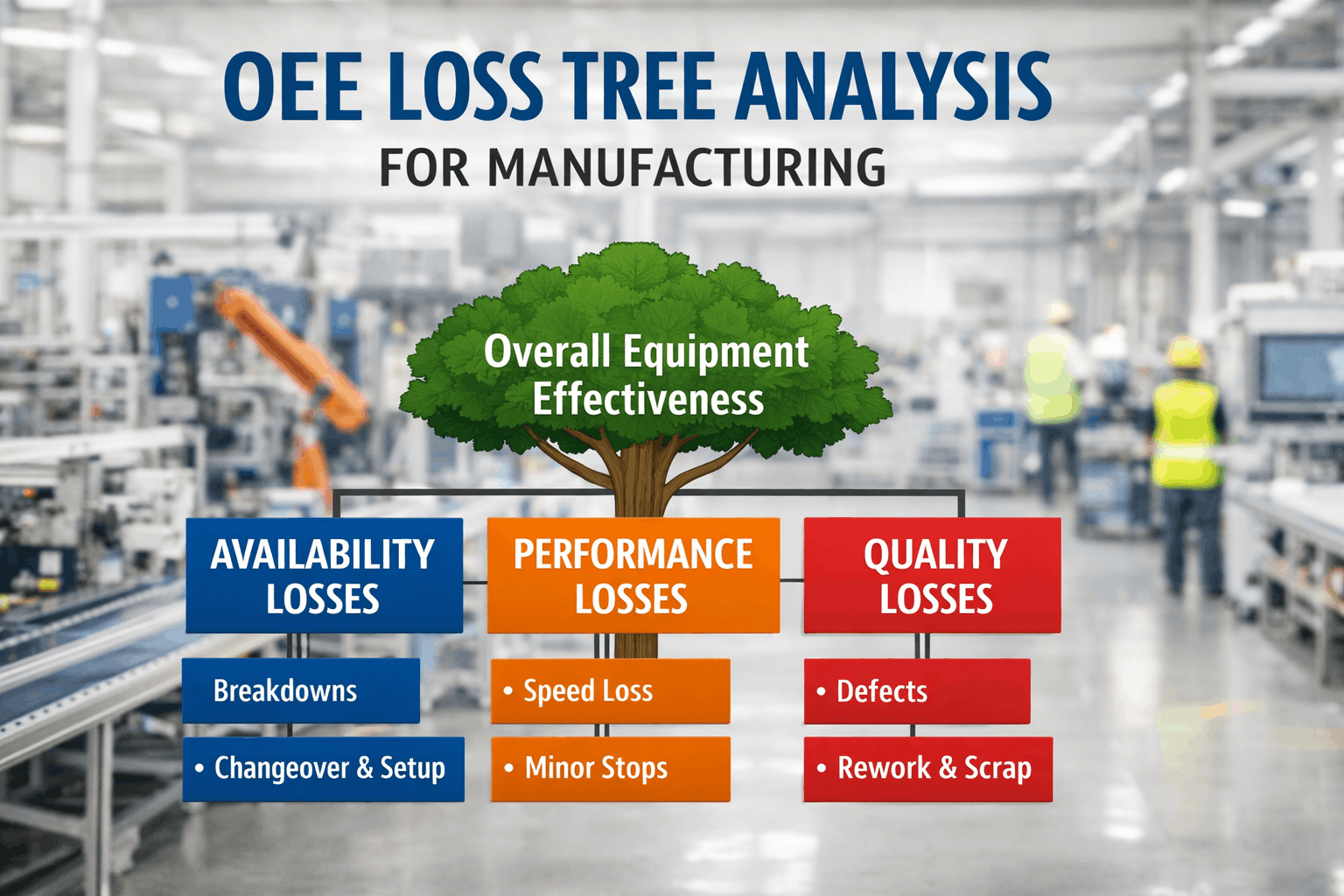
Performance degradation comes from two categories: speed losses (running below rated speed) and micro-stops (brief interruptions too short to count as downtime). Both are insidious because they're often invisible without continuous monitoring.
Speed Losses
Micro-Stops
The Performance Improvement Framework
Systematic performance improvement requires a structured approach combining measurement, analysis, and targeted intervention. Modern CMMS platforms provide the data foundation for this framework.
Establish Accurate Baselines
Define theoretical maximum speed based on engineering specifications, not historical averages. Validate with manufacturer specs and controlled testing. Measure actual performance continuously for 2-4 weeks to establish true current state.
Identify Loss Patterns
Analyze when and why performance degrades. Time-of-day patterns, product changeovers, material batches, operator shifts—find the correlations that point to root causes rather than symptoms.
Prioritize Improvement Targets
Focus on high-impact, achievable wins first. Target losses with clear root causes, accessible solutions, and measurable results. Build momentum with early successes before tackling complex issues.
Implement & Validate
Execute improvements systematically with before/after measurement. Use statistical process control to verify sustained gains. Document successful interventions for replication across similar equipment.
Sustain & Scale
Prevent regression through visual management, standard work, and continuous monitoring. Extend proven improvements to other lines and equipment. Build a culture of performance optimization.
Ready to Unlock Hidden Capacity?
Discover how systematic performance improvement can boost throughput 10-15% without capital investment.
Key Strategies for Performance Improvement
Effective performance improvement combines equipment optimization, process refinement, and operational discipline. Here are the highest-impact strategies based on real manufacturing results.
Equipment Optimization
Process Refinement
Operational Excellence
Tackling Micro-Stops
Micro-stops are the most underestimated performance killer. Individually trivial (10-60 seconds), collectively devastating (hundreds per day). They're often invisible in traditional reporting because they're too short to trigger alarms or get logged manually.
Micro-Stop Reality Check
Detection & Resolution
Data-Driven Performance Improvement
Gut feel and anecdotes don't improve performance—data does. Modern manufacturing generates the information needed for precise diagnosis and targeted intervention, if you capture and analyze it properly.
Data Collection
Data Analysis
Data-Driven Action
Transform Data Into Performance Gains
See how automated performance tracking identifies hidden losses and guides targeted improvements.
Common Performance Improvement Mistakes
Well-intentioned performance initiatives often fail due to predictable pitfalls. Learn from others' mistakes to accelerate your success.
Mistake: Unrealistic Speed Targets
The Error: Setting theoretical speed as the target without accounting for product mix, changeovers, or material variability. Leads to quality problems and operator frustration.
The Fix: Define "practical maximum speed" based on sustainable operation under real conditions. Use 95th percentile of best performance as target.
Mistake: Ignoring Micro-Stops
The Error: Focusing only on major downtime events while hundreds of brief stops go unnoticed and unaddressed. Loses 5-15% capacity silently.
The Fix: Deploy automated monitoring to capture all stops. Visualize micro-stop patterns to make the invisible visible and actionable.
Mistake: Equipment-Only Focus
The Error: Assuming performance problems are purely mechanical and ignoring process design, material handling, and human factors.
The Fix: Use root cause analysis that considers equipment, process, material, and human elements. Often the constraint isn't the machine itself.
Mistake: No Sustained Focus
The Error: Launching improvement blitzes that achieve gains, then moving on to other priorities. Performance gradually regresses to previous levels.
The Fix: Build performance review into daily management routines. Use visual management and standard work to prevent backsliding.
Performance Improvement Toolkit
Equip your team with the right tools and techniques to systematically identify and eliminate performance losses.
Pareto Analysis
Identify the vital few causes behind 80% of performance losses. Focus improvement efforts where they'll have maximum impact.
Statistical Process Control
Monitor performance over time to distinguish normal variation from significant changes requiring investigation.
Time Studies
Break down operations into granular steps to identify wasted motion, waiting time, and opportunities for cycle time reduction.
5 Whys Root Cause
Drill down from symptoms to fundamental causes by repeatedly asking "why" until the true root cause emerges.
SMED (Quick Changeover)
Systematically reduce changeover time by converting internal steps to external and eliminating waste from both.
Gemba Walks
Direct observation at the point of production reveals problems invisible in data—operator workarounds, material handling issues, ergonomic constraints.
Measuring Success
Track these metrics to quantify performance improvement progress and ensure gains are sustained over time.
Performance Rate
Average Cycle Time
Micro-Stop Frequency
Speed Loss Hours
Frequently Asked Questions
What's a realistic performance improvement target?
Most facilities can achieve 5-15% performance improvement within the first year through systematic approaches. Quick wins (low-hanging fruit) deliver 3-5% in 3-6 months, while deeper improvements require 6-12 months. Improvement potential depends on current performance level—facilities at 70% have more headroom than those at 85%.
Should we sacrifice quality to improve performance?
Never. Performance improvements must maintain or improve quality. If faster speed causes quality issues, the root problem is equipment capability or process design—not speed itself. Address those constraints first, then increase speed. True performance improvement eliminates waste while maintaining quality standards.
How do we identify which performance losses to tackle first?
Use Pareto analysis to identify the top 3-5 causes representing 70-80% of total losses. Then evaluate each on impact (capacity recovered) versus effort (resources, time, complexity). Start with high-impact, low-effort opportunities to build momentum and demonstrate ROI before tackling more complex issues.
Can we improve performance without expensive equipment upgrades?
Absolutely. Most performance improvements come from optimizing existing equipment, not replacing it. Better maintenance, process refinement, changeover reduction, and operator training typically deliver 10-20% gains with minimal capital. Only pursue equipment upgrades after exhausting operational improvements.
How do we prevent performance from regressing after improvement?
Sustainability requires three elements: standard work (document and train on optimized methods), visual management (real-time performance displays create accountability), and continuous monitoring (automated systems flag degradation immediately). Build performance review into daily management routines rather than treating it as a one-time project.
Unlock 10-15% Hidden Capacity Without Capital Investment
Performance improvement isn't about running faster—it's about eliminating the friction slowing you down. See how Oxmaint helps manufacturers systematically identify and capture performance losses.