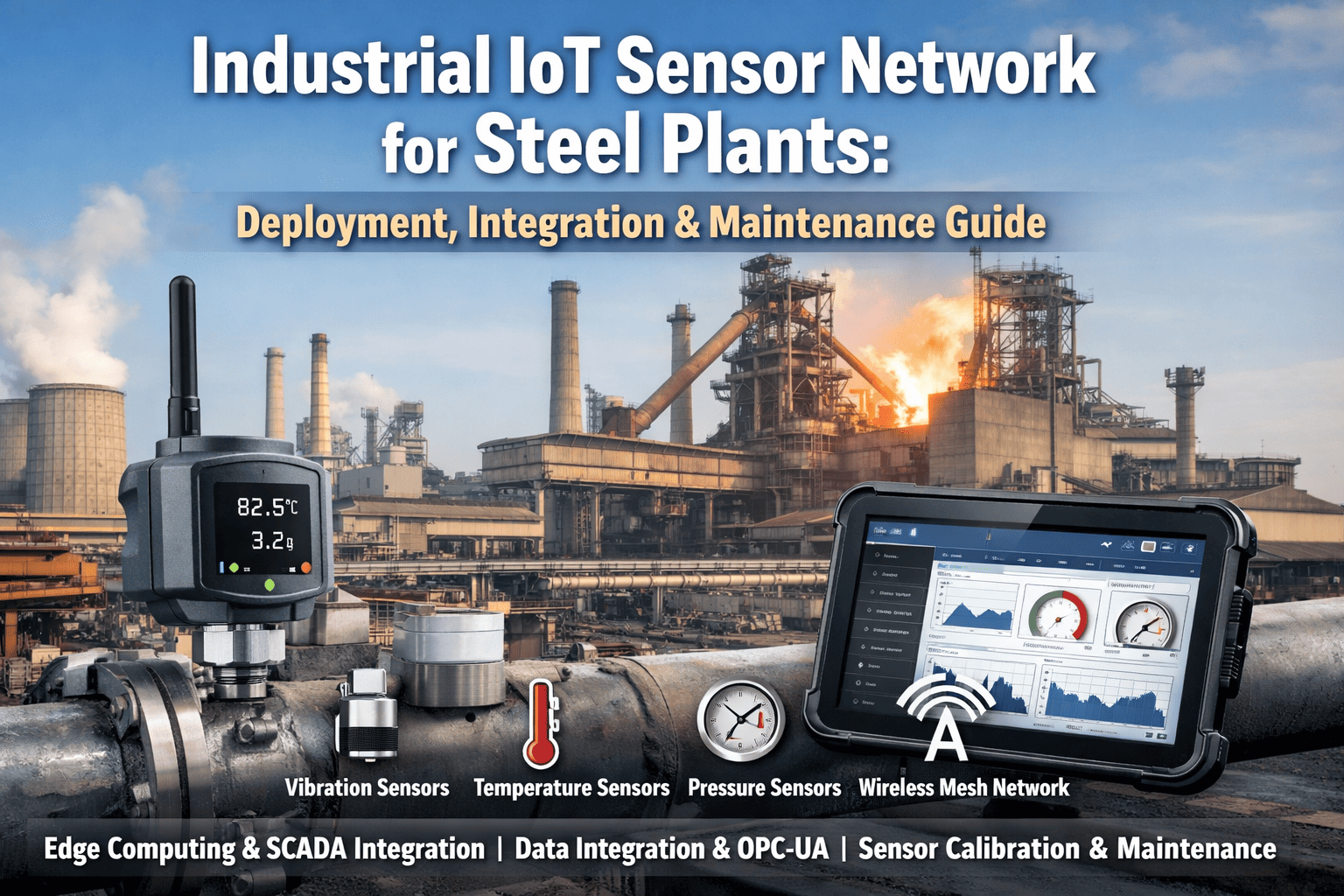
Steel plants operate in some of the most punishing conditions on earth—extreme heat near blast furnaces, airborne dust that blinds conventional electronics, and constant vibration from rolling mills. When equipment fails without warning, a single hour of downtime can cost hundreds of thousands of dollars. Industrial IoT sensors give your steel plant the ability to monitor temperature, vibration, pressure, and equipment health in real time, catching problems weeks before they become failures. OxMaint's CMMS platform connects directly with your IIoT sensor network to auto-generate work orders, track asset conditions, and power truly predictive maintenance. Schedule a demo to see how sensor-driven maintenance transforms steel plant operations.
Why Steel Plants Are Adopting IIoT at Record Pace
The global IIoT market is projected to grow from $289 billion in 2024 to over $847 billion by 2033, driven largely by heavy manufacturing sectors like steel. Predictive maintenance alone accounted for the largest application share in 2024—and steel plants stand to gain the most from this shift.
12.7%
CAGR Growth Rate
46.7%
Hardware Market Share
25.4%
Asia-Pacific CAGR
#1
Manufacturing Adoption
Sources: IMARC Group, Mordor Intelligence, Grand View Research — 2024 Reports
Ready to connect your steel plant assets? Start with OxMaint's free CMMS and integrate IIoT sensor data from day one.
Start Free
The Real Cost of Flying Blind
Steel mills, mining operations, and metals processing facilities face some of the highest downtime costs in all of manufacturing. Without real-time sensor data, maintenance teams are left guessing—and guessing wrong costs millions.
$1.4T
Lost annually to unplanned downtime by the world's 500 largest companies
Siemens True Cost of Downtime 2024
$125K
Cost per hour of unplanned outage for a typical industrial plant
82%
Of companies experienced unplanned downtime in the past 3 years
25
Average monthly downtime incidents per major manufacturing plant
62%
Increase in downtime costs since 2019 across heavy industry sectors
Sensor Types That Survive the Steel Mill
Not just any sensor can survive the hostile interior of a steel plant. Temperatures near blast furnaces exceed 1,500°C, rolling mills generate relentless vibration, and metallic dust infiltrates everything. Here are the five sensor categories engineered to thrive in these conditions—and what each one monitors.
Temperature Sensors
Thermocouples (Type K, S, R) & RTDs
Range: -200°C to 1,700°C
Blast Furnace Shell
Ladle Lining
Motor Bearings
Cooling Systems
Early detection of refractory wear, overheating motors, and cooling failures before they cascade into catastrophic shutdowns.
Vibration Sensors
Piezoelectric Accelerometers & Velocity Sensors
Range: Up to 325°F (163°C) operating temp
Rolling Mills
Conveyors
Pumps & Fans
Compressors
Detects bearing degradation, misalignment, and imbalance weeks before failure through vibration signature analysis.
Pressure Sensors
Piezoresistive, Capacitive & Strain Gauge
Range: -50°C to 600°C, up to 40 atm
Hydraulic Systems
Steam Lines
Gas Pipelines
Cooling Circuits
Monitors pressure anomalies in hydraulic presses and steam systems that signal leaks, blockages, or impending ruptures.
Fluid Property Sensors
Oil Condition, Moisture & Viscosity Sensors
Continuous inline monitoring
Gearbox Oil
Hydraulic Fluid
Lubricant Quality
Coolant Purity
Tracks lubricant degradation and contamination, extending equipment life and eliminating unnecessary oil changes.
Position & Proximity Sensors
AMR, LVDT & Inductive Proximity
Dust-proof & vibration-resistant designs
CNC Machines
Robotics Arms
Crane Positioning
Slab Tracking
Provides precise positional feedback for automation equipment even in dusty, high-vibration steel mill environments.
How IIoT Architecture Works in a Steel Plant
A well-designed IIoT deployment in a steel plant follows a four-layer architecture—from sensors on the shop floor all the way up to your CMMS dashboard. Here's how data flows from machine to maintenance decision.
01
Sensor Layer
Physical Data Collection
Temperature, vibration, pressure, and fluid sensors installed directly on critical equipment—blast furnaces, rolling mills, motors, pumps, and hydraulic systems. Industrial-grade housings in stainless steel or aluminum protect against extreme heat, dust, and vibration.
Thermocouples
Accelerometers
Pressure Transducers
RTDs
02
Edge & Gateway Layer
Local Processing & Transmission
Industrial gateways aggregate sensor signals and perform initial edge processing—filtering noise, running threshold alerts, and compressing data before transmission. This reduces bandwidth requirements and enables sub-second response for critical alarms.
Edge Computing
LoRaWAN / 5G
OPC UA
Modbus TCP
03
Cloud & Analytics Layer
AI-Driven Pattern Recognition
Sensor data flows into cloud platforms where machine learning models analyze vibration signatures, temperature trends, and pressure patterns. The system establishes baselines for every asset and flags deviations that indicate developing faults—often weeks before failure.
Machine Learning
Time-Series DB
Digital Twins
Predictive Models
04
CMMS Action Layer — OxMaint
Automated Maintenance Execution
Predictive insights automatically trigger work orders in OxMaint. Technicians receive mobile alerts with asset location, fault description, and recommended parts. Supervisors track completion rates, and every action is logged for compliance audits.
Auto Work Orders
Mobile Alerts
Parts Inventory
Audit Trail
Connect Your Sensors to Smarter Maintenance
Book a personalized demo and see how OxMaint turns raw sensor data into automated work orders, predictive alerts, and compliance-ready audit trails.
Predictive Maintenance ROI for Steel Plants
The shift from reactive to predictive maintenance isn't incremental—it's transformational. Steel plants that deploy IIoT sensors and connect them to a CMMS consistently report dramatic improvements in uptime, cost savings, and equipment longevity.
$1.5M
First-year savings from strategic sensor deployment in steel manufacturing
One steel plant prevented a $3M transformer failure through early vibration detection alone.
Plant Services Case Study
30–50%
Reduction in unplanned downtime
Comprehensive predictive maintenance programs consistently deliver this range of downtime reduction across manufacturing operations.
Industry Analysis 2024
20–25%
Increase in asset lifespan
IIoT-enabled predictive analytics enhance productivity and extend the useful life of critical industrial equipment significantly.
ABB IIoT Report
25–30%
Reduction in operational costs
Manufacturers with a proper predictive maintenance strategy and scalable IIoT platform achieve substantial operational cost cuts.
ABB Industry Analysis
20–30%
Parts consumption reduction
Intervening only when data indicates actual need—rather than on fixed schedules—eliminates waste from premature component replacements.
Strainlabs Research 2024
82%
Of failures are random, not age-related
Only 18% of equipment fails due to age. Condition-based monitoring catches the 82% of failures that time-based maintenance misses entirely.
ARC Advisory Group
Real-World IIoT Success in Steel
Leading steel manufacturers are already proving the value of IIoT sensor deployment. These examples demonstrate how sensor-driven maintenance delivers measurable results in real steel plant environments.
Challenge
Critical pumps and fans driven by high and low-voltage motors operated 24/7 with no real-time visibility into motor health or bearing condition.
IIoT Solution
Deployed ABB's predictive maintenance system combining vibration sensors, cloud computing, and machine learning to continuously monitor motor performance.
Results
Bearing failures detected early via vibration analysis
Short-circuit risks identified through power anomalies
24/7 continuous motor health monitoring achieved
Challenge
Aging transformers at risk of catastrophic failure with no early-warning system. A single transformer failure could cost up to $3 million in damages and lost production.
IIoT Solution
Strategic sensor deployment focused on critical transformer assets, monitoring temperature, vibration, and electrical parameters continuously.
Results
$1.5 million saved in first year
Prevented potential $3 million transformer loss
Moved from reactive to planned maintenance
5 Biggest IIoT Deployment Challenges (and How to Solve Them)
Implementing IIoT in a steel plant isn't plug-and-play. The environment is harsh, legacy systems are deeply entrenched, and cybersecurity risks are real. Here's what automation engineers face—and how to overcome each challenge.
01
Extreme Heat & Dust Environments
Standard industrial sensors fail quickly near blast furnaces (1,500°C+) and in dust-laden areas where metallic particles infiltrate housings.
Solution: Use high-temperature rated sensors (Type S/R thermocouples for 1,600°C+), stainless steel or aluminum sealed housings with IP67+ ratings, and non-contact measurement technologies where direct mounting isn't feasible.
02
Wireless Connectivity Reliability
Dense steel structures, electromagnetic interference from heavy machinery, and sprawling plant layouts create dead zones for wireless sensor networks.
Solution: Deploy hybrid connectivity using LoRaWAN for long-range, low-power sensors and private 5G for latency-critical data. Use mesh network topologies and strategically placed repeaters to eliminate coverage gaps.
03
Legacy System Integration
Steel plants run decades-old SCADA, DCS, and PLC systems using protocols like PROFINET and Modbus that weren't designed for cloud connectivity.
Solution: Use OPC UA as a bridge protocol between legacy systems and modern IIoT platforms. Industrial gateways can translate Modbus/PROFINET data into cloud-compatible formats without replacing existing infrastructure.
04
Cybersecurity for OT Networks
Connecting operational technology to the internet introduces attack vectors. In 2024, 31% of manufacturers experienced financial impact from cyberattacks affecting OT/IT systems.
Solution: Implement network segmentation between IT and OT, use encrypted data transmission, deploy industrial firewalls at edge gateways, and maintain strict access controls with role-based permissions through your CMMS.
05
Scaling from Pilot to Plant-Wide
Many IIoT pilots succeed in a single production area but stall when scaling across the entire steel plant due to cost, complexity, and change management.
Solution: Follow the 80/20 rule—instrument the 20% of critical assets that cause 80% of your downtime first. Use a scalable CMMS like OxMaint that grows with your sensor network without per-asset licensing penalties.
How OxMaint Closes the Loop
IIoT sensors generate data. OxMaint turns that data into action. Our CMMS platform is purpose-built to receive sensor feeds and convert condition alerts into maintenance workflows—automatically, in real time, with complete audit trails.
When a vibration sensor detects bearing degradation on a rolling mill motor, OxMaint automatically creates a priority work order, assigns it to the right technician based on skill and availability, and attaches the asset's maintenance history.
Technicians receive instant push notifications on their mobile devices with fault details, asset location, and recommended actions—even in areas with limited connectivity using offline-capable features.
A centralized dashboard displays real-time condition data for every connected asset. Color-coded health indicators let supervisors instantly identify which equipment needs attention and which is running within normal parameters.
Every sensor reading, work order, completion record, and approval is logged with timestamps and user attribution. Generate compliance reports for ISO 55000, OSHA, and environmental regulations with a single click.
Connect every technician, supervisor, and automation engineer across your steel plant without worrying about licensing costs. OxMaint scales with your team and your sensor network at one predictable price.
Combine sensor condition data with historical failure patterns to automatically schedule maintenance at the optimal time—maximizing equipment life while minimizing production disruption.
Frequently Asked Questions
What types of IIoT sensors work best in steel plant environments?
For steel plants, you need sensors specifically rated for extreme conditions. Type K, S, and R thermocouples handle temperatures from -200°C to 1,700°C. Piezoelectric accelerometers in stainless steel housings withstand the vibration and dust near rolling mills. Piezoresistive pressure sensors in Hastelloy or ceramic materials resist the corrosive gases common in steelmaking. Always look for IP67+ ratings and industrial-grade enclosures.
How does OxMaint integrate with existing IIoT sensor networks?
OxMaint connects with IIoT platforms through standard APIs and supports common industrial protocols. Sensor data from your edge gateways flows into OxMaint's condition monitoring module, where threshold-based rules automatically generate work orders. We integrate with existing SCADA and DCS systems through OPC UA bridges, meaning you don't need to replace your current infrastructure.
Book a demo to see integration in action.
What ROI can we expect from IIoT-connected CMMS?
Steel plants typically see 30-50% reductions in unplanned downtime, 20-30% savings on parts consumption, and 25-30% lower operational maintenance costs within the first year. One steel manufacturer saved $1.5 million in its first year of sensor deployment while preventing a potential $3 million transformer failure. The exact ROI depends on your plant's size, current maintenance maturity, and which critical assets you instrument first.
How do we start an IIoT deployment without disrupting production?
Start with a focused pilot on your most critical assets—typically 3-5 machines that account for the majority of your unplanned downtime. Use non-intrusive, wireless sensors that can be installed during scheduled shutdowns without modifying existing equipment. Connect these to OxMaint immediately to begin tracking condition data and generating automated work orders. Once the pilot proves ROI, expand systematically across departments.
Is our sensor data secure in the cloud?
OxMaint uses encrypted data transmission (TLS 1.3), role-based access controls, and network segmentation between IT and OT environments. Your sensor data is encrypted at rest and in transit. We recommend implementing industrial firewalls at edge gateways and maintaining strict user permission hierarchies—OxMaint's role-based access system makes this straightforward to manage across large teams.
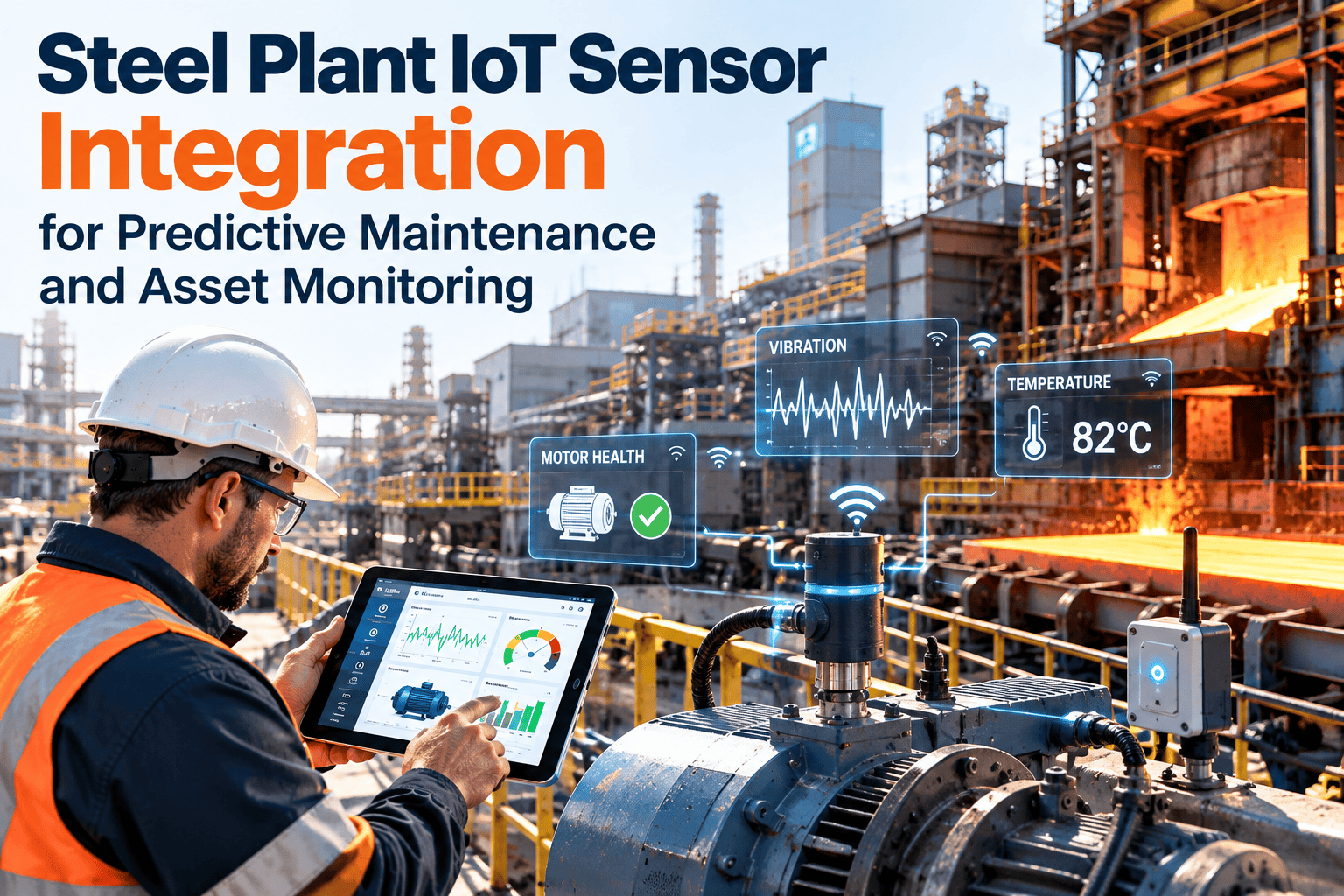
Turn Sensor Data into Maintenance Intelligence
OxMaint connects your IIoT sensors to a powerful CMMS that automates work orders, tracks asset health in real time, and gives your maintenance team the predictive edge they need to eliminate unplanned downtime.

-sensor-deployment-for-steel-plants.png)