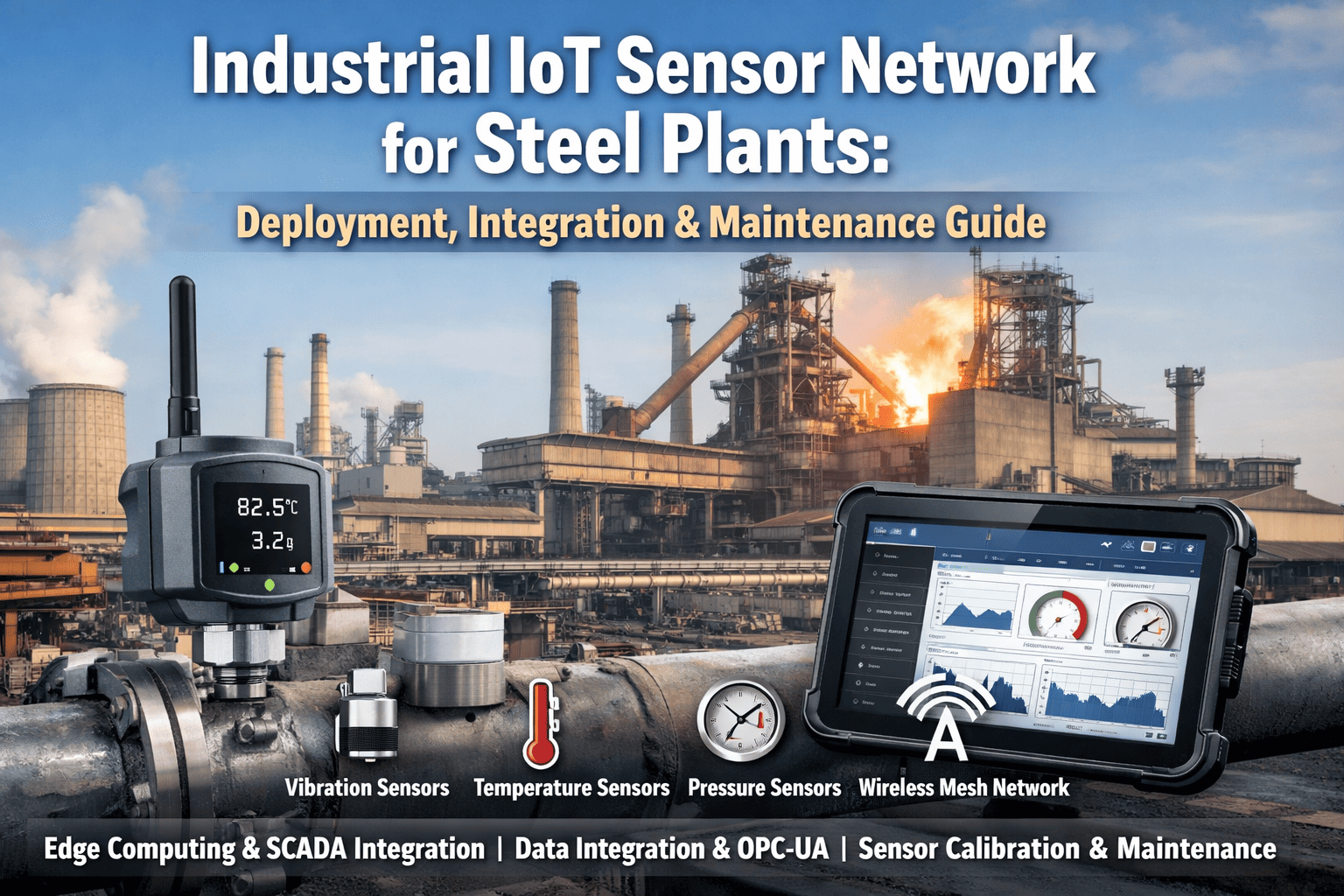
A rolling mill bearing that fails without warning costs a mid-size steel plant between $180,000 and $400,000 in emergency repairs, lost production, and expedited parts — every single time. Yet the degradation that causes that failure is detectable weeks in advance through vibration frequency shifts that no human can feel or hear during a routine walkround. IIoT sensors mounted directly on critical rotating equipment pick up those signatures continuously, feed them into your CMMS, and trigger a planned maintenance work order before the bearing ever seizes. Sign up for Oxmaint to connect your first steel plant sensor in under 30 minutes.
Six IIoT Sensor Categories Every Steel Plant Needs to Deploy First
Not all steel plant assets carry equal risk. Start sensor deployment on the assets where an unplanned failure creates the largest production impact — blast furnace auxiliaries, rolling mill drive trains, and continuous casting equipment. Sign up for Oxmaint to map your critical assets before your first sensor order.
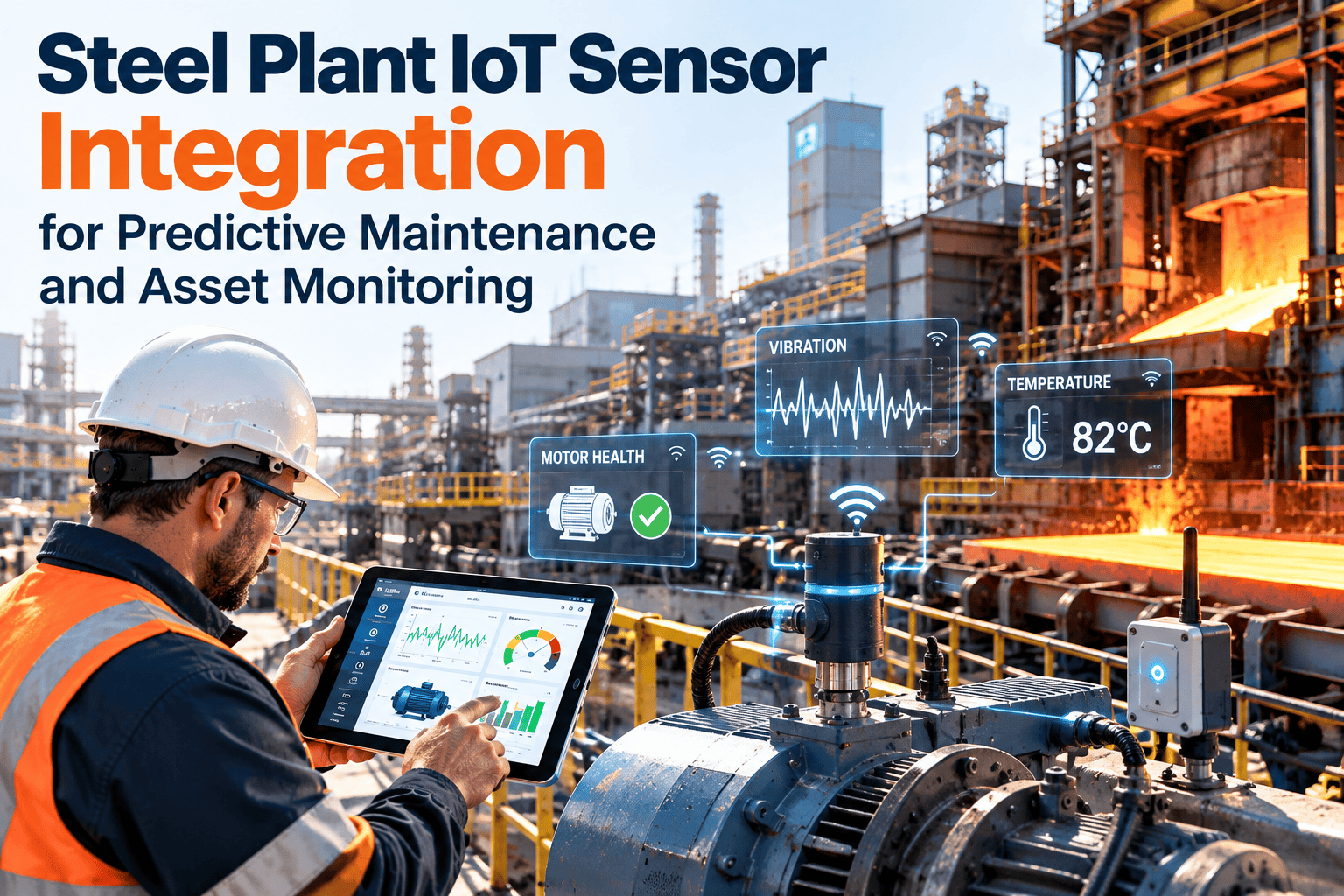
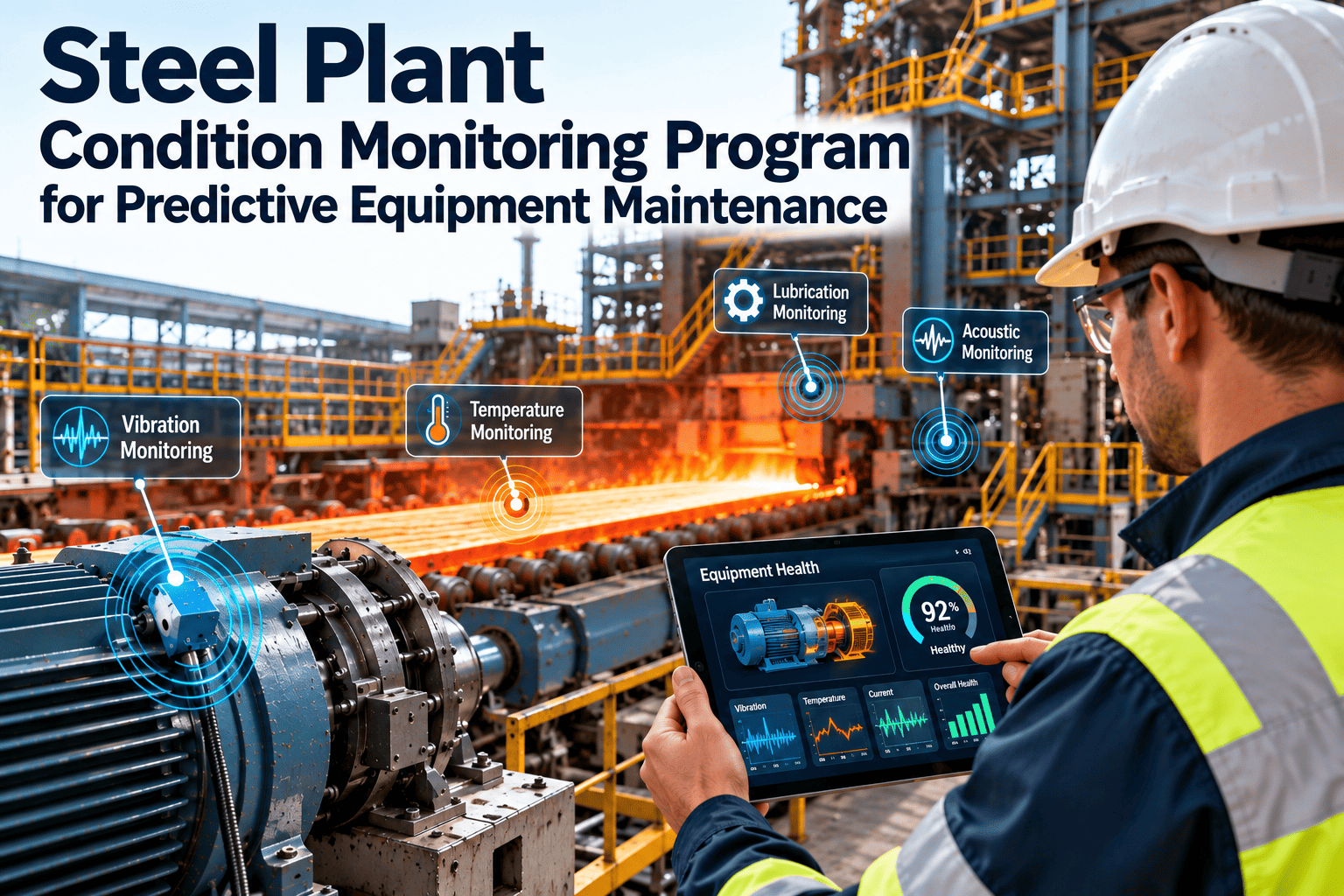
Tri-axial accelerometers mounted on motor and gearbox housings detect bearing wear, shaft imbalance, misalignment, and looseness weeks before audible symptoms appear. Steel plant rolling mills with high-cycle loads degrade bearing raceways rapidly — continuous vibration monitoring catches the signature shift from Zone A to Zone D before catastrophic seizure.
Thermocouples and infrared pyrometers placed on refractory walls, cooling systems, bearing housings, and electrical cabinets provide continuous thermal state monitoring. For blast furnace operations, stave cooler temperature trends are the primary early-warning signal for refractory lining wear — a failure that can cost $8–15M in unplanned outages.
Inline oil quality sensors fitted to gearbox and hydraulic system lube circuits detect water contamination, oxidation breakdown, and metallic particle accumulation in real time. Rolling mill gearboxes operating under high radial loads generate wear debris that precedes gear failure by 3–6 weeks — a window that allows planned replacement rather than emergency stoppage.
Fixed electrochemical sensors in coke oven corridors, blast furnace cast houses, and BOF hoods monitor hazardous gas accumulation continuously. When gas concentrations exceed defined thresholds, the CMMS receives an automatic alert, generates an emergency work order, and records the event for regulatory compliance — eliminating manual gas monitoring walks in the most dangerous plant zones. Book a demo to see the auto-alert workflow.
Current transformers and power quality monitors on EAF transformers, large drive motors, and crane systems detect winding insulation degradation, phase imbalance, and harmonic distortion. Motor current signature analysis (MCSA) identifies broken rotor bars and bearing faults through current spectrum analysis — without physical sensor contact on the motor itself.
Airborne ultrasonic detectors identify compressed air and steam leaks — a major hidden energy cost in steel plants where compressed air systems can waste 30–40% of generated air through small, inaudible leaks. Structural ultrasonic sensors on pressure vessels, pipelines, and ladle walls track wall thickness changes over time, flagging corrosion before it reaches safety-critical minimums.
From Raw Sensor Data to Planned Maintenance Work Order in Oxmaint
IIoT sensors are only useful when the data they generate creates action. Oxmaint closes the loop between sensor readings and maintenance scheduling — automatically, without spreadsheet intermediaries or manual data transfer.
Continuous Baseline Learning — Not Static Thresholds
Fixed alarm thresholds miss the gradual degradation patterns that matter most. Oxmaint's IIoT integration builds an equipment-specific baseline from the first 30 days of sensor readings and alerts when the rate of change accelerates — not just when a fixed number is crossed.
- Vibration trend accelerating beyond 15% week-over-week triggers a planning alert
- Temperature delta-T rise on cooling circuits flags flow restriction before overheating
- Oil particle count growth rate triggers lubrication sample request before gear damage
Any Sensor, Any Protocol — Connected to One CMMS
Steel plants run mixed sensor ecosystems — legacy SCADA historians, new wireless IIoT nodes, and PLC outputs. Oxmaint ingests data from all of them through OPC-UA, MQTT, REST API, and Modbus connections, normalizing it into a single asset condition view without requiring a full network overhaul.
- Existing Siemens, ABB, and Primetals systems connect via standard OPC-UA adapters
- Wireless IIoT sensors transmit over WirelessHART, ISA100, or LoRaWAN with edge gateway
- SCADA historian data is polled and mapped to Oxmaint asset records automatically
Steel Plant IIoT Sensor Deployment in 5 Stages
A structured deployment prevents the most common IIoT failure mode — sensors generating data that no one acts on. Follow this sequence to go from first sensor to active predictive maintenance in under six weeks. Create your account to begin the asset criticality mapping in Stage 1 today.
Scroll to see all deployment stages
Your Rolling Mills Are Telling You Something. Are You Listening?
Every hour of production lost to a bearing failure that vibration sensors could have predicted weeks earlier is a cost that cannot be recovered. Oxmaint connects your IIoT sensors to automated work orders — so the signal becomes action before the failure becomes downtime.
What Oxmaint Does with Your Steel Plant Sensor Data
Raw sensor streams become maintenance intelligence only when they are connected to asset records, work orders, and maintenance history. Oxmaint provides four core capabilities that turn IIoT data into measurable uptime improvement. Sign up to see how your sensor data maps to these workflows.
View all sensor-equipped assets on a single plant floor map. Color-coded health scores update continuously as vibration, temperature, and oil data streams in. Maintenance planners see deteriorating assets before the shift crew notices anything unusual.
- Plant map view with live asset health indicators
- Trend charts per sensor per asset — 30/90/365 day views
- Alert queue ranked by severity and production impact
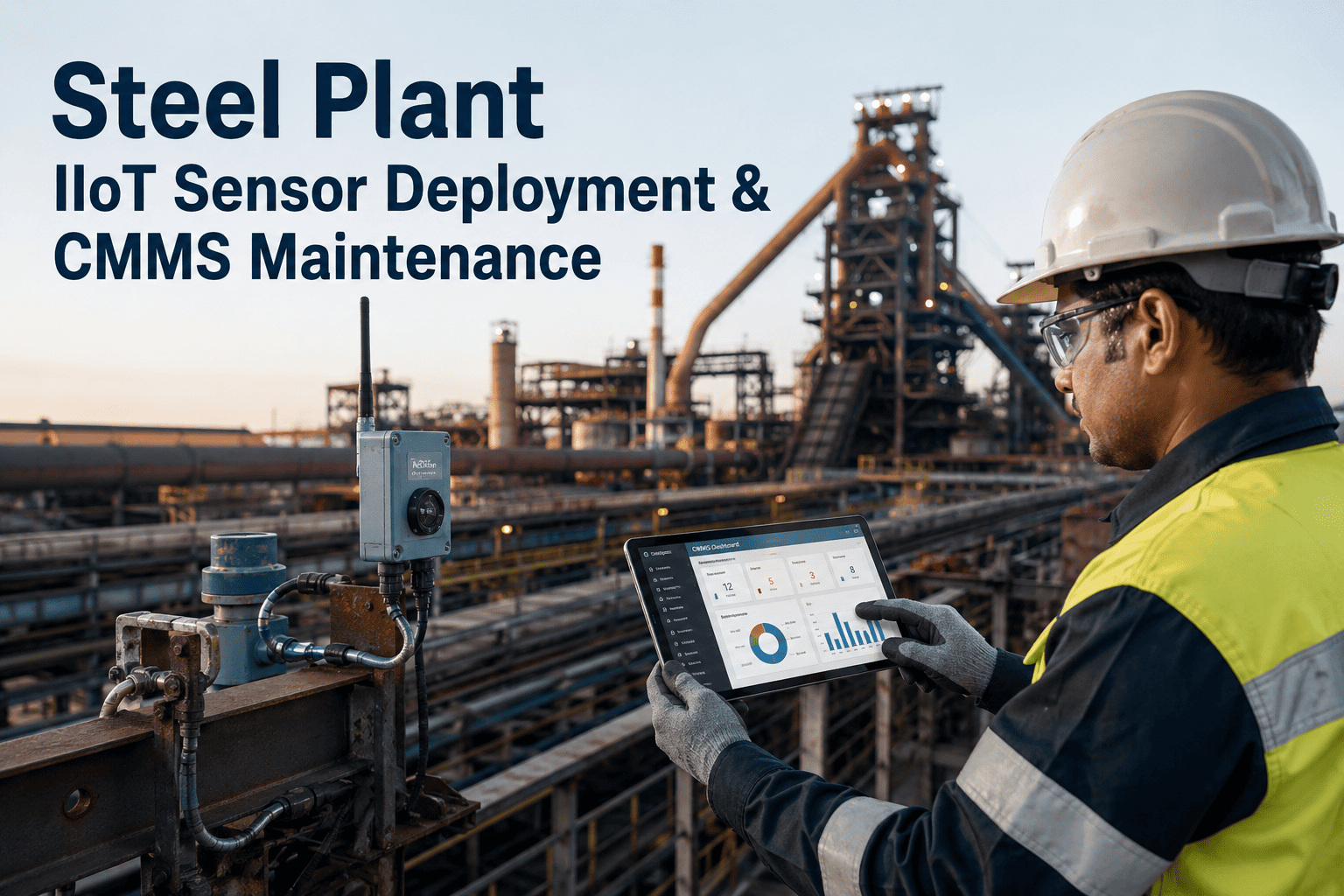
When a sensor reading crosses a defined threshold or trend rule, Oxmaint creates a work order automatically — with the sensor evidence, asset location, recommended repair action, and required parts attached. No manual interpretation step between the alert and the maintenance response.
- Threshold and trend-based trigger rules per asset
- Sensor data automatically attached to generated work order
- Technician assignment based on skill set and shift schedule
Oxmaint's analytics engine models the rate of deterioration on each monitored asset and projects the estimated time to failure based on current trend trajectory. Maintenance planners get a forecast window — typically 2–8 weeks — to schedule the repair during planned downtime rather than in an emergency. Book a demo to see forecasting configured for your rolling mill assets.
- Estimated failure date based on trend extrapolation
- Confidence intervals updated as new sensor data arrives
- Parts pre-ordering triggered when repair window opens
Every sensor alert, work order response, and repair completion is timestamped and stored in a tamper-evident audit trail. For steel plants operating under ISO 55001 asset management, ISO 45001 safety, or environmental permit conditions, Oxmaint's sensor-backed records provide the documented evidence that manual inspection logs cannot reliably deliver.
- ISO 55001 asset management evidence trail
- Gas detection events auto-logged for EHS compliance
- Calibration certificates linked to sensor asset records
IIoT Condition Monitoring vs. Manual Inspection Rounds in Steel Plants
Manual inspection walks remain standard practice in most steel plants — but they have fundamental limits that IIoT sensors overcome. This comparison shows the gap between what a human can detect on a four-hour walk and what continuous sensor monitoring captures between those walks.
| Monitoring Capability | Manual Walk (4-hr rounds) | IIoT Sensor + Oxmaint CMMS |
|---|---|---|
| Bearing vibration detection | Audible stage only — late detection | Frequency shift at 3–6 weeks pre-failure |
| Temperature deviation alert | Next scheduled walk — up to 4 hrs delay | Within 5 seconds of threshold crossing |
| Gas leak detection | Only during inspector presence in zone | Continuous — 24/7 with auto-alert to CMMS |
| Oil degradation visibility | Periodic lab sample — weekly at best | Inline sensor — continuous particle count |
| Trend data for failure prediction | Subjective — inspector notes inconsistent | Quantitative trend with failure forecast date |
| Audit trail quality | Paper log or manual entry — variable | Automatic timestamped record per reading |
| Night shift coverage | Reduced quality — fatigue factor | Identical coverage — sensors never fatigue |
Swipe horizontally to view full comparison
We installed vibration sensors on our hot strip mill pinion stands after a catastrophic gearbox failure cost us 11 days of production. The sensors paid for themselves in the first three months — we caught a developing gear wear pattern at week four and scheduled a planned replacement over a scheduled maintenance weekend. The gearbox came out with visible spalling that would have failed within two weeks. Without the sensor data in the CMMS triggering that work order, we would have had another unplanned stoppage costing us far more than the entire sensor program.
IIoT Sensor Deployment for Steel Plants — Common Questions
Stop Waiting for Failures That IIoT Sensors Can Predict Weeks in Advance
Every unplanned failure on a rolling mill gearbox, blast furnace blower, or continuous caster is a failure that sensor data could have flagged — and Oxmaint could have turned into a scheduled work order before the line went down. The technology is proven. The deployment is faster than you think.

-sensor-deployment-for-steel-plants.png)