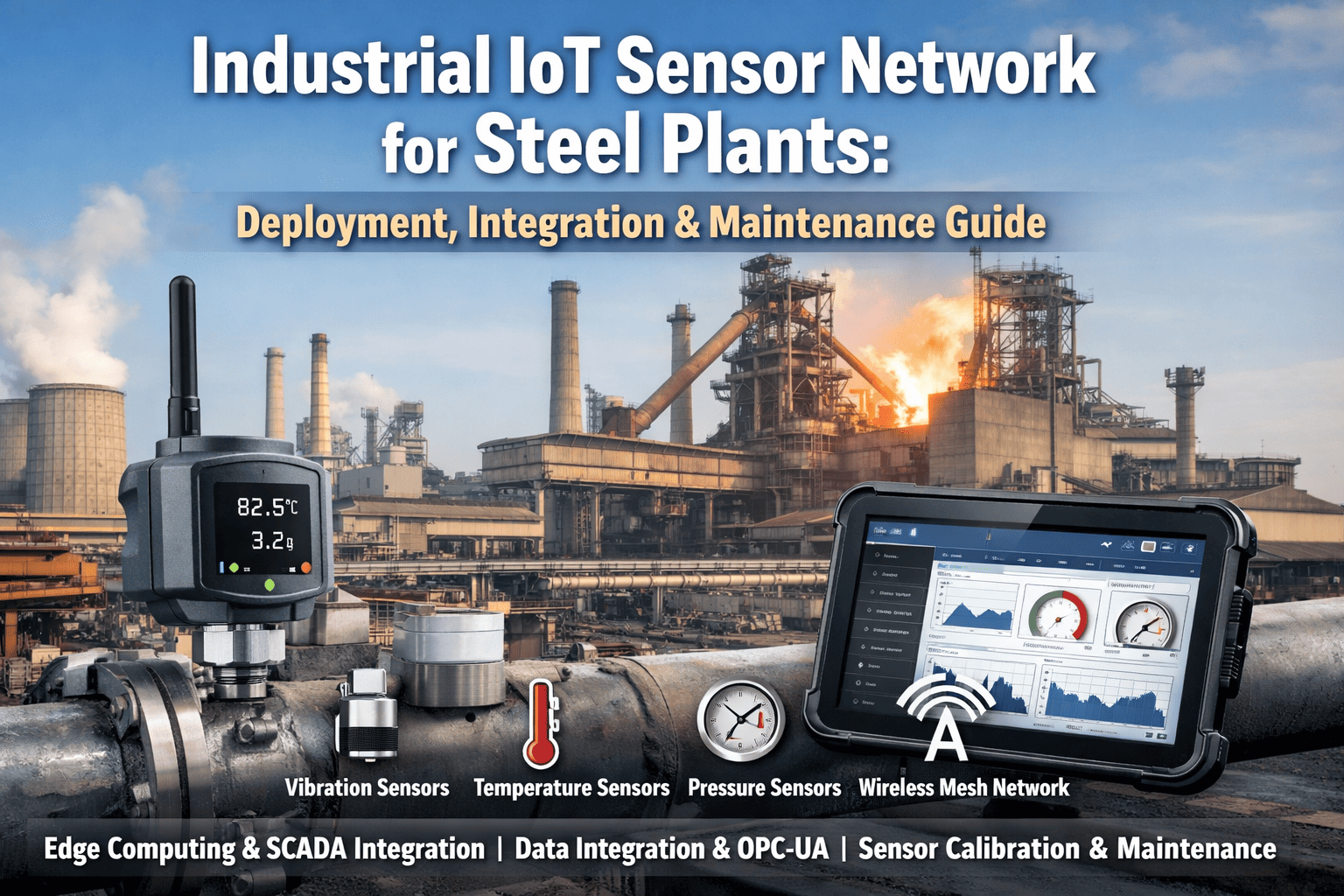
A steel plant's monitoring infrastructure faces a paradox: the equipment that needs the most frequent condition data—blast furnace cooling circuits, rolling mill bearings, crane motors, coke oven batteries, and gas recovery systems—operates in environments that destroy conventional wired sensors within months. Temperatures exceeding 1,500°F radiate across sensor pathways. Electromagnetic interference from arc furnaces corrupts signal transmission. Corrosive gases attack cable insulation. And the sheer physical scale of an integrated steel mill—often spanning 2,000+ acres with structures rising 150 feet—makes traditional wired instrumentation projects cost $500–$2,000 per monitoring point when you factor in cable routing, conduit installation, junction boxes, and the engineering labor to install them in active production areas. LoRaWAN changes the economics and physics of steel plant monitoring entirely. Long Range Wide Area Network sensors transmit condition data up to 10 miles line-of-sight on a single battery that lasts 5–10 years, penetrate through concrete and steel structures, operate in the harshest industrial environments, and cost 60–80% less per monitoring point than wired alternatives. A single LoRaWAN gateway covers an area that would require miles of cable and hundreds of junction boxes. The result: steel plants can deploy thousands of monitoring points across every critical asset—transforming condition monitoring from a selective luxury on a few high-value machines into a plant-wide intelligence layer that covers everything from blast furnace stave temperatures to warehouse door position sensors.
10 mi
Line-of-sight range from a single gateway—covers entire integrated mill campus
5–10 yr
Battery life per sensor—no wiring, no power supply infrastructure required
60–80%
Cost reduction per monitoring point vs. traditional wired sensor installations
1000s
Of sensors per gateway—scale monitoring across every asset class in the plant
Why Wired Monitoring Falls Short in Steel Plants
Steel plants have tried to solve the monitoring problem with wired sensors for decades—and the results consistently underdeliver. The installed base covers 10–20% of the assets that should be monitored, costs are prohibitive for expansion, and the cable infrastructure itself becomes a maintenance burden in corrosive, high-temperature environments. Facilities that sign up to integrate wireless sensor data with their maintenance platform are breaking through the coverage ceiling that wired infrastructure imposes.
Problem
Installation Cost & Complexity
Wired sensor installations in steel environments cost $500–$2,000 per point including cable routing through hazardous areas, conduit protection against heat and corrosion, junction boxes, marshalling cabinets, and engineering labor. A 500-point expansion project runs $500K–$1M before commissioning.
Problem
Cable Degradation & Failure
Radiant heat from furnaces, corrosive off-gases from coke ovens, and mechanical vibration from rolling mills degrade cable insulation and connections. Steel plants report 5–15% annual sensor cable failure rates, creating a permanent maintenance backlog that diverts resources from production equipment.
Problem
Coverage Gaps on Critical Assets
Because wired monitoring is expensive to deploy and maintain, most steel plants only instrument 10–20% of assets that would benefit from condition monitoring. The other 80–90% run to failure—with unexpected breakdowns costing $50K–$500K per incident in emergency repairs and lost production.
Problem
Shutdown Requirements for Installation
Running new sensor cables through active production areas often requires partial or full shutdowns of the affected zone. In continuous steel operations where downtime costs $500K+/day, the installation window becomes as expensive as the sensor infrastructure itself.
LoRaWAN Sensor Types for Steel Plant Applications
Industrial-rated LoRaWAN sensors cover every monitoring parameter that matters in steel production—from vibration and temperature to gas concentration and electrical load. Each sensor type is designed for the specific environmental challenges of heavy metal production: ATEX/IECEx ratings for explosive atmospheres, IP67/IP69K enclosures for wash-down and dust environments, and operating temperature ranges that span the extremes of steel plant conditions.
Measures: Tri-axial acceleration, velocity (mm/s RMS), temperature, FFT spectrum
Applications: Rolling mill main drives, cooling fans, pump motors, crane motors, conveyor drives
Battery life: 5–8 years at 30-min intervals
Value: Detects bearing wear, imbalance, misalignment 3–6 months before failure
Measures: Surface temperature up to 500°C (932°F) via thermocouple interface
Applications: BF stave monitoring, ladle shell, reheating furnace walls, caster mold, ductwork
Battery life: 3–5 years at 5-min intervals (external thermocouple)
Value: Early refractory wear detection, hotspot identification, thermal trend monitoring
Measures: Gas concentration (ppm), temperature, humidity
Applications: BF casthouse, coke oven battery, gas holder areas, confined spaces, perimeter monitoring
Battery life: 2–4 years (electrochemical cells require more power)
Value: Personnel safety, leak detection, environmental compliance, regulatory reporting
Measures: AC current (split-core CT), power factor, energy consumption
Applications: Motor load monitoring, pump performance, compressor efficiency, electrical panel health
Battery life: 5–7 years (CT-powered options available for continuous monitoring)
Value: Motor degradation detection, energy waste identification, load profiling
Measures: Hydraulic/pneumatic pressure, differential pressure, flow rate
Applications: Cooling water circuits, hydraulic systems, compressed air, steam lines, gas distribution
Battery life: 4–6 years at 15-min intervals
Value: Leak detection, filter condition, pump performance, system efficiency trending
Measures: Open/closed state, tilt angle, liquid level, proximity detection
Applications: Warehouse doors, bin/hopper levels, valve positions, hatch monitoring, safety gates
Battery life: 7–10 years (event-triggered transmission is extremely low power)
Value: Inventory management, process sequencing verification, safety compliance
LoRaWAN vs. Other Wireless Protocols: Why It Wins in Steel
Steel plants have experimented with Wi-Fi, Bluetooth, Zigbee, cellular, and proprietary wireless systems for condition monitoring. None of them solve the fundamental challenge: covering a 2,000-acre facility with dense steel structures, extreme EMI, and thousands of monitoring points at a cost that justifies plant-wide deployment.
Scroll horizontally on mobile
Connect LoRaWAN Sensor Data to Your Maintenance Workflow
Watch how wireless sensor readings flow directly into condition-based work orders—automatically triggering maintenance actions when vibration, temperature, or pressure thresholds are exceeded.
Deployment Architecture: Gateways, Sensors & Data Flow
A LoRaWAN deployment in a steel plant follows a three-tier architecture: sensors at the edge collecting data from equipment, gateways receiving transmissions across the facility, and a network server routing data to your CMMS, historian, and analytics platforms. The architecture is designed for resilience—overlapping gateway coverage ensures no single point of failure can create monitoring blind spots.
Edge Layer
Vibration Sensors
Motors, bearings, drives
Temperature Sensors
Furnaces, ladles, ducts
Gas Detectors
CO, H₂S, SO₂ monitoring
Power / Pressure
Current, flow, hydraulics
▼ LoRaWAN Radio (sub-GHz, AES-128 encrypted) ▼
Network Layer
LoRaWAN Gateways
3–6 gateways cover full integrated mill; redundant overlap ensures zero blind spots
Network Server
Device management, deduplication, decryption, data routing via MQTT/HTTP APIs
▼ API / MQTT Integration ▼
Application Layer
CMMS / OxMaint
Auto-generated work orders from threshold alerts
Historian / Analytics
Trend analysis, ML-based prediction, dashboards
Alert Engine
SMS, email, push notifications to maintenance teams
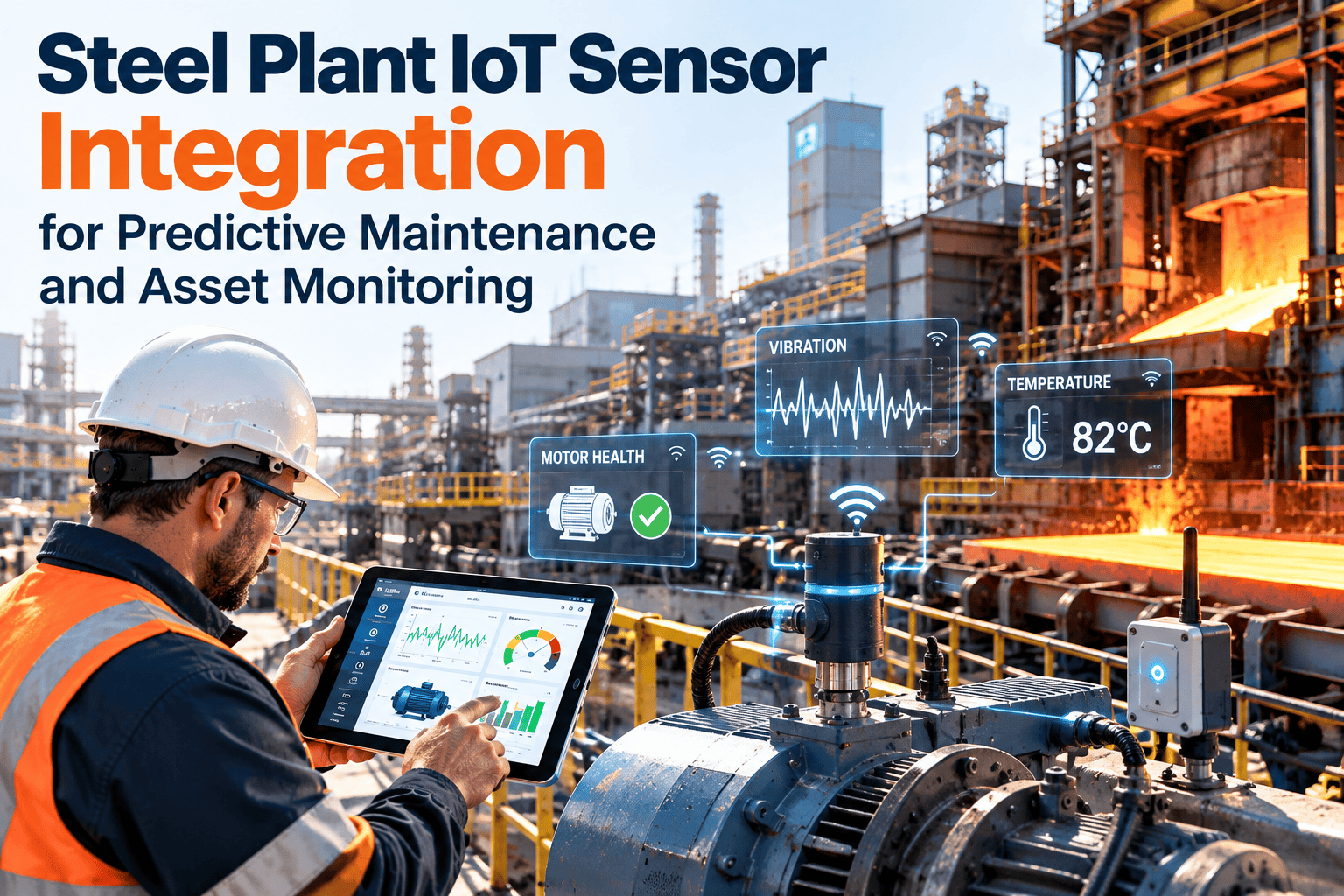
The integration between LoRaWAN sensors and your CMMS is where monitoring data becomes maintenance action. When a vibration sensor on a rolling mill motor exceeds the warning threshold, the system doesn't just send an alert—it generates a prioritized work order with the sensor reading, trend history, asset location, and recommended inspection procedure. Facilities that sign up to connect wireless sensor data with automated work order generation close the loop between detection and repair without manual handoffs.
ROI Analysis: LoRaWAN Monitoring Investment vs. Return
The financial case for plant-wide LoRaWAN monitoring is built on two pillars: the cost avoided by preventing unplanned failures (detected by sensors that weren't previously installed), and the cost saved by replacing expensive wired monitoring expansion with wireless alternatives.
$2.8M
Avoided Unplanned Downtime
Early fault detection on previously unmonitored assets prevents 5–8 major failures per year
$1.4M
Wired Infrastructure Avoidance
Replacing planned wired sensor expansion with wireless at 60–80% lower cost per point
$620K
Maintenance Labor Optimization
Condition-based scheduling replaces time-based rounds; technicians fix what needs fixing, not everything on the list
$340K
Energy & Utility Savings
Power monitoring identifies motor inefficiency, compressed air leaks, and cooling system waste
The payback period for LoRaWAN deployments in steel plants is among the fastest in industrial IoT—typically 8–14 months. A single prevented bearing failure on a rolling mill main drive ($150K–$400K repair + $500K/day lost production) can return the entire sensor investment for that production area. Facilities that book a free demo to see how sensor-triggered work orders integrate with their maintenance schedule can model this ROI against their own failure history and downtime costs.
Expert Perspective: Deploying LoRaWAN in Heavy Industrial Environments
"
The steel plants that get the most value from LoRaWAN don't start by deploying 2,000 sensors everywhere. They start with their top 50 failure modes—the assets that have caused the most unplanned downtime and emergency repair costs over the past 24 months. Put sensors on those first, connect them to your CMMS, and let the data prove the ROI before expanding. I've seen plants deploy sensors on every motor in the facility and then drown in data they don't act on. The ones that succeed instrument strategically, set meaningful alert thresholds with their maintenance engineers, and ensure every sensor alarm generates a tracked work order. The sensor is 10% of the value. The workflow that turns sensor data into completed repairs—that's the other 90%.
Start with your top 50 failure modes—prove ROI before scaling plant-wide
Connect every sensor to your CMMS—data without work orders is wasted investment
Set thresholds with process engineers—they know what readings actually matter
Plan gateway placement for redundant coverage—no single point of failure
Turn Sensor Data into Maintenance Action. Automatically.
OxMaint connects LoRaWAN sensor feeds to a complete maintenance platform—threshold alerts generate work orders, condition trends inform scheduling, and every repair is tracked from detection to completion. Monitor everything. Fix what matters. Prove the ROI.
Frequently Asked Questions
Can LoRaWAN signals penetrate steel structures and handle EMI from arc furnaces?
Yes—LoRaWAN's sub-GHz frequency band (typically 868 MHz in Europe, 915 MHz in North America) penetrates steel and concrete structures significantly better than 2.4 GHz protocols like Wi-Fi, Bluetooth, and Zigbee. The spread spectrum modulation technique (chirp spread spectrum) provides excellent resistance to electromagnetic interference from arc furnaces, induction heating equipment, and heavy motor drives. In practice, LoRaWAN sensors inside steel buildings communicate reliably with outdoor gateways mounted on building exteriors or elevated structures. For heavily shielded areas like enclosed furnace buildings, a single indoor gateway or repeater resolves any coverage gaps. Most integrated steel mills achieve full campus coverage with 3–6 strategically placed gateways.
How many sensors can a single LoRaWAN gateway support?
A single LoRaWAN gateway can support 1,000–10,000+ sensors depending on the data transmission frequency and payload size. For typical condition monitoring applications in steel plants where sensors transmit every 15–60 minutes with small data payloads (temperature, vibration level, pressure), a single gateway comfortably handles 2,000–5,000 devices. For the complete coverage of an integrated steel mill with 2,000–3,000 monitoring points, 3–6 gateways provide both capacity and redundant coverage. The architecture is star-of-stars topology—every sensor communicates directly with every gateway in range, and the network server deduplicates the data. This means losing one gateway doesn't create blind spots if coverage areas overlap.
What does a LoRaWAN deployment cost for a steel plant?
Total deployment costs for a comprehensive LoRaWAN monitoring program at an integrated steel mill typically range from $600K–$1.2M for initial deployment. This breaks down to sensors at $50–$200 each (2,000 sensors: $100K–$400K), gateways at $500–$2,000 each (5–6 gateways: $3K–$12K), network server infrastructure at $20K–$50K, integration development with CMMS and historian platforms at $50K–$150K, and engineering/installation labor at $200K–$400K. Ongoing annual costs are minimal: $50K–$100K for battery replacements (staggered over 5–10 years), network server licensing, and sensor calibration. Compare this to equivalent wired monitoring expansion: $1M–$4M for the same coverage with 5–15% annual cable maintenance costs. LoRaWAN typically achieves full payback within 8–14 months.
How does LoRaWAN sensor data integrate with our existing CMMS?
LoRaWAN sensor data integrates with CMMS platforms through the network server's API layer. The standard data flow: sensors transmit readings to gateways, gateways forward to the LoRaWAN network server, the network server processes and routes data via MQTT or HTTP APIs to your CMMS, historian, or analytics platform. For OxMaint and other modern CMMS platforms, the integration enables automatic work order generation when sensor readings exceed configured thresholds—a vibration level above 7.1 mm/s on a rolling mill motor generates a priority work order with the sensor reading, trend history, asset ID, and recommended inspection procedure. No manual data entry. No alert that sits unactioned. Integration typically takes 2–4 weeks for standard CMMS platforms with available APIs.
Is LoRaWAN secure enough for industrial monitoring in steel plants?
LoRaWAN provides robust security through AES-128 encryption at both the network and application layers—meaning data is encrypted end-to-end from sensor to application server. Each device has unique encryption keys, and the protocol includes mutual authentication between devices and the network server, replay attack protection through frame counters, and separate encryption for network routing data versus application payload data. For steel plants with OT cybersecurity concerns, LoRaWAN operates on a completely separate radio frequency from IT/OT networks—it cannot be used as an attack vector into your control system network. The sensor network is physically and logically isolated from SCADA and process control infrastructure, with data integration occurring only through controlled API connections at the application layer.

-sensor-deployment-for-steel-plants.png)